Rehearse an approach that begins before visible illumination activates. Review whether the first required colour distinction is actually recorded, including the approved outage condition.
Section 01
Choose lighting according to the evidence needed
Rehearse an approach that begins before visible illumination activates. Review whether the first required colour distinction is actually recorded, including the approved outage condition. If it is missing, revise the lighting arrangement or evidence requirement. Do not infer the transition result from footage captured after the light is already on.
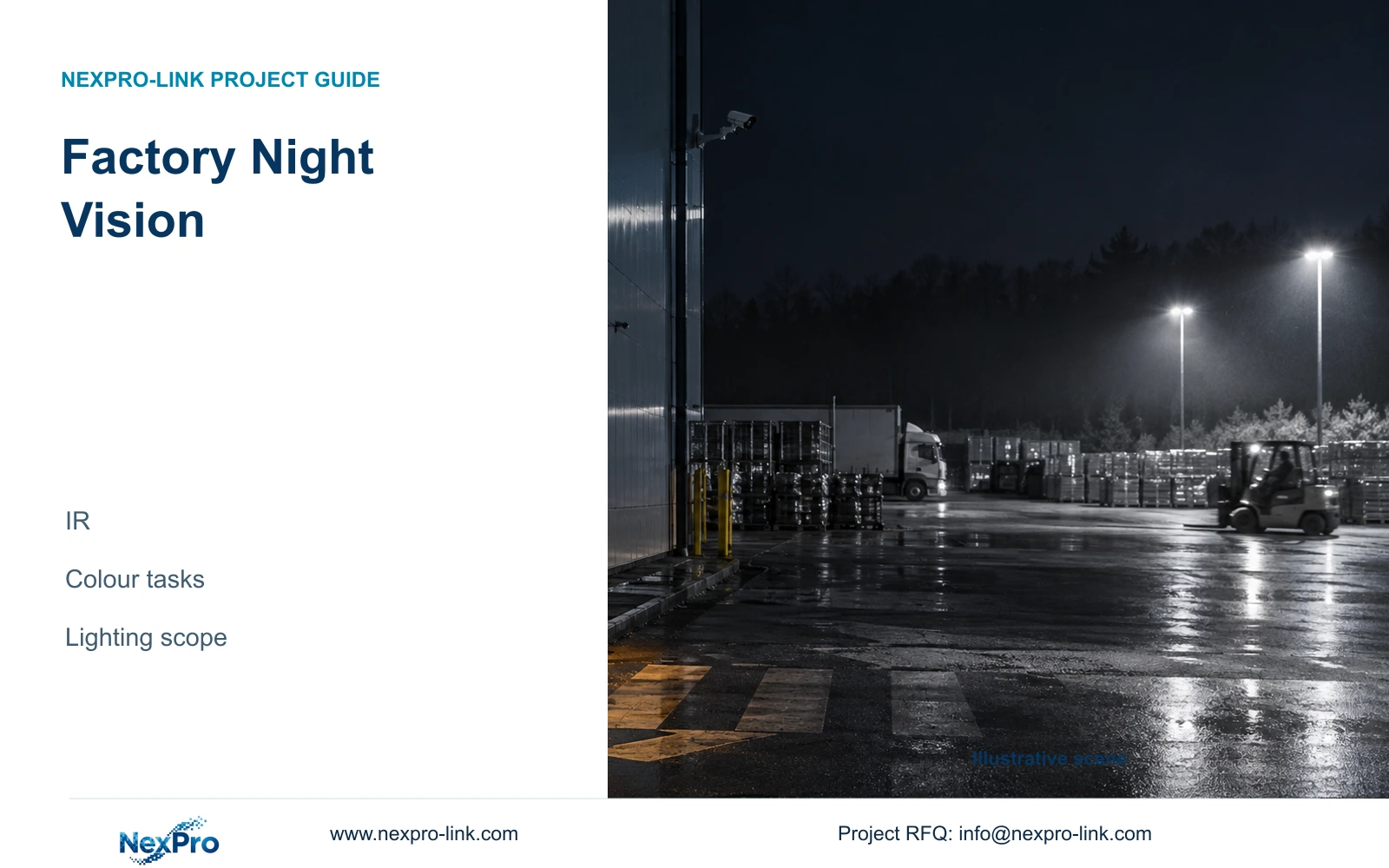
Use IR where accepted monochrome footage answers the factory security task. Consider dual-light operation or dedicated visible lighting where colour context is required. Select the mode per location, with moving-image quality and operational disturbance checked before approval. A colour requirement at one entrance does not justify visible illumination everywhere.
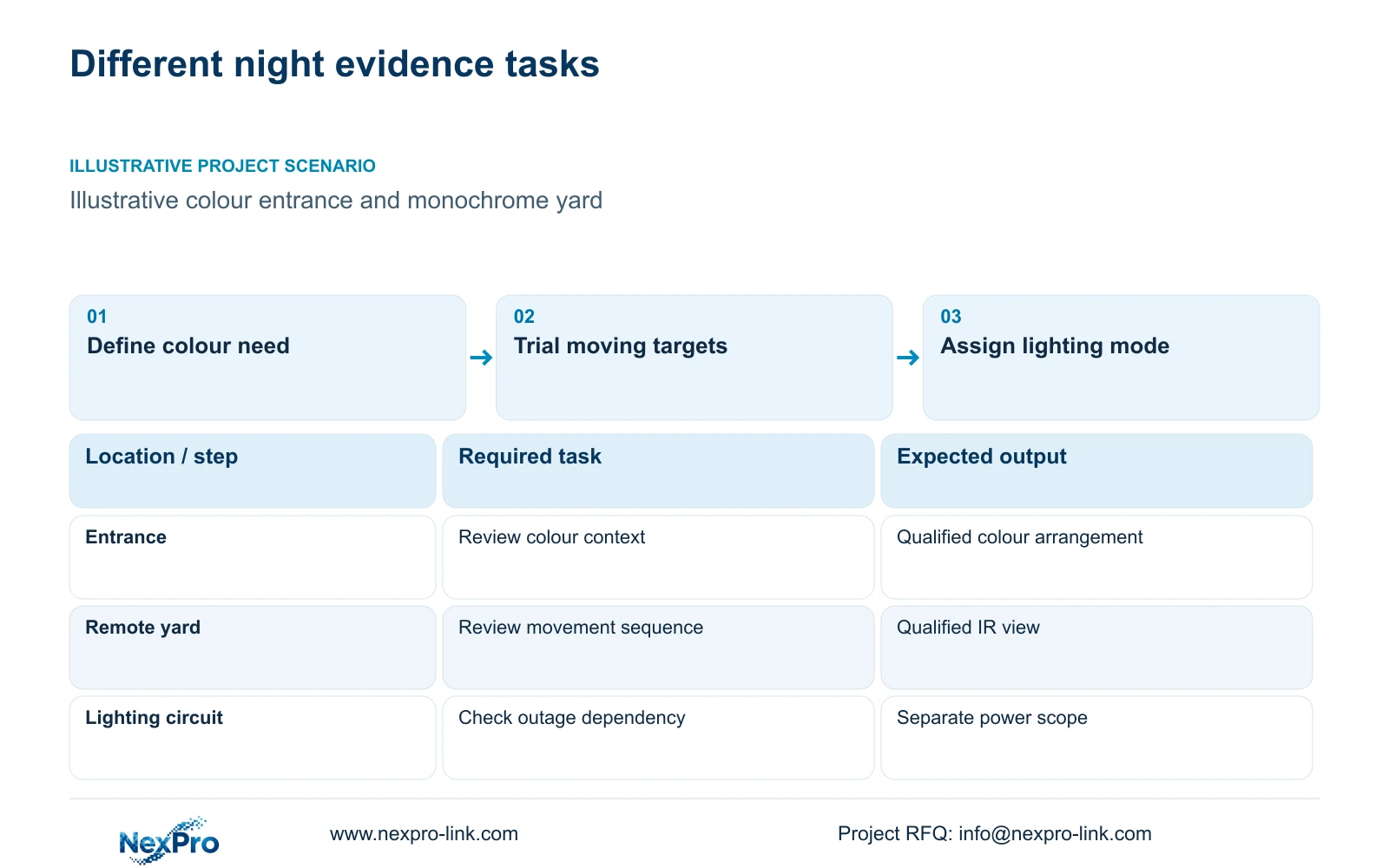
Illustrative project scenario: The owner needs colour context at one entrance but only movement sequence in a remote yard. Use the supplied CNC factory reference as the recording background, with ordinary gate and dispatch views feeding the local system. Assume the two locations have different night lighting conditions. This is a planning comparison, not a claim about a delivered project.
Write the evidence requirement in observable terms. The entrance may need a visible colour distinction during a handover; the yard may need the order and direction of movement. Ask the owner to identify what cannot be resolved from monochrome footage, so the design does not purchase colour capability without an associated decision.
Section 02
Evaluate glare and movement in the recorded night scene
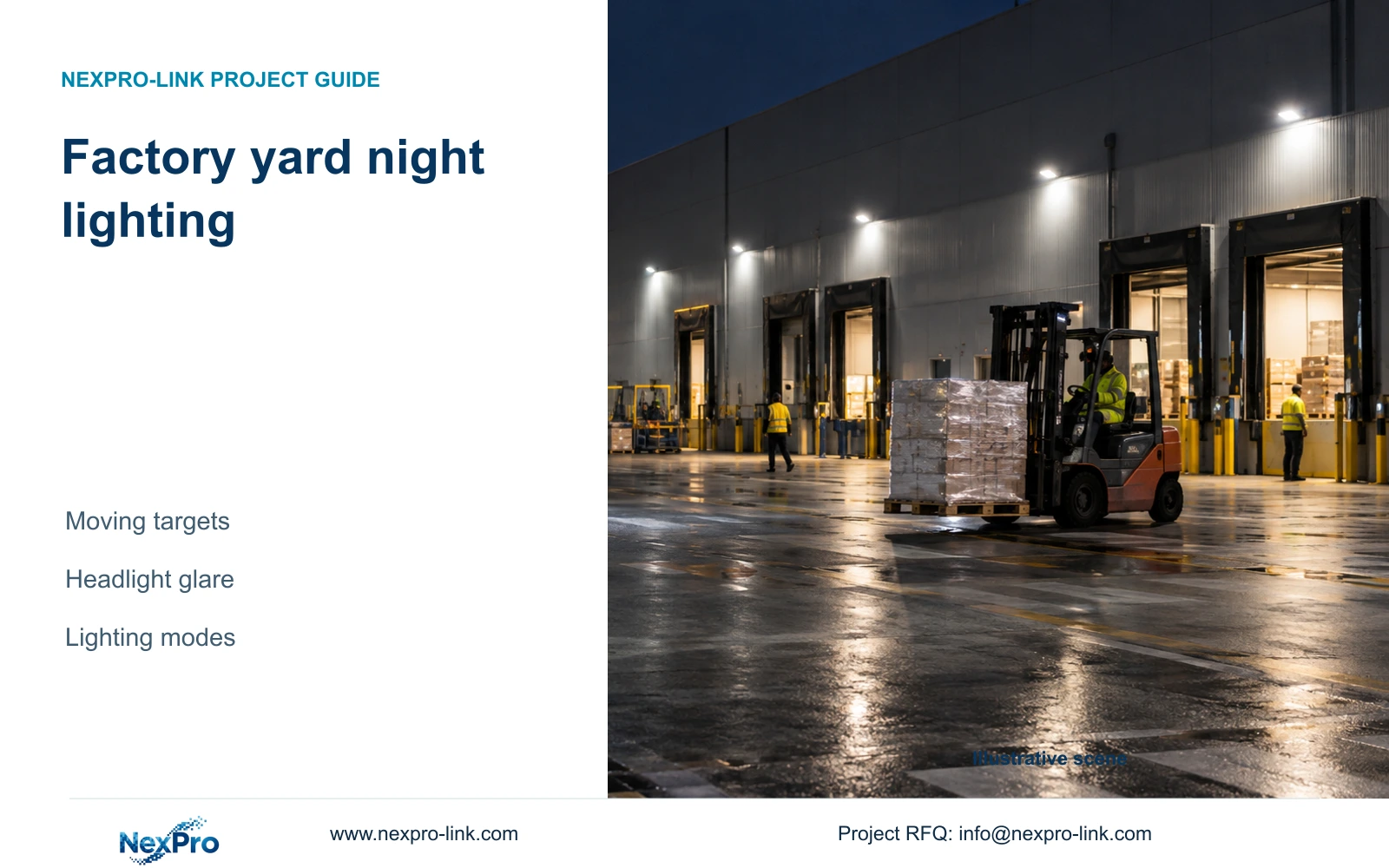
Test each candidate while a representative target moves through the required area. Include approaching headlights, reflective objects and the lighting states expected during the shift. Review the target at the near and far parts of the view, because an attractive central image can conceal an unusable transfer boundary.
At the entrance, check whether visible illumination disturbs drivers or changes the working environment in a way the owner will not accept. At the yard, check whether the proposed IR view preserves movement sequence across the full required route. These are separate acceptance questions and should produce separate settings.
Record exposure behaviour alongside the lighting mode. A bright still image may rely on an exposure that smears moving detail. Changing image brightness, exposure and illumination together makes the cause difficult to identify, so vary one condition at a time where practical and retain the corresponding recordings.
Section 03
Compare the whole lighting arrangement
The supplied NexPro-BL2812M55-5MP-DIC-AI specification lists dual light, PoE, a 2.8-12 mm motorized lens and a 2880×1620 output field. These facts make it a candidate for an ordinary-area trial. They do not establish its peak demand, a fixed night bitrate or a guaranteed colour result at the proposed entrance.
Compare the camera option with the supporting work needed to achieve the task. Dedicated lighting may require luminaires, mounting, controls, electrical distribution and commissioning. Retained lighting still needs an identified operating schedule and maintenance responsibility. Keep these items visible rather than placing them inside an unexplained camera-package allowance.
Separate CCTV power from lighting power. CASE01 uses 12 W per ordinary camera as an assumed planning demand, not a model rating. Replace it with verified demand for the selected operating state. If colour evidence depends on separate luminaires during an outage, their supply must be addressed independently of a UPS-protected PoE switch.
| Choice | Appropriate task | Qualification needed |
|---|---|---|
| IR | Yard movement sequence | Usable monochrome moving footage |
| Dual light | Entrance colour context | Mode behaviour and disturbance |
| Dedicated site lighting | Sustained colour task | Coverage, controls and power |
Section 04
Use exposure arithmetic to define the night trial
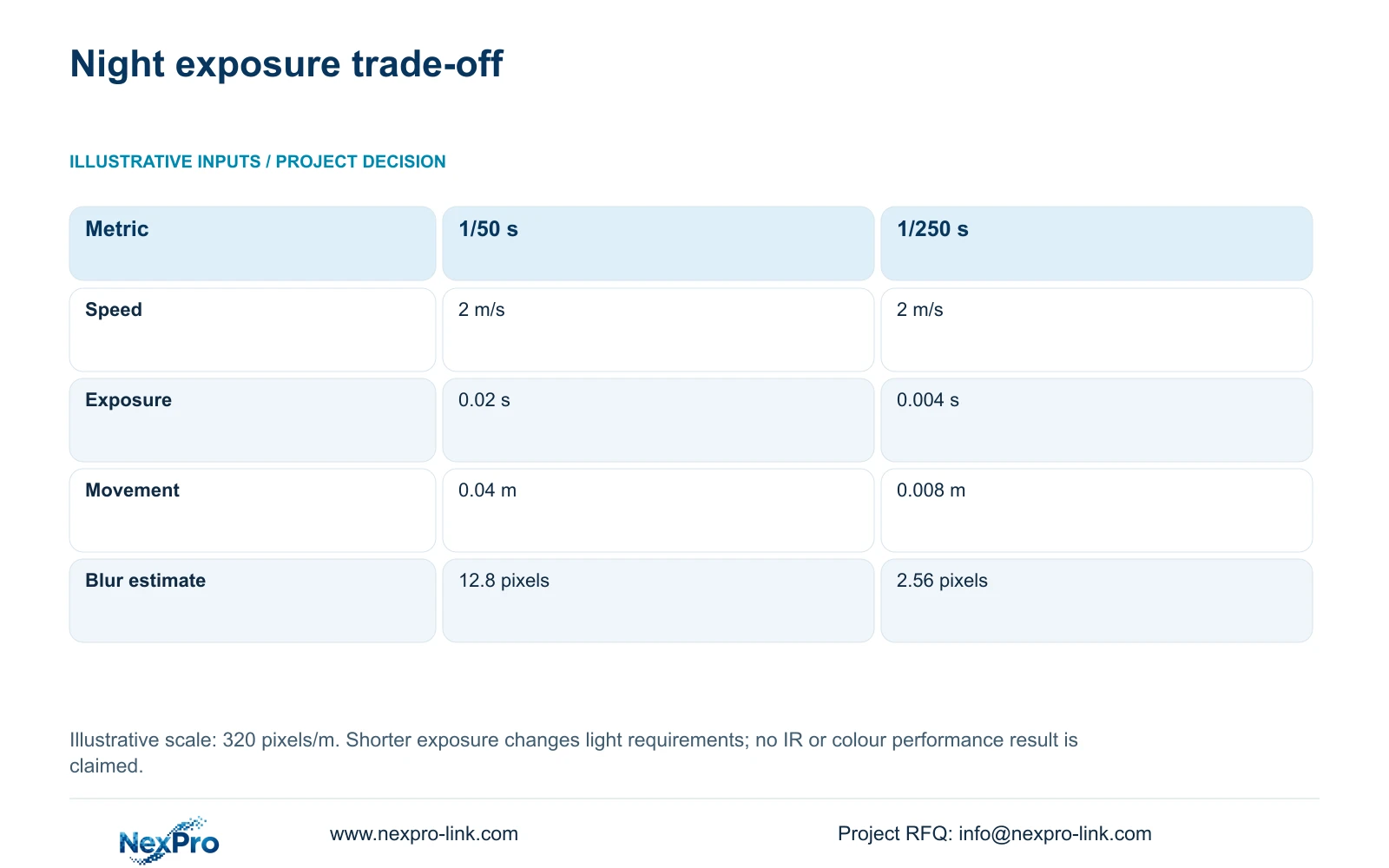
Assume a target moves at 2 m/s with an image scale of 320 pixels/m. Movement_m = speed_m_s × exposure_s, followed by estimated_blur_px = movement_m × pixels_per_m. At 1/50 s, or 0.02 s, the movement is 0.04 m and the geometric estimate is 12.8 pixels.
At 1/250 s, or 0.004 s, movement falls to 0.008 m and the estimate to 2.56 pixels. The shorter exposure changes the light requirement. This is why the night trial should assess usable moving detail at the proposed exposure rather than approve a static colour image.
The calculation does not favour IR or visible light by itself. Either arrangement must be tested with the actual scene, optics and recording settings. Frame rate is a separate parameter; increasing fps alone does not deliver the shorter exposure. Rolling shutter, flicker, gain and processing are outside this illustrative model.
| Metric | Longer exposure | Shorter exposure |
|---|---|---|
| Speed | 2 m/s | 2 m/s |
| Exposure | 0.02 s | 0.004 s |
| Movement | 0.04 m | 0.008 m |
| Blur estimate | 12.8 pixels | 2.56 pixels |
Section 05
Retain different modes where the tasks differ
For the illustrative yard, start with a qualified monochrome option if it preserves the required movement sequence without unacceptable gaps. For the entrance, trial the colour-capable arrangement against the specific colour task. Add dedicated lighting when the approved camera arrangement cannot maintain the required recorded detail under the available illumination.
Change the recommendation if colour becomes necessary elsewhere, the target speed increases or glare makes the trial unusable. A revised camera angle or narrower detail view may solve a local problem without changing every camera. Preserve an overview when tightening the image would remove context needed to interpret the event.
Compare supplier offers on the same night task and complete scope. Keep required platform functions and environmental suitability intact. There is no matched night test or price evidence here to support a brand winner. The useful procurement outcome is a location schedule with accepted lighting modes and separately priced supporting work.
Section 06
Carry lighting dependencies into handover
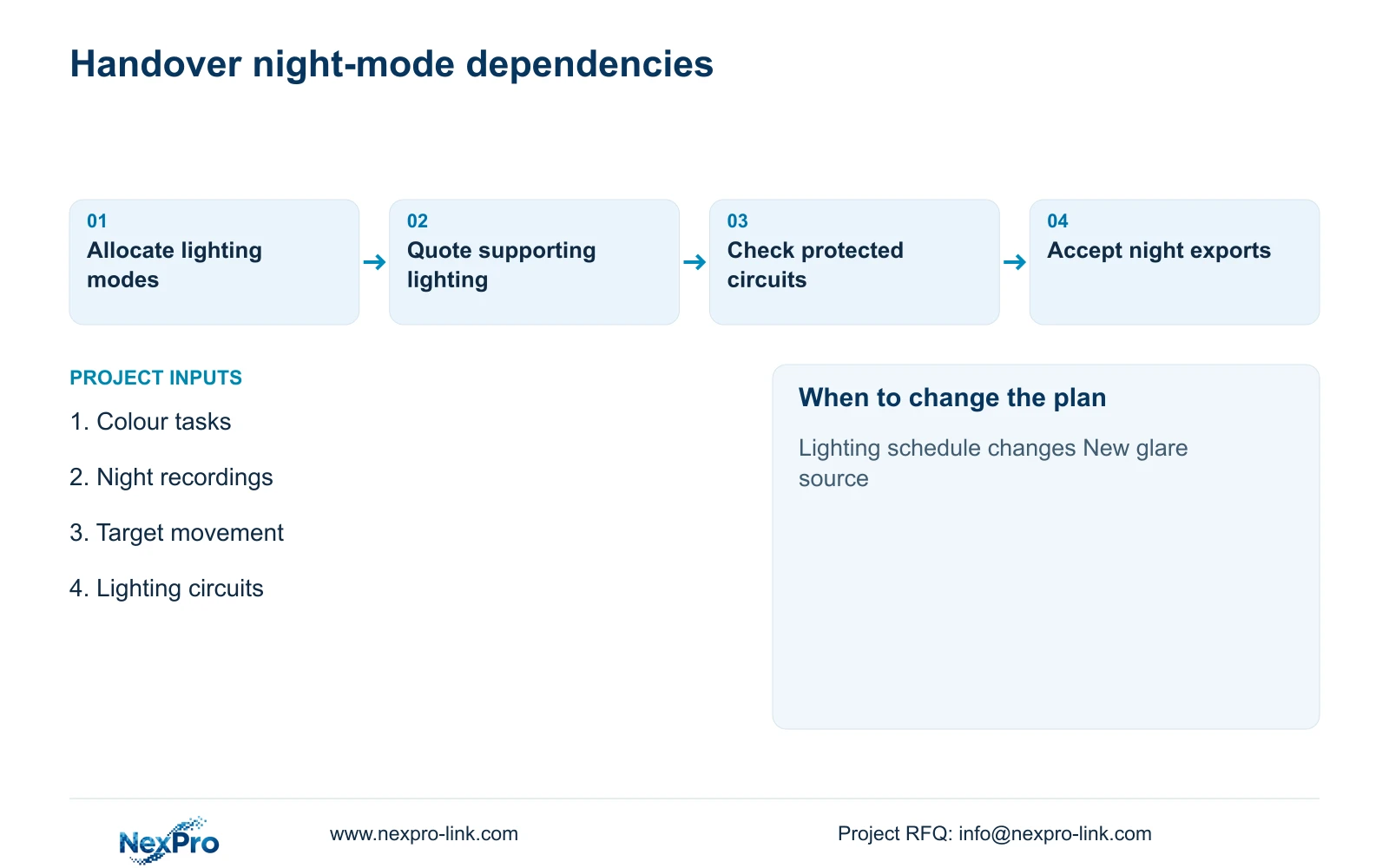
Identify each camera's accepted mode, relevant lighting source and operating schedule. Where a mode changes in response to events, request confirmation of the exact behaviour and test the transition through recorded footage. Do not infer trigger logic, timing or event compatibility from the words dual light alone.
NexPro-Link can discuss ordinary CCTV model matching, technical submittals and coordinated project supply. Assign separate luminaires and local electrical work to the relevant contractor unless expressly included in the quotation. Project labels should connect each camera to its approved location and night setting.
At commissioning, reproduce the representative night task and inspect playback and export. Retain the setting record for maintenance. If a luminaire is removed, lighting hours change or a camera replacement alters mode behaviour, reopen the affected view's acceptance rather than assume the original night evidence remains valid.
Section 07
Buyer questions
Can an event-triggered colour mode cover the beginning of a handover? That depends on the exact model's transition and recording behaviour. Test the approach and the first relevant action, not only footage after visible light is active. If initial colour context is essential, qualify an arrangement that supplies it throughout the required period.
Does backing up the cameras also back up site lighting? Only equipment on the protected electrical supply is backed up. Separate luminaires do not become protected because their camera uses a UPS-connected PoE switch. List the lighting dependency and its required outage behaviour separately.
Section 08
Define a location-specific night package
Send your colour-dependent tasks, target widths and movement conditions, representative night recordings and existing lighting/power arrangement to info@nexpro-link.com to discuss the appropriate camera and lighting scope.
Engineering references
These sources support the general planning principles. Always use the selected product's current datasheet and applicable project standards for final design.