Rank a failure by the important evidence tasks lost, not just endpoint count. Mark a small group containing the sole dispatch handover separately from a larger group of supplementary overviews.
Section 01
Protect the recording task before duplicating equipment
Rank a failure by the important evidence tasks lost, not just endpoint count. Mark a small group containing the sole dispatch handover separately from a larger group of supplementary overviews. Record the owner's accepted consequence and proposed remedy. Group arithmetic alone cannot decide which resilience purchase has greater operational value.
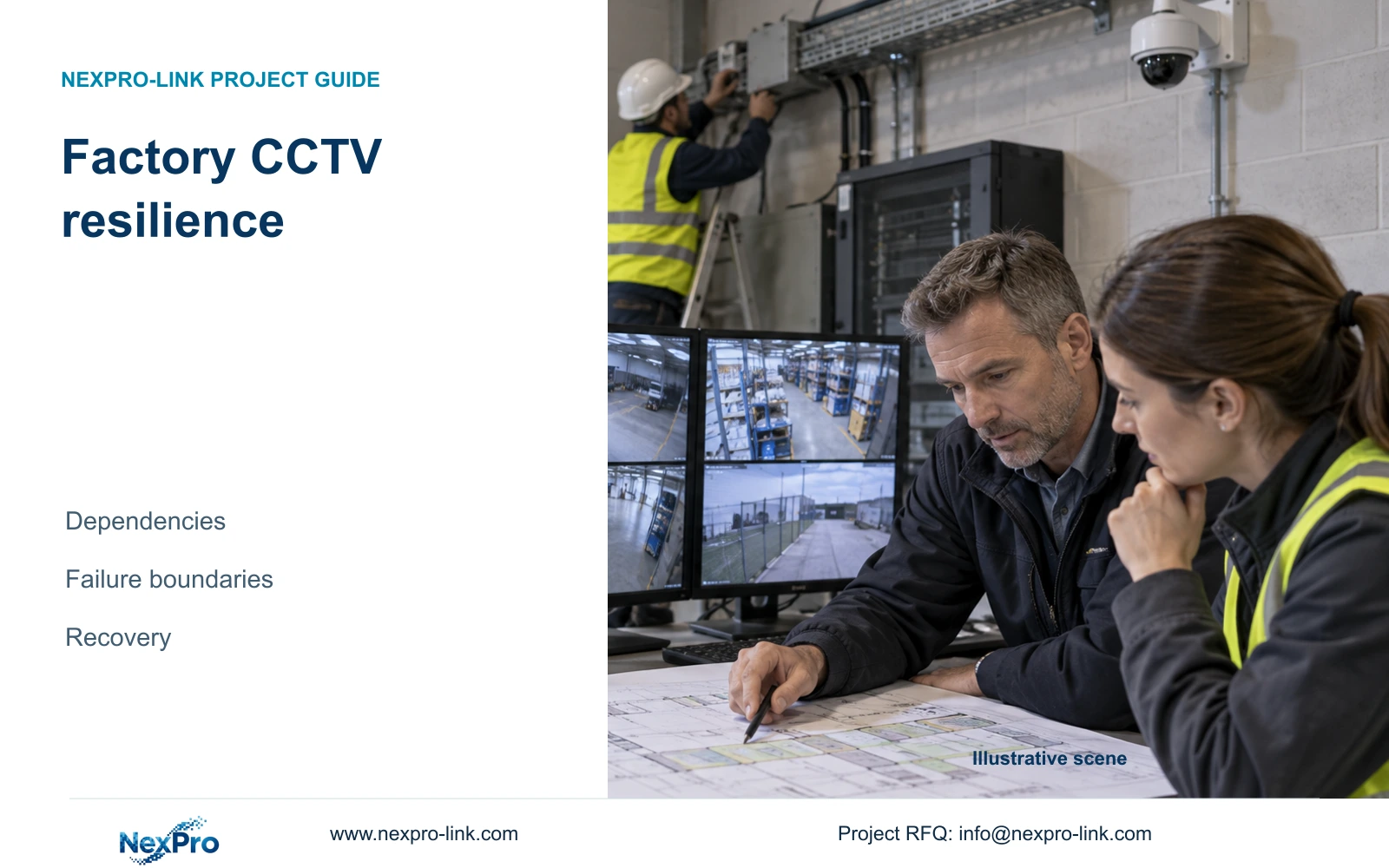
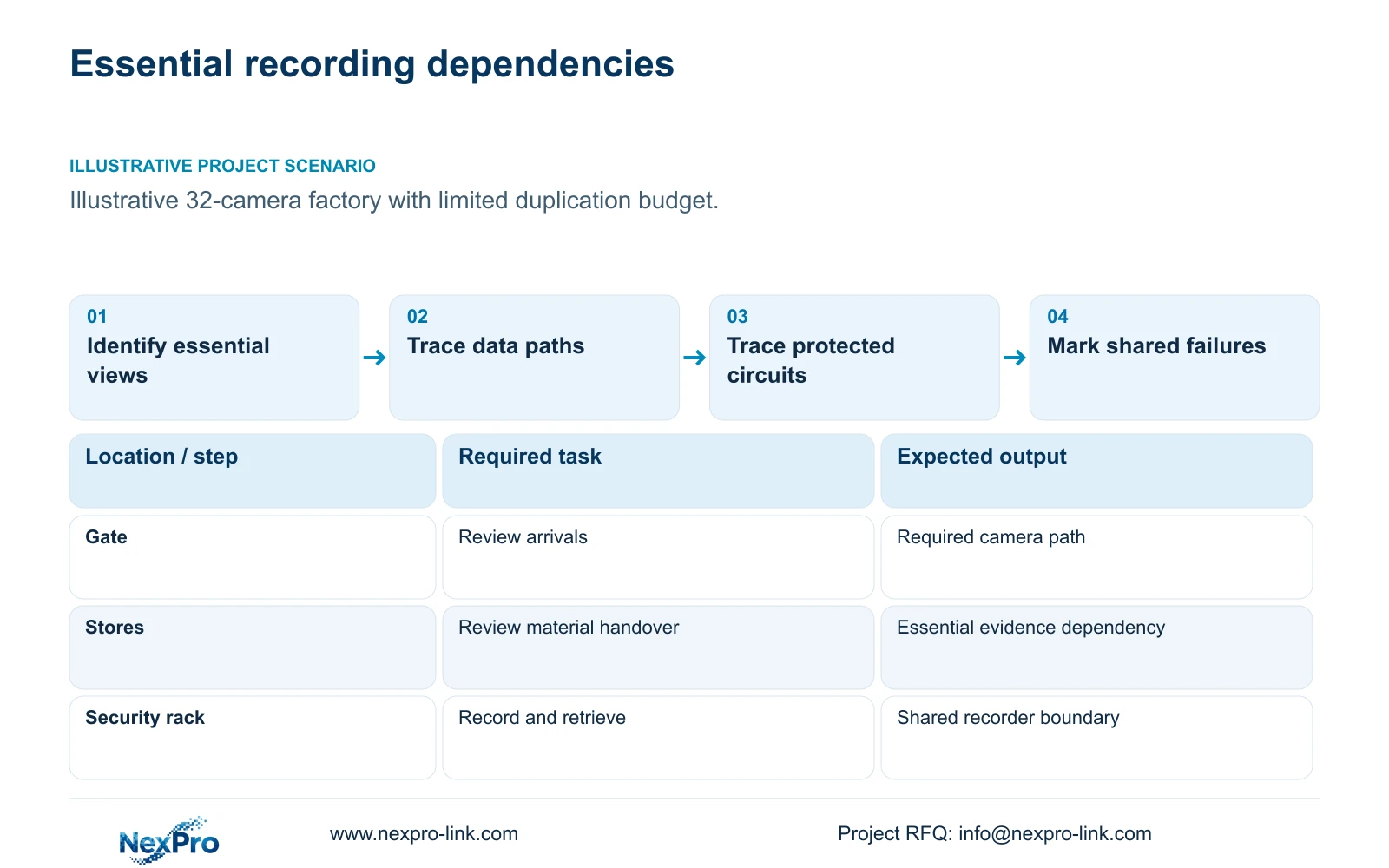
Factory CCTV resilience starts with a dependency map for the owner's essential task. Trace the required view through camera power, access switching, the recording path, disks and authorised retrieval. Prioritise the failure that would stop that task. A second recorder has little value against a camera switch that loses power, and an alternative network cable may still terminate at the same failed core.
Illustrative project scenario: A new CNC factory cannot fund duplication of every camera, switch and recorder. The supplied reference design has 32 ordinary security views covering gates, stores, permitted material transfers, common routes, dispatch and equipment-room approaches. Assume the owner prioritises review of authorised material movements and site access. This is a planning situation, not a completed installation or a machine-inspection system.
Ask the owner to distinguish uninterrupted recording from uninterrupted guardroom viewing. Record the acceptable interruption for each task without inventing a universal recovery target. The resulting map should show both data paths and electrical supply paths, including any generator transition and the equipment needed to retrieve footage after recovery.
Section 02
Rank failures by the evidence each zone loses
Use the camera schedule to describe consequences in operational terms. A lost gate view removes arrival context; a lost store counter view may remove the material handover itself. Ten unavailable hall cameras are not automatically more consequential than one unavailable dispatch view. Identify the transaction or movement each view supports, whether another view genuinely covers it, and whether an independent written record remains available.
For each zone, assign a failed component and follow its downstream effect. Test the proposition that a switch fault affects only its own cameras. Then examine a shared recorder fault, a common power distribution fault and a failed viewing connection separately. These failures have different boundaries even when the drawing shows four access switches.
Keep generator arrangements explicit. The existence of a generator does not establish that the security circuit is supplied, that transfer completes within the required interval, or that local cabinets remain powered. The electrical designer should identify those dependencies; the CCTV engineer should identify what footage and operator access would be lost during each transition.
Section 03
Match each improvement to a named failure
For this scenario, protect the complete camera-to-recorder path before adding optional display equipment. CASE01 assumes four eight-camera PoE load groups feeding one local recorder. Place every required switch, recorder and link device on an identified protected circuit. A central UPS protects a remote cabinet only if that cabinet's actual supply comes from the protected distribution.
The NexPro-NVR4449-4K provides a published reference of 49 channels, 320 Mbps input, four SATA bays and dual Gigabit LAN. Its summary distinguishes 49×5MP from 9×4K. These fields support capacity review, but neither the channel count nor the two interfaces establishes recorder failover, RAID or unrestricted simultaneous decoding.
Assign improvements to accountable parties. The electrical contractor owns circuit verification; the network engineer owns access-group boundaries; the integrator owns recording and recovery checks. Ask the supplier to identify supported equipment and configuration requirements. If recorder failure remains unacceptable after power and network dependencies are addressed, investigate a separately supported recording-continuity architecture rather than labelling an unused spare as automatic redundancy.
Section 04
Calculate the boundary of one access-group failure
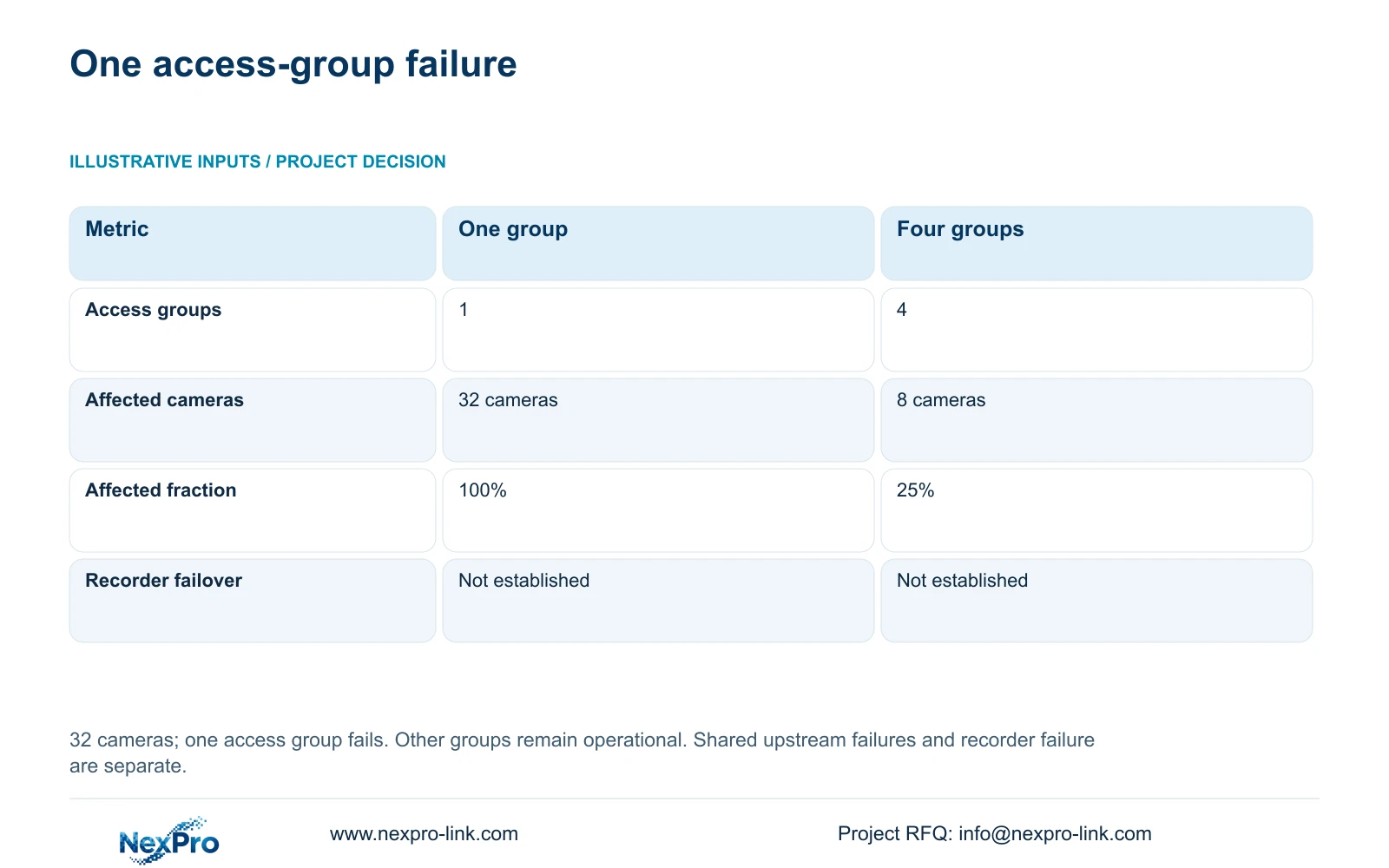
The illustrative comparison holds the total at 32 cameras. Option A has one common access group; Option B has four isolated groups of eight. Analyse failure of one group only. The formulas are Affected_endpoints = camera_count_in_failed_group and affected_fraction = affected_endpoints / 32. Option A therefore affects 32 / 32 = 100%; Option B affects 8 / 32 = 25%.
The decisive difference is the number of endpoints exposed to this particular local failure. Four groups reduce that boundary from 32 cameras to eight, assuming the other groups remain operational. This does not demonstrate a lower failure probability, an uptime percentage or a faster repair. It also does not mean the remaining 24 cameras retain useful recording if their common recorder has failed.
CASE01 already uses four PoE load groups, but electrical grouping alone does not prove the isolated failure domains assumed here. Verify upstream links, power distribution and configuration before applying the 25% figure to a proposed installation.
| Metric | Option A | Option B |
|---|---|---|
| Access groups | 1 common group | 4 isolated groups |
| Affected endpoints | 32 cameras | 8 cameras |
| Affected fraction | 100% | 25% |
| Automatic recorder failover | Not established | Not established |
Section 05
Choose limited failure domains with honest shared risks
Prefer the four-group arrangement where the proposed topology genuinely contains local access failures and the owner benefits from preserving unaffected views. Retain the single recorder only if the owner accepts its shared recording risk. This gives the cost team a defined improvement to price: access-group separation and complete protected supply, with recorder continuity quoted as a distinct option.
For the reference recording-first package, CASE01 calculates an assumed protected demand of 682.7407 W. SP1KR(S), quoted at 1 kVA / 900 W, is a capacity candidate under that example's assumptions. Its rating does not establish 30-minute operation. The exact battery arrangement and supported runtime curve remain necessary, consistent with the APC/Schneider distinction between output capacity and runtime.
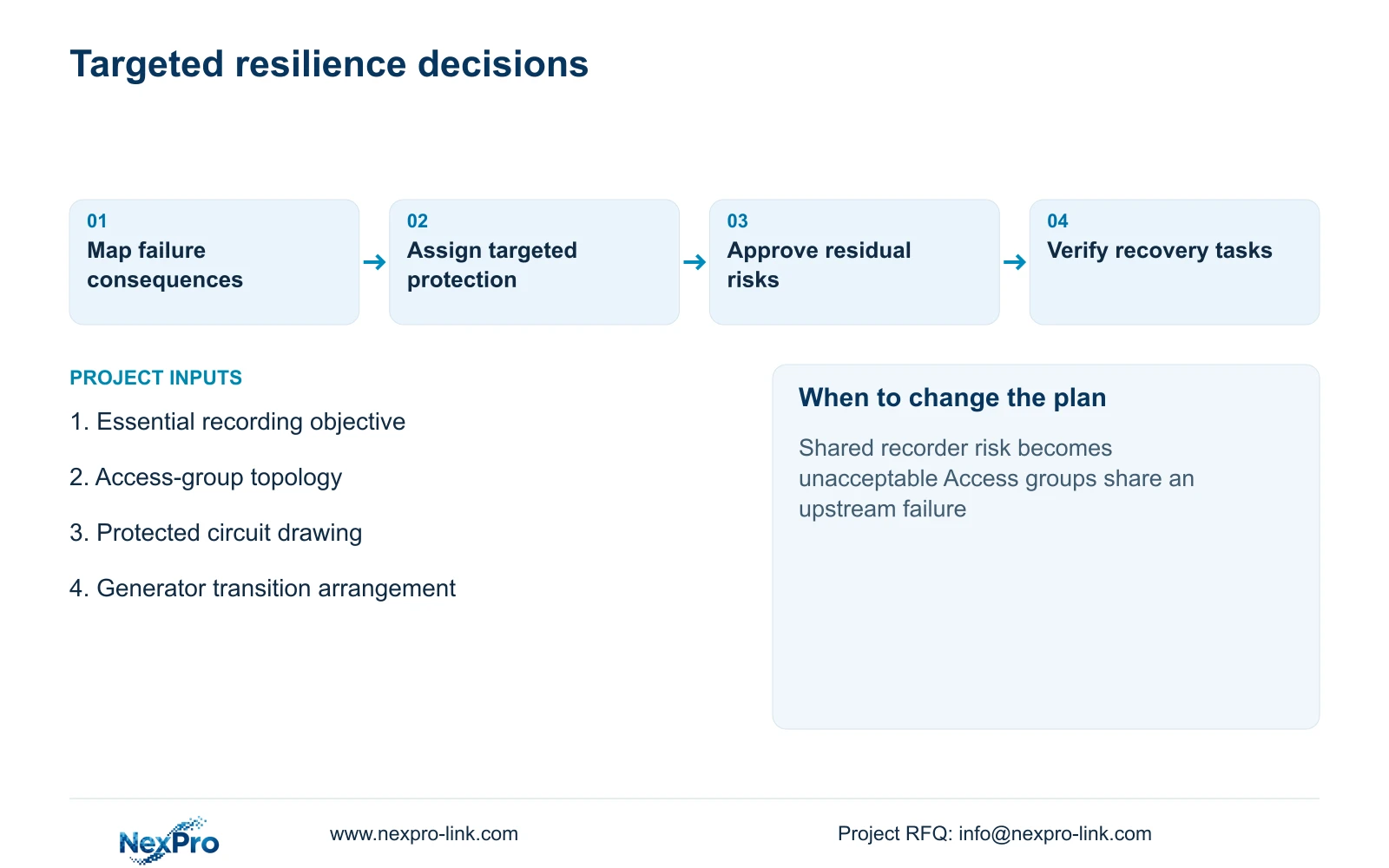
Change the recommendation if the owner requires recording through recorder failure, if multiple groups share an unavoidable failed backbone, or if maintenance must occur without losing essential evidence. Compare alternative suppliers against those same tasks and failure boundaries. Equipment quantity alone cannot establish equivalence, and unquoted installation or support work should remain visible rather than treated as free.
Section 06
Deliver a failure map and a recovery sequence
Issue a failure-impact schedule alongside the BOQ. For each essential task, identify the affected views, shared dependency, proposed protection, accepted interruption and recovery owner. Mark each component as supplied, retained, installer-provided or optional. The schedule should make a shared recorder or common upstream circuit immediately visible to procurement.
Write the recovery sequence around dependencies: confirm approved power availability, establish camera and switch paths, verify recorder storage and schedules, then prove playback and export. Name the person who declares each task restored. A return of live images should not close the incident before usable recorded footage has been checked.
NexPro-Link's factory project and BOQ support scope can help translate this schedule into model matching, equipment lists and technical submittals. Project labels can preserve access-group and circuit identity through packing and installation. Local electrical work and final acceptance remain with the appointed project team; the supply quotation should state those boundaries clearly.
Section 07
Buyer questions
Is an on-site spare recorder worthwhile without automatic failover? It can support a planned replacement strategy if configuration, disk compatibility and authorised recovery steps are prepared. It does not preserve footage during the replacement interval. Price it as a recovery resource, with its expected use documented, rather than as uninterrupted recording.
Should the most important cameras share one switch? Grouping can simplify installation, but it also concentrates essential evidence in one failure domain. Review whether distributing complementary views across genuinely separate paths would preserve useful context during a local fault.
Can the 25% affected figure be used in an availability guarantee? No. It describes one assumed access-group failure boundary. An availability commitment needs supported architecture, defined operating conditions and evidence about failure and recovery behaviour.
Section 08
Define the resilience scope for quotation
Send your essential recording objective, power and network dependency drawing, generator arrangement and required restart tasks to info@nexpro-link.com. NexPro-Link can discuss a targeted equipment scope and failure-impact schedule for your factory.
Engineering references
These sources support the general planning principles. Always use the selected product's current datasheet and applicable project standards for final design.