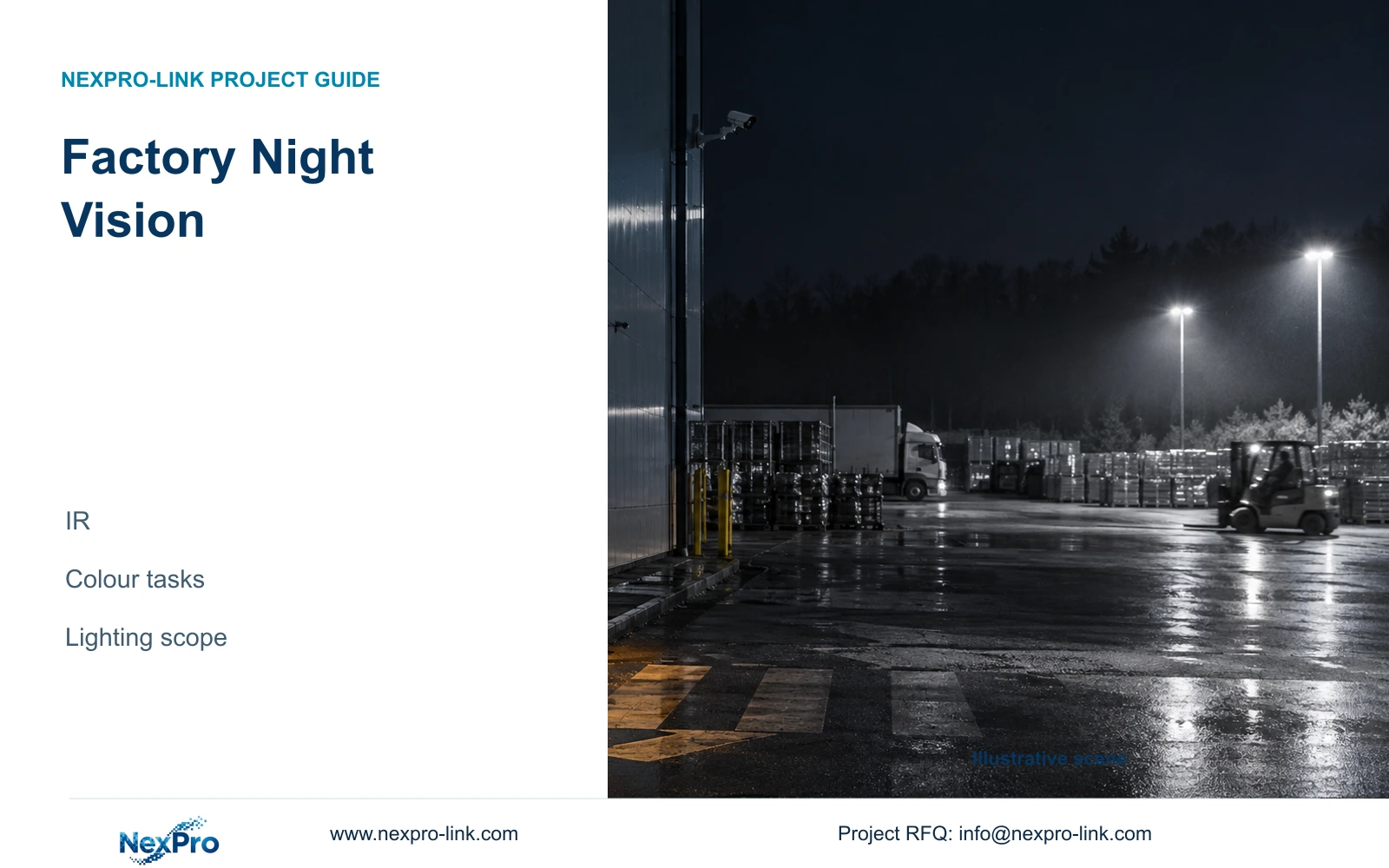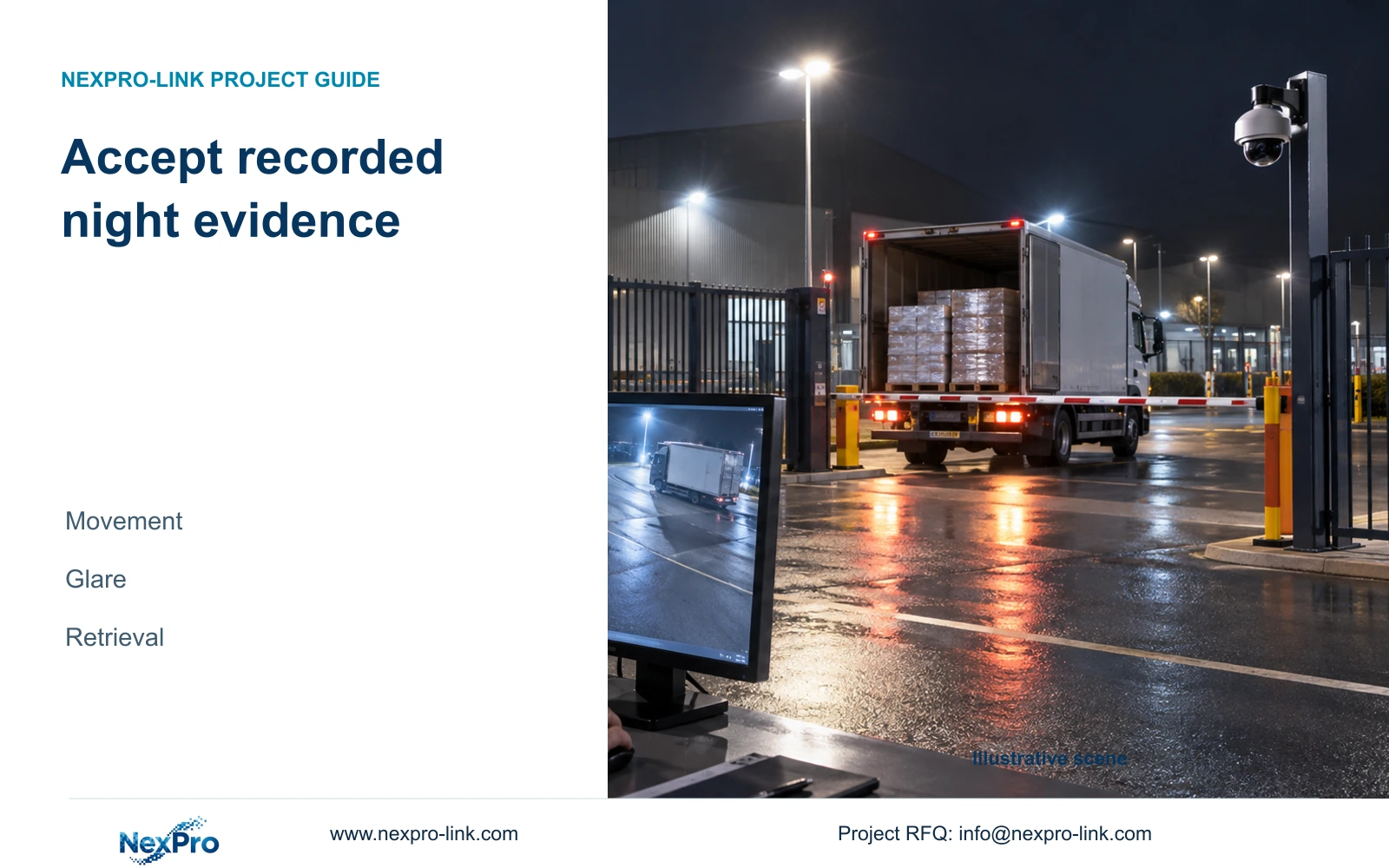
Factory CCTV night acceptance should judge a moving delivery event from the recorder, with the lighting state, exposure and retrieval path documented.
Section 01
Agree the night scene before judging the picture
Factory CCTV night acceptance should judge retained video under the agreed movement and lighting conditions. Record the scene and settings, then demonstrate retrieval of the event. A daytime preview or stationary night screenshot cannot establish whether the system preserves useful evidence of a moving delivery load.
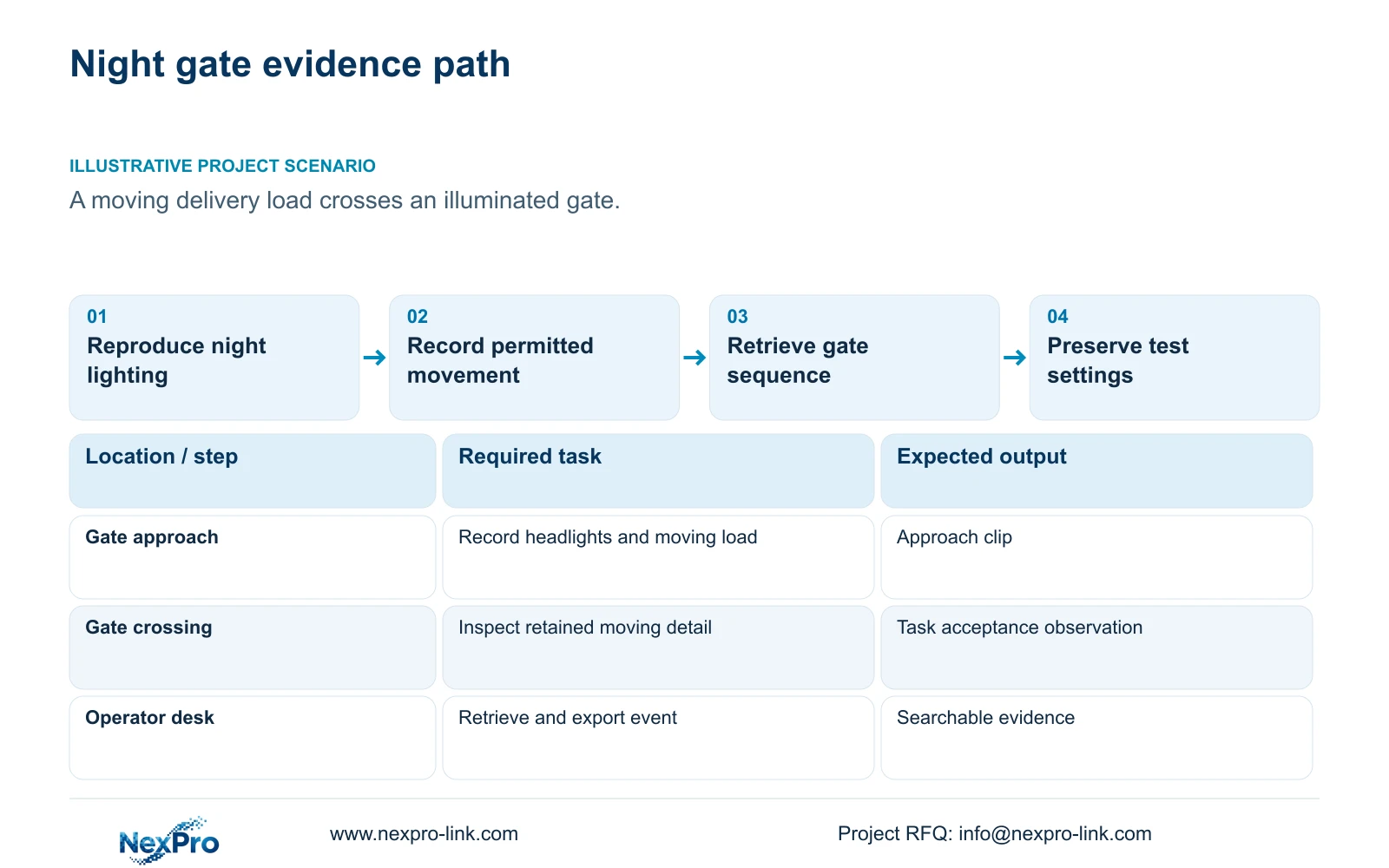
Illustrative project scenario: The acceptance test must cover a moving delivery load at an illuminated gate in the hypothetical CASE01 CNC factory. Its four gate overview cameras provide the planning context. Assume the owner wants to establish the load's movement through a defined gate position, with normal gate lighting and permitted vehicle headlights present.
The engineer should agree the travel path, relevant viewing area and required evidence before the demonstration. Record which luminaires are on, where headlights face and whether the gate is open or closed. Use authorised normal movements rather than asking personnel to create a hazardous situation. If a required lighting state cannot be reproduced, leave that acceptance condition open.
Section 02
Review the recorder sequence and the export
Start with a known event time and project point. Retrieve the sequence from the intended recorder, including approach, passage and departure. Inspect whether the evidence remains useful while the target moves through glare and shadow. Review at normal playback speed before selecting individual frames, because a favourable frame can hide gaps elsewhere in the sequence.
Check the actual recording stream and settings. A client may display a different stream from the one retained, and its layout may alter apparent detail. Record the viewing route used for acceptance. Export the agreed interval and replay it through the recipient's intended method so the evidence is usable outside the recorder.
Separate failure categories. If the local recording is useful but a remote preview stalls, investigate the viewing path. If the target is smeared in retained footage, investigate scene and image settings. If an interval is missing, check recording continuity and schedule. These distinctions prevent a network symptom from being treated as a night-image defect.
Section 03
Preserve the settings that produced each result
Each test record should identify the camera model, firmware, installed position, view width, illumination mode and relevant image controls. Include resolution, frame rate, exposure settings, gain limits where available and recording parameters. When automatic controls are used, document their configured limits and the operating state visible during the test.
The supplied NexPro-BL2812M55-5MP-DIC-AI specification lists 2880×1620 output, 25fps, a 2.8–12mm motorized lens and dual light. Those fields make it a candidate for a suitable ordinary-area role. They do not establish the exposure achieved at this gate, a guaranteed identification distance or an acceptable glare result.
Keep the baseline and adjustment records separate. If the installer changes exposure and illumination together, the combined result may be useful, but it does not isolate which change caused the improvement. Where practical, change one relevant input at a time. Preserve the final accepted state and its clip references so a later configuration change can be reviewed against real evidence.
Section 04
Use exposure time to understand movement blur
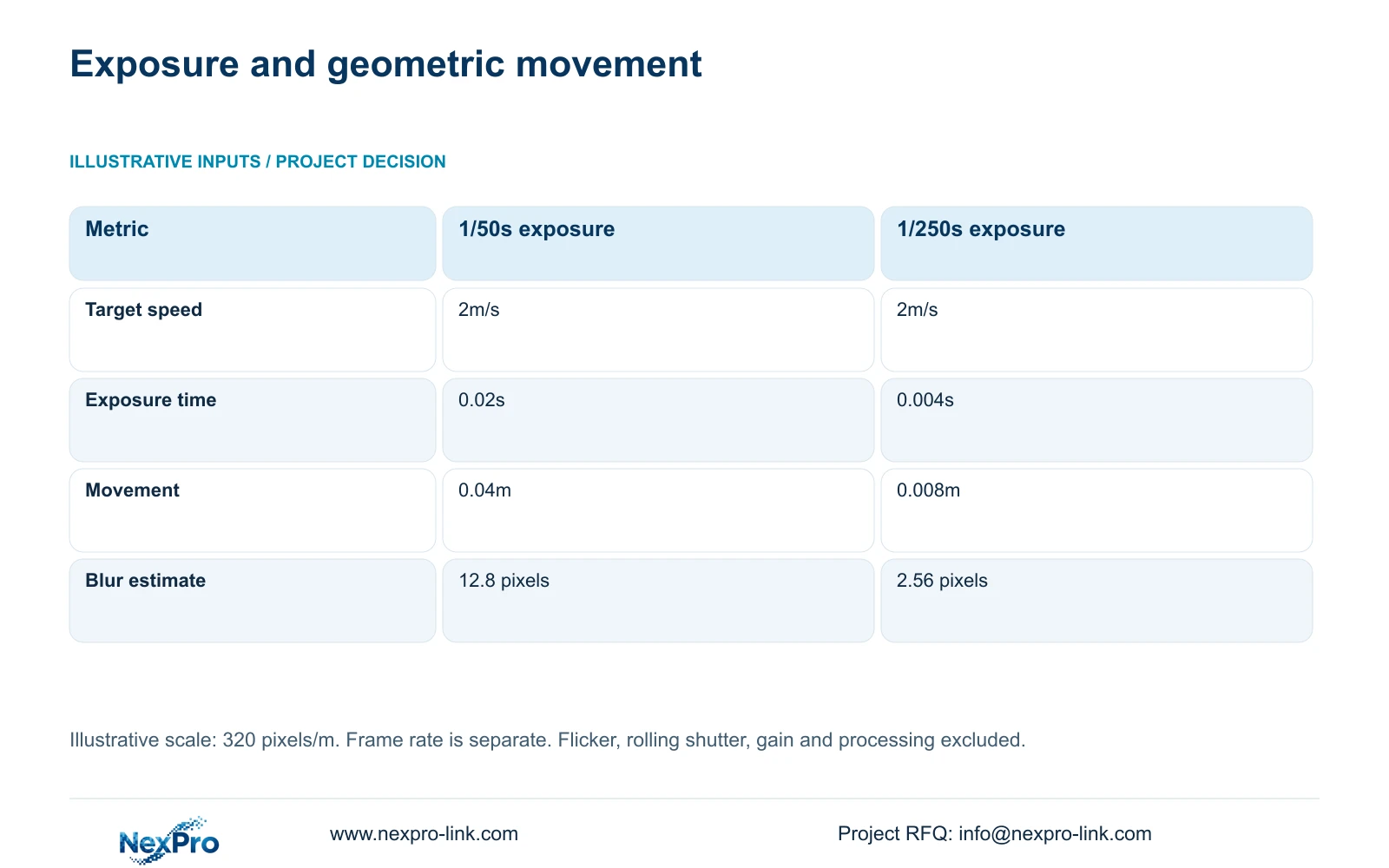
The illustrative motion calculation assumes target speed of 2m/s and image scale of 320 pixels/m at the target plane. Compare exposure times of 1/50s, or 0.02s, and 1/250s, or 0.004s. Frame rate is a separate input and is not used in this calculation. The speed used here is the component across the view at the target plane; movement directly towards the camera does not create the same image displacement.
Movement_m = speed_m_s × exposure_s. Estimated_blur_px = movement_m × pixels_per_m. At 1/50s, movement is 2 × 0.02 = 0.04m and estimated blur is 0.04 × 320 = 12.8 pixels. At 1/250s, movement is 0.008m and the geometric estimate is 2.56 pixels.
The shorter exposure reduces the estimated movement during one exposure, but it also changes the light required for a useful image. A higher fps setting alone does not deliver that reduction. Treat the figures as a simple geometric explanation, not measured sensor performance: rolling shutter, lighting flicker, gain and processing are outside the model.
| Input or result | Option A | Option B |
|---|---|---|
| Target speed | 2m/s | 2m/s |
| Exposure | 1/50s = 0.02s | 1/250s = 0.004s |
| Movement during exposure | 0.04m | 0.008m |
| Geometric blur estimate | 12.8 pixels | 2.56 pixels |
Section 05
Choose a remedy that preserves the agreed gate task
Recommend a moving-target test with retained footage before accepting the gate view. Begin with the installed baseline, then test a supported shorter exposure where motion is the limiting issue. Judge whether the resulting image still contains the required information in darker portions of the scene and when headlights enter it.
If the adjustment cannot preserve useful evidence, consider the view width, mounting position or separately designed lighting. A narrower view may improve scale at the critical point while reducing overview coverage. Retain an overview role where the owner needs it, and define any added detail view as a changed scope rather than declaring that every camera needs an upgrade.
Any light addition must be coordinated with traffic and site operations. Any changed camera or stream configuration must be checked against recording and power requirements. CASE01 uses a 4Mbps average stream assumption; accepted night settings may require that assumption to be revisited. The cost comparison should include brackets, lighting work, commissioning and retests as applicable.
Section 06
Close the night test with searchable evidence
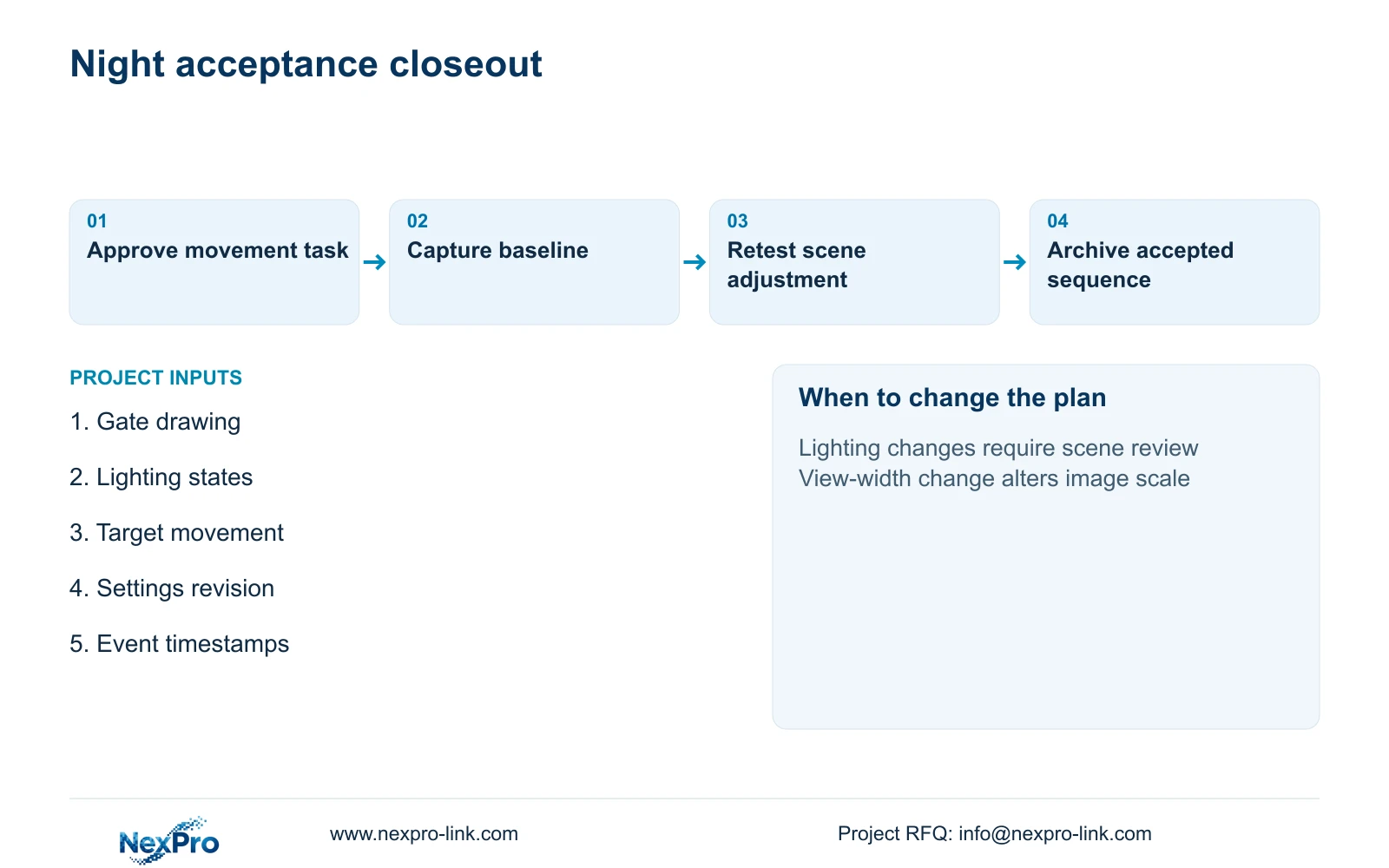
Close each tested role with its scene record, settings revision, event time and retained clip reference. The engineer should state whether the required evidence was demonstrated and list the conditions covered. If only one movement direction or lighting state was tested, keep that scope explicit rather than extending the result to every gate condition.
For an unresolved issue, identify the proposed adjustment, responsible party and retest state. The next demonstration should reproduce the failed task closely enough to support closure. A new daytime image after a night complaint is insufficient. Operator handover should show how to find the accepted gate point and report a later change in visibility.
NexPro-Link's model-matching and technical submittal support can help connect the observation requirement to a candidate and record deviations. Its factory project supply scope provides the equipment-planning context. Final scene tuning, authorised movements and the installed acceptance decision remain with the appointed site team and owner.
Section 07
Buyer questions
Should the gate test include plate recognition? Only if plate recognition is a separately specified task with suitable equipment and acceptance criteria. General gate overview and human or vehicle classification do not establish ANPR performance.
Can the owner accept a still image instead of video? A still can document one observation, but it does not demonstrate movement continuity, retrieval or export. Use the retained sequence for a moving-delivery task.
Does testing with all lights on cover normal night operation? Only if that is the agreed operating state. Test the normal lighting arrangement and identify any reduced-light or headlight conditions that remain required.
Section 08
Define the night gate acceptance task
Send the gate view or drawing, required moving-load evidence, normal lighting states and permitted test window to info@nexpro-link.com. NexPro-Link can discuss candidate roles and the settings evidence needed for site acceptance.
Engineering references
These sources support the general planning principles. Always use the selected product's current datasheet and applicable project standards for final design.