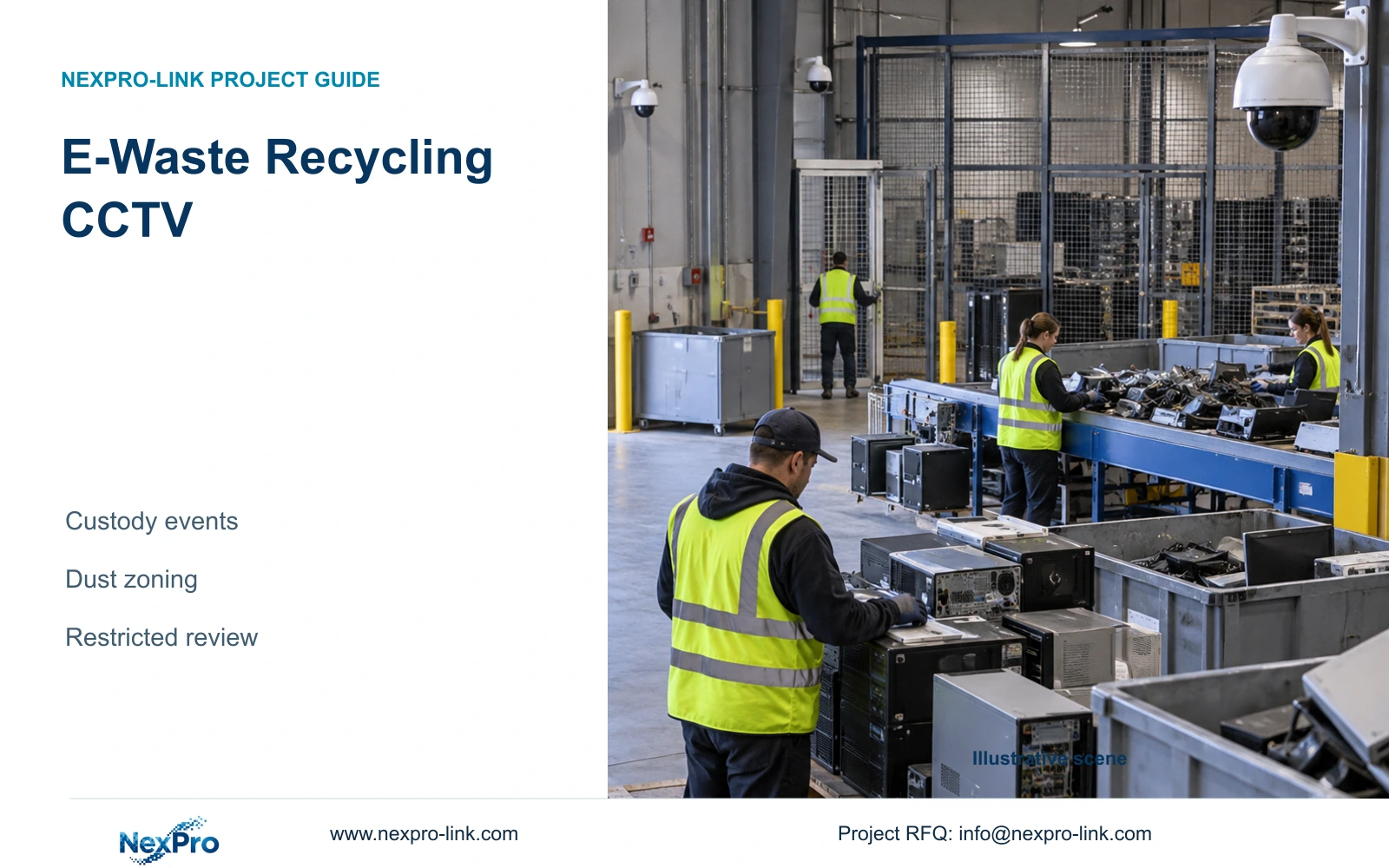
E-waste recycling CCTV should follow intake and custody events, respect actual dust and hazard conditions, and restrict sensitive material views. Controlled recycling records remain the authority for destruction.
Section 01
Define the custody event the footage must explain
E-waste recycling CCTV should record authorised intake and movements into controlled areas, with equipment selected for the actual environment. Use the recycling record to identify the load or container and video to explain its visible custody sequence. CCTV does not certify destruction or replace the operator's controlled recycling records.
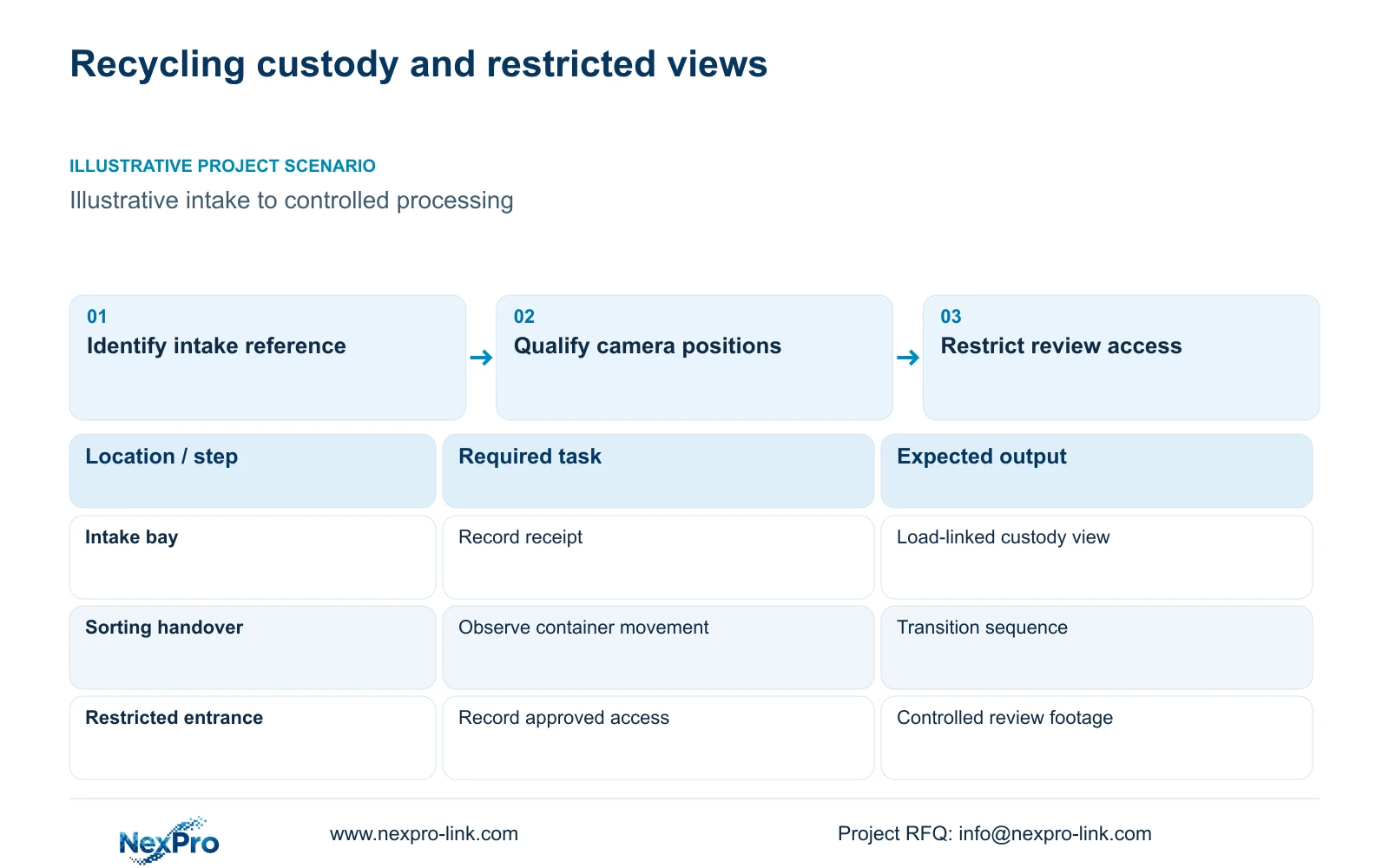
Illustrative project scenario: The recycling operator needs evidence of incoming equipment and movements into controlled areas. Assume the initial scope covers unloading, sorting handovers and entry to restricted processing, while the controlled process retains its own records. The design engineer should identify where a load reference is available and where physical responsibility changes.
Write the required event around those points. At intake, the view may need to show the receiving container and its movement from the vehicle. At a restricted doorway, it may need to retain entry and exit context. Do not equate a container disappearing behind a door with completed processing. The acceptance statement should distinguish what is visible from what the recycling record establishes.
For data-bearing storage media, distinguish intake custody from sanitization completion. NIST SP 800-88 Rev. 2 separates verification of an operation from validation of its effectiveness and includes media identification, method, tools/version and results in its sample record. Link the approved video event to that record where useful; do not label a doorway clip a sanitization certificate. The operator selects the applicable media-specific process and customer obligations.
Section 02
Use the actual dust and hazard assessment
Obtain the operating and location information for each camera position, including dust accumulation, cleaning, temperature, moisture and any classified boundary. Do not treat every sorting location as hazardous or every reception position as ordinary. The responsible designers should identify the applicable conditions from the actual process and verify current local requirements.
A position outside the processing enclosure may preserve access evidence while avoiding unsuitable exposure. Compare its view with the proposed internal position, checking whether containers or machinery hide the transition. If the external view meets the custody task, keep it as the ordinary-area candidate. If it loses essential context, retain a separately qualified specialist selection.
Keep cable routes, terminations and maintenance access in that decision. Frequent lens contamination can make a nominally suitable camera ineffective between service visits. Agree who can safely clean or inspect it and how the task fits operations. A mounting change that improves service access should be assessed for its resulting angle and route costs.
Section 03
Limit sensitive views without losing custody context
Data-bearing equipment may carry visible customer identifiers or displayed information unrelated to the security task. Define the approved scene so it captures custody without unnecessary close views of that material. The operator should decide which roles may see live video, search recordings and export clips. Customer-facing reporting is a separate permission from general security monitoring.
Review actual camera framing before relying on software restrictions. Aim away from information displays where the task does not require them. If privacy masking is proposed, confirm the selected device and recording workflow support the required behaviour, then check recorded playback and export. Do not assume a mask shown in one live client applies to every output.
Store sensitive footage on a controlled recording node with named account ownership and a clear export process. The reviewer should receive the relevant load or container reference and authorised event window. Any contractor or supplier demonstration should use suitable redacted material. Confirm applicable customer agreements and local requirements with the operator rather than making a general legal claim.
Section 04
Compare ordinary and specialist positions independently
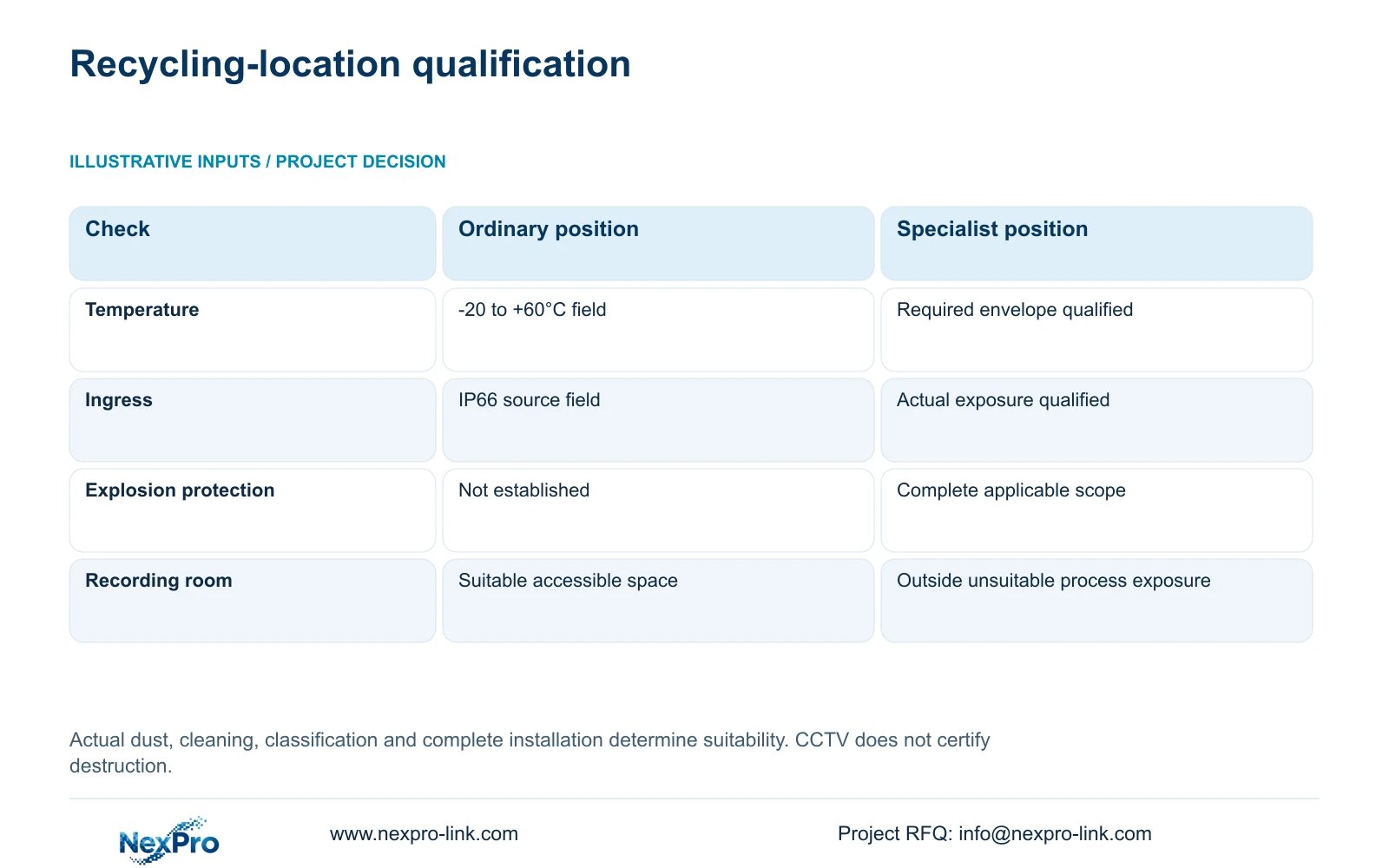
The ordinary BL2812M and DM2812M references list IP66 and a temperature field of -20 to +60°C. These are documented model fields, not a qualification for every recycling process. The selection method is location conditions AND complete product scope AND approved installation requirements. All must fit; an ingress rating cannot override a missing protective scope.
The table applies that method to the illustrative intake and restricted-processing arrangement. The decisive difference is whether an approved ordinary position can provide the custody view. Specialist requirements remain attached to positions that need them. A metal enclosure or PoE connection does not establish explosion protection, corrosion resistance or cleaning compatibility.
For a suitable normal-area view, NexPro-DM2812M55-5MP-DIC-AI is a source Dome-family reference listing 2880x1620 output at 25fps and a 2.8-12mm motorized lens. Keep that naming and output in the schedule. Housing shape does not establish an IK rating, and the camera does not supply a destruction-verification function.
| Decision | Ordinary position | Specialist position |
|---|---|---|
| Temperature | Check against -20 to +60°C | Qualify required operating envelope |
| Dust and cleaning | IP66 plus actual exposure review | Process-specific equipment qualification |
| Classified boundary | Remain in approved ordinary location | Applicable complete protective scope |
| Custody observation | Intake or external doorway view | Internal view only when justified |
| Recording infrastructure | Accessible suitable service room | Ordinary racks outside unsuitable exposure |
Section 05
Retain the required evidence on suitable local nodes
Recommend cameras at approved custody points, restricted review permissions and suitable local recording spaces. CASE05 provides an illustrative distributed recording reference from a solar-module campus: three 32-camera nodes. Its structure may help organise separate reception and processing buildings, but its all-ordinary schedule does not qualify recycling positions or establish the required camera count.
Retention should follow the operator's actual event-review requirement. CASE05 assumes 30 days at 4Mbps continuously; those are project inputs, not an industry obligation. If a recycling customer requires another review period, calculate its stream groups separately. A selected export should not be confused with the retention capacity needed to preserve the original recording.
Back up the camera supply, switches and recorder at each required electrical node if the custody task must continue during outages. Keep processing machinery and safety systems outside that CCTV power scope. Use a review screen suited to the task, with any broader display wall priced separately. Additional monitoring must respect the approved sensitive-view permissions.
Section 06
Release equipment with environmental and access responsibilities
The BOQ should identify new ordinary cameras, separately qualified specialist positions, retained recycling records and optional reporting interfaces. Attach load or container reference points to the view schedule. Name the party responsible for environmental approval, installation, camera cleaning and permission administration. An exclusion without a responsible project owner leaves a gap in the operational package.
NexPro-Link's factory and BOQ support scopes can assist with model matching, technical submittals and coordinated preparation. For this application, camera IDs and location labels should match the restricted-area schedule through packing and commissioning. OEM labels or cartons do not change the suitability of a camera or confer a destruction certificate.
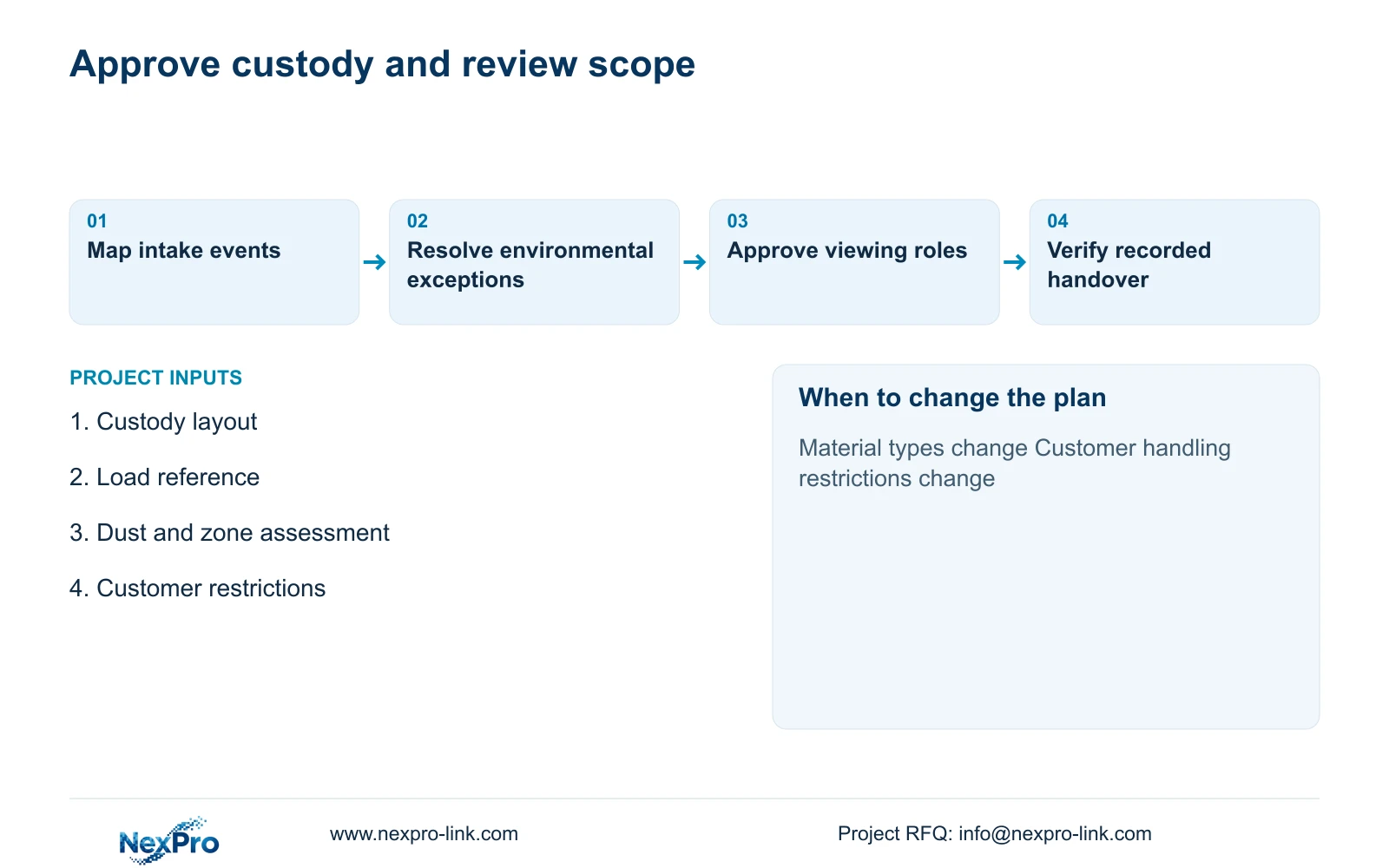
Accept the package through an authorised intake-to-doorway review using representative material and operating conditions. Check recorded visibility, approved account access and export scope. Reopen the affected design if material types, dust conditions or customer handling restrictions change. Keep the controlled recycling process and its acceptance records separate throughout that change.
Section 07
Buyer questions
Can customers receive unrestricted access to all cameras? Do not make that the default. Define the customer's permitted locations, records and reporting purpose, then confirm a supported access method that does not expose other customers' material.
Is viewing through a processing-room window an acceptable option? It can be a candidate if the location and recorded view meet the task. Check reflections, contamination, obstruction and the complete mounting route before approving it.
Can a video clip be labelled proof of destruction? The operator must rely on its controlled process and records for that conclusion. CCTV can accompany the record as handling context without independently certifying the outcome.
Section 08
Define your recycling custody scope
Send the intake-to-processing layout, dust and hazard information, required custody events, and customer-viewing restrictions to info@nexpro-link.com to discuss the suitable surveillance and documentation package.
Engineering references
These sources support the general planning principles. Always use the selected product's current datasheet and applicable project standards for final design.