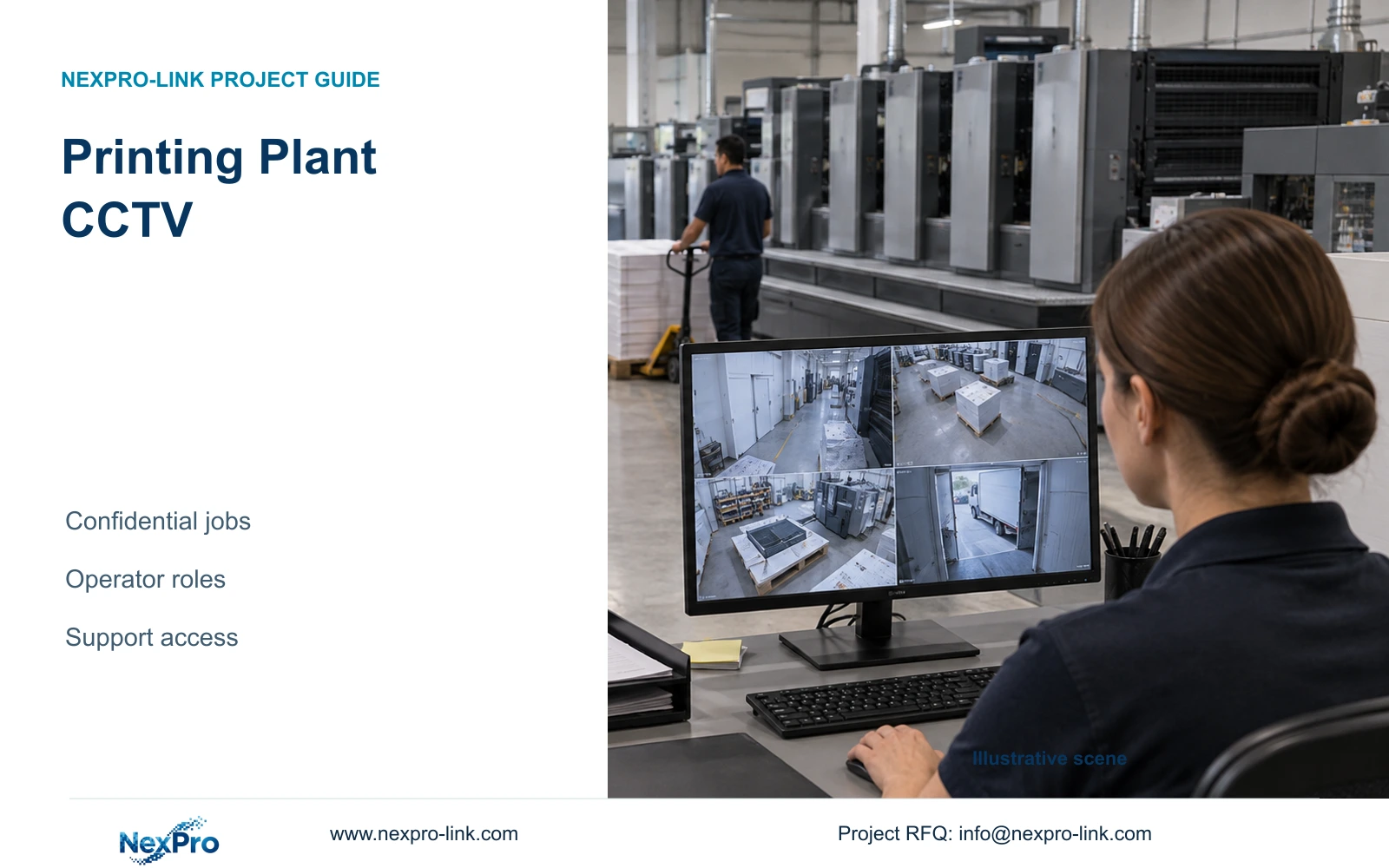
Specify printing-plant CCTV around material movement, with tested operator permissions, controlled supplier support and separate recording and viewing bandwidth budgets.
Section 01
Frame material movement without unnecessary artwork detail
Commercial printing plant CCTV should restrict views and retrieval to the defined security purpose. Frame material movement, access and dispatch while avoiding unnecessary customer-artwork detail. Specify operator and supplier-support permissions before procurement, because administrative access can expose more than the routine viewing layout suggests. Resolution and bandwidth choices should support the accepted security task without being treated as confidentiality controls.
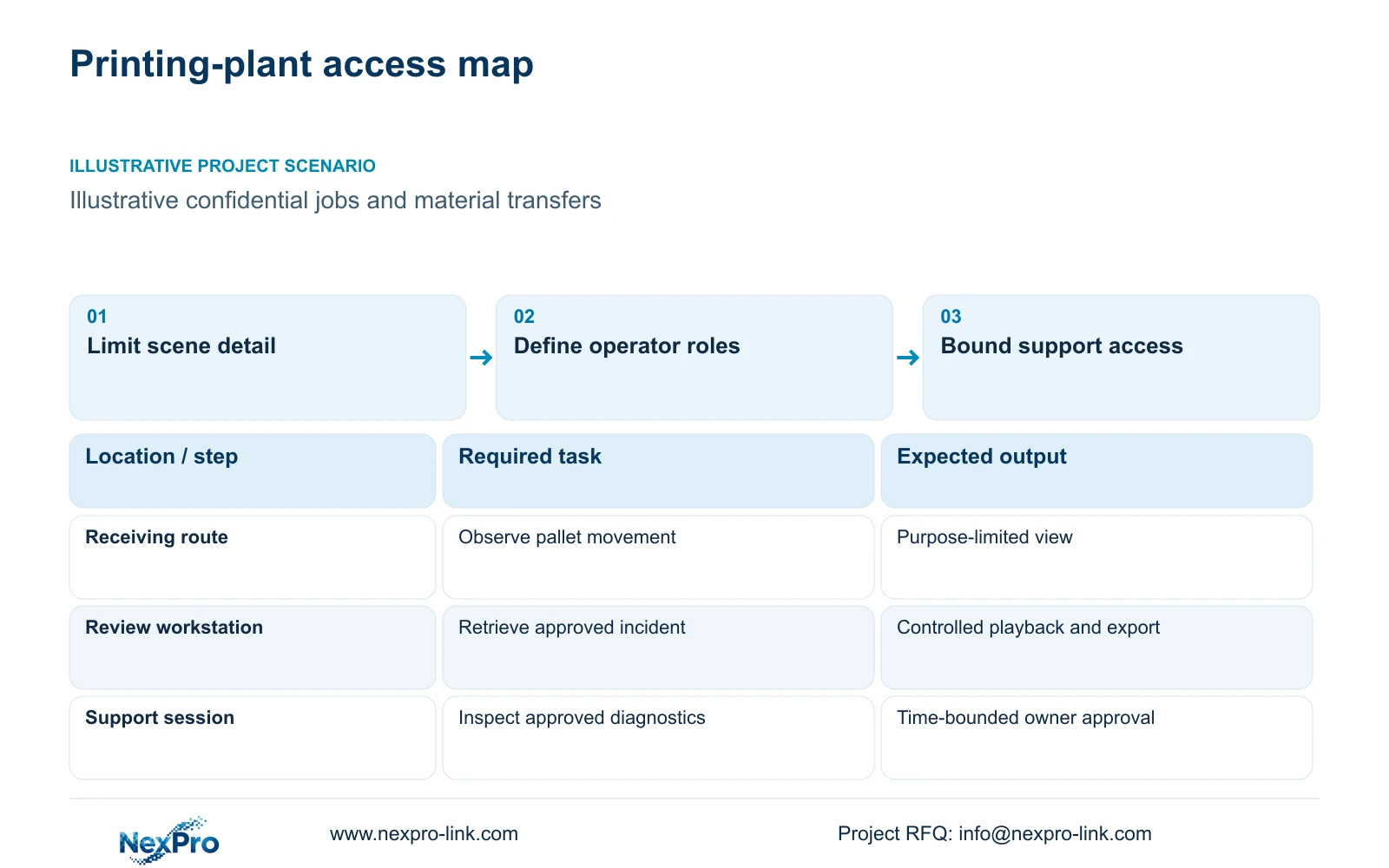
Illustrative project scenario: A printer handles confidential customer artwork and wants security footage of material movement. Assume security staff need to follow pallets through receiving and dispatch, while an authorised incident reviewer may need selected recordings. The quantity surveyor requests a view-purpose schedule and an access matrix alongside the camera BOQ. These hypothetical roles are project-method examples. They do not establish that a particular recorder or client already enforces the proposed separation.
Section 02
Separate live viewing, playback and export permissions
Define permissions by task rather than giving all operators one shared administrative account. Routine staff may need approved live views; incident reviewers may need playback for a defined area and period; export should follow a named approval route. System administration is another responsibility. Ask suppliers to identify which restrictions the exact recorder, client and firmware enforce, and which require an additional platform or operational control.
Test the matrix using each intended account. Check direct recorder access, local output, PC client and any approved remote route because a restriction visible in one interface may not cover another. Include a negative test: the routine viewer attempts to open an excluded camera or export footage. Where masking is proposed, verify its effect on recorded material and every required client rather than assuming a hidden live-view area is absent from stored video. The owner should approve framing that captures the handover while excluding sensitive artwork where feasible.
Section 03
Make supplier support a bounded service
Write supplier support as an approved maintenance workflow with a named owner, permitted purpose and defined end. Prefer diagnostic information, configuration records and a non-sensitive test view when they can resolve the fault. If live production footage is necessary, the owner should approve the selected scope and supervise the session through an appropriate controlled route. Do not include unrestricted standing video access as an unstated condition of a camera warranty or configuration service.
Price the practical work needed to establish and maintain this arrangement: account setup, permission demonstrations, operator guidance and removal of temporary support access. Keep credentials out of shipping labels, public diagrams and routine documentation. NexPro-Link's BOQ support can help describe equipment and submittal boundaries, but it does not establish that every desired permission exists in a basic recorder. Where the owner's access policy exceeds the selected platform's capabilities, retain the required management-system scope and show the commercial difference explicitly.
Section 04
Budget recording and operator traffic on their actual paths
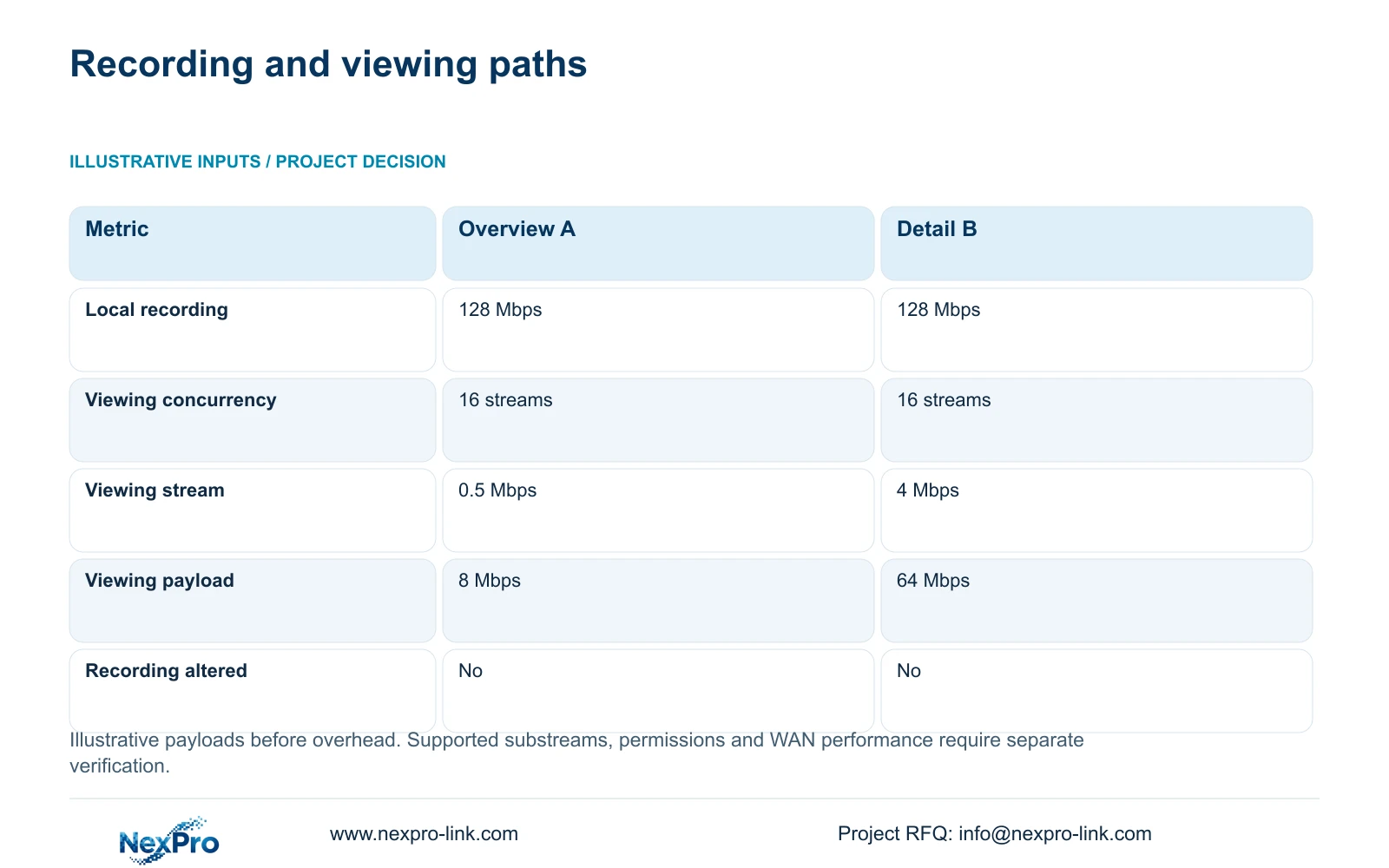
The illustrative network inputs are 32 local main streams at 4 Mbps and 16 simultaneously viewed cameras. Option A uses an assumed 0.5 Mbps per viewing stream; Option B uses 4 Mbps. The formulas are recorder_Mbps = 32 × 4 = 128 Mbps and viewing_Mbps = 16 × stream_Mbps. Thus the viewing payload is 8 Mbps or 64 Mbps before protocol overhead, while local recording remains 128 Mbps in both options.
The decisive difference is the selected operator stream, not a reduction in the main recording stream. Add each payload only to interfaces it actually traverses, and include playback, export and other shared traffic where present. A low-bandwidth overview can support an approved routine-viewing task if the selected devices and client support it. It does not prevent disclosure of readable artwork, enforce account rights or guarantee WAN performance. Confidentiality still depends on framing, verified permissions and controlled handling of recordings.
| Metric | Option A: overview | Option B: detail |
|---|---|---|
| Local recorder input | 128 Mbps | 128 Mbps |
| Concurrent viewing streams | 16 | 16 |
| Viewing bitrate per stream | 0.5 Mbps | 4 Mbps |
| Viewing payload | 8 Mbps | 64 Mbps |
| Local recording changed | No | No |
Section 05
Compare bids against the permission workflow
Recommend purpose-limited views with a demonstrated separation between routine viewing, incident retrieval and supplier support. Select the lower-bandwidth overview where it meets the routine task, with authorised detail access available through the agreed review workflow. Change the platform or service scope if camera-level restrictions, export controls or required administration boundaries cannot be demonstrated. Do not compensate for missing permissions by merely lowering image quality.
CASE01 provides a separate illustrative 32-camera recording baseline at 128 Mbps. The NexPro-NVR4449-4K lists 320 Mbps input, but that capacity does not prove the proposed permissions, simultaneous client workload or export performance. For a like-for-like bid, keep retention, supported streams, viewing concurrency and access controls constant. The quantity surveyor should separate equipment, any additional software, permission setup, commissioning and support services. A proposal with a complete access-management layer may legitimately differ from a basic hardware package; compare current matching quotations without declaring an unsupported brand winner.
Section 06
Handover tested roles and a controlled retrieval procedure
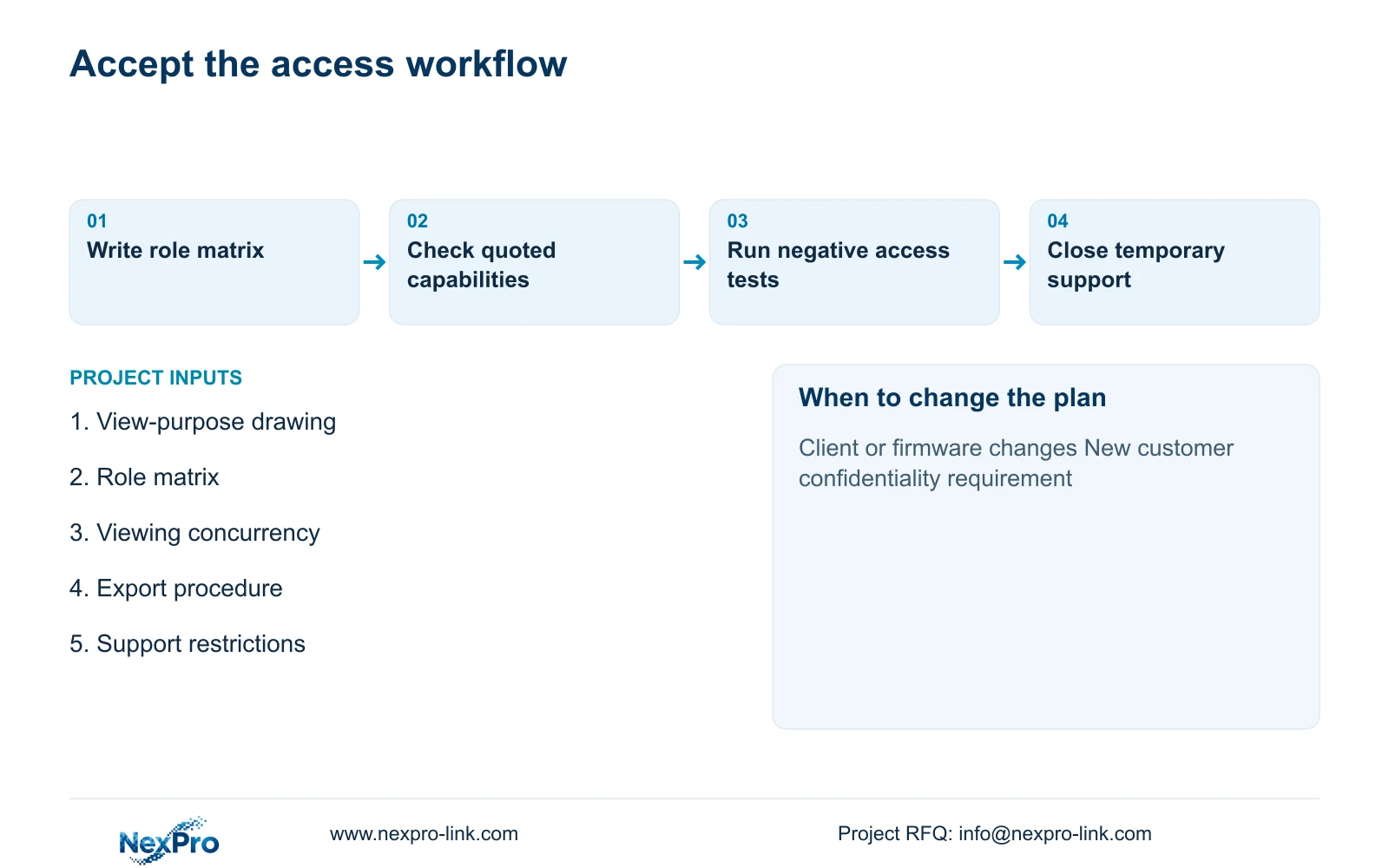
The procurement package should include a camera-purpose drawing, role matrix, network-path diagram and support-access procedure. Use non-confidential examples for supplier demonstrations where possible. Give each view a location ID and a stated security purpose, with specialist inspection or solvent-area positions separately scoped. Ordinary security recording should not be described as print-quality inspection, machine protection or hazardous-area qualification.
At acceptance, demonstrate a routine operator's approved view, an authorised incident search and a controlled export. Record model and firmware identity, unresolved permission limitations and the person responsible for account changes. Confirm that support access is closed after the approved work and that the owner retains the necessary administrative control. Keep protected recording power and cable design in the equipment scope, but do not confuse those availability measures with access restrictions. The useful handover result is a system whose everyday tasks and exceptional access paths have both been examined.
Section 07
Buyer questions
Does a lower-bitrate substream protect confidential artwork? No. It is a bandwidth choice. Sensitive content may remain visible, and users may have another route to higher-quality recordings. Verify framing and permissions independently.
Can every CCTV platform enforce the proposed role matrix? No capability is assumed here. Require a demonstration on the quoted model, firmware and client, and identify additional software or operational controls where necessary.
What should a support quotation include besides remote access? Include the permitted diagnostics, owner approval route, account setup and closure responsibilities, and any on-site work needed when remote access is unsuitable.
Section 08
Define printing-plant access before comparing bids
Email a non-confidential camera-purpose plan, proposed operator and export roles, viewing concurrency, and supplier-support restrictions to info@nexpro-link.com for a scoped equipment and commissioning comparison.
Engineering references
These sources support the general planning principles. Always use the selected product's current datasheet and applicable project standards for final design.