Check that the wood-dust camera submittal covers its connection and maintenance scope, not just an ingress label. Keep missing approvals visible in a position-level release record.
Section 01
Confirm the location before accepting an ingress rating
For a wood-dust CCTV purchase, release each affected position only when the location basis, complete equipment configuration and installation scope agree. An IP rating cannot fill a missing protection requirement. Separate the camera document from connection and maintenance evidence, then assign each unresolved item to the responsible qualified team. The result is a complete-position release record, not a CCTV team's classification of a combustible-dust area.
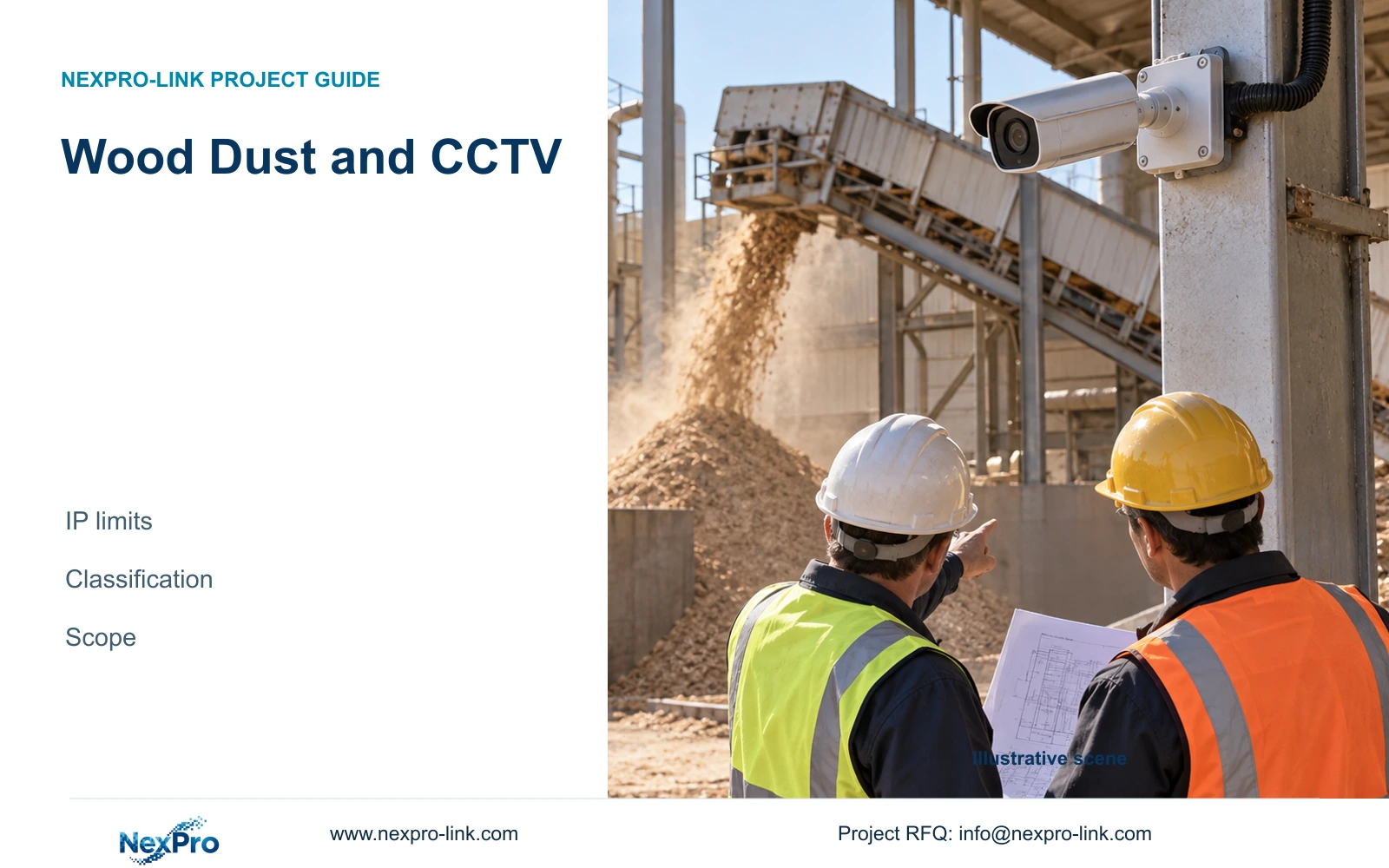
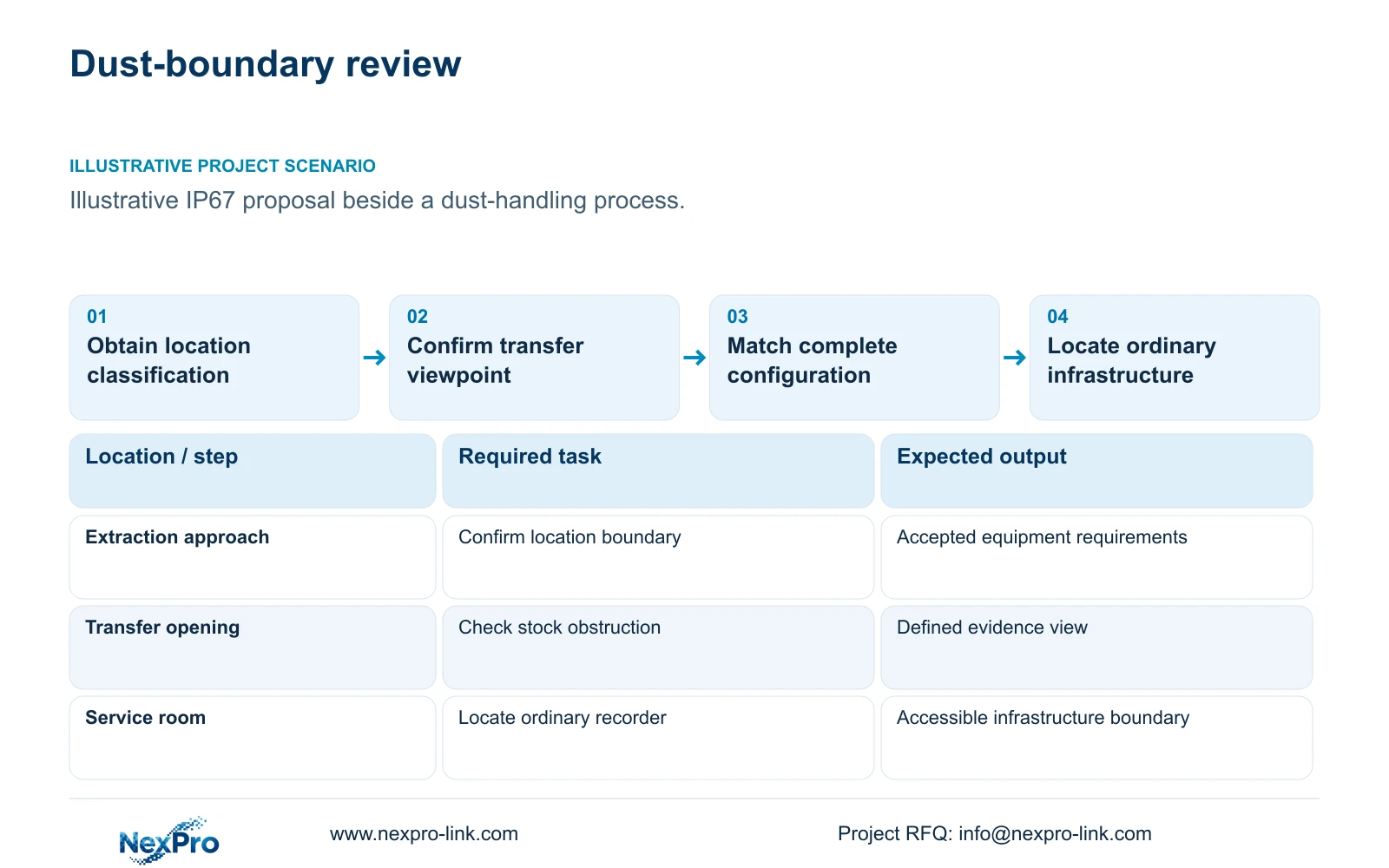
Illustrative project scenario: The plant proposes an IP67 camera beside a dust-handling process. Assume the desired task is to record material transfers near an extraction connection, while the exact classified boundary has not yet been supplied. The camera position remains provisional. Its proximity to the process is a reason to obtain the responsible designer's information, not evidence that a particular classification applies.
Request the current location drawing with revision, boundaries and the conditions relevant to equipment selection. Identify normal operation, cleaning and maintenance arrangements that the responsible designer has considered. Verify applicable local requirements with that team. The supplied OSHA hazardous-locations reference is a US-specific research reference, not a current worldwide installation rule or a project approval.
Section 02
Review the completeness of each dust-area submittal
Convert the accepted location requirements into a submittal schedule covering camera, enclosure if applicable, connections, mounting and service access. Ask the specialist supplier to identify the exact approved configuration and its limitations. Do not treat an unrelated enclosure as a way to convert an ordinary camera into a qualified assembly unless that complete arrangement is supported and accepted.
Keep the observation task attached to this schedule. A technically appropriate protective configuration still needs to show the transfer opening at the required detail. Stock height, extraction ductwork and handling equipment may obstruct it. The engineer should check both suitability and visibility before procurement; satisfying only one leaves either the installation or the recording task unresolved.
The supplied NexPro ordinary BL2812M55 and DM2812M55 references list IP66 and -20 to +60°C. Their 5MP-family output includes 2880x1620, with a 2.8–12mm motorized lens. These are useful fields for appropriate ordinary positions. They provide no established explosion-protection scope, and the source Dome designation does not imply an IK rating or a specialist dust-area approval.
At submittal review, ask which issued drawing and configuration each document actually covers. A camera document does not close an unspecified cable entry, and an accepted assembly does not establish a cleaning or replacement method omitted from its scope. Record the outstanding interface and approval owner against the position ID. Reopen that record after an extraction or access change; do not carry forward an approval solely because the camera model is unchanged.
| Condition / stage | Required input | Decision and evidence |
|---|---|---|
| Camera scope supplied | Exact configuration and applicable location basis | Check scope, not IP as a substitute |
| Connection scope absent | Entry/termination requirement and approval owner | Keep the complete position on hold |
| Extraction or service access changes | Revised drawing and affected installation items | Refer the affected scope for renewed acceptance |
Section 03
Locate ordinary recording equipment outside unsuitable areas
Where the approved layout allows it, put recorders, ordinary switches and batteries in an accessible suitable service room. Show the data path and power path separately. A specialist camera at the process boundary does not make a nearby ordinary cabinet suitable, and an ordinary switch serving that camera still needs an accepted location and compatible interface.
Assign each crossing of the boundary to a responsible designer or installer. The procurement schedule should identify the required connection arrangement without prescribing a hazardous-area assembly method. Cable entries, termination points and maintenance access belong in the complete accepted installation scope. A missing interface is an unresolved item rather than an assumed ordinary accessory.
CASE01 illustrates the benefit of an explicit ordinary-area infrastructure boundary: 32 cameras use local PoE groups, one recorder and a suitable equipment location. It contains no specialist camera positions. Therefore, its topology can inform recordkeeping and node allocation, but its ordinary camera demand, cable routes and equipment suitability cannot be transferred unchanged to this dust-handling scenario.
Section 04
Use independent qualification checks rather than a score
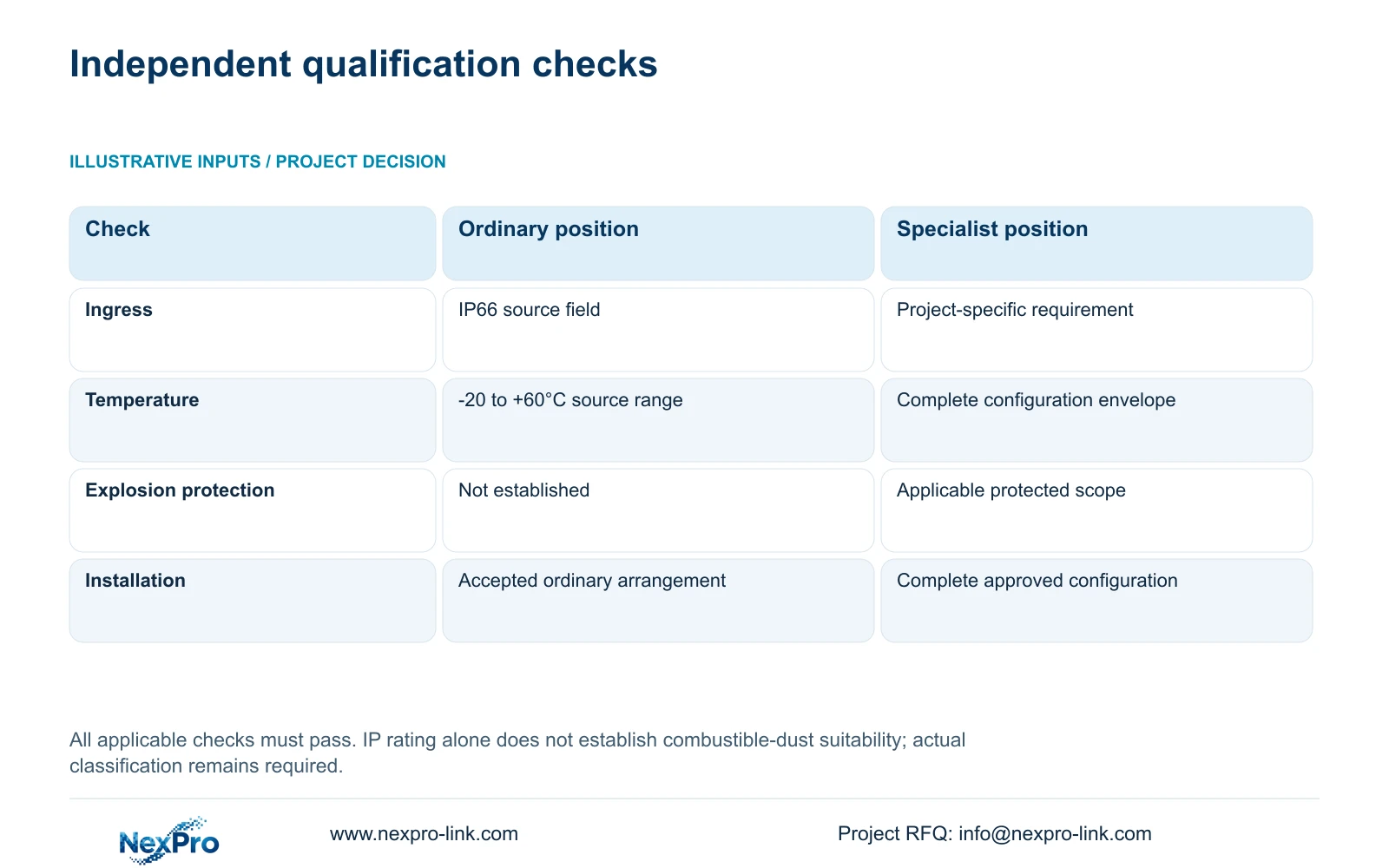
Qualification is conjunctive: location conditions AND complete product scope AND approved installation requirements must fit. Use the comparison table to preserve those independent decisions. There is no useful average score in which good image resolution compensates for missing protection, or an IP rating compensates for an incompatible cleaning exposure.
The decisive comparison concerns the proposed mounting location. Option A is a position accepted for ordinary security equipment; Option B is a position requiring a specialist configuration. These options may record different views. If relocation outside the boundary loses the required transfer detail, the owner must either accept that limitation or retain the specialist task in the quotation.
Review cleaning separately from ingress. Record the cleaning method, access restrictions, expected deposits and any chemical exposure. The source IP66 field does not establish every cleaning or material-compatibility condition. Also check local temperature and condensation conditions rather than treating the documented temperature endpoints as proof of suitability for all operating states.
| Check | Option A: ordinary position | Option B: specialist position |
|---|---|---|
| Location basis | Accepted ordinary location drawing | Actual classified-location requirements |
| Temperature | Source range: -20 to +60°C | Required envelope for complete configuration |
| Ingress and cleaning | IP66 field; exposure still checked | Actual cleaning and material compatibility |
| Explosion protection | Not established by ordinary PDFs | Applicable complete protected equipment and installation |
| Infrastructure | Suitable accessible service room | Ordinary cabinets outside unsuitable locations |
Section 05
Choose relocation only when it preserves the required view
For a transfer task, first examine whether an accepted ordinary-area viewpoint can record the event from outside the unsuitable location. This may simplify service access and ordinary infrastructure coordination. Make that recommendation conditional on the actual boundary drawing and an accepted sightline, rather than promising that an external mount automatically avoids specialist requirements.
Retain a specialist configuration when the task requires a position within the classified location or when an external view cannot provide the agreed evidence. Separate its equipment, interfaces and specialist installation services from the ordinary camera package. A buyer comparing alternatives should preserve that complete scope, including any owner-mandated platform or approval requirement.
Write exclusions in operational terms. An access camera may record people and material movement while providing no process inspection, dust monitoring or safety interlock function. That distinction prevents a security purchase from acquiring an unpriced safety responsibility. The approved site design remains responsible for the protective systems, with current requirements verified locally.
Section 06
Release documents that keep boundaries visible
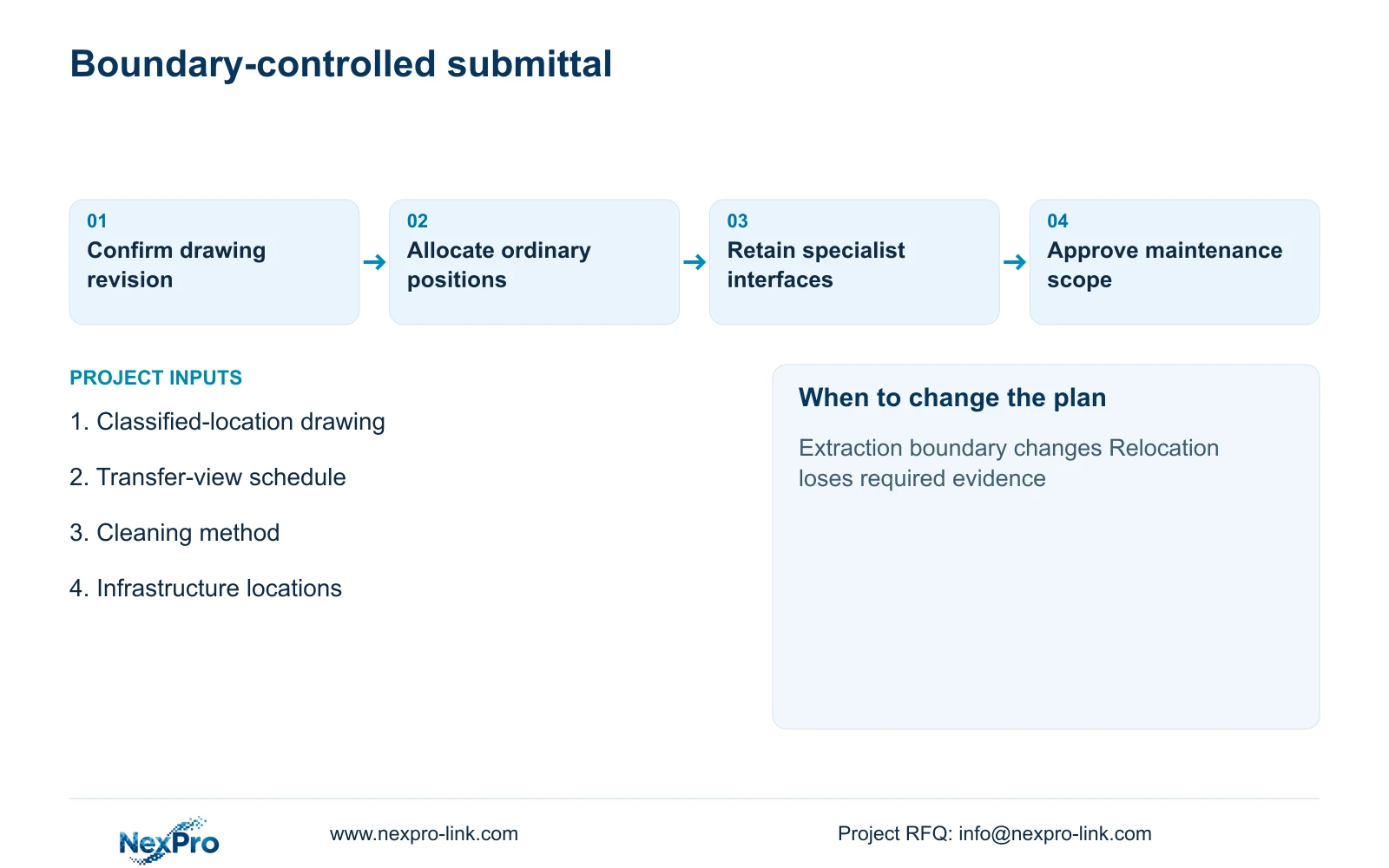
Prepare a camera schedule with task, coordinates or drawing reference, location status, equipment scope and approval owner. Add a maintenance column identifying the accepted access and cleaning method. The owner approves the evidence objective, the responsible area designer supplies the location requirements, and the CCTV team demonstrates the accepted recording and retrieval workflow.
Record changes to extraction equipment, stock arrangements or service access as design changes. A relocated duct or revised boundary can invalidate a mount even when the camera model remains unchanged. Revisit the complete affected position before shipment or installation; merely updating a model number leaves connections and maintenance assumptions behind.
NexPro-Link's BOQ and tender support can help separate ordinary model matching, technical documents and quotation deviations from specialist responsibilities. Its factory project-supply scope can coordinate the ordinary recording package and related equipment. Keep specialist selection and local installation approval assigned explicitly, so a coordinated equipment order does not imply that every protective system is supplied or approved by the same party.
Section 07
Buyer questions
Can procurement proceed while the classified-location drawing is missing? Ordinary positions with an accepted location basis can be discussed separately. Hold unresolved dust-process positions as provisional and avoid releasing their installation configuration until the responsible requirements are available.
Does a weatherproof enclosure resolve the camera proposal? Weather protection alone does not establish the complete protective scope. Obtain evidence for the exact camera, enclosure and connection arrangement where specialist qualification is required.
What should a supplier deviation state? Identify the exact unmet requirement, affected position and proposed alternative. State any change in viewpoint, connection or approval responsibility so the buyer can decide without interpreting an ambiguous equivalent-product claim.
Section 08
Separate your dust-area CCTV scope
Send the classified-location drawing, required transfer views, cleaning and exposure information, and proposed service-room location to info@nexpro-link.com to discuss ordinary equipment boundaries and clearly separated specialist interfaces.
Engineering references
These sources support the general planning principles. Always use the selected product's current datasheet and applicable project standards for final design.