Build dyeing plant CCTV around actual moisture, cleaning and substance exposure, while keeping ordinary cameras and recording infrastructure within suitable locations.
Section 01
Qualify each exposure at the camera position
Dyeing plant CCTV needs a position-specific exposure schedule before ordinary and specialist equipment can be compared. Identify moisture, condensation, cleaning substances, corrosion concerns and any assessed location classification independently. A suitable temperature field cannot compensate for unsupported material compatibility. Use ordinary security equipment where all relevant conditions fit, and retain specialist scope where the proposed location requires it.
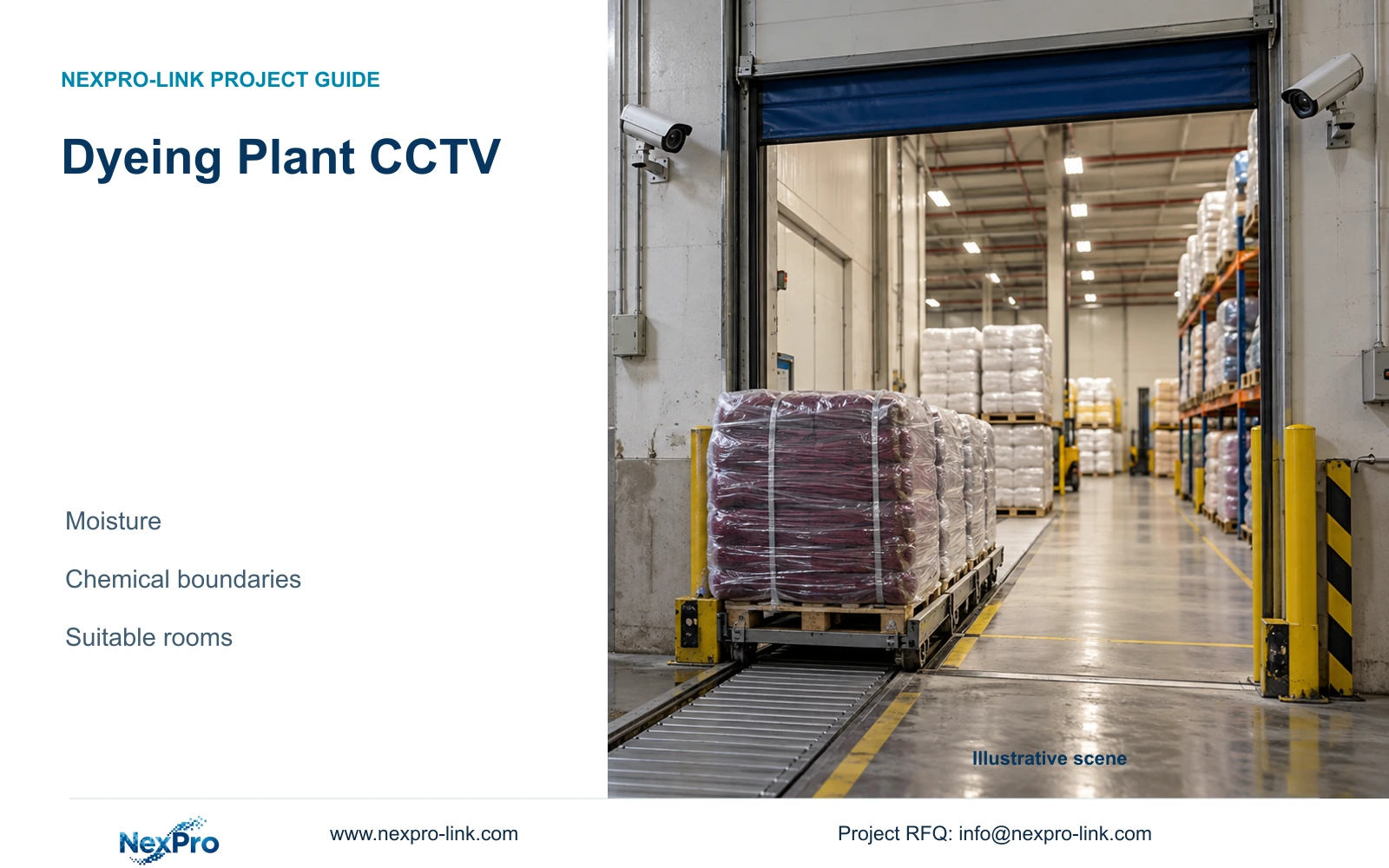
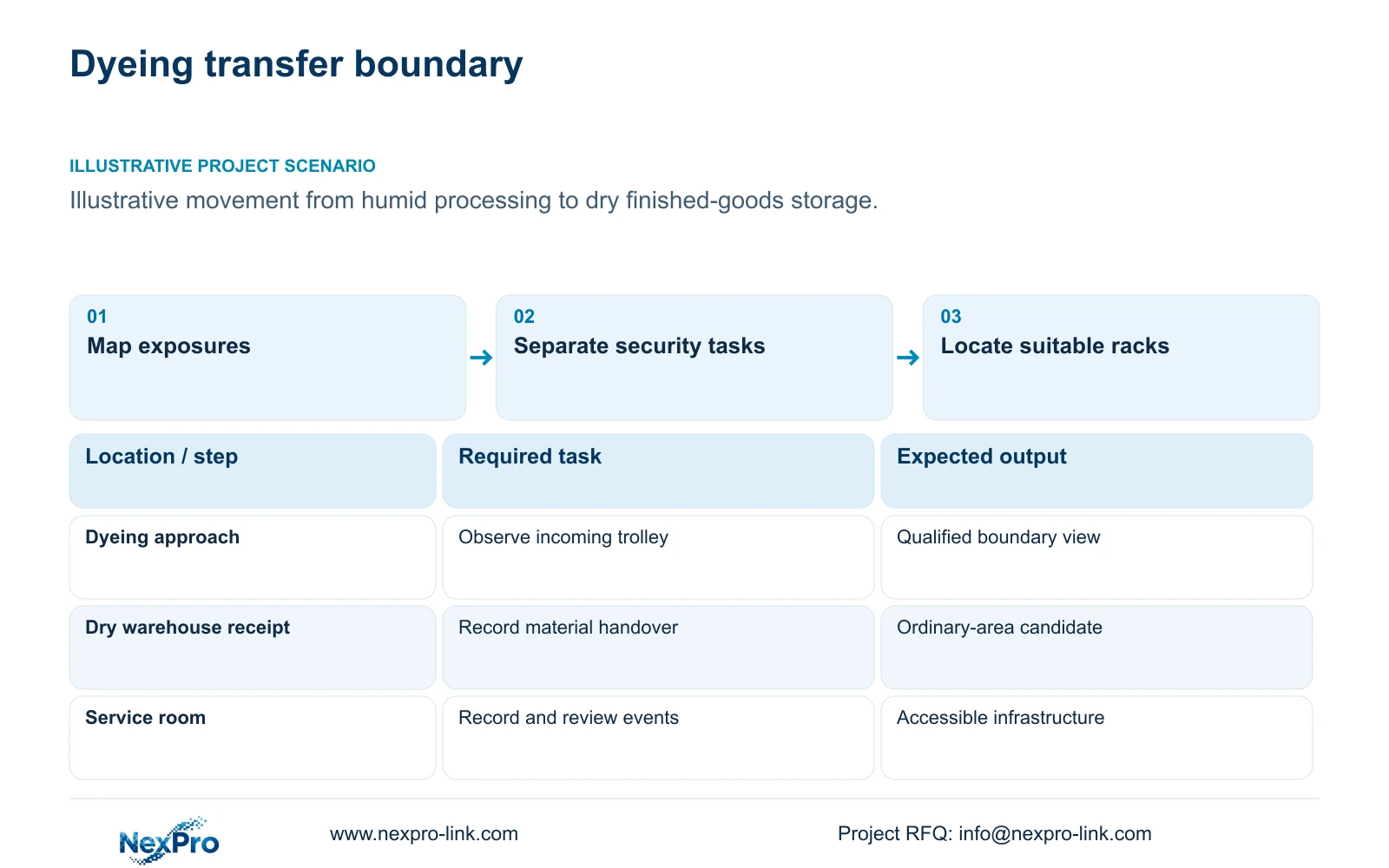
Illustrative project scenario: Material movements link a humid dyeing building to a dry finished-goods warehouse. Assume the project needs evidence of trolleys crossing the building boundary and goods being received into dry storage. The designer first checks whether those events can be observed from suitable approaches. These assumed tasks do not establish that the humid room, its doorway or any chemical-handling position is an ordinary location.
Create an exposure entry for the camera, connector, bracket and cable route. Request actual conditions at their installed positions rather than relying on the room name. Include lint or deposits where relevant, changing lighting and the arrangement of material stacks. Have the responsible site specialists resolve classification and protective requirements, and verify applicable local requirements before approving the installation.
Section 02
Separate access evidence from process observation
Define general security tasks around receipt, access and material transfer. A view of a trolley entering the dyeing building may be obtainable from a suitable corridor, while observation inside the process area introduces different exposure and equipment requirements. Record both the observation target and the camera's physical location. Looking toward a process area does not prove that the mounting position or connection path is acceptable.
Keep process measurement, safety interlocks and specialist monitoring outside the ordinary CCTV brief. A security recording can provide context about movement without determining dye quality, chemical concentration or safe process conditions. If the owner requires those outcomes, assign them to the appropriate specialist system and document any proposed interface separately. This avoids a camera substitution quietly changing the intended function.
Validate the transfer view when doors are used normally and representative loads occupy the route. Moisture on an optical surface, steam in the sightline or stacks at the receiving point may conceal the event even when the equipment itself is suitable. Try a different approved viewpoint where practical; if the event remains inside an unsuitable location, retain the necessary specialist position.
Section 03
Put recording and power equipment in suitable rooms
Choose accessible service rooms for recorders, disks, switches and UPS batteries, checking their own environmental requirements. A dry warehouse is not automatically a suitable equipment room: the rack location still needs conditions compatible with the selected equipment, ventilation and maintenance access. Mark the room as an owner-provided dependency, including the person responsible for making it available before commissioning.
CASE04 illustrates a separate four-building, 80-camera campus with local recording at four 20-camera nodes and authorized retrieval across the backbone. That arrangement is useful here as a system-boundary example. It does not qualify a dyeing-area camera or prove that the same camera count fits this plant. Preserve local camera-to-switch-to-recorder paths so cross-building viewing is distinguishable from recording.
Trace electrical protection independently from data connections. A central UPS does not protect remote AC equipment unless the actual distribution supplies it. Cable and connector suitability must follow the route's exposures, including transitions into humid or chemical areas. An operator screen can remain in a suitable review room; recording should not depend on a display being continuously switched on.
Section 04
Use a qualification matrix before comparing prices
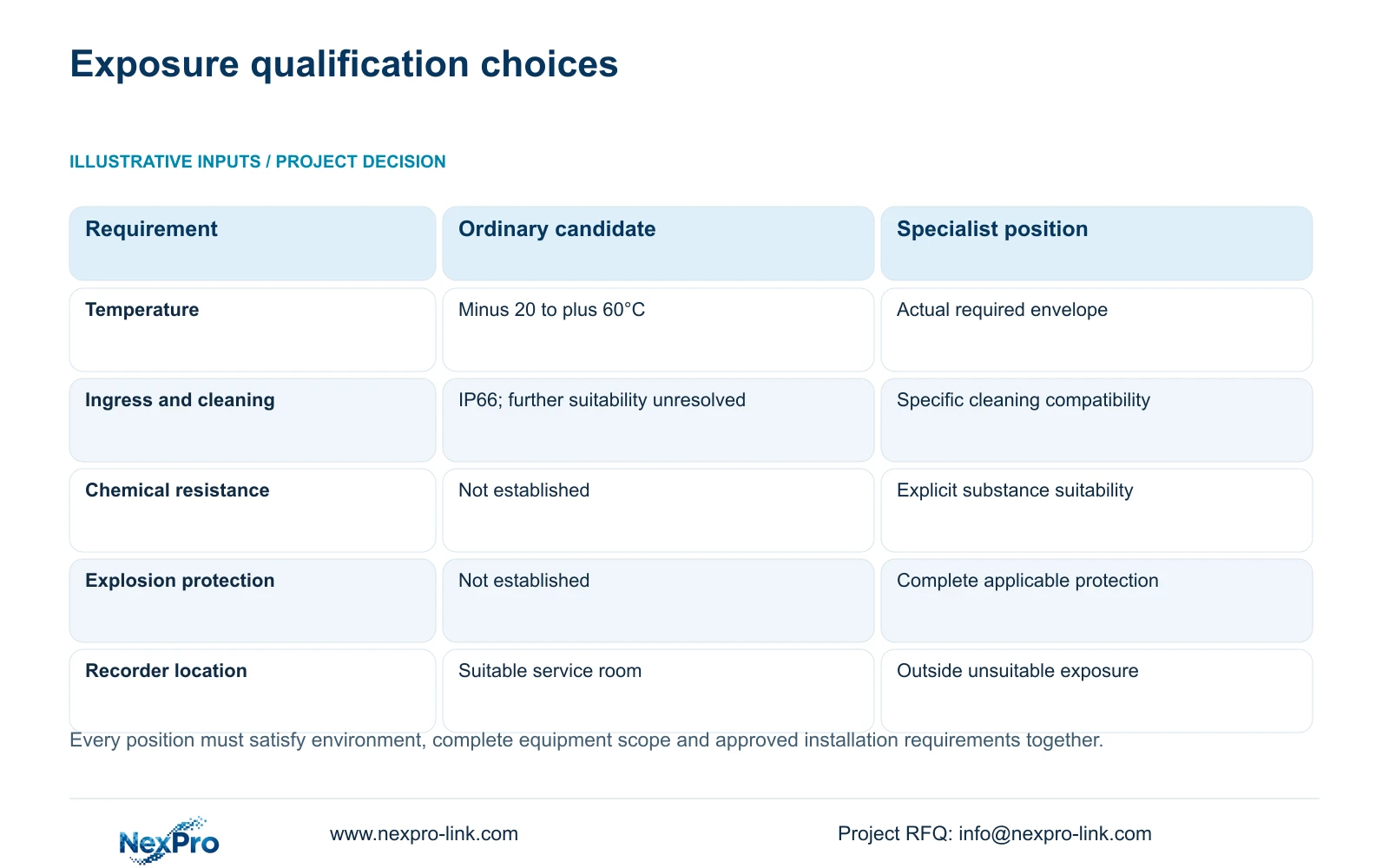
Qualification requires location conditions AND complete product scope AND approved installation requirements to fit. Apply that conjunction to every position. The ordinary NexPro-BL2812M55-5MP-DIC-AI and NexPro-DM2812M55-5MP-DIC-AI source fields list IP66 and minus 20 to plus 60°C. The comparison below shows what those fields support and what remains a separate requirement for the dyeing plant.
The decisive difference is the evidence required for acceptance. A dry, suitable approach can be assessed against an ordinary camera specification. A position exposed to cleaning chemicals, severe condensation or a classified environment needs explicit suitability for those conditions and its complete installation. An IP66 field, metal enclosure or PoE description supplies no missing chemical-resistance or explosion-protection evidence.
The AXIS P1468-XLE is a specialist reference with stated Zone2/22 and Division2 scopes on its official source. It demonstrates why specialist equipment has a distinct qualification boundary; it is not a recommendation for every dyeing position. Exact applicable documentation and installation scope still need review, and that reference does not establish compatibility with the plant's particular cleaning substances.
| Decision | Ordinary-location basis | Specialist-location basis |
|---|---|---|
| Temperature | Compare actual ambient with minus 20 to plus 60°C | Specify the actual required operating envelope |
| Moisture and cleaning | IP66 field; verify remaining exposure suitability | Document condensation, cleaning and material compatibility |
| Chemical exposure | No resistance established by the supplied ordinary PDF | Require explicit suitability for identified substances |
| Classified position | Explosion protection not established | Match complete applicable protection and installation |
| Recording room | Suitable accessible service room | Keep ordinary infrastructure outside unsuitable positions |
Section 05
Retain the required boundary in every alternative
Recommend ordinary access and warehouse cameras where complete suitability is established, with separately qualified equipment for positions that cannot meet that basis. This allows a useful security package without treating the entire dyeing plant as either universally ordinary or universally specialist. The owner can approve event coverage while the design team preserves the environmental boundary.
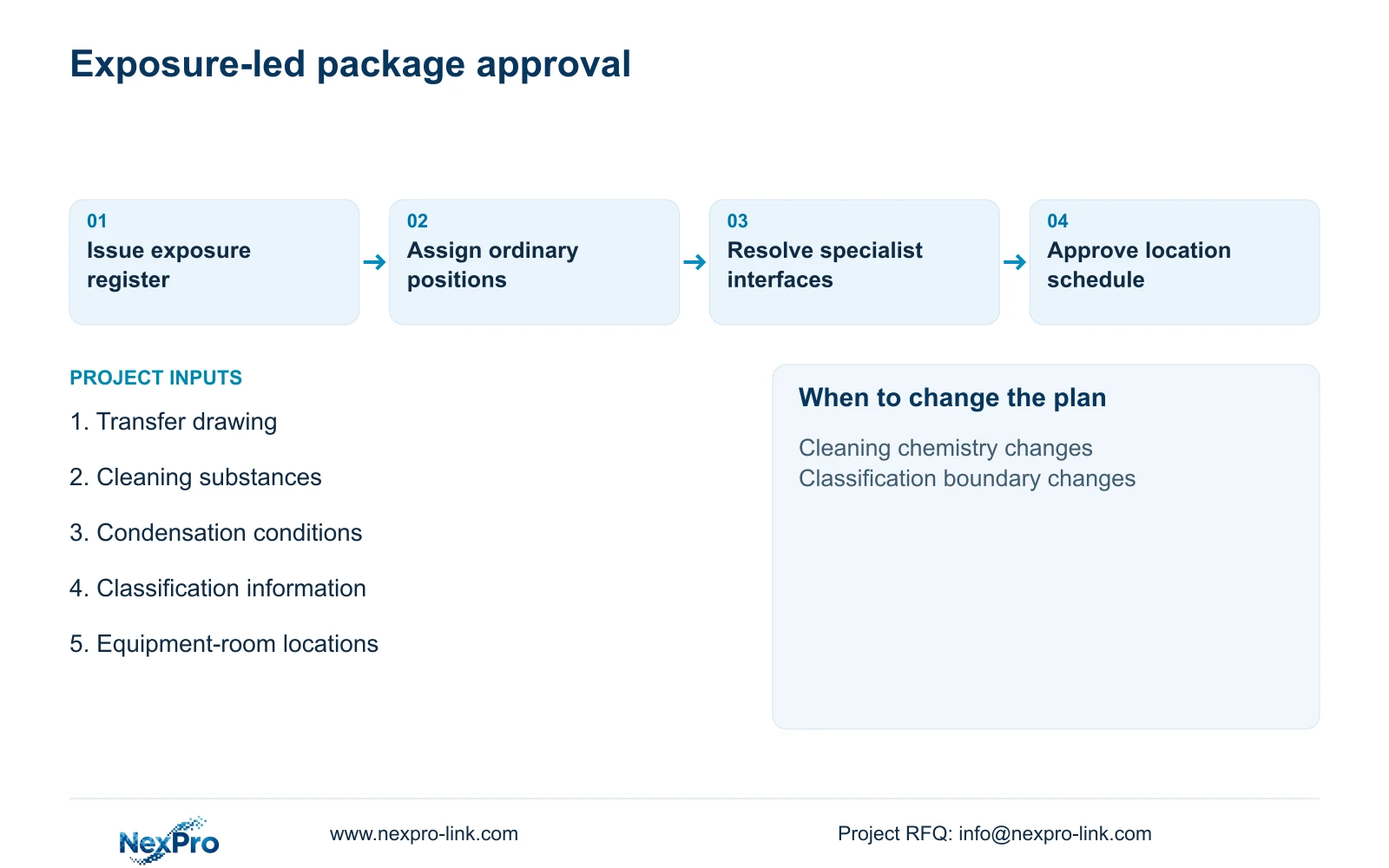
Change the proposed equipment or position when chemical use, cleaning methods, ambient conditions or classification changes. Moving a camera to a dry corridor is acceptable only if its required evidence remains obtainable and the new position is suitable. Show any lost interior visibility explicitly. Do not offer relocation as an equivalent when the owner requires a process-area event that the corridor view cannot capture.
For cost comparison, separate ordinary cameras, specialist assemblies, route-specific cabling and installation responsibilities. Match proposals from NexPro-Link and other suppliers to the same tasks and qualification requirements. Unknown specialist costs should remain identified quotation items. Removing protective scope from one bid would make its total incomparable, regardless of the ordinary camera price.
Section 06
Issue exposure decisions with the equipment schedule
Release the camera map with a service-access arrangement and an exposure register tied to position IDs. Mark ordinary supplied positions, any retained suitable equipment, unresolved specialist positions and optional additional views. Include target lighting, cleaning access, recording node and the local team's approval responsibility. Each quotation should reference the same register revision so a later clarification cannot be mistaken for an approved substitution.
NexPro-Link's BOQ & Tender Support scope can support model matching, technical submittals and explicit deviations for the ordinary package. Its Factory & Warehouse project supply scope covers related equipment coordination and project inputs. Keep specialist qualification and local installation as named responsibilities. Where project packing is requested, label cartons to the approved location list without implying that packaging or branding changes equipment suitability.
Section 07
Buyer questions
Can procurement proceed while one chemical-area position remains unresolved? The confirmed ordinary-area package can be developed separately if its interfaces are clear. Keep the unresolved position excluded from ordinary approval, identify its responsible specialist and avoid ordering dependencies that assume a final configuration.
Does placing a camera inside an enclosure qualify it? An unspecified enclosure provides no complete qualification. Review the camera, enclosure, connections and installation as the actual proposed configuration against the position's requirements.
Should video establish batch identity between buildings? Use the site's material records for identity and connect them to location and time references in the recording workflow. Automatic batch-data integration is a separate interface requiring specification and verification.
Section 08
Separate your ordinary and specialist positions
Send the material-transfer drawing, position-specific moisture and cleaning conditions, substance and classification information from your site specialists, and suitable equipment-room locations to info@nexpro-link.com for an ordinary-area package and interface discussion.
Engineering references
These sources support the general planning principles. Always use the selected product's current datasheet and applicable project standards for final design.