Recheck footage access when a formulation trial changes the scene or temporary reviewers change roles. Existing dispatch permission does not authorize newly visible recipes or an exported copy.
Section 01
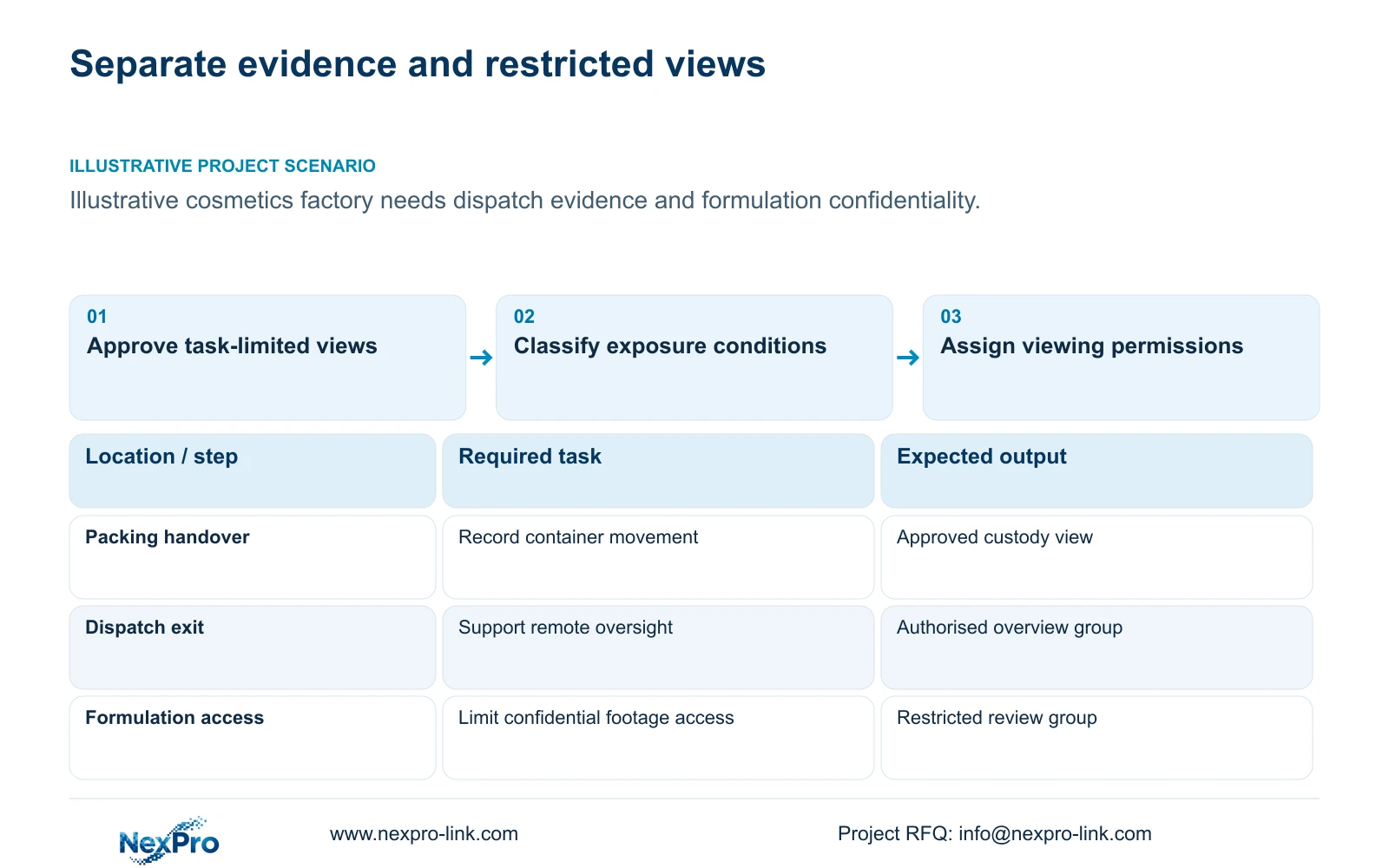
Limit each view to its approved operational task
When a cosmetics formulation trial changes what a camera can see or who needs access, recheck the view and permissions before extending an existing dispatch workflow. Identify newly visible recipe information, approve the temporary review role and define what happens to exported copies. Verify the controls on the actual platform. This is a change-review method: it does not assume that low-bitrate viewing, masking or an account name protects formulation information.
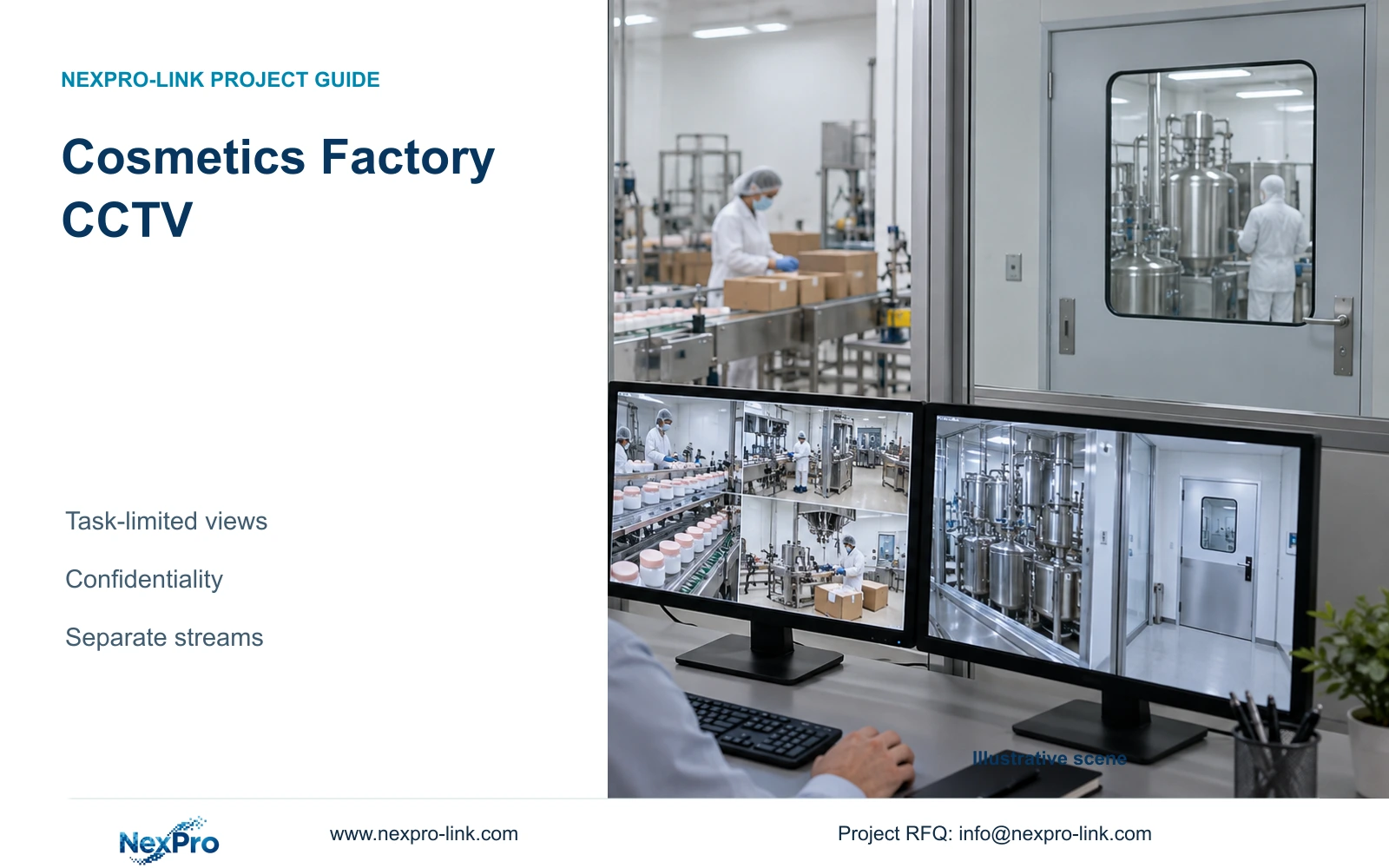
Illustrative project scenario: A cosmetics factory needs dispatch evidence without exposing formulation details through remote viewing. Assume the owner permits remote oversight of packing and dispatch but restricts formulation-area footage to designated local reviewers. These are proposed planning roles, not established device features or a completed project. The design engineer must turn that distinction into view boundaries and a testable permissions schedule.
Mark the handover surfaces, container routes and dispatch exits that support the security question. Note nearby recipe boards, screens or mixing activity that should remain outside general views. Where a wide camera includes both an authorised task and restricted detail, reconsider mounting and framing first. Any software masking proposed as an additional control needs its own verified behaviour in live view, recording and export.
Section 02
Assess solvent exposure and cleaning as separate inputs
Ask the process team for the applicable classification drawing and the environmental conditions at the proposed positions. A packing corridor, filling location and formulation room can have different constraints even within one building. Record temperature, condensation, chemical contact and cleaning method against each camera reference. Missing information should remain an open selection item rather than being replaced by a general industrial description.
The ordinary NexPro-BL2812M55-5MP-DIC-AI reference lists IP66, minus 20 to plus 60°C and a 2.8 to 12 mm motorized lens. Its listed 5MP-family output includes 2880×1620. Those fields can support selection at a suitable ordinary position. They do not demonstrate compatibility with cleaning chemicals, direct washdown or a hazardous location, so environmental acceptance remains independent of image and network acceptance.
If a proposed view crosses a specialist process boundary, examine whether an appropriately located external view still provides the required custody context. If it does not, retain separately specified specialist equipment and installation. Qualified designers determine that scope and verify current local requirements. Moving the lens farther away is only an observation alternative when the mounting location and the resulting image both remain acceptable.
Section 03
Control temporary formulation-review access
Develop a camera-group permission schedule for dispatch operators, formulation reviewers and system administrators. Define live viewing, playback and export independently for each group. The proposed remote dispatch role should not gain restricted footage through a saved layout, alternate client or export menu. Test those routes on the exact supplied hardware and client versions rather than relying on a broad compatibility description.
NexPro-Link's Seetong System page provides app and PC-client context, but it does not establish every permission or mixed-brand workflow required here. Ask the supplier to demonstrate the approved tasks and identify functional deviations. If a shared recorder or client cannot maintain the required separation, consider a separately authorised architecture and include its equipment and administration effort in the comparison.
Keep confidential recipes and production credentials out of supplier preparation files. A camera identifier such as packing exit or dispatch lane is usually enough for project mapping. The owner retains responsibility for approving who receives footage and how exported copies are handled. Security video remains separate from process control, safety trips and validated production records, even when authorised personnel use it to review an event.
Treat a moved recipe board or trial layout as a scene change even if the camera has not moved. Record who authorizes access, which footage and actions the role needs, and when that permission must be reconsidered. After the trial, check retained exports separately from the live account; revoking an account does not remove copies already released. If the supplied platform cannot enforce the approved separation, retain the limitation and revise the architecture or process.
| Condition / stage | Required input | Decision and evidence |
|---|---|---|
| Trial scene changes | Newly visible confidential detail | Reframe or verify an approved control |
| Temporary review role | Camera group, actions and authorization period | Demonstrate actual live/playback/export boundaries |
| Trial closes | Account status and released-copy register | Review access and copies independently |
Section 04
Size recording and remote viewing on their actual paths
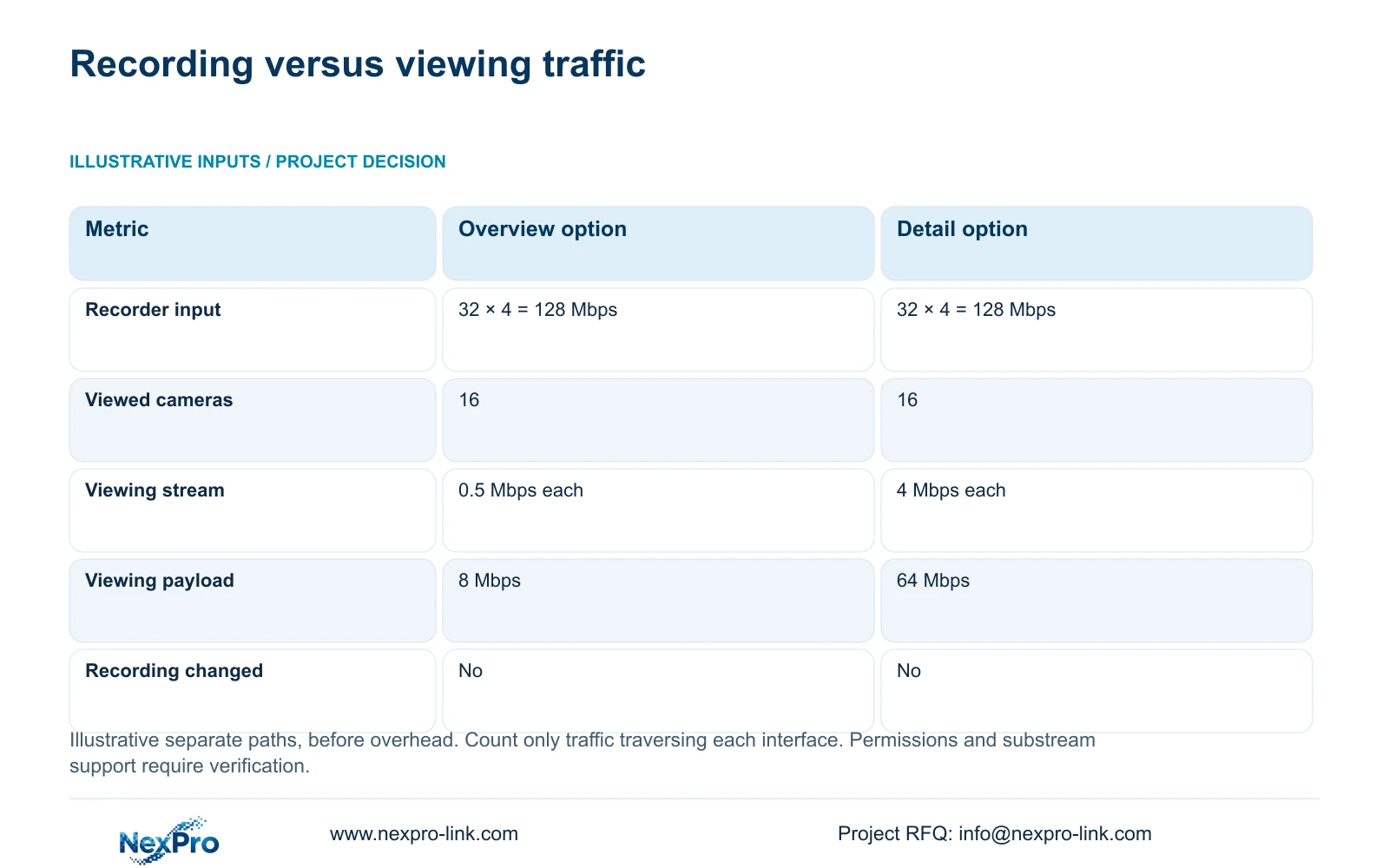
The illustrative network comparison assumes 32 local main streams at 4 Mbps each and 16 simultaneously viewed authorised cameras. Local recorder demand is recorder_Mbps = 32 × 4 = 128 Mbps in both options. For the separate remote overview, viewing_Mbps = 16 × 0.5 = 8 Mbps. For the detail-viewing comparison, viewing_Mbps = 16 × 4 = 64 Mbps. These are payload estimates before protocol overhead.
The decisive difference is the stream selected for viewing. The local recording stream remains unchanged, preserving the agreed evidence basis while the operator uses a lower-bandwidth overview where it is adequate. Low bitrate does not enforce confidentiality: the same forbidden scene can still be exposed through an overview stream. Apply the permissions decision first, then choose the stream quality needed by that authorised role.
Count traffic interface by interface. Add playback, exports and other traffic only where they actually traverse the link being sized. A camera access link does not automatically carry the total recorder demand, and a WAN link does not necessarily carry every local recording stream. Verify substream support, concurrent client behaviour and the actual connection quality; the calculation does not guarantee WAN performance.
| Metric | Remote overview | Remote detail |
|---|---|---|
| Local recorder input | 128 Mbps | 128 Mbps |
| Concurrent viewed cameras | 16 | 16 |
| Viewing stream per camera | 0.5 Mbps | 4 Mbps |
| Remote viewing payload | 8 Mbps | 64 Mbps |
| Local recording changed | No | No |
Section 05
Choose a viewing workflow that preserves the evidence
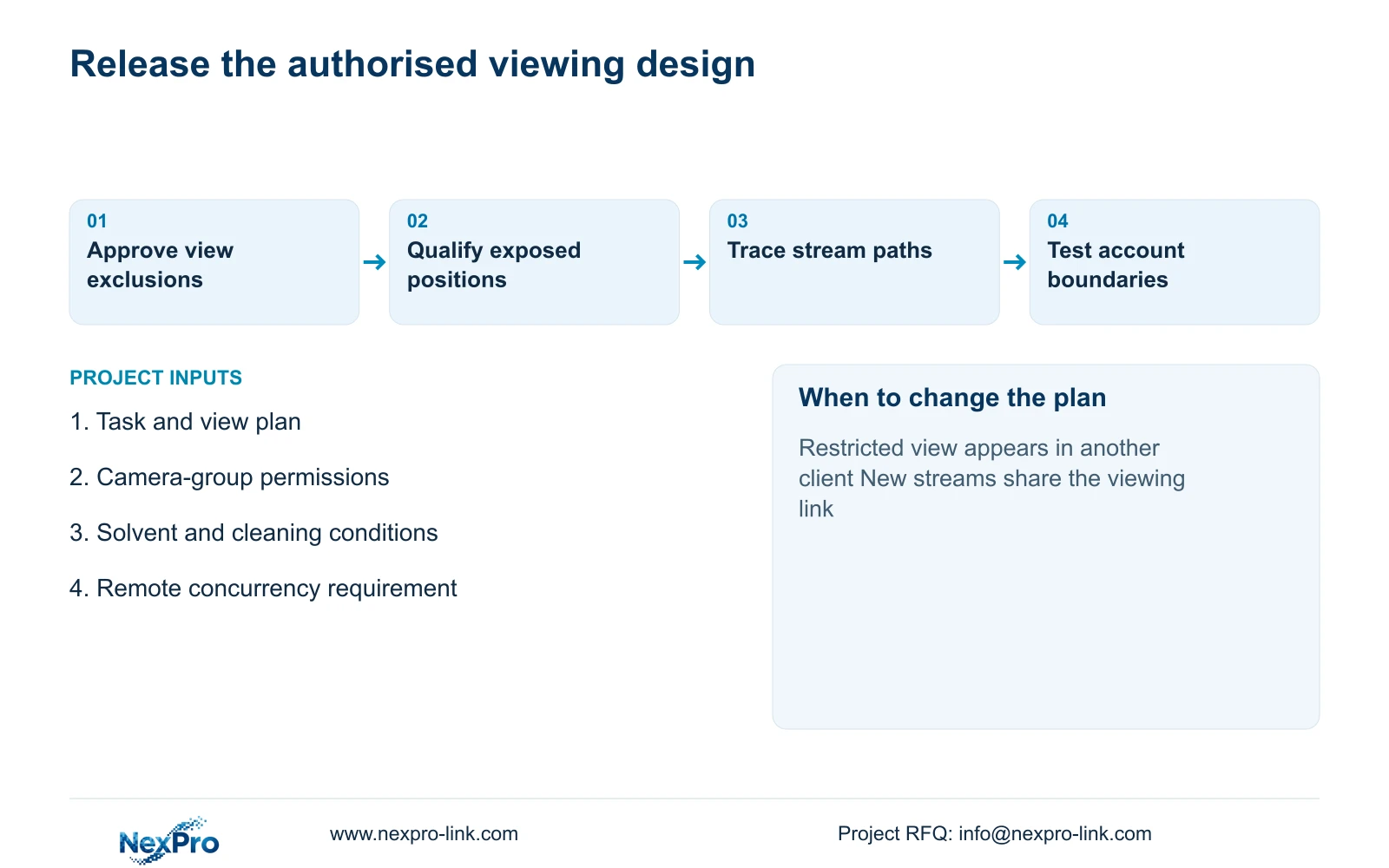
Recommend task-limited camera coverage, verified account separation and a remote overview workflow for authorised dispatch tasks. Provide an approved route to detail playback when the reviewer needs it. Change that recommendation if the operator must resolve fine detail continuously, if the lower-quality stream fails the accepted task, or if the proposed platform cannot enforce the restricted camera boundary.
NexPro-NVR4449-4K offers a recording capacity reference with 320 Mbps input, four SATA bays up to 18 TB per drive and published modes distinguishing 49×5MP from 9×4K. The illustrative 128 Mbps input is below the stated input field, but stream modes, playback and client concurrency still need confirmation. Input capacity does not prove the required remote layouts, permissions or simultaneous decode performance.
The supplied reference case has 40 streams, including 32 ordinary and eight specialist positions, at 160 Mbps aggregate input. Its full-system number must remain separate from this 32-stream comparison. Use that case to check ordinary/specialist supply boundaries and suitable rack locations. If eight specialist streams are later added, revise the actual link, storage and power schedules instead of continuing to display the old 128 Mbps total.
Section 06
Make confidentiality part of the equipment release
The supply schedule should show permitted fields of view, camera-group access and the stream used for each operator task. Include selected equipment, retained infrastructure, optional integration and local specialist installation as separate responsibilities. NexPro-Link can support model matching and technical submittals, while the owner approves the confidentiality boundary and the local project team confirms installation conditions.
Coordinate the access-switch PoE budget with confirmed device demand, and protect the necessary recorder, switching and communication equipment on their actual backup circuits. Trace copper routes, backbone transitions and specialist entries on the drawing. A normal retrieval monitor can meet the review task; any LCD wall or other display option needs a separate operating reason and does not change the confidentiality rules.
Before shipment approval, demonstrate an authorised dispatch account and a restricted formulation account using representative views. Check live layouts, playback and export, then record any unsupported control. At site acceptance, repeat the test after final framing and account configuration. Changes to formulation-room use, remote roles or shared-link traffic should trigger a focused revision of the affected scope.
Section 07
Buyer questions
Does a lower-bitrate stream protect confidential information? No. It changes viewing demand and potentially visible detail, but it is not an access-control policy. Exclude restricted cameras or use a separately approved, verified control.
Can the local recording remain detailed when remote viewing is limited? That is the proposed design objective. Verify that the chosen devices and client can use the intended viewing stream without changing the configured local recording stream.
When should formulation cameras use a separate architecture? Consider it when the selected platform cannot enforce the owner's camera-group and export boundaries. Compare the additional administration and infrastructure against the required confidentiality task.
Section 08
Define confidential and general viewing scopes
Send the task/view plan, camera-group permissions, classification and cleaning schedule, and remote viewing requirement to info@nexpro-link.com to discuss a cosmetics factory package.
Engineering references
These sources support the general planning principles. Always use the selected product's current datasheet and applicable project standards for final design.