An external camera may simplify maintenance in a controlled manufacturing space, but glass and sightlines can defeat the required view. Compare image acceptance and facility access rules before choosing the mounting side.
Section 01
Choose the mounting side by the required evidence
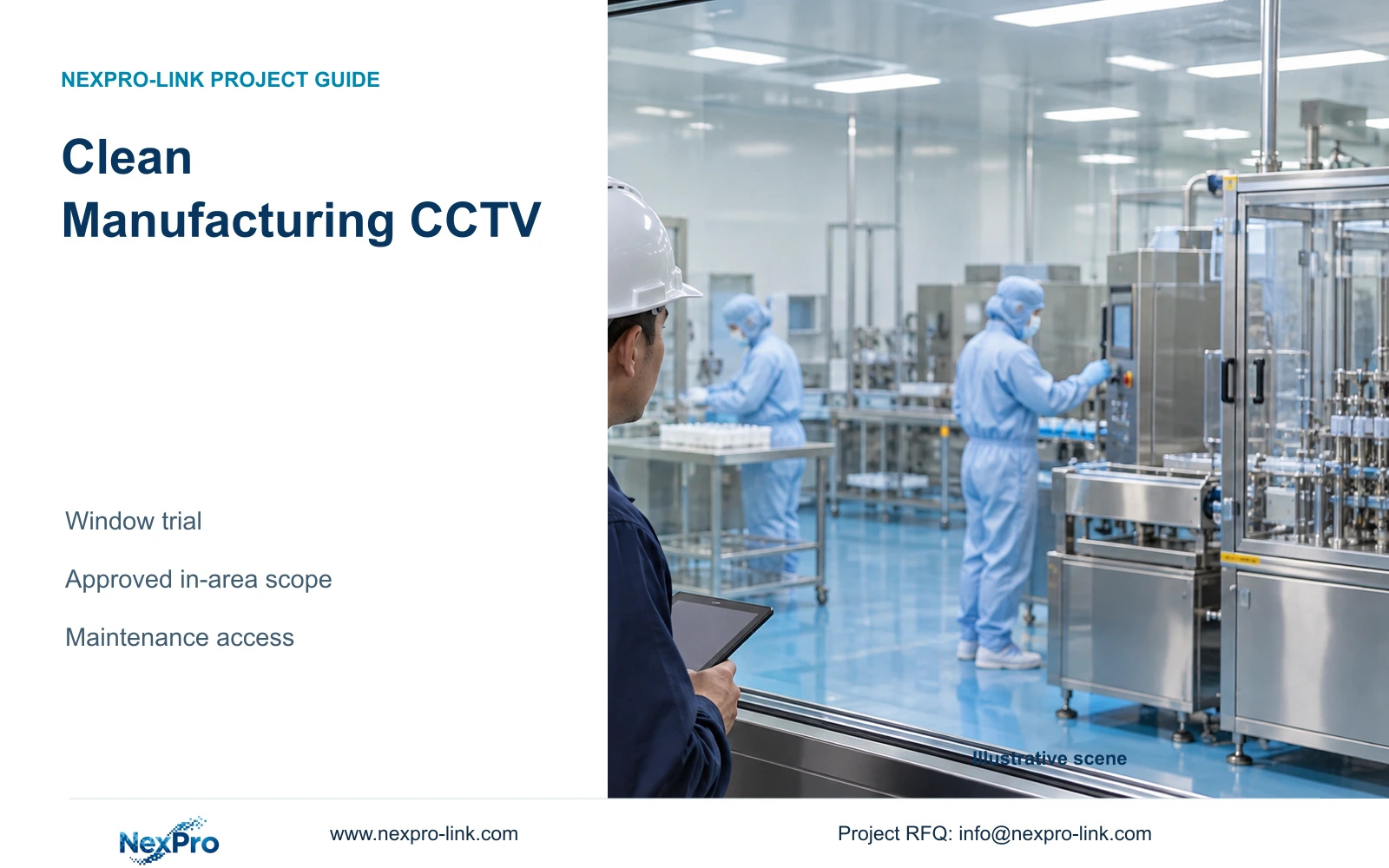
Clean manufacturing CCTV should use an external window view when it meets the agreed evidence task and the mounting location is suitable. Choose approved in-area equipment when the external view cannot provide that evidence and the facility accepts the complete installation. An outside position may simplify servicing, but it can introduce reflections and obstruction. Compare the actual task and facility rules before assigning a camera count.
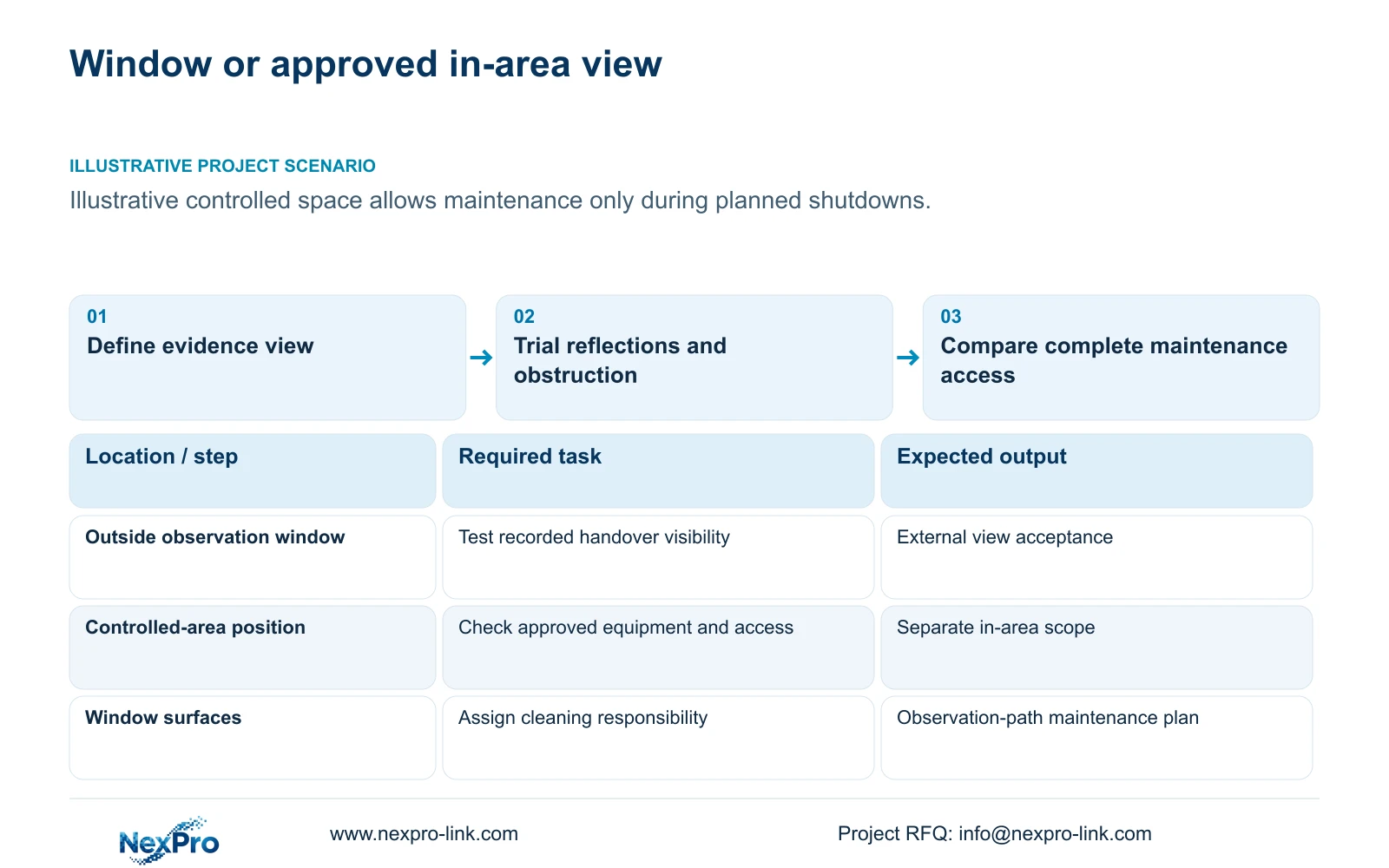
Illustrative project scenario: A controlled manufacturing space permits maintenance only during planned shutdowns. Assume an observation window offers a possible external view of a transfer point, while an in-area position could provide a closer angle. These are planning alternatives, not a cleanroom-qualified product claim or an installed client case. The project manager needs an accepted view and a realistic maintenance arrangement for either choice.
Define whether the task is movement overview, custody handover or a specific visible detail. Mark the target plane, obstructions and excluded process information. Confirm classification, temperature, cleaning exposure and access restrictions at the proposed mounting location. An ordinary camera outside the space still needs qualification for its own environment, and an in-area camera needs the facility's independently accepted equipment and installation basis.
Section 02
Test reflections under the operating lighting
A window-view trial should use representative lighting on both sides of the glass. Check normal operation, darker periods and cleaning-related conditions relevant to the owner. Record the proposed framing rather than judging only a live image viewed from a convenient angle. Reflection, window frames and equipment movement may obscure the target at the moment that matters.
Inspect any camera illumination that could reflect from the window before relying on it. Adjustments to position, angle or permitted lighting may help, but the actual result needs confirmation. Do not promise a through-glass performance level from an IP rating, motorized lens or larger resolution label. If the window is frequently covered, fogged or outside the maintenance team's control, include that availability constraint in the option comparison.
The external option's service benefit is also specific. A technician may access the camera without entering the controlled space, while cleaning the inner window surface may still require planned access. Assign responsibility for both sides of the observation path. A view that depends on an inaccessible surface can inherit the same maintenance delay that the external mounting was meant to avoid.
Section 03
Compare the complete maintenance and contamination scope
For the external option, identify the camera mount, cable route, window cleaning responsibility and service access. For the in-area option, ask the facility team to define accepted materials, cleaning conditions, penetrations and maintenance procedures. Keep those requirements attached to the equipment line so procurement compares complete workable arrangements rather than just two camera prices.
The ordinary NexPro-DM2812M55-5MP-DIC-AI reference lists Dome-family 2880×1620 output, 25fps and a 2.8 to 12 mm motorized lens. Its IP66 and minus 20 to plus 60°C fields do not establish cleanroom, contamination-control or cleaning-agent suitability. It can be discussed as an ordinary-location candidate where the actual conditions fit, while any in-area specialist requirement remains independently specified.
Have the owner identify the consequence of waiting until the next shutdown to service a failed camera or obstructed view. That may justify another view, a different mounting position or a changed maintenance plan, but no failure rate or downtime saving is supplied here. Keep CCTV's security purpose separate from validated process recording and safety functions. Facility and local requirements need current project-specific review.
Section 04
Balance detail width against the movement context
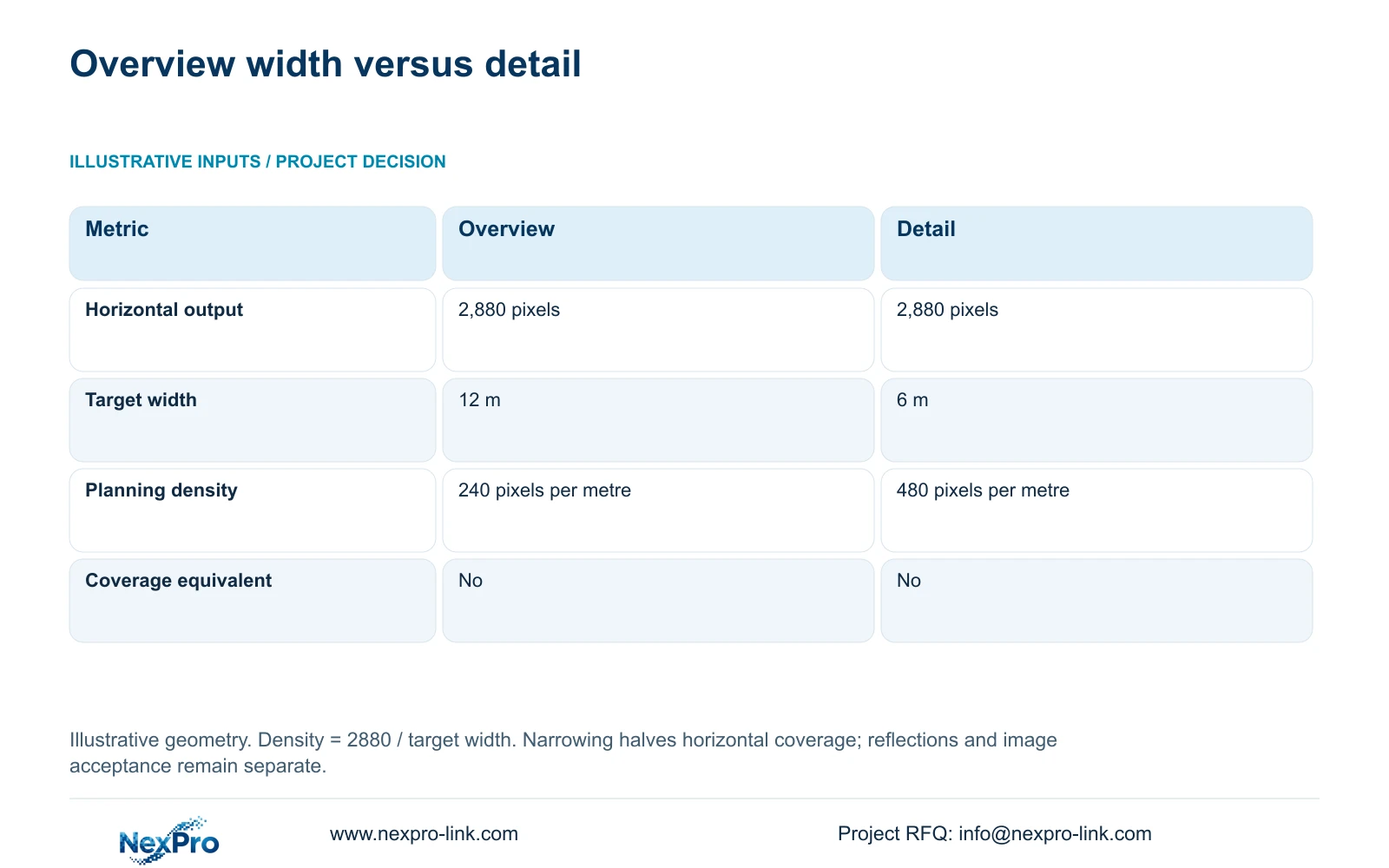
The illustrative coverage comparison holds horizontal output at 2,880 pixels. Option A covers 12 m at the target plane; option B covers 6 m. Planning pixels per metre = horizontal output pixels / target width in metres. The results are 2880 / 12 = 240 pixels per metre and 2880 / 6 = 480 pixels per metre. These widths are assumed geometry, not guaranteed fields of view for a listed lens setting.
Narrowing the view doubles this planning density while removing half the horizontal coverage. That is the decisive trade-off. It does not establish that one narrower camera can replace the overview when the wider movement sequence remains necessary. Preserve a separate overview if the reviewer must connect departure, approach and handover beyond the six-metre detail region.
The same arithmetic can inform either side of the window, but it does not choose that side. Glass reflections, lens geometry, motion, exposure, compression and obscuration remain independent acceptance inputs. No universal recognition threshold is assigned to 240 or 480 pixels per metre. Use the figures to plan a trial, then assess whether the recorded view actually answers the owner-approved question.
| Metric | Overview view | Dedicated detail view |
|---|---|---|
| Horizontal output | 2,880 pixels | 2,880 pixels |
| Target-plane width | 12 m | 6 m |
| Planning density | 240 pixels per metre | 480 pixels per metre |
| Horizontal coverage | Full example width | Half example width |
| Equivalent coverage | No | No |
Section 05
Select the accepted view and preserve its dependencies
Prefer the external option when representative recorded footage meets the task and both the camera and window can be maintained under the accepted plan. Choose an approved in-area arrangement when reflections, angle or obstruction prevent acceptance outside. A mixed design can retain external overview and separately approved detail where both tasks are necessary. The decision should follow evidence and service access, without arbitrary option scores.
The supplied reference case separates 32 ordinary positions from eight specialist positions. Use that distinction to organise this project's mounting choices, without assuming eight in-area cameras are required. Its ordinary recorder, switching and batteries belong in suitable service locations. Specialist field requirements do not automatically require moving the entire recording rack into the controlled space.
Keep the complete evidence path available. Camera data reaches the selected access network and recorder, while an authorised workstation provides retrieval. Backup power should cover the actual camera supply, switching, recorder and necessary links. Cable penetrations, route testing and facility access are separate installation items. An optional display wall does not solve a failed window view or make an in-area product acceptable.
Section 06
Release equipment after view and facility acceptance
The RFQ should ask suppliers to address the external and in-area candidates against the same required observation. Include the window geometry, representative lighting conditions, target width and service restrictions. Separate environmental or facility approval from camera-image acceptance, since a candidate may satisfy one and fail the other. Identify unresolved penetrations or cleaning compatibility before the quotation becomes an order.
NexPro-Link can discuss suitable ordinary camera candidates, model matching and technical documentation through its BOQ support scope. Local facility personnel approve controlled-area equipment and installation responsibilities. Compare complete quotations with the same maintenance, cabling and recording tasks. Retain any mandatory platform or specialist requirement instead of dropping it from an alternative to lower the equipment subtotal.
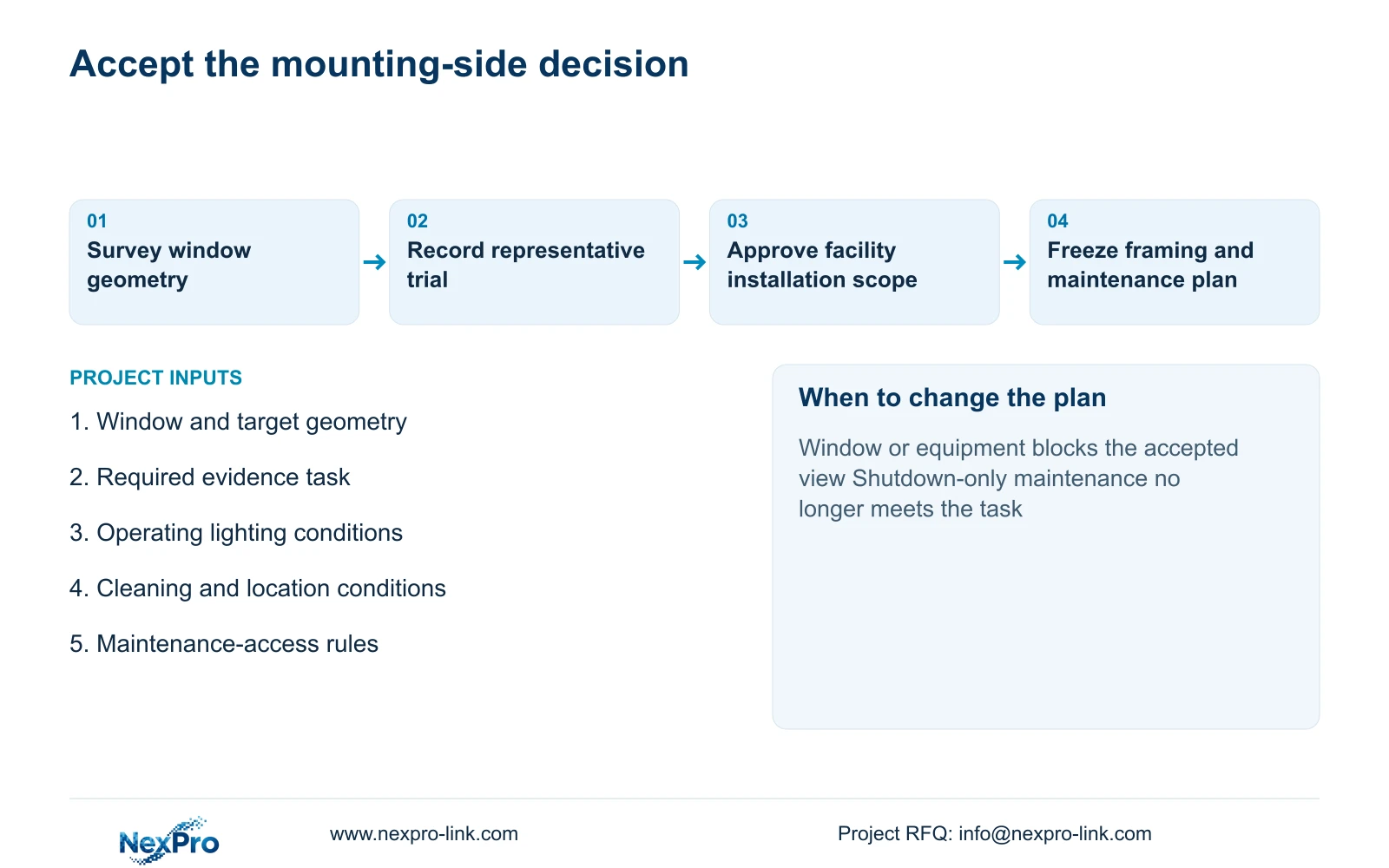
Before volume release, document the accepted framing and recorded sample for the chosen mounting side. At site handover, verify that final lighting, equipment positions and permissions match the approved test. Reopen the view decision if the window changes, new machinery blocks the target or the maintenance interval becomes unacceptable. Project packing and location labels should follow the accepted schedule, with no claim that preparation substitutes for facility approval.
Section 07
Buyer questions
Does an outside camera remove all controlled-area maintenance? No. The inner window surface or an obstruction may still require controlled access. Include responsibility and access for the complete observation path in the maintenance plan.
Can an IP66 camera be approved for a clean manufacturing space from that rating alone? No. The facility must assess its actual material, cleaning, installation and environmental requirements. The ingress field does not establish contamination-control suitability.
What should be retained from a successful window-view trial? Keep the recorded sample, mounting and framing references, target geometry, lighting conditions and stated exclusions. They form a useful comparison basis when the final installation is checked.
Section 08
Compare window and in-area observation
Send the window/target geometry, required evidence task, cleaning and location conditions, and maintenance-access rules to info@nexpro-link.com to discuss the appropriate ordinary and specialist supply split.
Engineering references
These sources support the general planning principles. Always use the selected product's current datasheet and applicable project standards for final design.