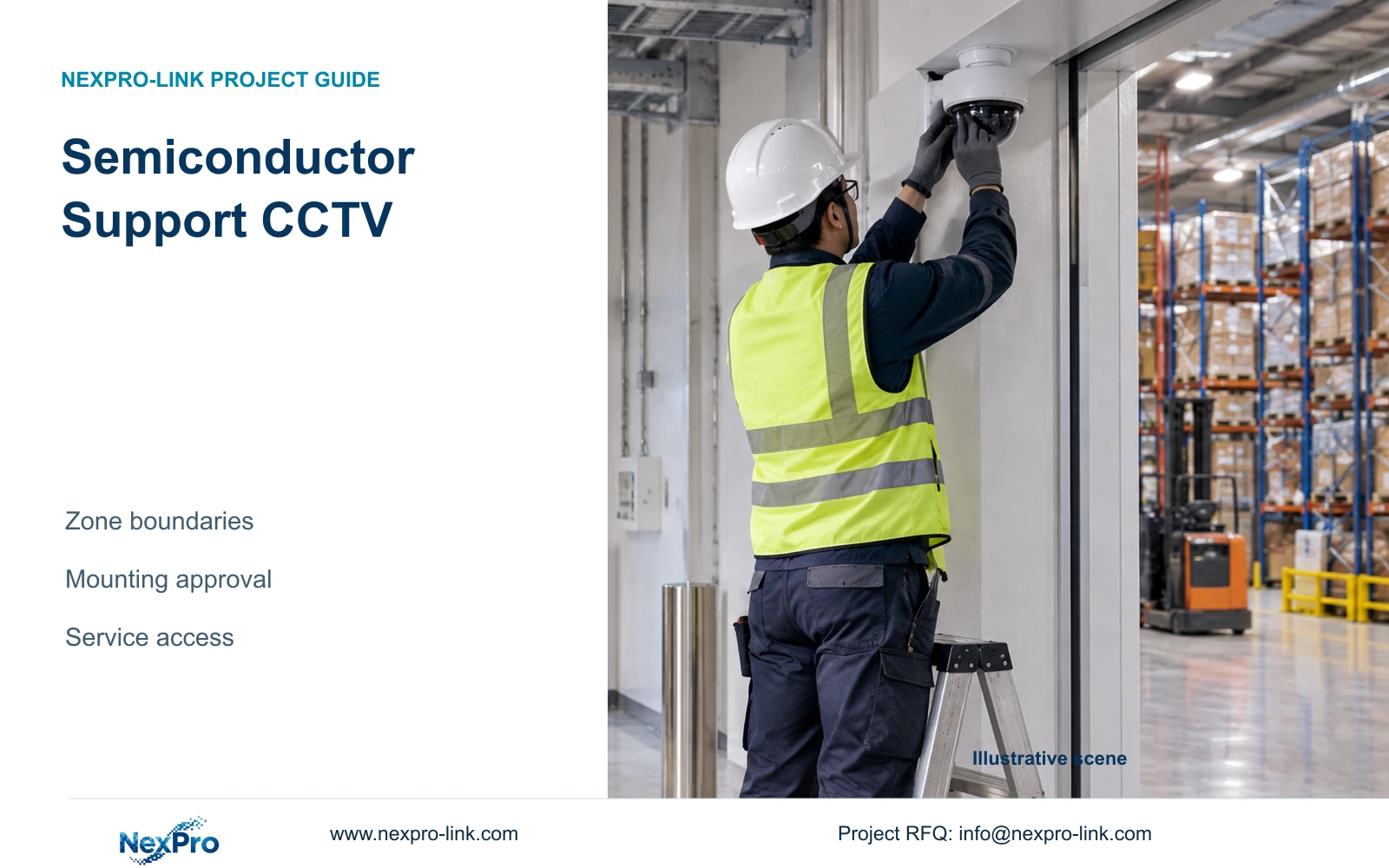
A semiconductor support building can use ordinary security cameras in suitable locations, but every controlled boundary needs its own mounting, material and maintenance decision.
Section 01
Classify each camera location before selecting equipment
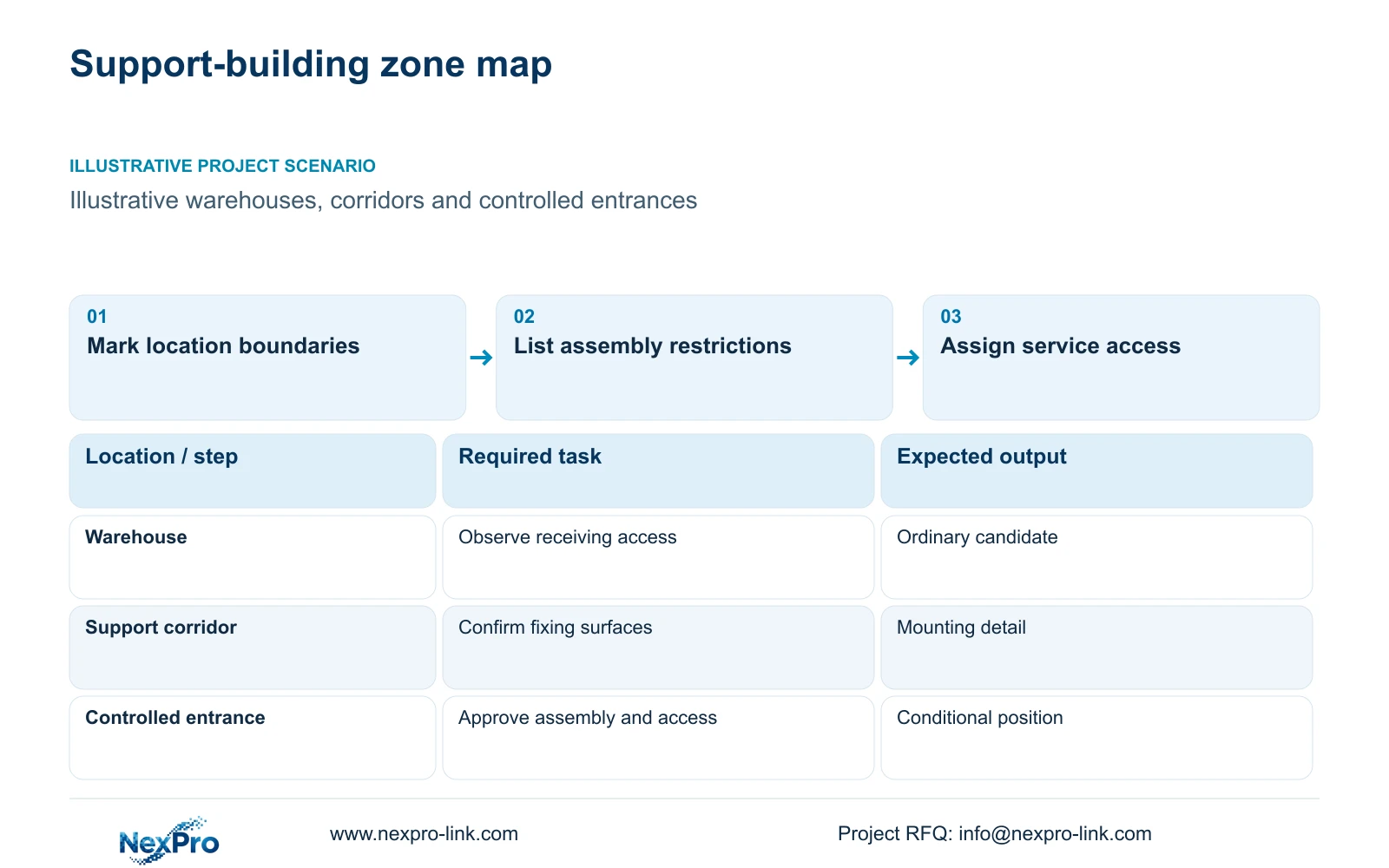
Semiconductor support buildings CCTV should be selected by the conditions at each installed position. Treat cleanliness, contamination controls and installation permissions as separate location requirements. An ordinary indoor housing does not establish cleanroom compatibility. Start with a drawing that distinguishes warehouse space, support corridors, controlled entrances and any position requiring specialist assessment, then attach the intended security task to each camera.
Illustrative project scenario: A semiconductor site needs CCTV in warehouses, support corridors and selected controlled entrances. Assume the warehouse provides ordinary receiving and storage functions, while some entrances lead to spaces with additional facility controls. No room classification or installation permission is established by this example. The engineer must obtain those inputs from the site before treating a candidate as suitable.
Map the camera body, bracket, cable entry and maintenance approach, not just the viewing direction. A camera outside a controlled room may still require a penetration or service activity affecting that room. Assign a status of ordinary candidate, conditional pending facility approval or specialist requirement. This prevents an unresolved location from appearing as an approved quantity in the BOQ.
Section 02
Obtain restrictions for the complete installed assembly
Ask facilities for permitted mounting surfaces, enclosure materials, cleaning methods and access procedures at each controlled entrance. Request the relevant conditions rather than assuming all support corridors share one specification. A wall bracket, ceiling fixing and cable gland can create different approval questions even when they carry the same camera. The local designer should turn these inputs into an installation detail.
An ordinary-location baseline can place the camera on an approved corridor surface with service access from the ordinary side. A conditional alternative may relocate it outside the boundary and revise the view. If that move loses the required doorway transfer, retain a specialist-position requirement. Relocation is useful only when it preserves the accepted observation.
Record who approves the materials and who supplies them. A camera offer may exclude the bracket, penetration treatment or enclosure demanded by the facility. Leaving those items unassigned creates a gap between equipment approval and installation readiness. Require a response for every restriction, with supporting product information or a clearly stated deviation.
Section 03
Keep routine service in suitable accessible spaces
Place recorders, switches and backup batteries in suitable service rooms wherever the layout allows. Identify the route for disk replacement, switch inspection and camera cleaning before choosing the rack position. Access convenience must be checked against cable routes and the actual electrical supply. A distant rack that forces unsuitable links or unprotected remote equipment is not a complete solution.
CASE02 provides an illustrative 64-camera electronics support architecture with local PoE access groups, one recorder and two operator seats. It assumes ordinary-area camera roles and leaves cleanroom/ESD conditions separate. Use that separation as the planning pattern: camera data travels to recording and authorised clients, while UPS protection follows actual power circuits. The case does not approve semiconductor-room installation.
The maintenance schedule should identify which checks can occur from the ordinary side and which need a controlled access window. Label any removable camera assembly and preserve its accepted mounting detail for replacement. If a service task requires entry into a controlled space, include the responsible facility contact and access dependency in the handover documentation.
Section 04
Require all location conditions to fit
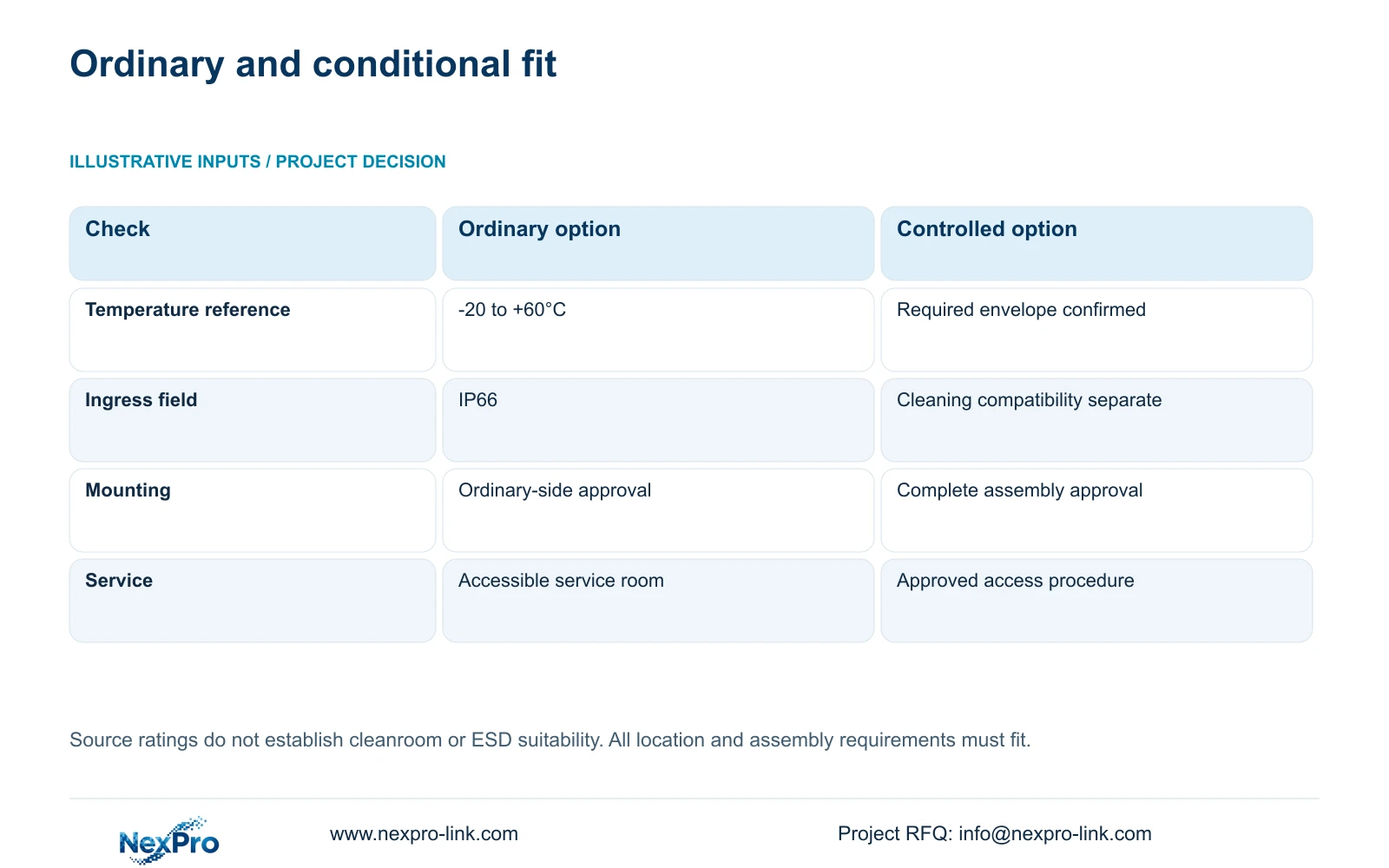
Qualification is conjunctive: location conditions AND complete product scope AND approved installation requirements must fit. Passing one field does not override another. The supplied ordinary 5MP BL2812M and DM2812M references list IP66 and an operating temperature field of -20 to +60°C. Those are source specifications; they do not answer every cleaning, contamination or material question.
The comparison below turns the method into purchasing decisions for the support-building scenario. The decisive difference at a controlled entrance is the additional approval of the installed assembly and service method. A specialist position remains conditional until its complete requirement is matched. There is no numerical score that can compensate for missing location evidence.
IP66, a metal enclosure or PoE does not establish explosion protection, chemical resistance, washdown compatibility or operation outside the documented temperature envelope. If a location introduces such conditions, obtain a separately qualified design and verify applicable local requirements through the responsible project specialists. No hazardous-area requirement is assumed for this hypothetical semiconductor site.
| Check | Ordinary support location | Controlled or specialist position |
|---|---|---|
| Temperature | Match documented -20 to +60°C field | Match actual required operating envelope |
| Cleaning | Confirm ordinary cleaning exposure | Approve method and material compatibility |
| Mounting | Approved ordinary-side fixing | Approved complete assembly and penetration |
| Protection scope | No specialist protection inferred | Retain required qualified product scope |
| Service | Accessible ordinary service room | Approved controlled access or external service |
Section 05
Price ordinary and conditional positions separately
Recommend an ordinary-room package for locations whose conditions are known to fit, alongside a conditional schedule for controlled or specialist positions. The NexPro-BL2812M55-5MP-DIC-AI and source Dome NexPro-DM2812M55-5MP-DIC-AI can be considered for suitable ordinary views. Preserve their listed 2880×1620 output and 2.8-12mm motorized lens fields when preparing a trial or submittal.
For the owner, this approach preserves receiving, corridor and access evidence without assuming every location is identical. For the engineer, it makes unresolved mounting and contamination inputs visible. The cost manager can distinguish ordinary equipment, specialist assemblies, local installation and controlled service access. Unknown items should remain explicit quotation dependencies rather than being treated as zero cost.
Change the ordinary option when the actual location cannot meet its installation or operating conditions, or when relocation cannot preserve the required event. Keep mandated platform integration and specialist protection in any brand comparison. A lower ordinary-camera price has little relevance if the alternative omits the assembly or service conditions required at that entrance.
Section 06
Issue a location schedule with approval ownership
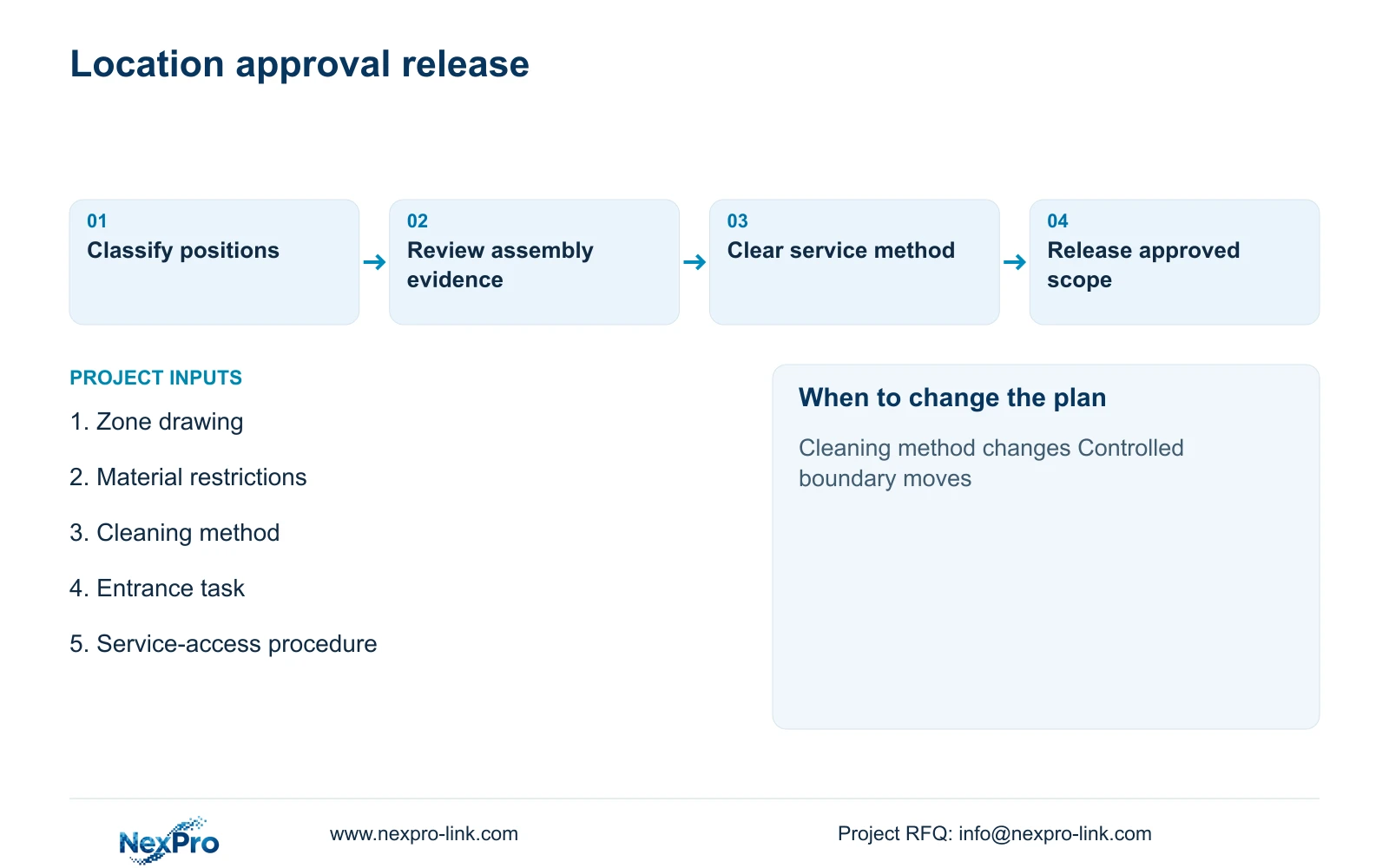
The project-ready schedule should connect each camera ID to its zone, observation, product candidate and installation approval. Add a reference to the facility restriction document and name the role responsible for clearing it. Separate supplied equipment, retained infrastructure, optional items and local contractor work. This allows procurement to release the ordinary package while unresolved positions remain controlled.
NexPro-Link's BOQ & Tender Support scope is relevant to model matching, technical documents and stated deviations. Its Factory & Warehouse project supply scope can support coordination of recording, cabling and protected equipment nodes. Neither scope replaces facility acceptance of controlled-space materials or the local designer's installation responsibility.
Before handover, review an entrance event from recorded footage and demonstrate the planned maintenance access. Confirm that the camera's physical position, cable route and approved drawing agree. Where the facility changes a cleaning method or room boundary, reopen the affected approval rather than retaining an old camera approval solely because the model number has not changed.
Section 07
Buyer questions
Can ordinary areas be procured while controlled positions remain unresolved? Yes, when the schedules and dependencies are separate. Release only positions with an accepted task and installation basis, and check whether shared cabling or rack decisions depend on the unresolved locations.
Would an added enclosure automatically make a camera suitable? No. Assess the complete assembly, its connections, service method and effect on the view against the actual facility requirement. An enclosure description alone does not establish the required suitability.
What should a replacement camera approval preserve? Preserve the accepted location conditions, mounting detail, materials, recording task and service access. A technically similar camera still needs review if its physical assembly or installation method changes.
Section 08
Separate your ordinary and controlled camera scope
Email your zone-marked layout, controlled-entrance tasks, mounting and cleaning restrictions, and service-access requirements to info@nexpro-link.com for a location-based equipment and submittal discussion.
Engineering references
These sources support the general planning principles. Always use the selected product's current datasheet and applicable project standards for final design.