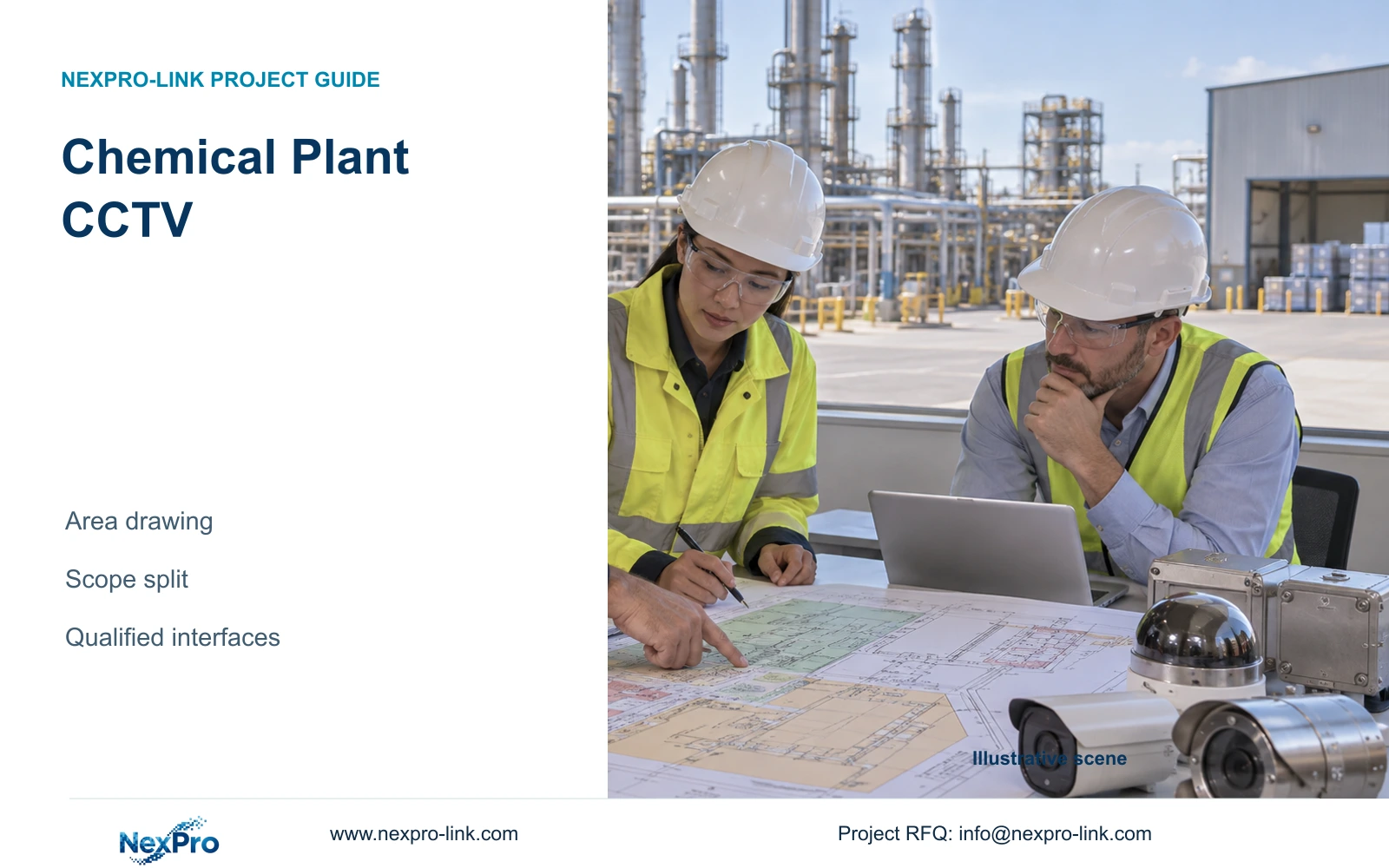
A chemical plant camera schedule needs a location decision before a model decision. Use the classification drawing to separate ordinary security equipment from specialist positions and their installation requirements.
Section 01
Separate camera locations before selecting equipment
Chemical plant CCTV should begin with the area-classification drawing and the actual conditions at each proposed mounting position. Separate ordinary security equipment from location-specific specialist equipment and installation. An office, warehouse or approach road is a task description; its name alone does not establish that ordinary equipment is suitable. Record the drawing revision, position reference, observation purpose and environmental inputs before assigning a camera model.
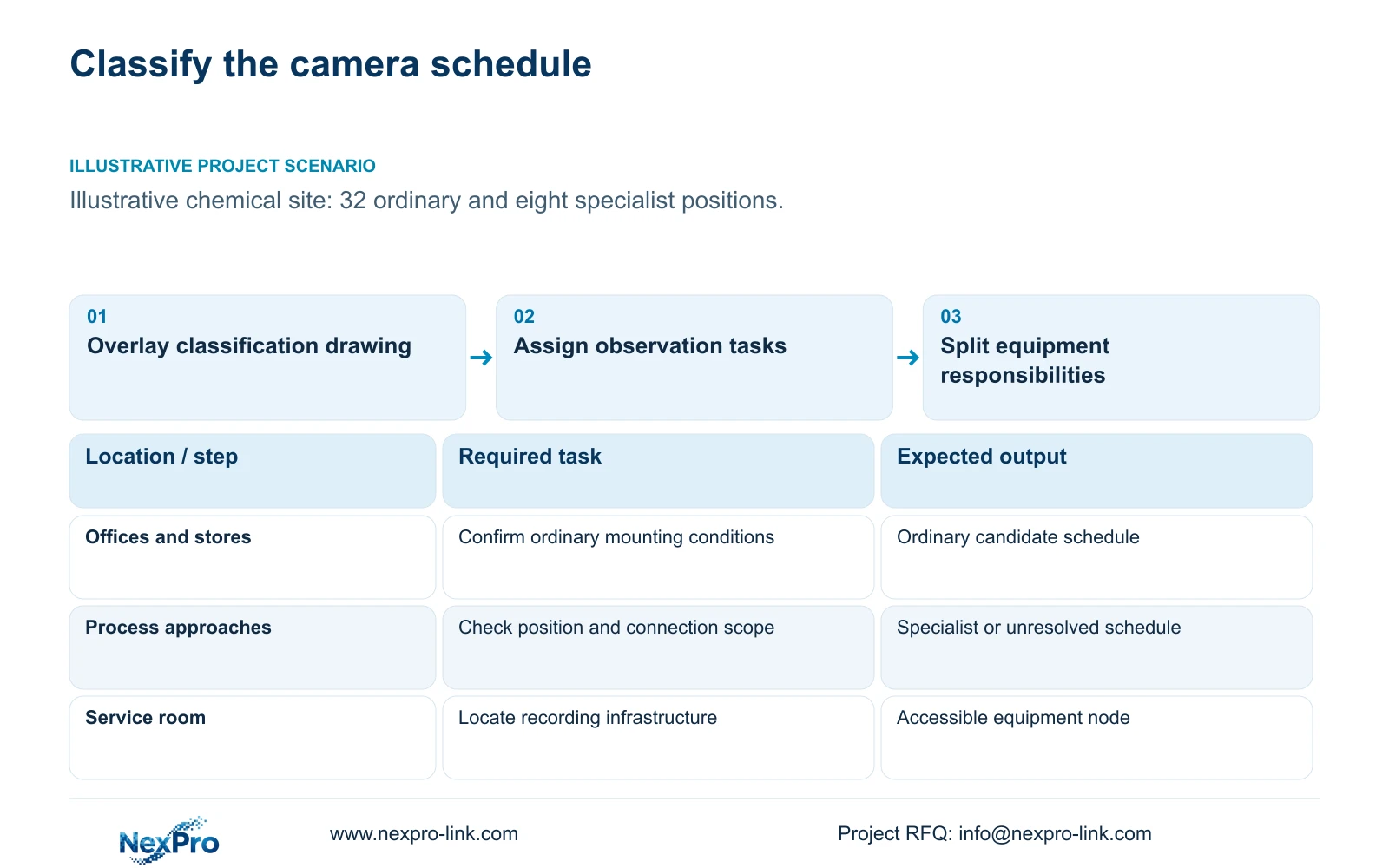
Illustrative project scenario: A chemical facility requests one camera quotation spanning offices, warehouses and process approaches. The supplied reference design assumes 32 ordinary positions and eight separately qualified specialist positions, making 40 cameras in total. Those quantities are a procurement planning example, not a classification assessment or completed client installation. The responsible designer must confirm which actual positions belong in each group.
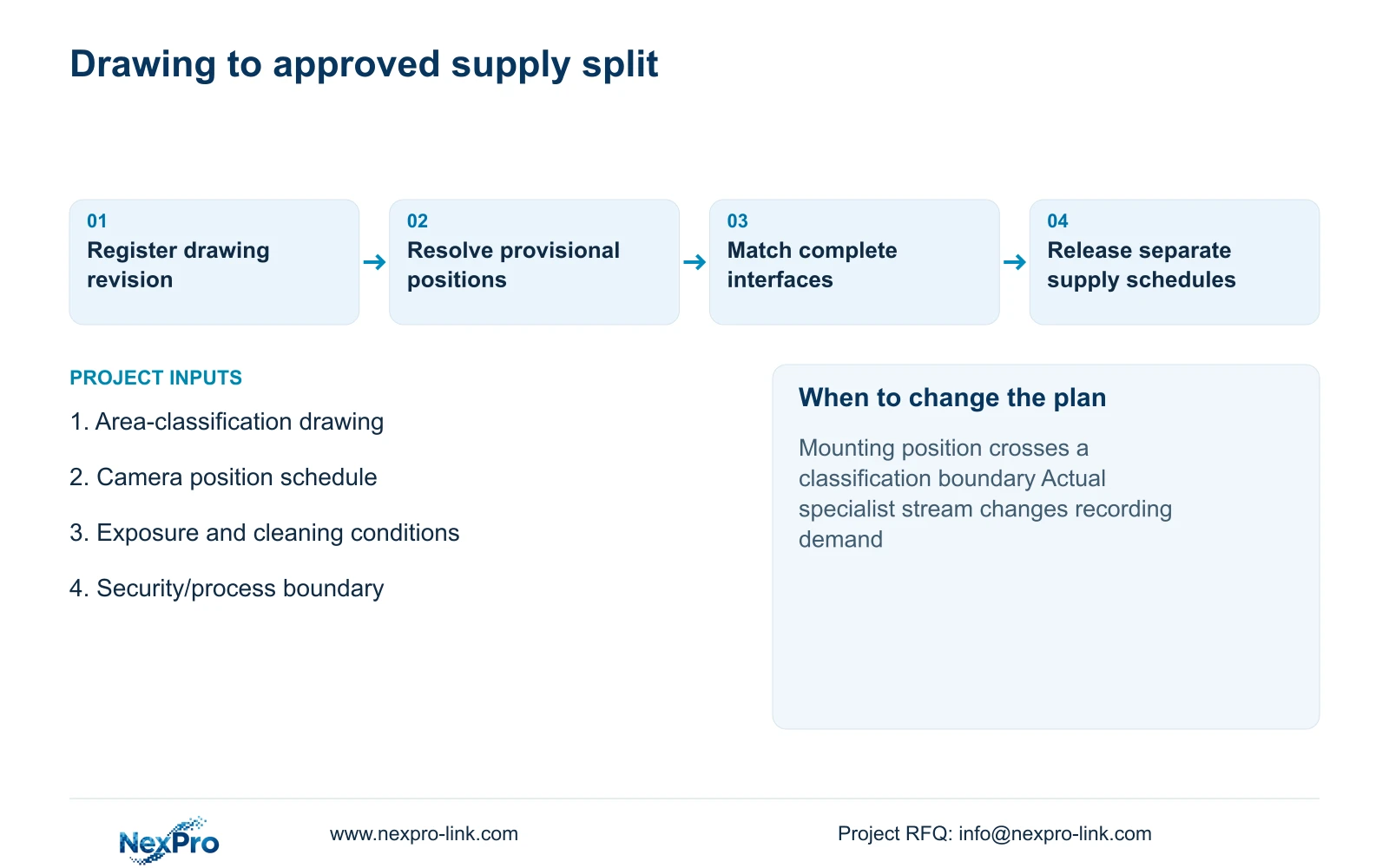
Place the camera schedule over the classification drawing rather than keeping the two documents in separate tender folders. Include the mounting location and relevant connection points, since a view aimed toward a process area may have equipment installed elsewhere. Where classification or exposure information is unresolved, mark the position provisional and identify who will resolve it. This prevents an assumed ordinary position from becoming an approved purchase through repetition.
Section 02
Specify the complete specialist installation
For each specialist position, translate the approved location information into a complete equipment requirement. Ask for the exact product variant, applicable protective scope, environmental limits, connection requirements and installation documentation. The specialist supplier and qualified designer should address the complete arrangement, including interfaces and entries, rather than offering a protective housing as an unexplained accessory to a standard camera.
AXIS P1468-XLE provides a specialist reference with stated Zone 2/22 and Class I/II/III Division 2 applications. That scope is useful for understanding why a documented specialist product belongs in a separate comparison. It does not establish suitability for every hazardous position, and it cannot be transferred to an ordinary NexPro-Link camera. Compare the actual location requirement against the full applicable documentation before treating any reference model as a candidate.
A classification change can affect more than the camera line. It may change the connection arrangement, supporting materials, installation contractor and maintenance method. Keep those dependencies attached to the position reference so the cost team can price a complete alternative. Local requirements and the current approval basis need verification by the responsible project team; an archived regulatory reference is insufficient for a fresh compliance conclusion.
Section 03
Keep security observation separate from process safety
Define what the operator needs to see at each position. An approach camera might show access to a process building, while a dispatch camera might record a physical handover. Neither task establishes a safety instrumented system, validated process recorder or certified alarm function. Write those exclusions into the interface schedule so ordinary security video is not accidentally assigned responsibility for a process decision.
For the illustrative facility, the owner can approve access and custody observation as the CCTV purpose. The security engineer then defines views and retrieval tasks, while the process and specialist teams retain classification and safety responsibilities. If the owner requests alarm-related video, describe the human review workflow separately and obtain the appropriate interface review before adding a connection.
Keep recording, switching and batteries in suitable, accessible service locations where practicable. The data path can run from the permitted camera arrangement through local access equipment to the recorder and authorised clients. UPS protection is a separate power layer covering only equipment on its actual circuits. A display is a client branch, so an optional wall should not become a dependency for recording.
Section 04
Use a location qualification matrix without scoring shortcuts
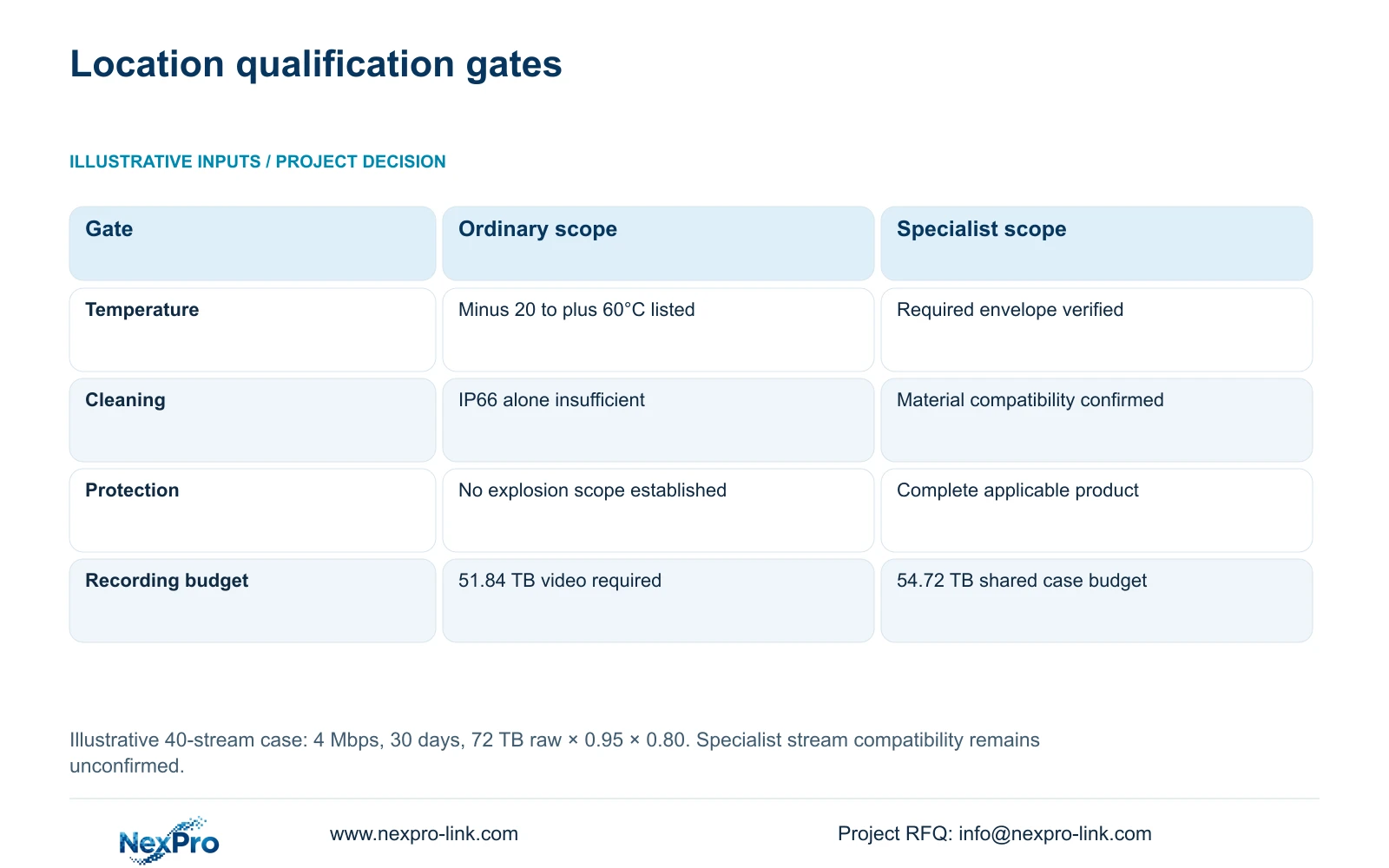
The selection rule is conjunctive: location conditions AND complete product scope AND approved installation requirements must fit. Passing one field does not cancel a mismatch elsewhere. The matrix below translates that rule into two purchasing scopes for the illustrative chemical facility, without assigning arbitrary scores or implying that a specialist configuration is merely a higher-grade ordinary camera.
The ordinary BL2812M and DM2812M references list IP66 and an operating temperature range from minus 20 to plus 60°C. Their 5MP-family source output includes 2880×1620. These fields can support normal-area model matching, but they do not establish chemical resistance, cleaning compatibility or explosion protection. Obtain the actual exposure and cleaning information instead of treating the ingress field as a complete industrial qualification.
The decisive difference is the protection and installation basis for the location. A standard model can remain a candidate at an appropriately confirmed ordinary position. A specialist position requires its own applicable complete product and installation review. Where cleaning or corrosion is the unresolved constraint, resolve that specific material question even if the temperature and ingress fields appear satisfactory.
| Decision | Ordinary positions | Specialist positions |
|---|---|---|
| Temperature | Listed minus 20 to plus 60°C | Match required operating envelope |
| Ingress and cleaning | IP66 field; assess actual exposure | Confirm cleaning and material compatibility |
| Explosion protection | Not established by ordinary specification | Applicable complete protective scope |
| Infrastructure location | Accessible suitable service room | Keep ordinary racks outside unsuitable locations |
| Price comparison | Same accepted security task | Retain required specialist installation scope |
Section 05
Preserve the recording task across both supply scopes
Recommend an ordinary security package plus separately specified specialist supply, with a common recording task wherever the selected interfaces support it. The 40-camera reference assumes compatible 5MP-class streams at an average 4 Mbps each, giving 160 Mbps input. That assumption needs replacement or confirmation for the specialist devices; neither their protective scope nor the recorder channel count proves stream compatibility.
At 24-hour recording for 30 days, the illustrative formula is video_TB = 40 × 4 × 10^6 × 86400 × 30 / 8 / 10^12 = 51.84 TB. Four 18 TB disks provide 72 TB raw. Applying the stated planning factors gives 72 × 0.95 × 0.80 = 54.72 TB recording budget, which exceeds 51.84 TB. The budget already includes formatting allowance and reserve, so no second reserve deduction belongs in that comparison.
NexPro-NVR4449-4K is a capacity candidate with 320 Mbps input and four SATA bays supporting up to 18 TB per drive. Its published summary distinguishes 49×5MP from 9×4K. Recheck the architecture if actual modes, retention or resilience requirements change; these capacity fields do not establish RAID or simultaneous decoding. Price alternatives against the same accepted tasks and interfaces, preserving required specialist services.
Section 06
Release a schedule with explicit approval boundaries
The RFQ should identify each position as ordinary, specialist or unresolved, with a named decision owner. Attach environmental conditions to the relevant positions and separate the security purpose from process-system requirements. This lets suppliers offer a useful provisional scope without presenting unanswered classification questions as approved equipment choices.
Allocate supply and installation responsibilities line by line. NexPro-Link can discuss ordinary camera matching, recording infrastructure, related equipment coordination and technical submittals through its factory project and BOQ support scope. The specialist product basis, local installation and final location approval remain with the parties appointed for those responsibilities. Project labels and packing should preserve position identities without replacing manufacturer identification.
Before releasing the purchase order, reconcile the equipment schedule against the accepted drawing revision. Any moved camera, changed process boundary or new cleaning exposure should reopen the affected qualification and interface checks. Retain the rest of the accepted package where its inputs are unchanged, making variations visible instead of silently replacing the whole schedule.
Section 07
Buyer questions
Can suppliers quote before every position is classified? They can quote confirmed ordinary positions and identify provisional allowances for unresolved items. Keep the unresolved positions out of an approved substitution list until the responsible designer supplies their location and installation basis.
Does a camera outside a process room automatically qualify as ordinary equipment? No. Confirm the actual mounting location, relevant connections and exposure against the drawing. An outside view may be useful, but the room boundary alone does not settle equipment suitability.
Should a mandatory specialist brand prevent an ordinary-area alternative? Only if the project specification extends that restriction to the ordinary scope. Present any permitted alternative separately, retaining the specialist models, interfaces and services required by the owner.
Section 08
Define the ordinary and specialist supply split
Send the area-classification drawing, position schedule, relevant environmental conditions and security/process boundary to info@nexpro-link.com to discuss a chemical plant equipment scope.
Engineering references
These sources support the general planning principles. Always use the selected product's current datasheet and applicable project standards for final design.