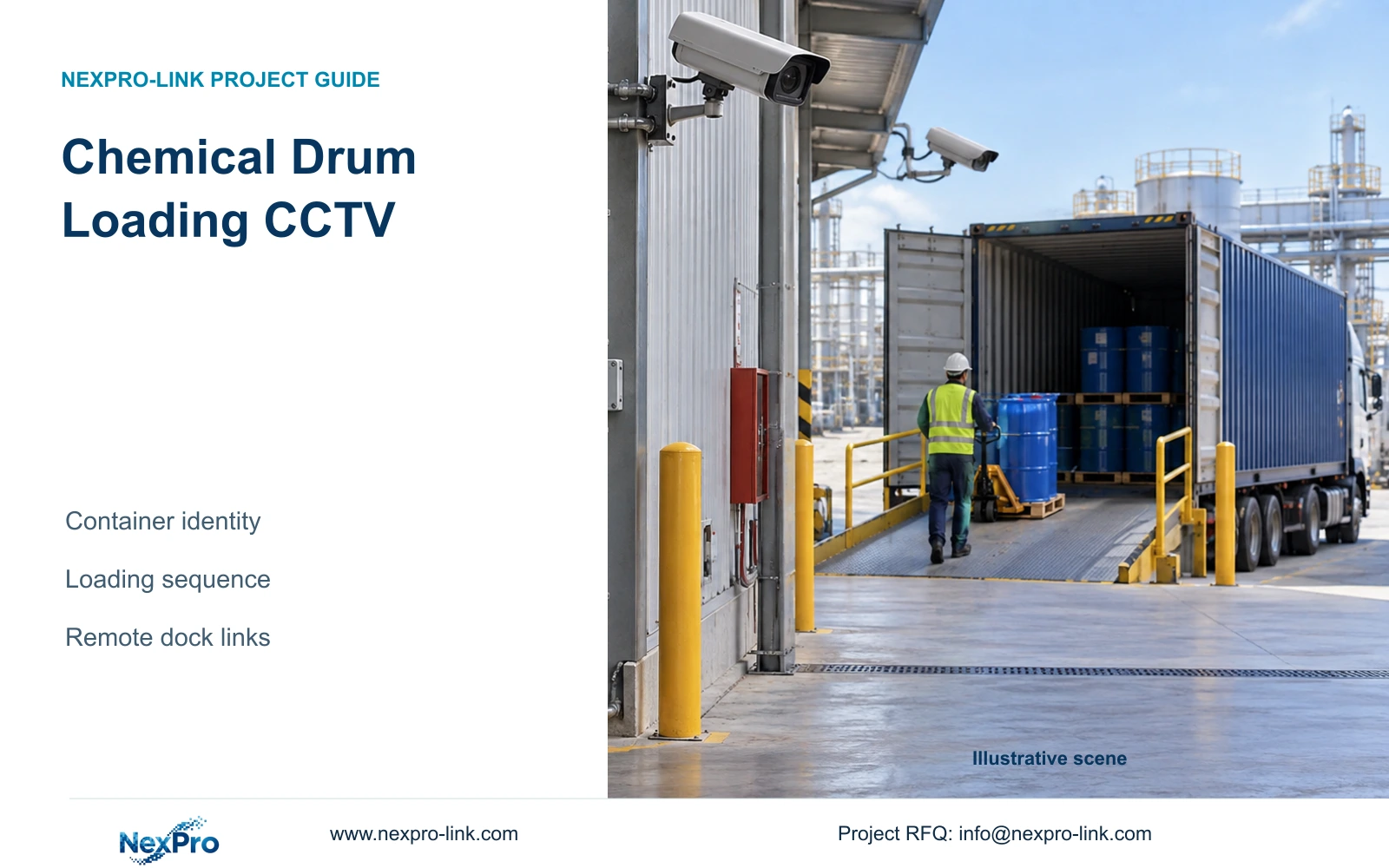
Chemical drum loading needs a close identity workflow and an independent sequence view. Compare actual output dimensions at the target plane, then resolve distance, power and classification boundaries separately.
Section 01
Define how container identity will be captured
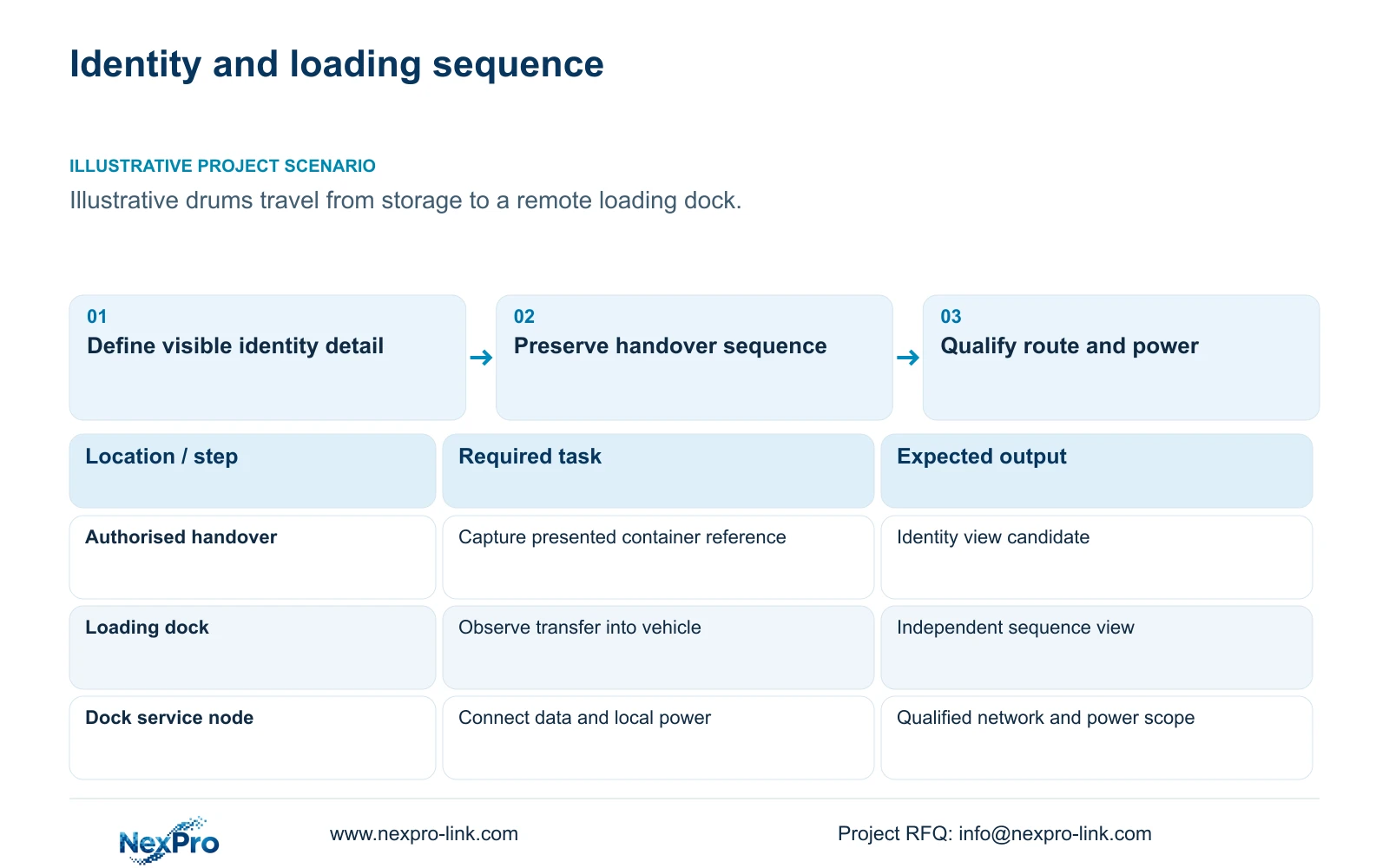
Chemical drum loading CCTV should combine a suitable close identity workflow with an independent view of the handling sequence. Begin with the label or container reference the reviewer must resolve, its presentation and the point where it can be observed. Keep camera positions and cable transitions aligned with the site's classification and handling controls. A wide yard image alone may provide movement context without enough usable label detail.
Illustrative project scenario: Drums move from a storage area to a remote loading dock under a site-specific hazard plan. Assume the project team proposes an identity view at an existing authorised handover position and a separate overview of loading. These are planning alternatives, not instructions to change drum handling or a claim of successful label recognition. The process team must approve any observation position and handling interaction.
Capture label size, orientation, wrapping, movement and likely obstruction as design inputs. If the label is not consistently visible, retain the authorised scanning or dispatch record as the identity source and use CCTV for associated custody context. Do not claim barcode reading, OCR or automatic drum identification from a general security camera specification. Define which visible details the actual sample must demonstrate.
Section 02
Keep the loading sequence visible from suitable positions
The overview should show the required transfer sequence despite pallets, vehicles and operators changing the sightline. Mark the storage departure, staging position, loading edge and vehicle approach on the drawing. Choose mounting locations that meet the relevant classification and exposure requirements, then assess whether the views connect the event. A closer position is not an acceptable improvement if its equipment suitability remains unresolved.
Check the proposed identity view during representative movement and lighting. Reflections from curved drums, wrapping and wet surfaces can obscure text even when the planning density appears adequate. Keep illumination and exposure adjustments within the permitted equipment and site arrangements. The engineer should report whether a failed sample needs a different angle, narrower task or separately qualified equipment rather than increasing resolution without diagnosing the cause.
The ordinary BL2812M bullet references offer a 2.8 to 12 mm motorized lens range for framing candidates. Their IP66 and minus 20 to plus 60°C fields apply to the documented ordinary models; they do not establish hazardous-location suitability or chemical compatibility. Where the necessary view requires a specialist position, preserve that complete product and installation scope while comparing the observation task.
Section 03
Resolve network distance and classification crossings independently
Measure the installed cable route to the remote dock, including vertical runs, service allowances and termination locations. Copper distance and hazardous-area suitability are separate decisions. Fluke Networks guidance distinguishes a typical 90 m permanent link from a 100 m complete channel; the actual link type and local requirements govern testing. Staying within a length boundary does not approve a route through a specialist location.
The supplied reference case uses continuous copper lengths from 41 to 76 m, including a declared 6 m service and termination allowance. Its 40 new links total 2,340 m and have an executable eight-reel cut plan using 305 m reels. Those routes do not establish that a different remote dock fits the same copper design. Survey the real backbone separately and consider an appropriately designed fibre link where the route requires it.
A fibre backbone does not provide camera power. Identify the dock access equipment, its local supply and the backup circuit that reaches it. The site designer determines permitted transitions and specialist connections. Ordinary recorder, switch and battery equipment should remain in suitable accessible locations where practicable. Record these responsibilities in the schedule so a network solution does not leave an unpriced power dependency.
Section 04
Compare actual horizontal pixels at the same target width
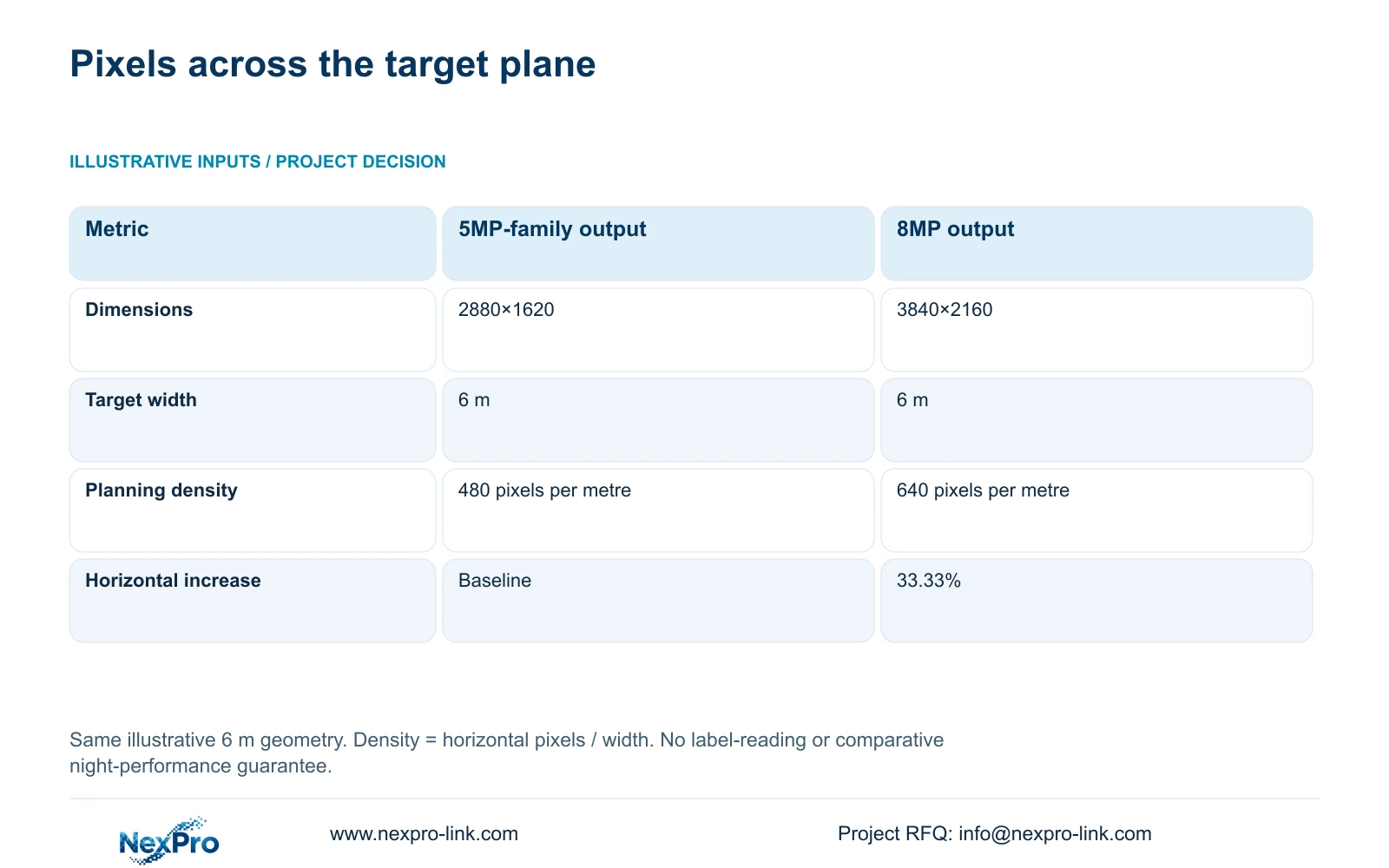
The supplied BL2812M specification lists 2880×1620 output in the 5MP family and 3840×2160 at 25fps for the 8MP reference. At an illustrative 6 m target plane, planning pixels per metre = horizontal output pixels / target width. The results are 2880 / 6 = 480 pixels per metre and 3840 / 6 = 640 pixels per metre. The same geometry is assumed solely for this arithmetic.
Relative horizontal-density increase = (3840 / 2880 - 1) × 100 = 33.33%. That is the decisive numerical difference under the stated width. It is not a 60% detail guarantee derived from the 5MP and 8MP labels. Preserve the source dimensions rather than changing the 5MP output to another assumed format. Neither the density result nor the larger sensor field establishes comparative night performance.
Use the calculation to identify which candidate deserves an image trial for the actual label task. Lens geometry, angle, motion, exposure, compression and obstruction still determine usable detail. A six-metre view may be appropriate for movement context but too broad for a particular small label. If the task fails, change the approved framing or identity method and repeat acceptance; do not treat a pixels-per-metre value as a universal recognition threshold.
| Metric | 5MP-family listed output | 8MP listed output |
|---|---|---|
| Output dimensions | 2880×1620 | 3840×2160 |
| Horizontal output | 2,880 pixels | 3,840 pixels |
| Target width | 6 m | 6 m |
| Planning density | 480 pixels per metre | 640 pixels per metre |
| Relative horizontal increase | Baseline | 33.33% |
Section 05
Select the task combination before expanding the hardware
Recommend a dedicated identity task where presentation supports it, paired with an overview that preserves the loading sequence. If the close image cannot reliably show the required reference, retain the authorised container-identification record and connect video through time and location. This gives the owner a clear acceptance decision instead of an unsupported promise that every drum label will be readable.
An 8MP candidate may be useful where the actual trial shows a justified detail benefit, but it also changes stream-mode and resource checks. The supplied 40-camera case assumes compatible 5MP-class modes at 4 Mbps each. Do not apply its recorder-channel promise to an all-8MP package. Reconfirm the selected recorder's modes, input demand, storage and operator playback requirements after changing cameras.
Include access-switch power using confirmed device demand and the approved supply arrangement. Neither ordinary camera peak watts nor specialist power requirements are supplied for this final design. Protect the remote dock equipment on its actual power node, and distinguish the retrieval client from recording infrastructure. Compare quotations for the same identity, sequence and location-qualified scope, including backbone and local services.
Section 06
Ask for evidence and route details that change the quote
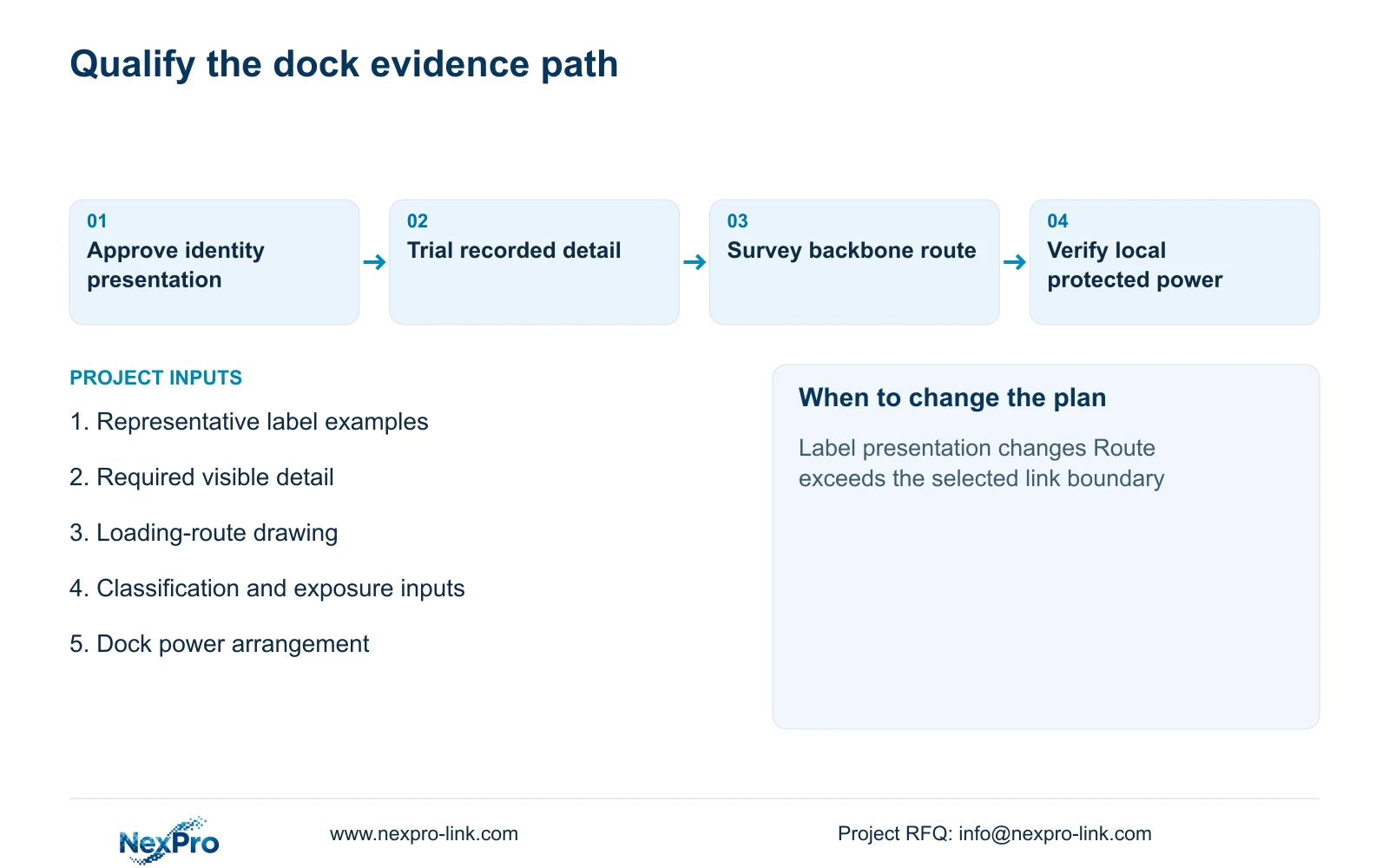
The RFQ should include representative label examples, the required visible detail and a route drawing showing the handover and loading sequence. Attach the classification and exposure information for mounting positions and connection transitions. This gives suppliers enough information to propose ordinary candidates where appropriate and leave specialist positions to their separately defined complete scope.
NexPro-Link can support candidate camera matching, a coordinated equipment schedule and BOQ deviations for the ordinary security package. Backbone equipment, cabling and project preparation can be discussed against the approved route, while the local team confirms installation and specialist responsibilities. Do not use a patch-panel reference as a bulk cable SKU or assume that an export equipment quote includes dock electrical work.
At acceptance, replay a representative drum movement and compare its identity reference with the authorised dispatch record. Check that the loading sequence remains available when the close view is obstructed. Verify the actual installed links and protected power path separately. A moved handover position, changed label format or longer dock route should trigger a focused update to views, resources and materials.
Section 07
Buyer questions
Does 640 pixels per metre guarantee readable drum labels? No. Label size, orientation, movement, lighting and compression remain decisive. Define the required visible detail and test representative recorded footage.
Can the fibre backbone eliminate the dock UPS requirement? No. Fibre carries data, while the remote camera and access equipment still need an appropriate local power arrangement. Backup protection depends on the circuits that actually supply them.
Should the loading overview be replaced by the identity camera? Only if the owner no longer needs the wider sequence and the remaining view passes that revised task. Otherwise preserve both purposes in the accepted coverage plan.
Section 08
Scope the drum identity and dock link
Email representative labels and detail requirements, the loading-route drawing, classification/exposure inputs and dock power arrangement to info@nexpro-link.com for a task-based equipment discussion.
Engineering references
These sources support the general planning principles. Always use the selected product's current datasheet and applicable project standards for final design.