A central UPS protects remote CCTV cabinets only through an actual protected electrical path. Compare feeder work, local batteries and shared recording dependencies before choosing the architecture.
Section 01
Choose the architecture from the actual electrical paths
Use local UPS protection as the initial basis for separately powered factory CCTV cabinets unless an approved central protected feeder serves them. Compare the complete electrical paths, shared recording dependencies and maintenance arrangements before deciding. One large UPS and several smaller units are not equivalent packages when their protected endpoints differ.
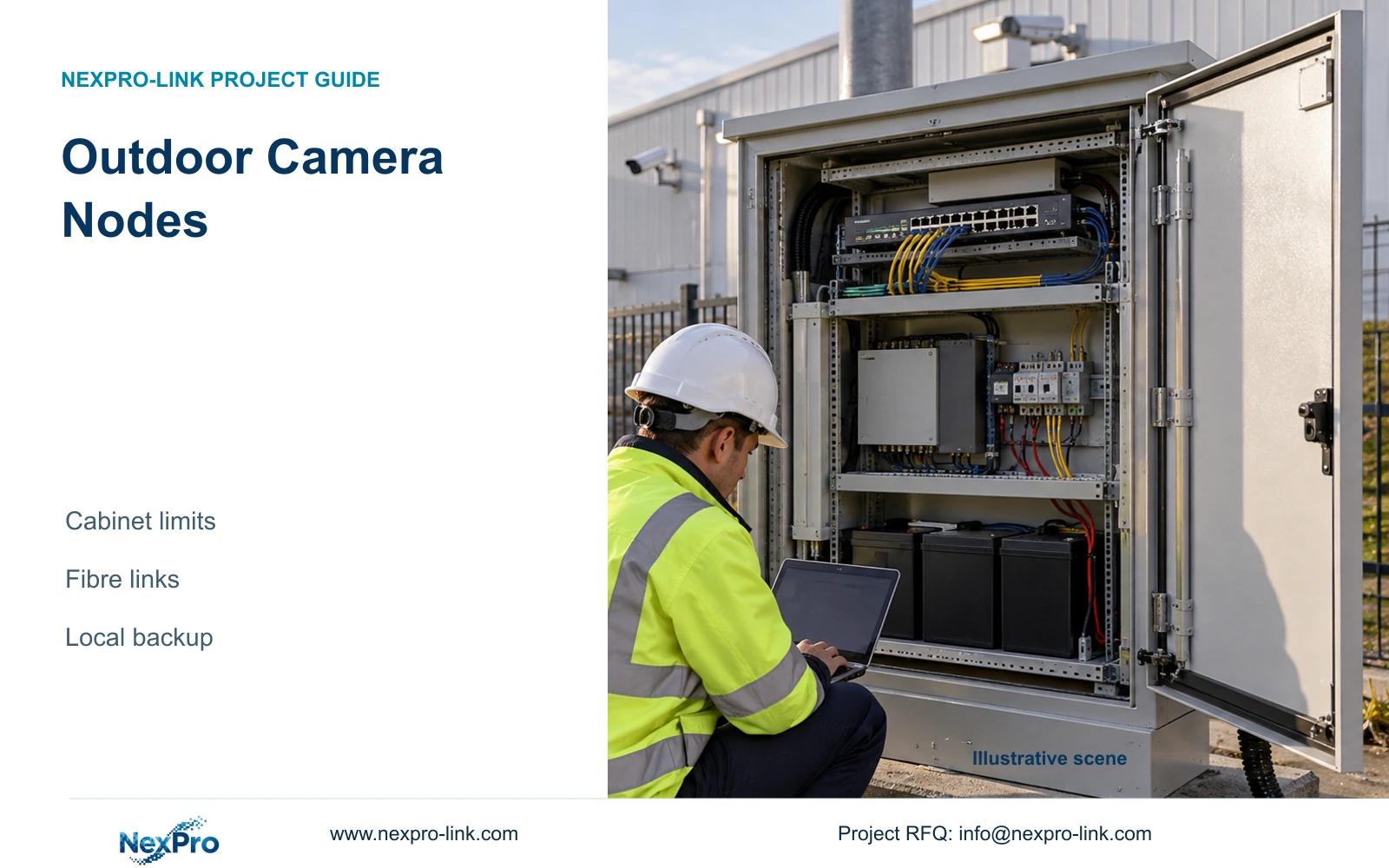
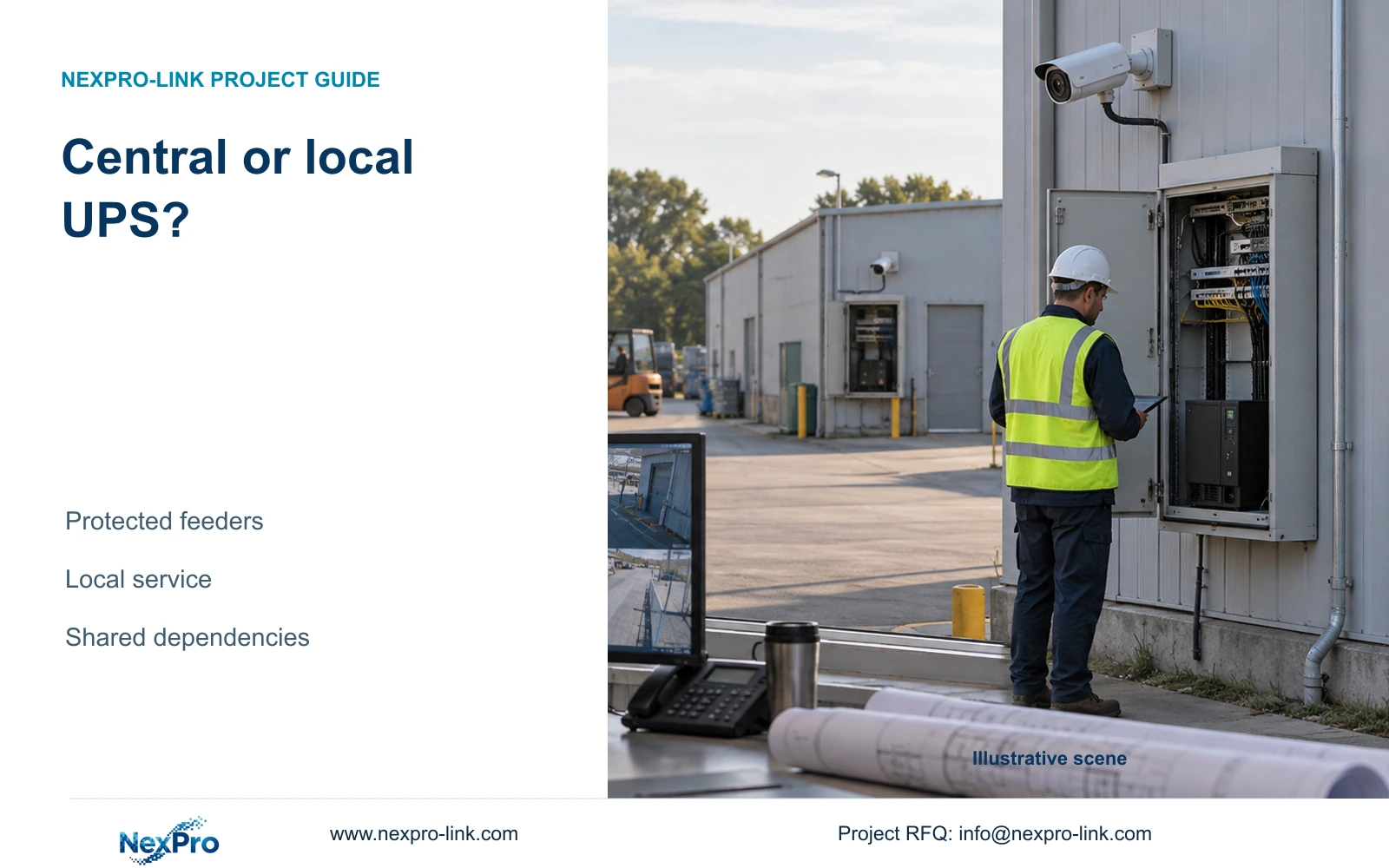
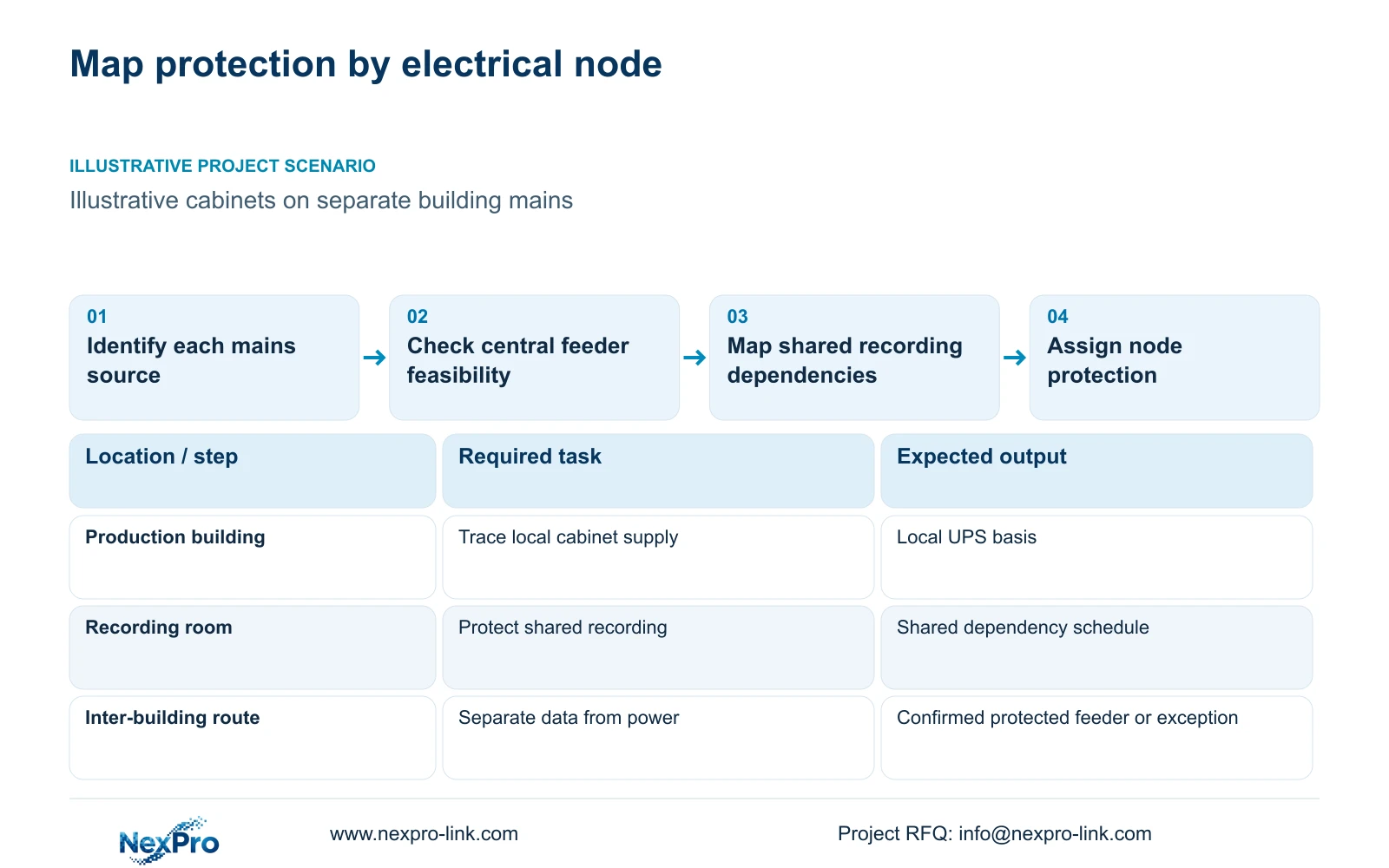
Illustrative project scenario: Several camera cabinets sit in separately powered production buildings. Assume the site has data links between buildings but no confirmed central backed-up electrical distribution. The supplied CNC factory reference provides a single-node load example; it does not provide measured loads or protected feeder drawings for these additional buildings.
Ask the electrical team to identify each cabinet's mains source and whether that circuit can be supplied from a central UPS. Draw power and data as separate layers. A fibre route may support shared recording while every access switch still relies on local mains. Mark central protection as conditional until the feeder arrangement is actually defined.
Section 02
Compare maintenance locations and the service lost at each one
Local UPS units create several inspection and battery-service locations. For each cabinet, record access permissions, environmental conditions, available space and whether maintenance can occur without disrupting production. A remote location that is difficult to reach may need a different cabinet arrangement even when its electrical load is small.
Central protection can concentrate battery maintenance in a serviceable room, but its UPS and distribution may form a common failure point for several buildings. Local protection can limit a power-equipment failure to one node, yet shared recorders or network equipment may still stop the service across multiple nodes. Map the lost task for each failure rather than declaring either architecture inherently redundant.
Ask the maintenance team to review both arrangements before procurement. Identify who receives alarms, where spare equipment is stored and how a unit is isolated for service. Do not infer monitoring, bypass or hot-replacement capabilities from a family name. Request those functions only when required and verify them for the exact configuration.
Section 03
Price local batteries against complete central distribution
A local architecture needs an identified UPS and compatible battery configuration at each approved node, along with local installation and commissioning. A central architecture needs the central unit plus the protected distribution that reaches every cabinet. The BOQ should include relevant feeders, distribution equipment, connections and site work without inventing quantities before routes are known.
Keep retained and new scope separate. If the main recording room already has adequate protection, retain it and price the remote gaps. If a central protected feeder already exists, assess its usable project scope before ordering local batteries. Unknown installation work is an unresolved cost, not a zero-cost advantage.
Normalize quotations to the same essential cameras, recording service and duration. Include repeated battery-service locations on the local side and shared infrastructure on the central side. Current matching quotations are required for a price conclusion. No supplied data establishes that one architecture is cheaper or has lower lifetime maintenance cost.
Section 04
Use the rack calculation at its stated node boundary
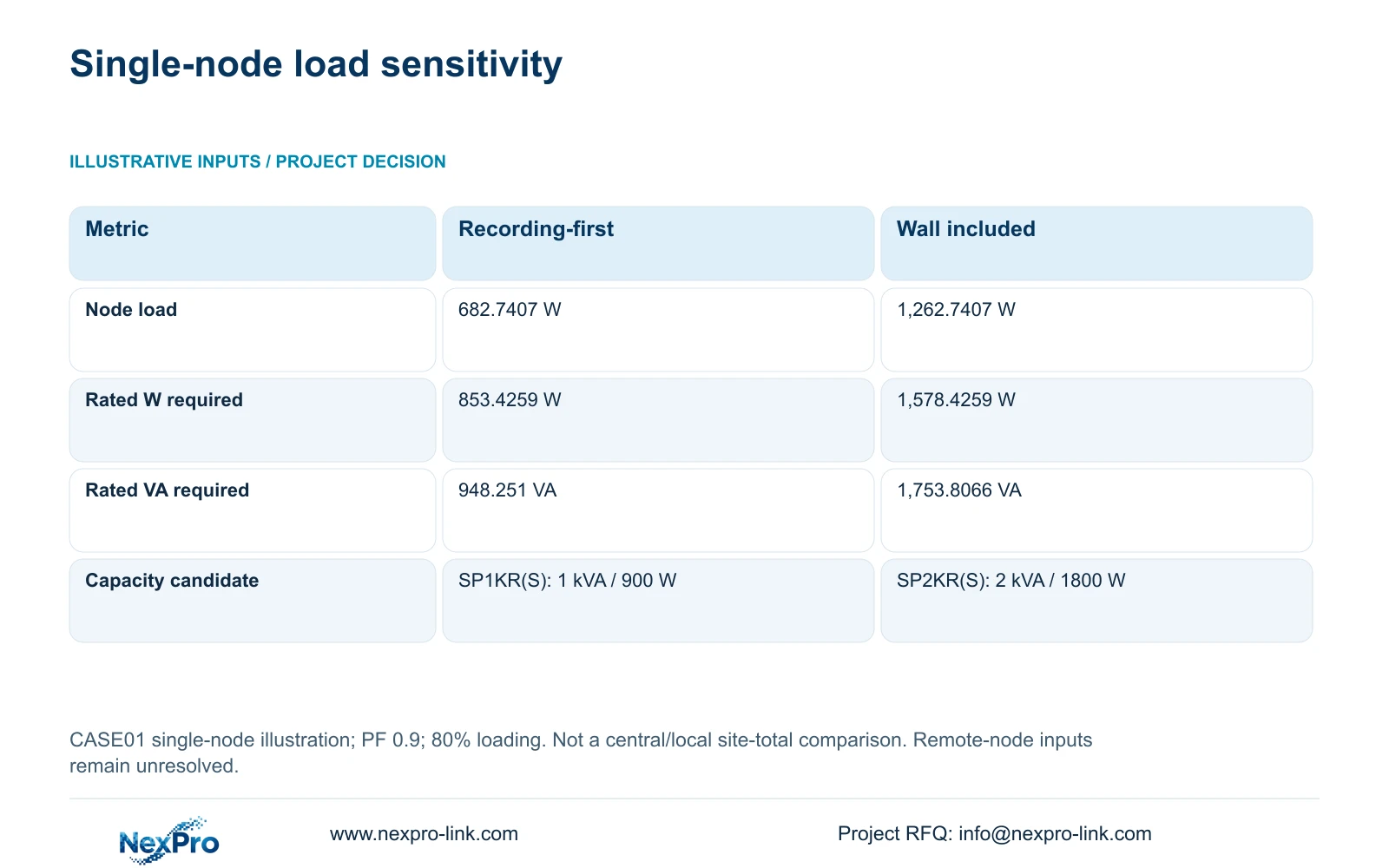
The single-node CASE01 illustration uses 32 cameras at assumed 12 W demand, grouped into four sets of eight. Each complete switch AC input is ((8 × 12)/0.90 + 15)/0.90 = 135.1852 W, using assumed cable delivery and PSU efficiency of 90%. Add 30 W recorder electronics, four 8 W disks, 25 W core, 15 W router and 40 W screen to obtain 682.7407 W.
The optional wall retains this equipment and adds four assumed 120 W panels plus a 100 W decoder, giving 1,262.7407 W. With PF 0.9 and 80% loading, required_UPS_W = P_AC/0.8 and required_UPS_VA = P_AC/(0.9 × 0.8). The comparison shows how a local scope change moves the output requirement.
SP1KR(S) and SP2KR(S) are capacity candidates for these respective single-node loads. The decisive difference is the 580 W display addition. Neither figure sizes the hypothetical multi-building site. Prepare a fresh load calculation for every local node, or a central total based on the actual protected feeders; do not multiply the example by an assumed building count.
| Metric | Recording-first node | Node with wall |
|---|---|---|
| Protected AC demand | 682.7407 W | 1,262.7407 W |
| Required rated W | 853.4259 W | 1,578.4259 W |
| Required rated VA | 948.251 VA | 1,753.8066 VA |
| Capacity candidate only | SP1KR(S): 1 kVA / 900 W | SP2KR(S): 2 kVA / 1800 W |
Section 05
Prefer local protection where separate mains already define the nodes
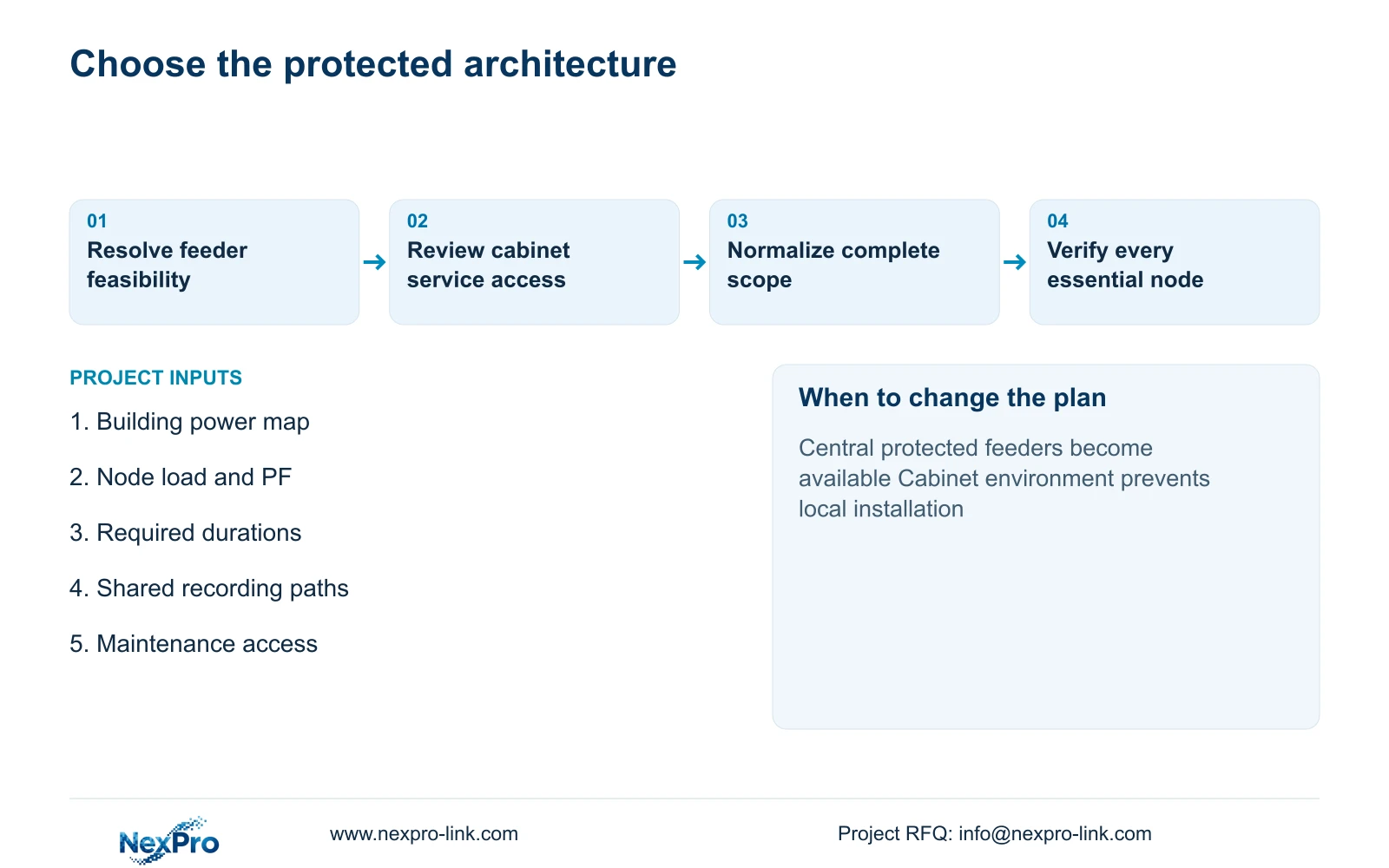
For the hypothetical buildings described here, recommend local protection at essential cabinets while retaining suitable protection for shared recording equipment. This follows the known separate mains arrangement without assuming new inter-building electrical distribution. Keep the recommendation conditional on cabinet environment, service access and exact loads.
Change to a central basis when an approved protected feeder system exists or the project team chooses to construct one after reviewing service and failure implications. A hybrid arrangement may protect the main recorder centrally and remote access groups locally. Its duration is limited by the necessary dependency with the shortest supported operating window.
For each UPS, check W, VA and battery duration separately. The NexPro-Link series lists 1 kVA/900 W, 2 kVA/1800 W and 3 kVA/2700 W references. Those ratings do not establish runtime or protection at another electrical location. Battery evidence should identify the actual variant and supported arrangement rather than copying nominal energy across models.
Section 06
Deliver a node schedule with shared dependencies attached
The design output should include a node identifier, essential devices, complete AC demand, PF, target duration, supply source and proposed UPS arrangement. Attach the recording and viewing dependencies to each node. This makes a remote camera addition traceable to local power and shared equipment instead of silently altering only the camera count.
Assign local installation, battery service and acceptance responsibilities in the BOQ. During commissioning, verify each essential node and the complete path to saved footage. Test a local power interruption through a site-approved procedure and record whether other buildings retain their agreed service. A site-wide total alone cannot expose a missing cabinet feed.
NexPro-Link can discuss coordinated equipment, model matching and technical submittals through factory project and BOQ support. The local electrical team confirms protected distribution and installation. An architecture comparison becomes procurement-ready when both offers show the same service, complete circuit scope and maintenance assumptions, with unresolved feeder work explicitly identified.
Section 07
Buyer questions
Can local UPS units remove every shared failure point? No. Shared recorders, core equipment and required network links may still affect several buildings. Review the full service dependency map alongside the electrical architecture.
Should every building receive the same UPS model? Only if its load, PF, duration, interfaces and installation conditions justify that model. Standardization can simplify supply, but it should preserve node-specific capacity and battery checks.
Can remote spare capacity be pooled in the calculation? No. Spare capacity at one local UPS does not support another cabinet unless an approved electrical arrangement connects that load. Evaluate each actual protected node separately.
Section 08
Compare complete cabinet protection architectures
Send your building/cabinet power map, node loads with PF, required service durations and maintenance-access constraints to info@nexpro-link.com for a central, local or hybrid equipment-scope review.
Engineering references
These sources support the general planning principles. Always use the selected product's current datasheet and applicable project standards for final design.