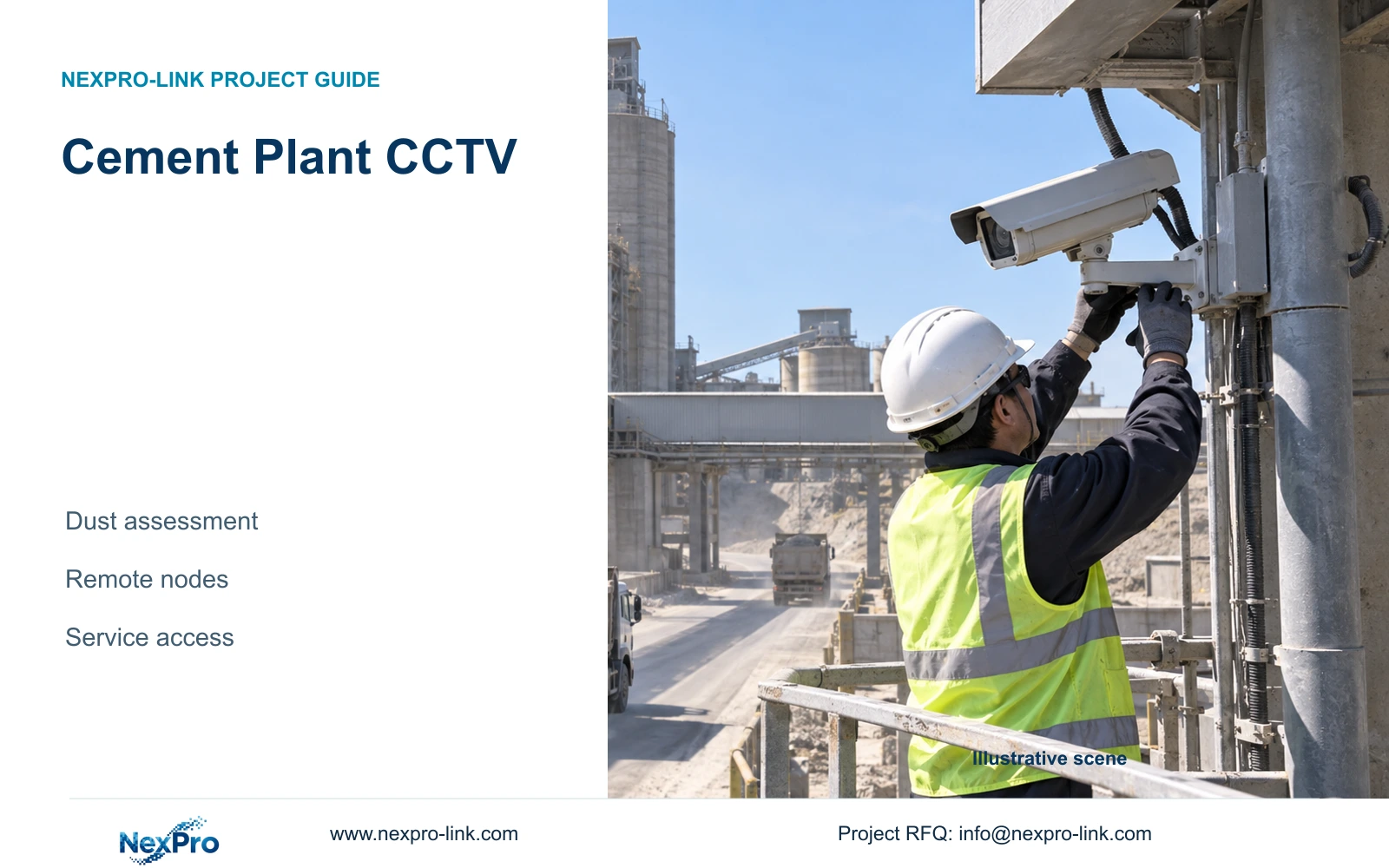
Cement plant CCTV needs usable transfer views despite dust, changing stockpiles and remote gates. Separate environmental qualification from recording, links and maintenance access.
Section 01
Choose transfer views that remain useful during normal operations
Design cement plant CCTV around permitted vehicle movements and material transfers, then qualify each camera position against its actual exposure. Ordinary cameras may suit a gatehouse approach or a protected loading view; a dusty road, hot process boundary or assessed hazardous location needs its own decision. Keep recording equipment in accessible normal-area rooms and include the links and local power needed to reach remote guard stations.
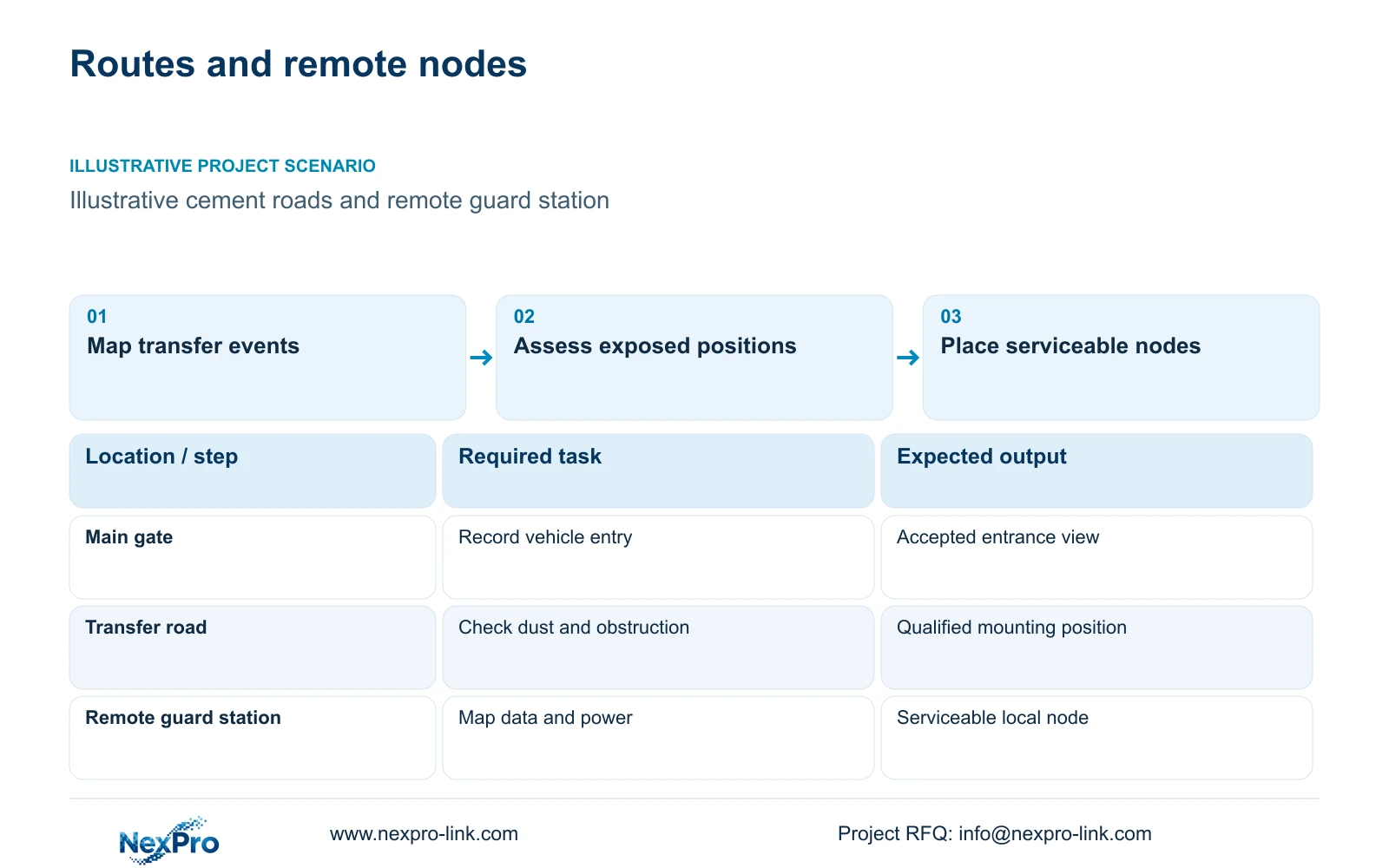
Illustrative project scenario: A cement facility needs vehicle and transfer footage across exposed buildings and roads. Assume the planning team is reviewing a main entrance, a material-transfer road and a remote guard station. These are proposed observation tasks, not a completed installation. Stockpile heights, truck stopping positions and operating dust conditions remain site inputs.
For each view, identify the event the owner wants to reconstruct: entry, a turn into the transfer route, arrival at a loading position or departure. Mark where trucks and stockpiles can block that event. A second viewpoint at a stable transfer boundary can be more useful than increasing resolution on an obstructed overview.
Section 02
Turn the dust assessment into location-specific requirements
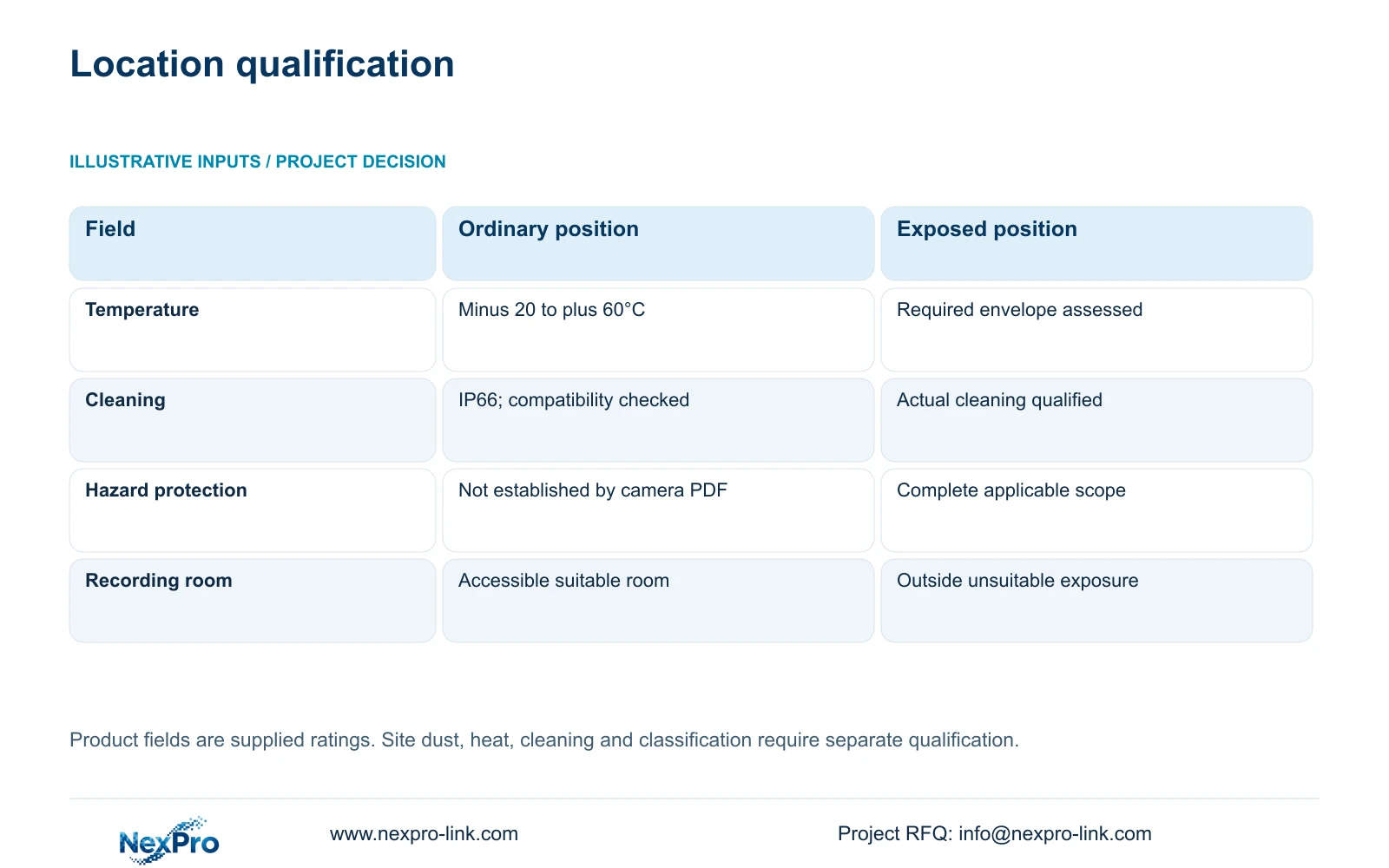
Ask the plant team to distinguish airborne dust, settled deposits, cleaning exposure and any classified location. Record radiant heat separately from ambient air temperature. A camera mounted near a warm process building can experience conditions different from a nearby weather reading, so the assessment should describe the proposed mounting surface and operating state.
The BL2812M and DM2812M ordinary camera references list IP66 and minus 20 to plus 60°C. Those fields provide a starting envelope, but they do not establish resistance to every cleaning chemical, abrasive deposit or process exposure. The supplied documents also do not establish explosion protection. Keep unresolved conditions visible against the affected location.
Apply a conjunctive qualification rule: location conditions AND complete product scope AND approved installation requirements must fit. If a cleaning method changes, reopen the camera, connection enclosure and service method together. Responsible site designers should verify applicable local requirements rather than treating an archived regulatory reference as a current installation approval.
Section 03
Make remote guard stations maintainable and electrically reachable
Draw the data route from each remote camera group to its recorder and authorised viewing station. Identify actual distances, available ducts, cabinet locations and access restrictions before deciding between local copper links and a designed fibre backbone. A guard station shown on the network drawing also needs an explicit electrical supply and outage objective.
CASE01 provides an illustrative system boundary: cameras feed local PoE access groups, recording is local, and viewing is a client branch. Its single-node arrangement is not evidence that one central UPS can protect separate remote AC supplies. If the cement layout introduces another powered cabinet, create a separate load list and identify which devices that cabinet's backup source actually supplies.
Assign the local installer responsibility for cabinet position, approved mains distribution and cable protection. The equipment schedule should identify supplied cameras and switches, any retained guardroom display, optional local recording and separately priced civil work. Include access for dust removal, disk replacement and battery service, rather than placing the cabinet wherever the shortest cable happens to end.
Section 04
Choose ordinary or specialist scope for each exposed position
Use the following matrix to separate a protected normal-area package from positions requiring additional qualification. The options are location decisions, not competing grades for the entire plant. The engineer should attach each row to a point identifier so the quantity surveyor can see which exception changes the quotation.
The decisive difference is the complete exposure requirement. Passing the ordinary temperature field cannot compensate for an unsupported cleaning method or required protective scope. Relocating a camera is acceptable only when the revised view still captures the agreed transfer event. Otherwise retain a separately specified specialist position.
| Requirement | Protected ordinary position | Exposed or specialist position |
|---|---|---|
| Temperature | Listed minus 20 to plus 60°C envelope | Required envelope and radiant heat assessed |
| Dust and cleaning | IP66 field; cleaning compatibility checked | Deposits and cleaning method explicitly qualified |
| Hazard scope | Ordinary location confirmed by site team | Complete applicable protective scope retained |
| Recording equipment | Accessible suitable service room | Ordinary infrastructure outside unsuitable exposure |
| Cost comparison | Price the accepted normal-area task | Price the required exception separately |
Section 05
Preserve the operating task when comparing equipment packages
Use ordinary cameras at qualified positions and retain specialist scope only where the assessed location or required task demands it. NexPro-BL2812M55-5MP-DIC-AI and the corresponding DM2812M55 Dome reference list 2880×1620 output, 25fps and a 2.8 to 12mm motorized lens. These fields support view selection; they do not guarantee plate identification or usable pictures through a dust cloud.
Compare proposals at the same truck positions, dust conditions, recording period and maintenance boundary. Include mounts, protected connections, remote cabinets, backbone equipment and installation access. A lower camera goods price has little meaning if another offer includes those dependencies and the cheaper offer leaves them unpriced.
Start with a practical guardroom viewing and retrieval arrangement. Add a display wall only when operators need defined simultaneous views. Recording should continue independently of that display branch. Change the recommendation if the owner requires a specific platform, the selected view cannot survive routine obstruction, or the location assessment rules out the ordinary equipment.
Section 06
Release a schedule that installers and suppliers can use
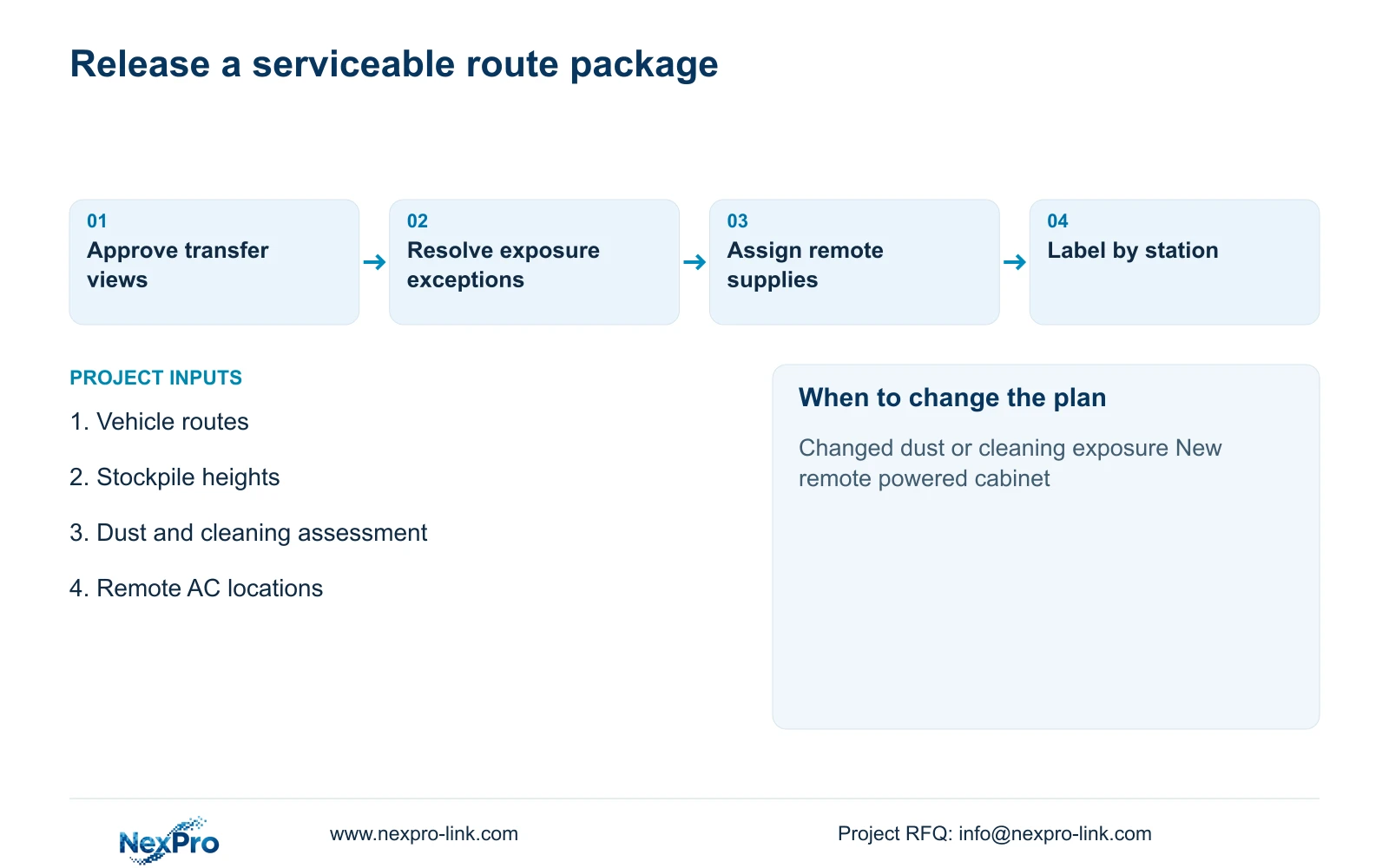
Issue a point schedule containing the event, mounting position, exposure status, data node, power node and cleaning access for each location. Separate confirmed ordinary points from unresolved exposed points. This allows procurement to progress on a stable package without silently approving equipment for a location still under assessment.
NexPro-Link's factory project supply and BOQ support scope can help translate those requirements into model matching, equipment lists and technical submittals. Project labels and packing can group equipment by guard station or cabinet. Overseas supply coordination should preserve those identifiers so the local team can match delivered units to the approved schedule.
Before release, have the plant representative approve the transfer tasks and the local designer confirm installation responsibilities. Require commissioning to demonstrate recorded playback during representative vehicle activity and dust conditions. Record any view change in the cable, mounting and power schedules as well as the camera list.
Section 07
Buyer questions
Can cleaning frequency be fixed at quotation stage? Use a provisional allowance based on the plant's access plan, then revise it after representative operation. Dust accumulation and cleaning restrictions vary by position; one interval for every camera can conceal difficult locations.
Does a fibre link keep a remote guard station operating during a power cut? No. The link transports data. Its powered endpoints, local switches, cameras and any recorder need their own reachable protected supply if continued operation is required.
Should every dusty point receive a specialist camera? No. First establish the exposure and whether a suitable protected viewpoint meets the task. Specify specialist equipment where the complete requirements exceed the ordinary product scope.
Section 08
Define the exposed points before pricing
Send your vehicle and stockpile route drawing, dust and cleaning assessment, remote cabinet power locations, and required transfer events to info@nexpro-link.com for a location-based equipment and supply discussion.
Engineering references
These sources support the general planning principles. Always use the selected product's current datasheet and applicable project standards for final design.