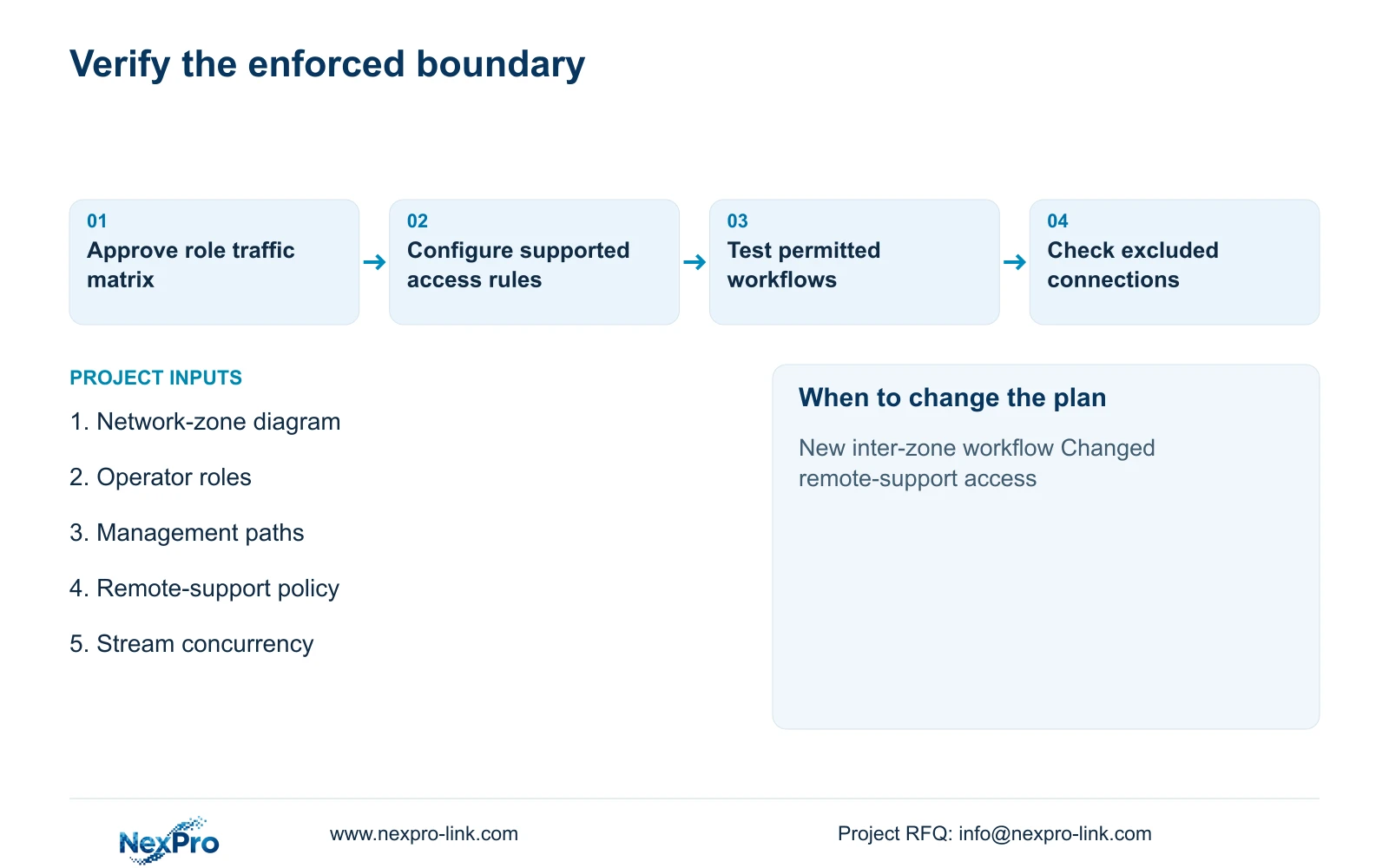
Retest permitted and denied paths after a switch replacement or support-rule change. Compare results with the approved service matrix and record rule ownership.
Section 01
Define security zones before choosing VLAN identifiers
Retest permitted and denied paths after a switch replacement or support-rule change. Compare results with the approved service matrix and record rule ownership. Where the actual configuration differs, hold the affected connection for network-owner review; a retained VLAN number is not evidence that the earlier enforcement behavior survived the change.
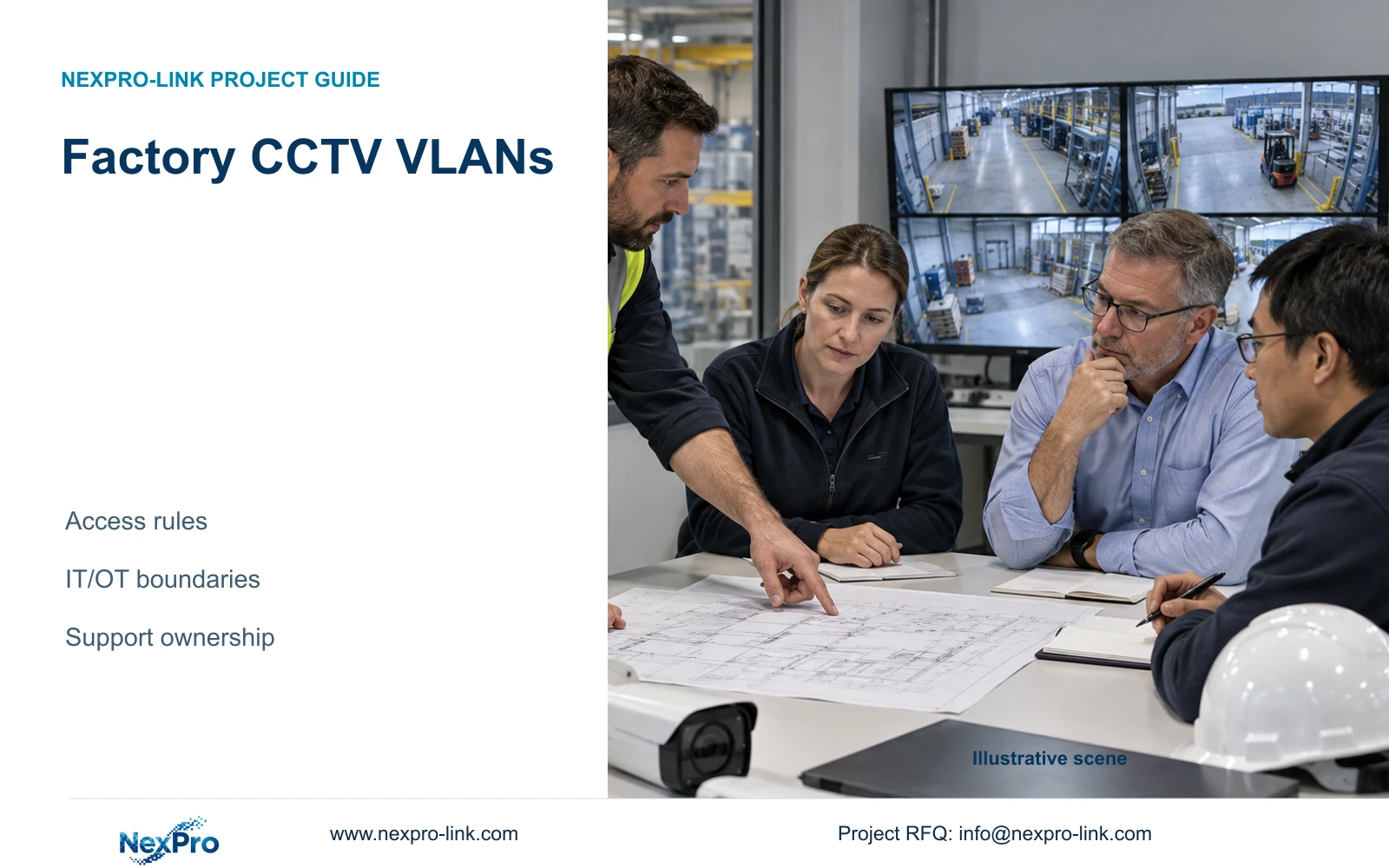
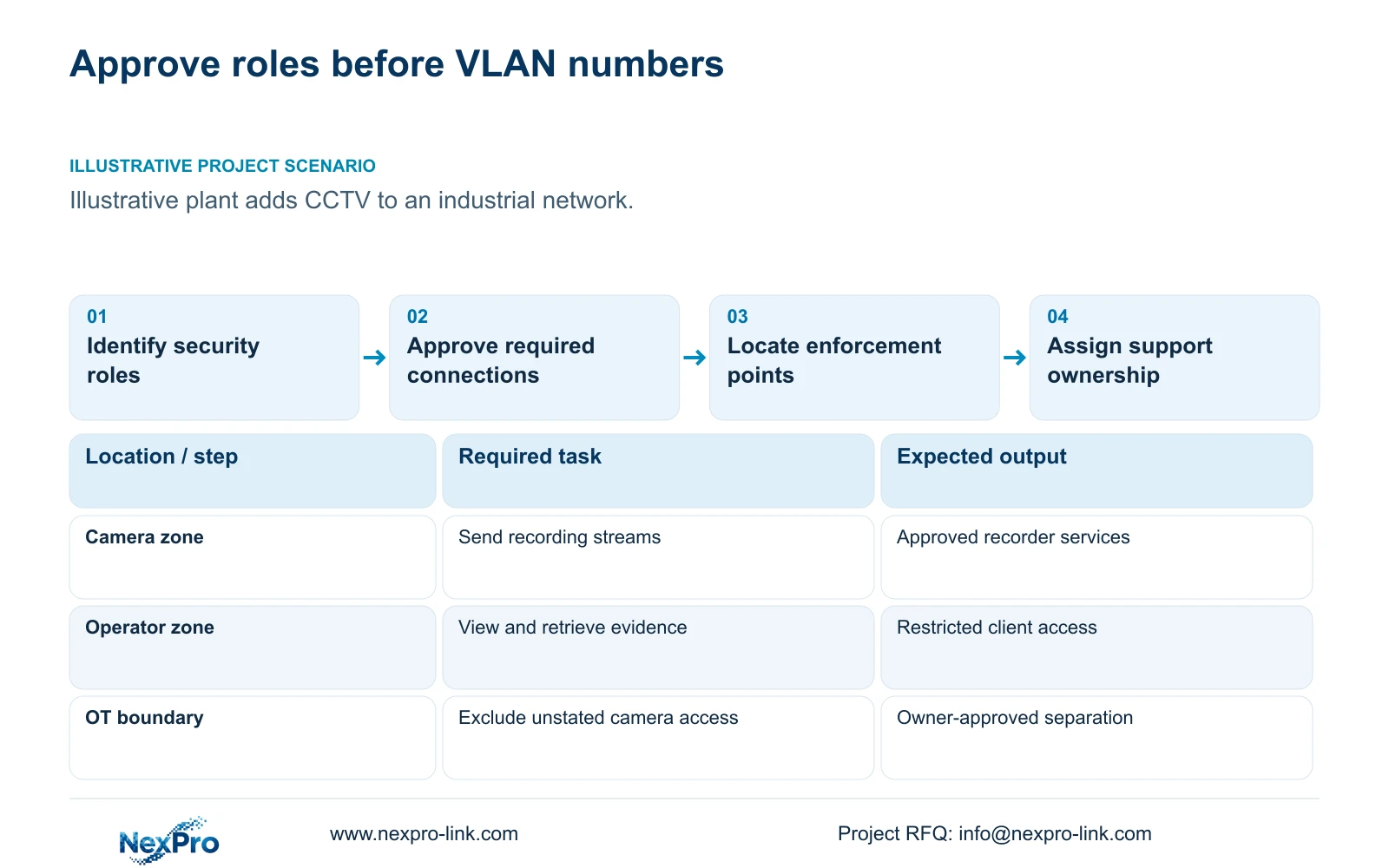
Factory CCTV segmentation needs an approved routing, filtering, management and support boundary in addition to VLAN membership. Start with the services and people that need access, then identify where those permissions will be enforced. A camera VLAN label alone cannot establish an effective IT/OT security boundary.
Illustrative project scenario: The plant proposes a camera VLAN on an existing industrial network. The security scope follows the supplied CASE01 reference of 32 ordinary cameras recording material transfers and site access. Assume the owner wants local recording and authorised operator viewing while leaving production-control networks outside the security workflow. These are planning choices, not an inspected site configuration.
List camera endpoints, recorder services, operator clients and administration as distinct roles. Mark production-control systems as a separate responsibility. NIST SP 800-82 Rev.3 is the supplied OT-security reference for operational constraints and separation; translate that context into site-approved access decisions rather than copying generic switch commands into a live plant.
Section 02
Turn operating tasks into permitted traffic
For each proposed connection, record source role, destination role, purpose, required service and approving owner. Camera-to-recorder communication supports recording; operator-to-recorder communication supports authorised viewing and retrieval. Administration should have its own defined path rather than inherit whatever connectivity happens to exist for live video.
Use a filled planning matrix to expose decisions early. In this scenario, recording and approved operator access are required; direct camera access from ordinary office clients is unnecessary for the stated task. Camera access to production controllers has no stated security purpose and should not be enabled as a convenience.
The network owner must translate these role-level decisions into supported rules for the exact equipment and services. Obtain the required connection details from the selected supplier, including management and discovery needs. Avoid opening broad inter-zone access simply to make a sample connect, because that would change the agreed boundary without resolving the missing technical input.
| Connection | Decision | Approval owner |
|---|---|---|
| Cameras to recorder | Permit required recording services | Security and IT |
| Operators to recorder | Permit authorised viewing/export | Security owner |
| Administration to devices | Restricted approved management path | IT administrator |
| Office clients to cameras | No access for stated task | IT owner |
| Cameras to production control | No stated permitted workflow | OT owner |
Section 03
Assign support access and configuration ownership
Name the party that can change network rules, camera settings and recorder accounts. Separate routine viewing from configuration privileges. For supplier support, agree an authorised route and a way to end access when the task is complete. A device delivery does not by itself grant ongoing access to the plant network.
Where a Seetong-based workflow is proposed, the supplied NexPro-Link Seetong System page provides APP and PC-client context. It does not establish universal mixed-brand functionality or justify bypassing the owner's remote-access policy. Confirm the exact workflow, account responsibilities and approved external connections before enabling it.
Keep configuration backups and a change record with the responsible team. Identify how access will be recovered if the usual administrator is unavailable, without placing credentials in public diagrams or cartons. The installer should receive the approved addressing and interface schedule through the project handover process, while the owner retains control of operational accounts.
Section 04
Size the controlled boundary for the approved workload
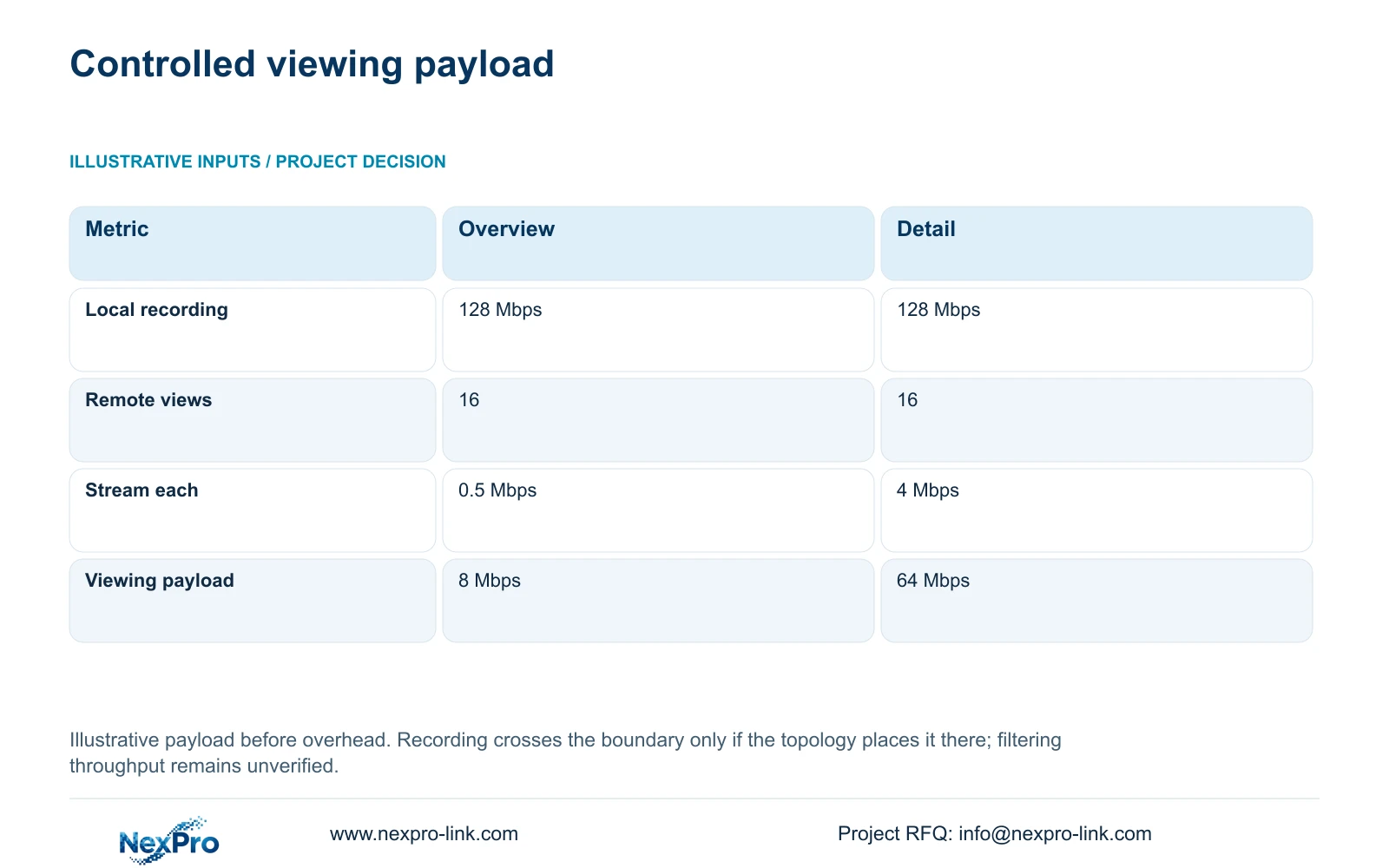
A permitted traffic matrix also needs a capacity basis. The supplied calculation is recorder_Mbps = 32 × 4 = 128 Mbps for local main-stream recording. For 16 concurrent remote views, viewing_Mbps = 16 × stream_Mbps gives 8 Mbps at 0.5 Mbps each or 64 Mbps at 4 Mbps each. These are illustrative video payloads before overhead.
If recording remains within the local security network, a controlled operator boundary may carry the viewing payload without carrying every main stream. If routing places the recorder across that boundary, the 128 Mbps recording flow must be counted there as well. Draw the actual connection arrangement rather than assigning every VLAN the same aggregate figure.
Prefer the lower-bandwidth overview when its detail meets the operator's task and exact devices support it. Local recording stays unchanged in this comparison. Add playback, export and other shared services on the interfaces they use; neither option establishes WAN performance or the throughput of an unspecified filtering device.
| Metric | Overview | Detail viewing |
|---|---|---|
| Local recording input | 128 Mbps | 128 Mbps |
| Concurrent remote views | 16 | 16 |
| Viewing stream each | 0.5 Mbps | 4 Mbps |
| Viewing payload | 8 Mbps | 64 Mbps |
| Recording quality changed | No | No |
Section 05
Choose shared infrastructure only with an enforceable boundary
Retain the shared factory network when its owner can provide the required segregation, capacity and supported management arrangements. If those conditions cannot be provided, consider a separate security transmission design with only approved interconnections. Physical separation still needs clear operator and support access decisions.
Check recorder interfaces explicitly. The NexPro-NVR4449-4K source lists dual Gigabit LAN and 320 Mbps input, but these fields do not establish a firewall or approve bridging security and production networks. Define the supported purpose of each connected interface and verify that the chosen arrangement preserves the intended boundary.
The cost comparison should retain the same recording and retrieval task. Price required switching, filtering, approved remote access, configuration and support separately where appropriate. NexPro-Link's technical submittal scope can identify equipment requirements and deviations, while the plant's IT/OT owner approves network policy and live-system changes.
Section 06
Test both allowed workflows and blocked paths
Acceptance should demonstrate authorised recording, viewing, retrieval and administration from their assigned roles. It should also confirm that connections excluded by the approved matrix remain unavailable. A successful live view proves one useful path; it cannot demonstrate the absence of unintended access elsewhere.
Plan these checks with factory IT and OT, using approved windows and methods. Preserve production operations and document the exact devices and configuration revision involved. Record who witnesses the result and which unresolved service requirements need follow-up, without inventing a security certification from the test.
Issue the final permitted traffic matrix alongside the node and power schedule. Revisit it when a new operator client, external support route, recorder interface or integration changes the connection requirements. Supplier preparation can follow the approved equipment configuration, but enforcement on retained industrial infrastructure remains with its appointed administrator.
Section 07
Buyer questions
Can the supplier choose our VLAN numbers? It can work with an addressing schedule, but the plant network owner should allocate identifiers and approve routing. Identifier selection does not replace the access-policy decision.
Must cameras and recorders occupy different VLANs? That depends on the approved architecture and required enforcement points. Define permitted roles and paths first; confirm that the chosen placement can enforce and maintain those decisions.
Should a support connection remain enabled after handover? Only under the owner's agreed support policy. Document its purpose, owner and access-ending procedure rather than treating temporary commissioning access as permanent permission.
Section 08
Define the CCTV access boundary
Email your current network-zone diagram, required viewing/export roles, proposed management and remote-support routes, and stream concurrency to info@nexpro-link.com for a scope-specific equipment and interface review.
Engineering references
These sources support the general planning principles. Always use the selected product's current datasheet and applicable project standards for final design.