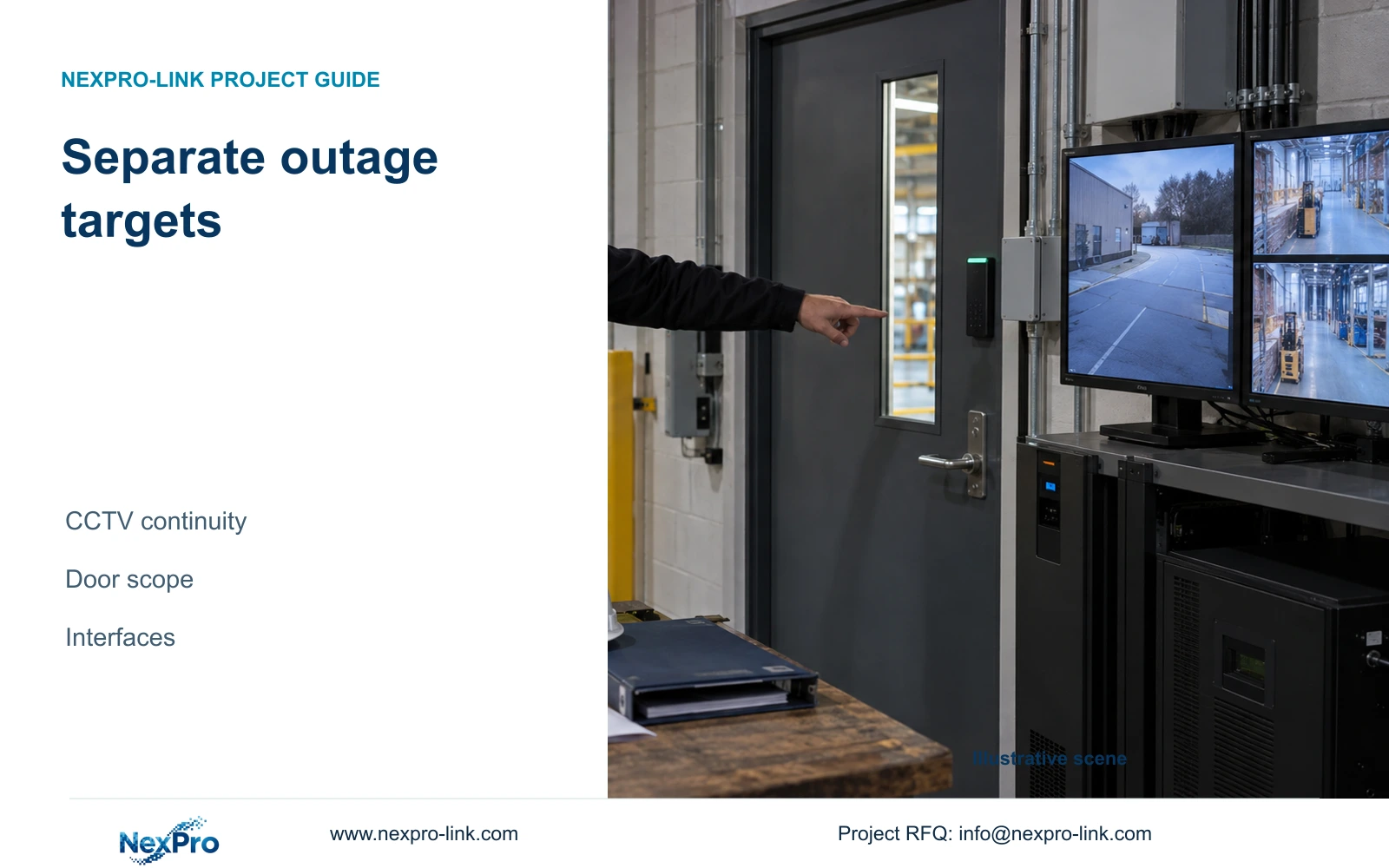
A shared security procurement package should preserve separate CCTV and access-control service targets, especially where door behaviour has life-safety implications.
Section 01
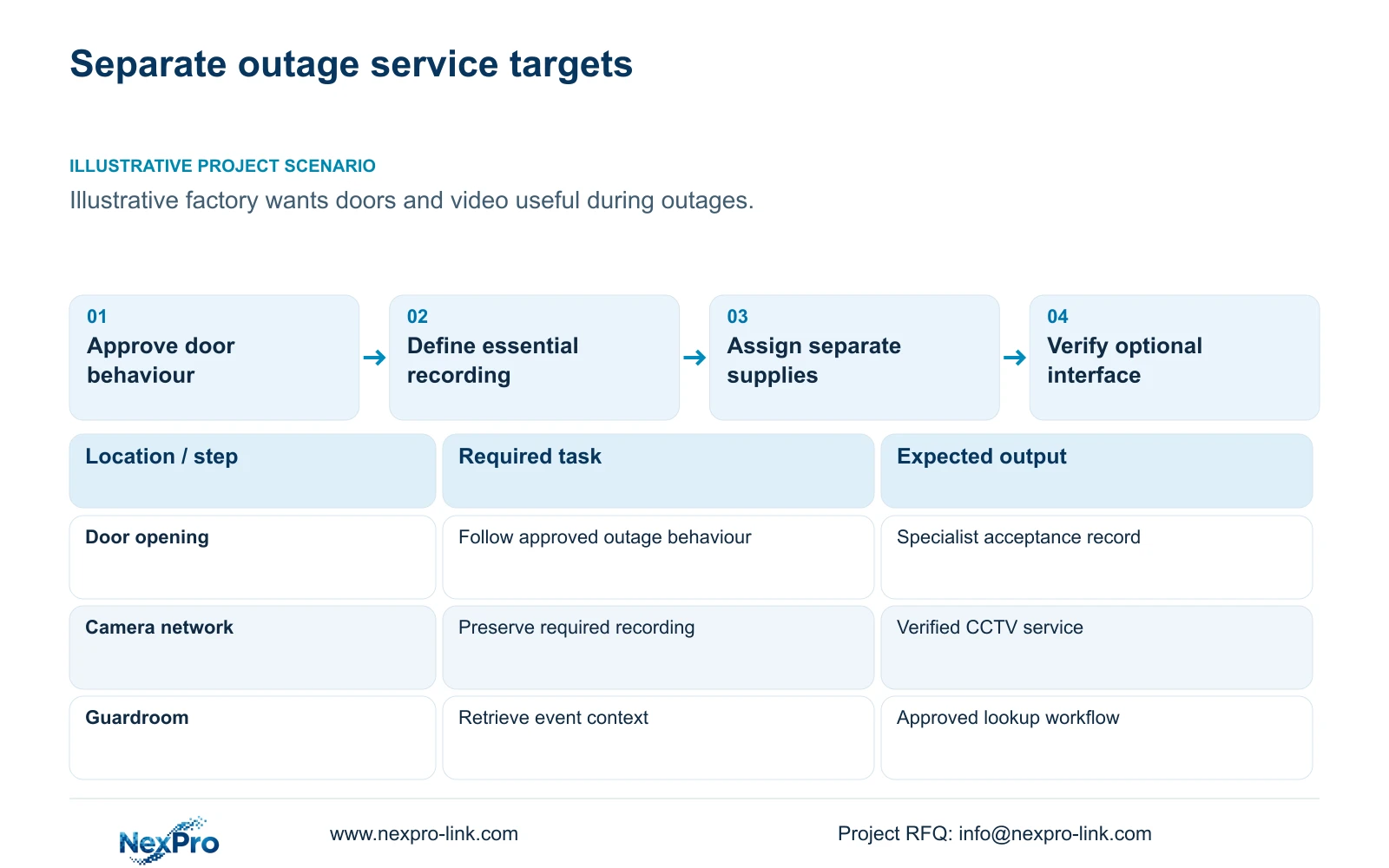
Approve door behaviour independently of surveillance continuity
Specify CCTV and access control during factory outages as separate functions with separate acceptance criteria. Recording continuity concerns cameras, network paths and storage. Door behaviour concerns the approved access and escape arrangement for each opening. A shared UPS order cannot make those functions equivalent or replace the responsible door and life-safety design.
Illustrative project scenario: A factory wants door systems and video to remain useful through a power interruption. Use CASE01's 32-camera CNC security package as the surveillance baseline, with access-control equipment treated as additional, separately designed scope. No lock models, controller loads or approved door modes are supplied, so their selection remains with the appointed specialists.
Ask the responsible team to provide the door schedule and approved behaviour for mains loss, controller loss and any relevant emergency condition. Verify current local requirements through that team before equipment approval. The CCTV specification should observe agreed approaches and support evidence retrieval without deciding whether a particular door remains secured or releases.
Section 02
Define the video service that must remain available
For surveillance, identify the views needed during the outage and whether the owner requires local recording, guardroom viewing or both. CASE01 covers four gate views, six store views, ten permitted hall-transfer views, four common-route views, six dispatch views and two equipment-room approaches. Those tasks provide a starting point for prioritising evidence around access points.
Trace camera power through the PoE switches to the recording device and disks. Include link equipment where it is necessary to deliver the required streams. A powered door controller does not establish video continuity, and a functioning recorder does not establish that its cameras are receiving protected power.
Use the reference's 30-minute objective only as an illustrative CCTV planning target. Its 682.7407 W recording-first demand and 341.3704 Wh load-side energy are assumed inputs and arithmetic, not proven UPS runtime. Access-control loads are absent from that total and must not be added to the same circuit without an approved load and service review.
Section 03
Assign each power scope and interface to one owner
Prepare separate schedules for CCTV AC loads and the access system's actual supplies, voltage requirements and peripheral loads. The access specialist should identify controllers, readers, locks and any interfaces that affect approved operation. The electrical designer should show how their supplies relate to the generator, distribution and any proposed shared UPS.
For the illustrative procurement split, CCTV cameras and recorder are supplied equipment; existing site networking is retained only after review; door supplies and approved door behaviour are specialist-provided; additional management integration is optional. Name one responsible party for every connection between these scopes. This prevents an equipment supplier from being assumed to own an unquoted site interface.
If a shared upstream source remains appropriate, retain separate service targets and fault records. Identify what happens when that source fails and whether either system depends on the other's software or network. NIST SP 800-82 Rev.3 provides useful operational-separation context, but the project's actual permissions and dependencies still need explicit approval.
Section 04
Buy a working baseline before adding joint management
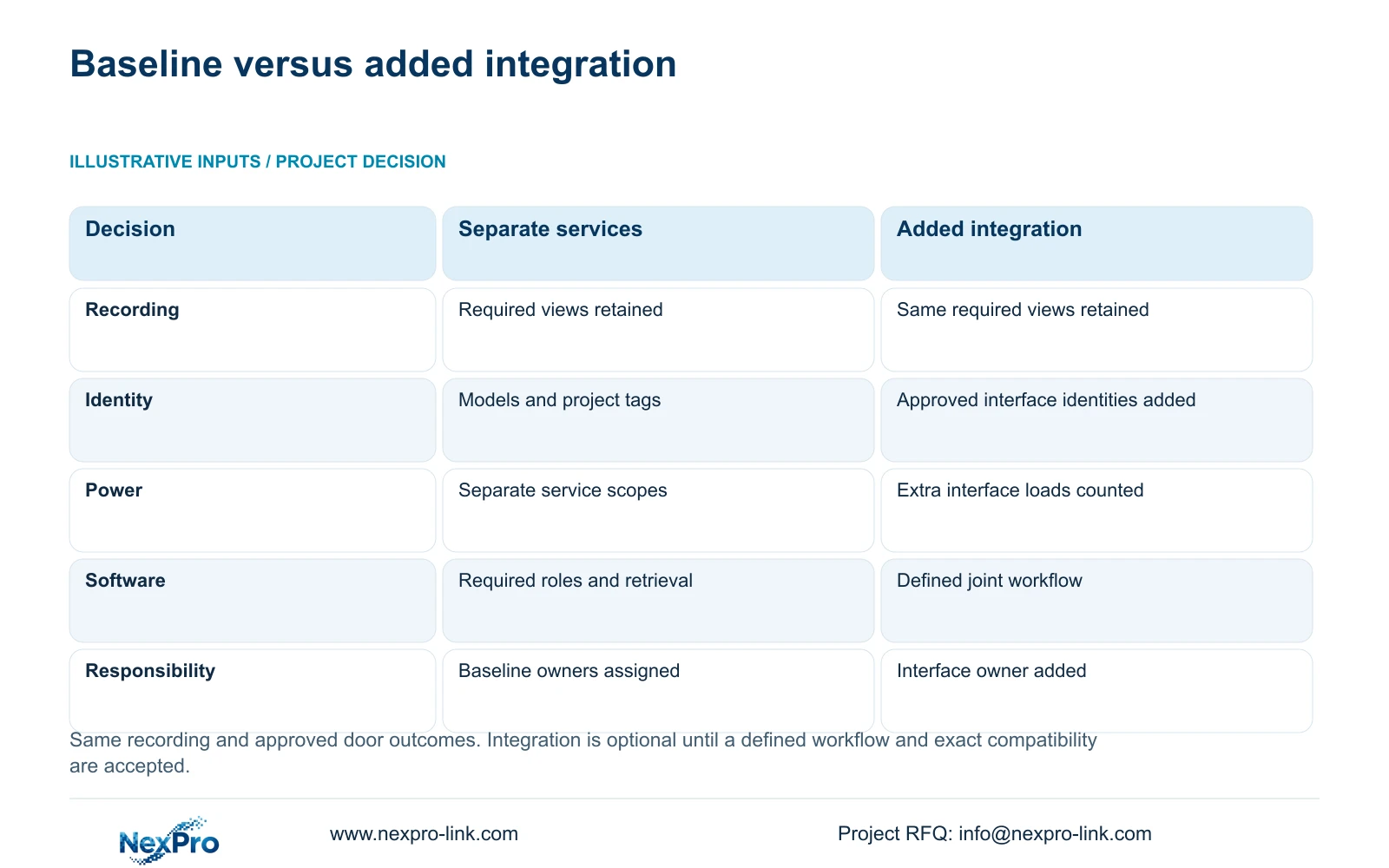
Option A is a complete CCTV recording package alongside separately approved access-control service. Option B retains those outcomes and adds a specific management workflow, such as authorised lookup of video around an access event. Compare the same recording and door targets in both options; integration cannot justify removing an essential supply or approved door function.
The decisive difference is the additional interface and its operating dependencies. Option B needs exact compatibility evidence, access permissions, configuration ownership and any extra server or network power. The supplied product evidence does not establish native integration with an unspecified access-control platform.
Assign each matrix row as supplied, retained, installer-provided or optional in the project schedule. An empty field is an unresolved scope item, not a zero-price allowance or evidence that products are incompatible. The buyer should approve the additional workflow before the cost team requests an integrated quotation.
| Decision | Option A: separate services | Option B: added integration |
|---|---|---|
| Recording outcome | Required views recorded | Same required views recorded |
| Hardware identity | Exact models and project tags | Same plus approved interface identities |
| Power and network | CCTV and door scopes separately assigned | Extra servers and interfaces included |
| Software access | Authorised retrieval and door roles | Approved event-to-video workflow |
| Procurement responsibility | Complete baseline BOQ and specialist scope | Added interface scope with named owner |
Section 05
Keep independent operation unless integration has a defined benefit
Recommend the separate-service baseline for this scenario until the owner identifies a joint management task worth its added dependencies. Preserve approved door behaviour and complete camera-to-disk recording in either option. If time-based video lookup around door events is sufficient, document that workflow before commissioning custom integration.
Where integration is required, demand evidence for the exact platform, recorder and firmware combination. ONVIF Profiles distinguishes device and client functions, but basic video availability cannot prove access-event association, alarm actions or search behaviour. Test each required workflow without using the video system to determine life-safety door actions.
The NexPro-NVR4449-4K can be considered against the reference recording workload using its published input and disk fields. SP1KR(S), quoted at 1 kVA / 900 W, is a CCTV capacity reference, not an approved door-system supply or a combined-runtime promise. Change the proposal if specialist requirements, added loads or mandatory software interfaces alter that boundary.
Section 06
Commission separate outcomes and document the interface boundary
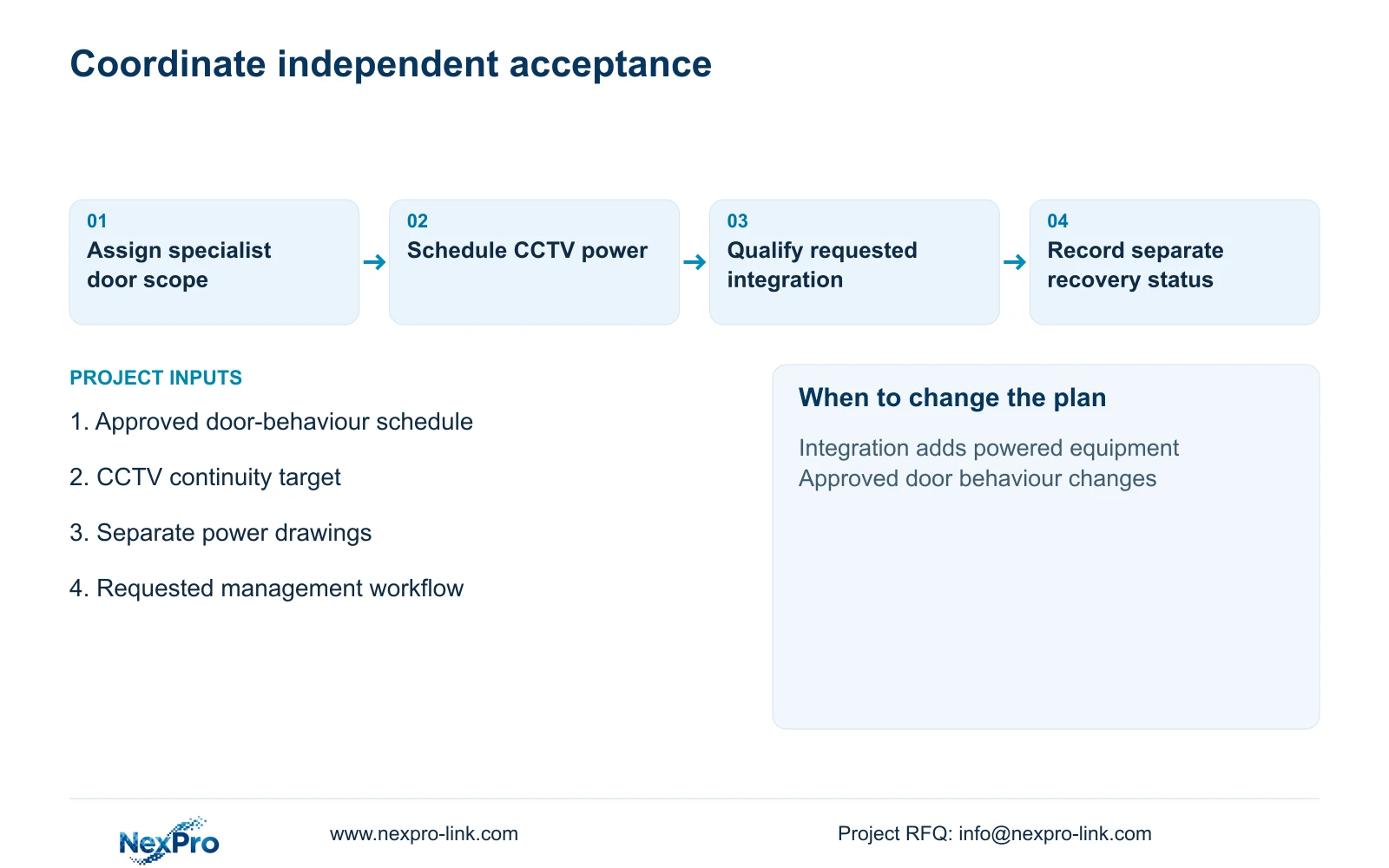
Write separate acceptance records for surveillance and access control. The integrator verifies current recording, timestamps, playback and export. The access specialist verifies the approved door behaviours through its authorised procedures. The project manager then verifies any defined management interface and records which upstream dependencies remain shared.
NexPro-Link's factory project and BOQ support can help organise CCTV model matching, protected equipment and submittal deviations. One coordinated supply enquiry can simplify equipment and document handling while keeping specialist systems and local installation responsibilities distinct. It should not imply that every product shares software or comes from the same manufacturing process.
Include a restart responsibility for each service after an outage. Restoration of video viewing should not be used to close an unresolved door-system issue, and a recovered access log should not establish successful camera recording. The handover pack should let the owner identify each service's status without interpreting a single broad system-healthy indicator.
Section 07
Buyer questions
Can one supplier coordinate both systems without providing integration? Yes. Equipment schedules, packing and technical documents can be coordinated while the systems retain separate operation and specialist responsibilities. State whether software integration is included, optional or outside the offer.
Can the CCTV runtime calculation size the door-system battery? No. It excludes door-system loads and does not establish their supply requirements or approved operating behaviour. Obtain a separate specialist load and backup assessment.
Is time-based lookup an acceptable alternative to custom integration? It may be sufficient if the owner accepts the retrieval workflow and timestamps are consistent. Define the task and demonstrate a relevant event lookup before purchasing additional software or interfaces.
Section 08
Separate the two outage scopes
Send your approved door-behaviour schedule, essential CCTV service target, separate power drawings and requested event-to-video workflow to info@nexpro-link.com. NexPro-Link can discuss the surveillance equipment and coordination boundary alongside your appointed specialists.
Engineering references
These sources support the general planning principles. Always use the selected product's current datasheet and applicable project standards for final design.