For each approved housing, pair the exact camera with its documented bracket, entry arrangement and service-access requirement. Reconcile those kits against location tags before packing.
Section 01
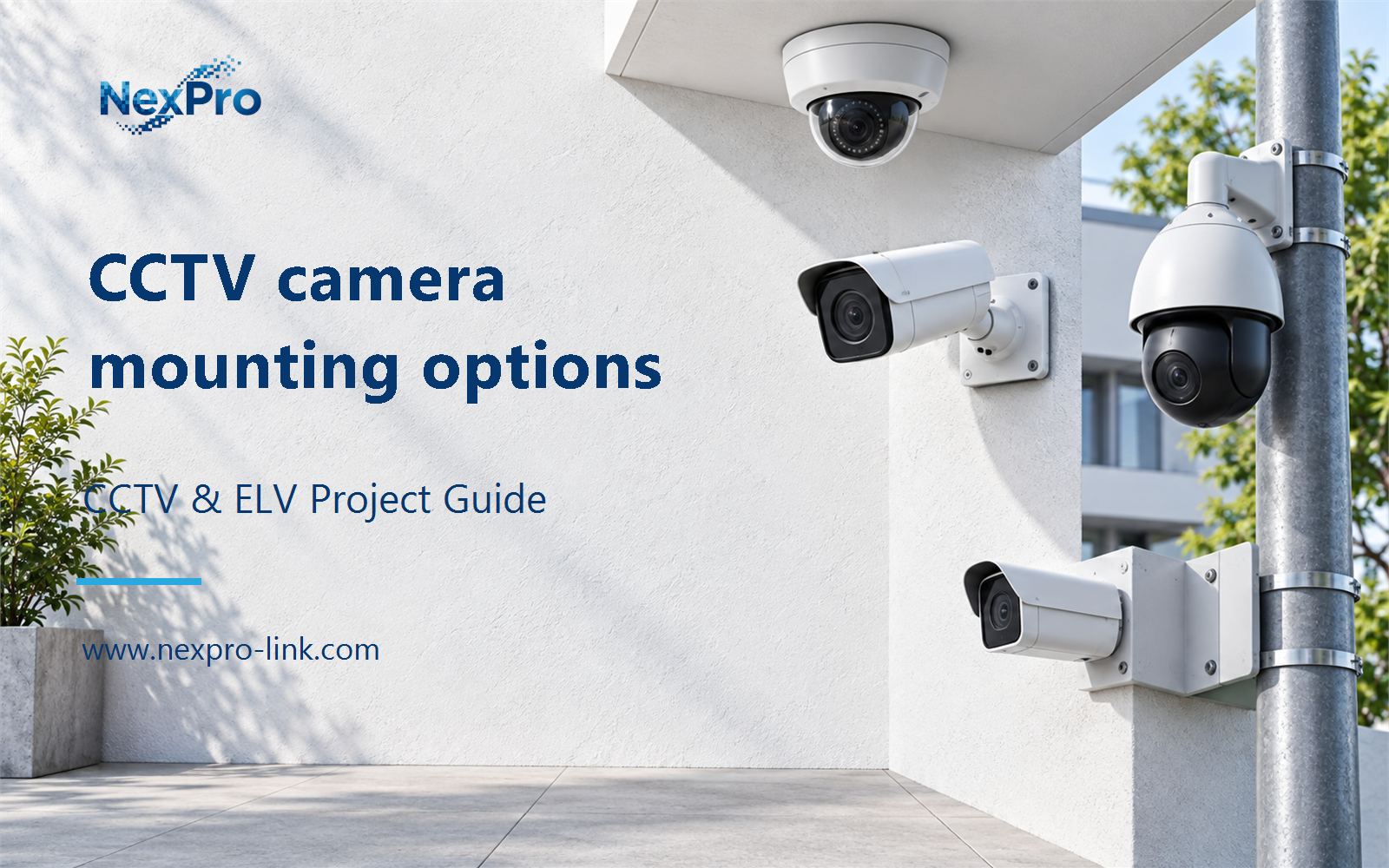
Start with a mount that can be installed and serviced
For each approved housing, pair the exact camera with its documented bracket, entry arrangement and service-access requirement. Reconcile those kits against location tags before packing. Hold an unmatched accessory or unqualified substitute separately; a carton containing the correct camera model is not proof that its installed assembly can be completed.
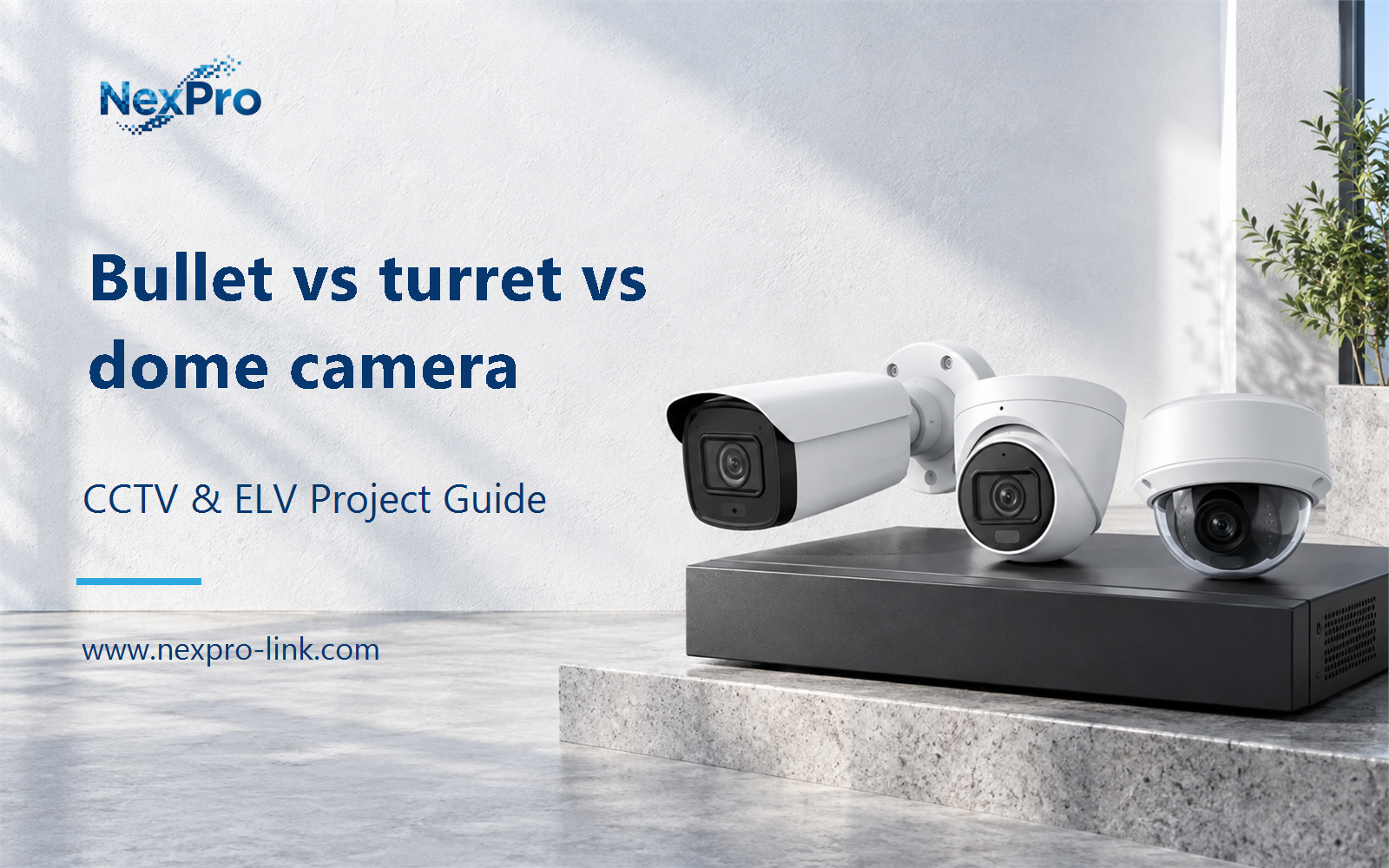
Choose bullet, dome or turret forms according to the proposed mount, cleaning access and security conditions. First confirm that the installed assembly preserves the required view. Then check exact product ratings and accessories. A dome-style appearance does not independently establish an IK impact rating or suitability for a particular industrial environment.
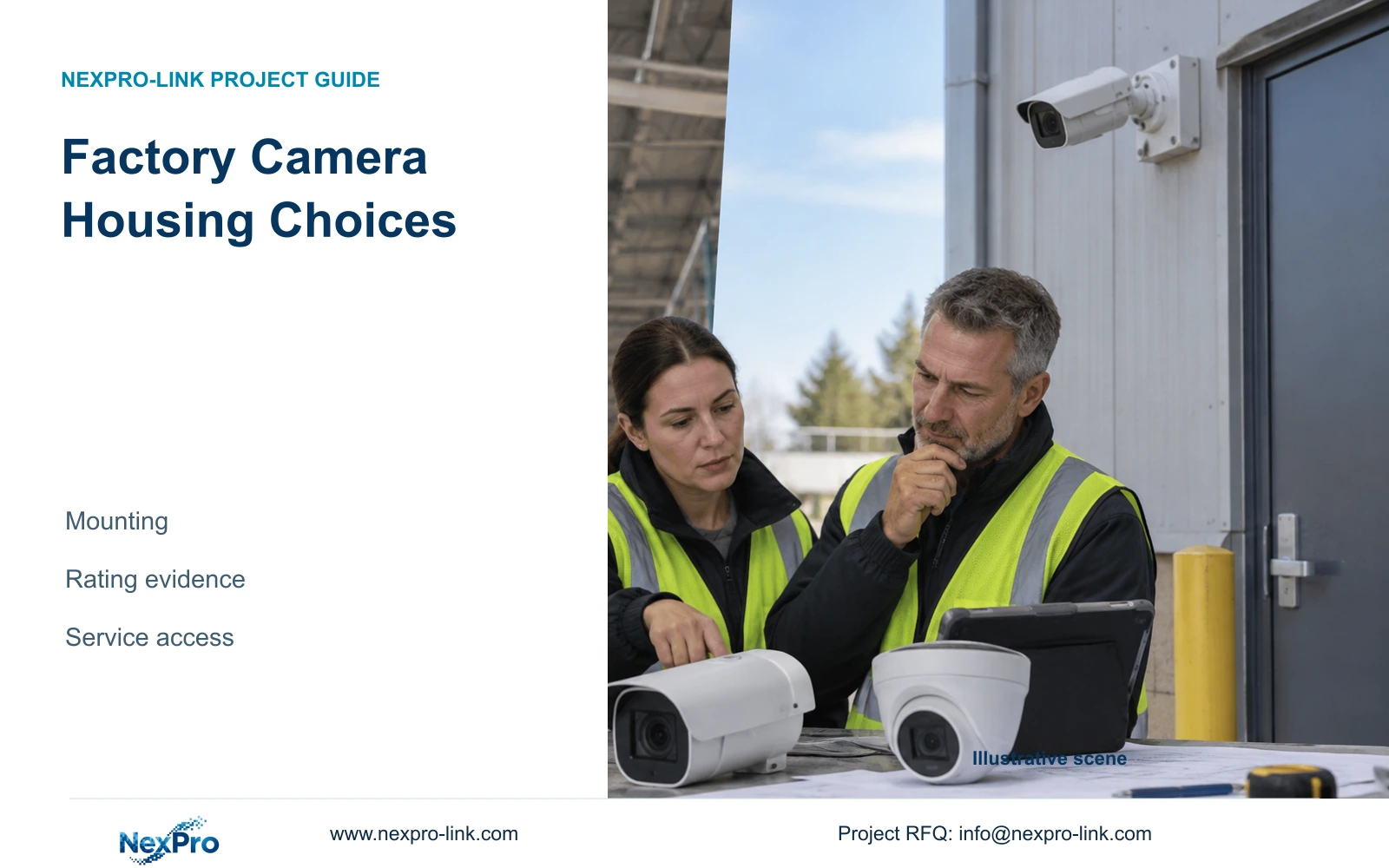
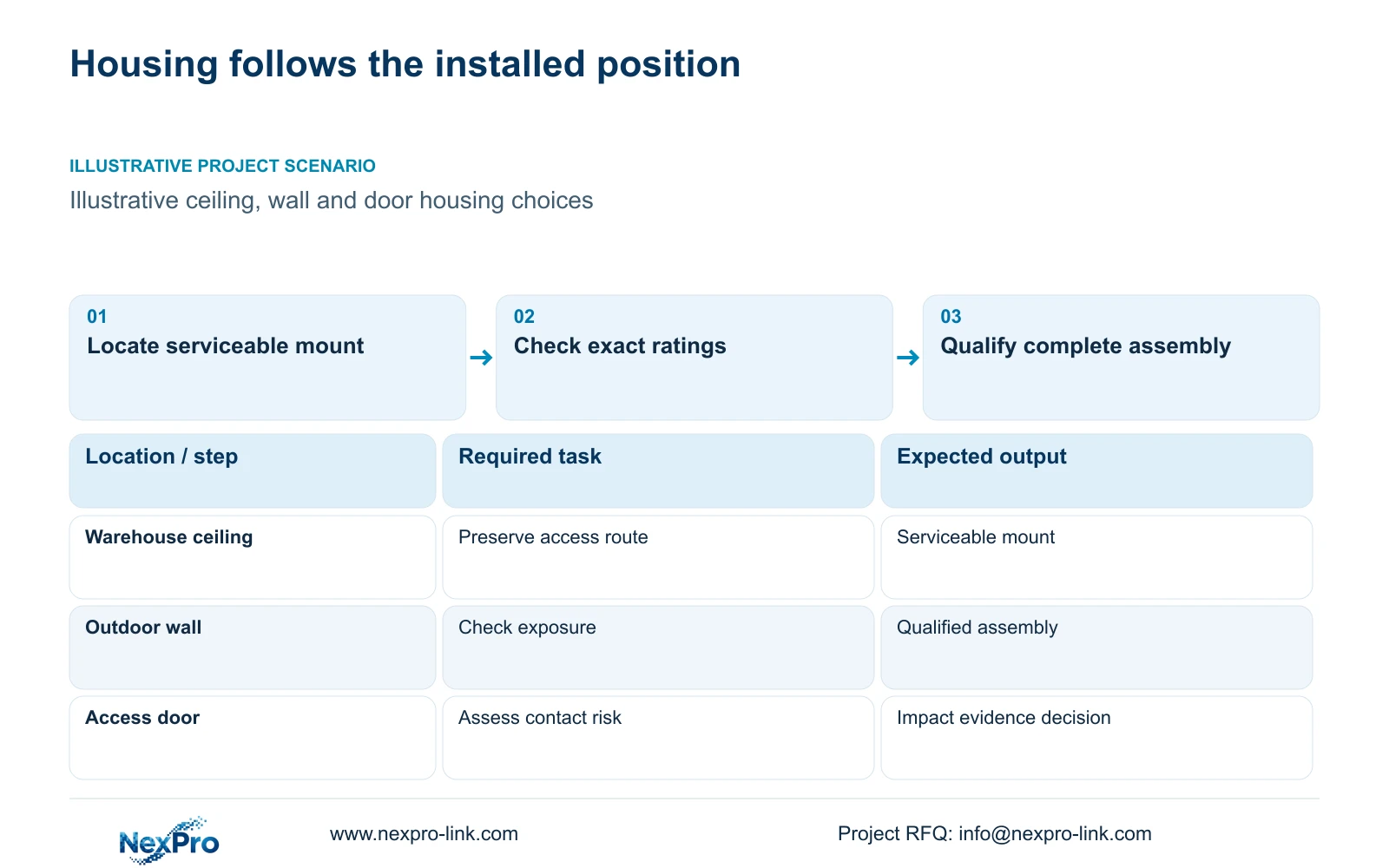
Illustrative project scenario: A contractor is choosing housings for a warehouse ceiling, an outdoor wall and an exposed access door. Use the supplied 32-camera CNC reference as the wider ordinary-security system. Assume these three positions have different access and interference risks. The housing choices remain provisional until mounting and maintenance conditions are reviewed.
For each position, mark the supporting surface, cable entry, required viewing direction and service approach. Include obstructions that appear when stock or equipment occupies the space. A visually tidy ceiling position may become difficult to service after racking, while a convenient wall position may expose the assembly to routine handling.
Section 02
Separate housing form from documented protection
Keep body form, environmental rating and impact evidence in different schedule fields. The supplied NexPro-BL2812M55-5MP-DIC-AI bullet reference lists IP66. The NexPro-DM2812M55-5MP-DIC-AI source is named Dome and also lists IP66. Neither supplied reference establishes an IK rating, so do not describe either as meeting an unspecified impact requirement.
At the exposed door, ask whether interference or accidental contact requires documented impact performance. If it does, request an exact qualified model and assembly rather than selecting by shape. A change to mounting height or position can also be considered, provided it preserves the agreed evidence and remains serviceable.
No exact turret model is supplied in this evidence set. Keep a turret as a functional alternative requiring its own dimensions, ratings, mounting details and image qualification. Do not relabel the DM source family to fill that gap. The commercial comparison should identify which candidates are documented and which still need evidence.
Section 03
Describe the service task before estimating effort
Ask site personnel to define the planned service activity at each location. Access, visual inspection, cleaning and a recorded-image check may require different time and equipment. Include the work needed to open or reach the selected assembly, then return it to the accepted view without leaving an unresolved image change.
For the warehouse ceiling, coordinate access with the final rack layout. For the outdoor wall, confirm how the contractor reaches the camera and cable connection. At the access door, consider both service access and interference exposure. These conditions can change the preferred form without changing resolution or the underlying security task.
The qualified schedule should identify the supplied housing and accessory, the local installation work and the maintenance owner. The supplier confirms the selected product and compatible accessories; the installer confirms the mount; the owner accepts the service arrangement. Keeping these responsibilities separate prevents an equipment-only quotation from being mistaken for a complete installation plan.
| Position | Practical decision | Evidence needed |
|---|---|---|
| Warehouse ceiling | Keep service approach clear | Mount and rack coordination |
| Outdoor wall | Match assembly to exposure | Exact ratings and accessories |
| Exposed door | Assess contact and interference | Impact evidence if required |
Section 04
Compare access effort using declared assumptions
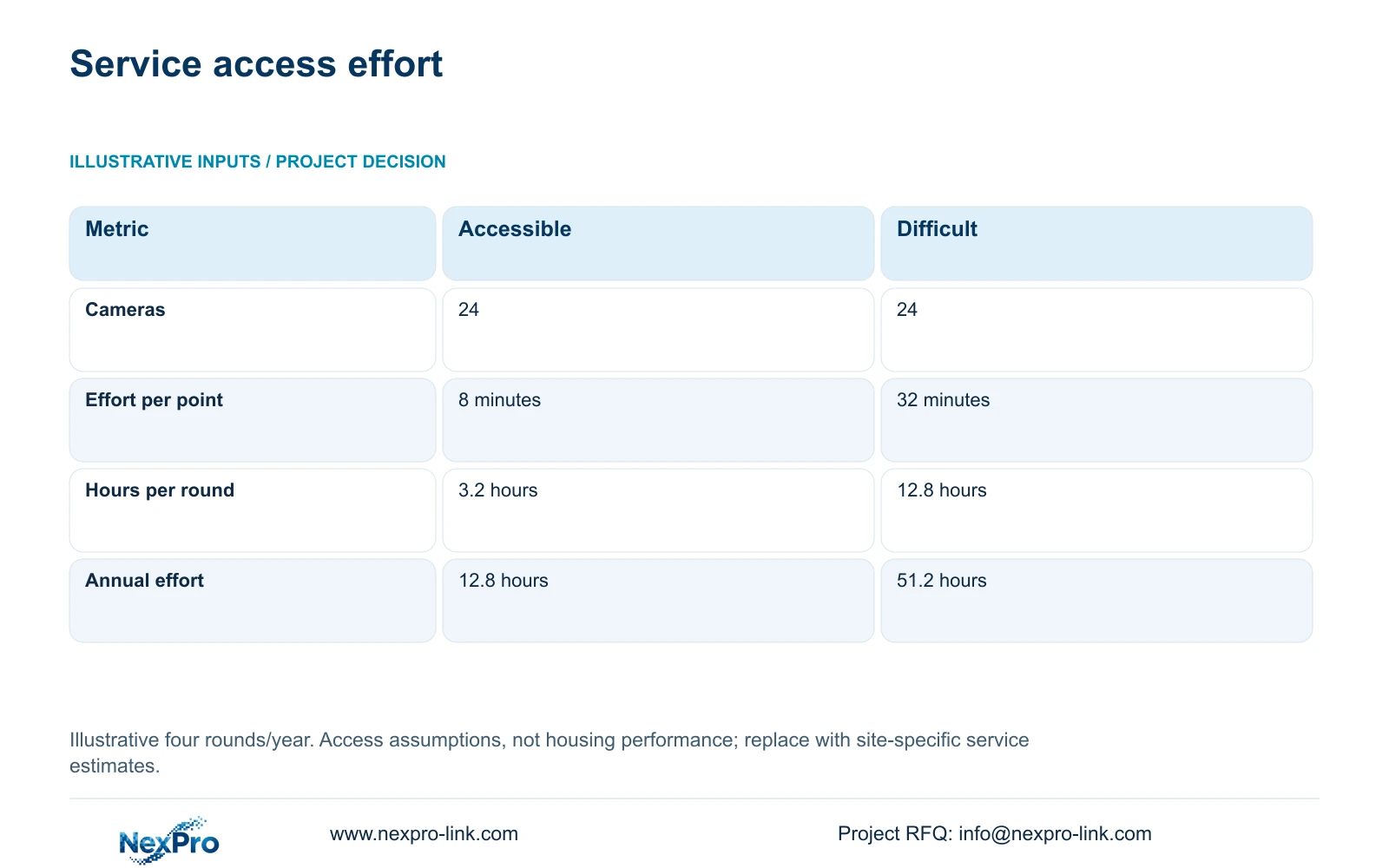
The illustrative maintenance calculation covers 24 cameras, separate from the full 32-camera reference. Option A assumes 8 minutes of access and inspection effort per point; Option B assumes 32 minutes. Both use four rounds per year as a planning input, not a universal maintenance interval.
Hours_per_round = cameras × minutes_per_point / 60. Option A gives 24 × 8 / 60 = 3.2 hours; Option B gives 24 × 32 / 60 = 12.8 hours. Annual_hours = cameras × minutes_per_point × rounds / 60, producing 12.8 and 51.2 annual hours respectively.
The decisive difference comes from access assumptions, not from a claimed housing advantage. Identical camera prices can sit within very different service plans. Replace the minutes and frequency with site-specific estimates before commercial use, and identify whether they represent elapsed time or person-hours. Crew size, equipment hire and production coordination need separate treatment.
| Metric | Accessible arrangement | Difficult arrangement |
|---|---|---|
| Cameras | 24 | 24 |
| Minutes per point | 8 | 32 |
| Hours per round | 3.2 | 12.8 |
| Rounds per year | 4 | 4 |
| Annual hours | 12.8 | 51.2 |
Section 05
Approve a mixed housing schedule without changing evidence
Prefer the documented form that meets the location's mounting and service needs while passing the recorded-view task. A bullet candidate may suit the proposed wall arrangement; the documented Dome candidate may suit a ceiling arrangement. Those are options to qualify, not universal rules about where each housing belongs.
Keep the image requirement constant when changing form. The supplied 5MP-family bullet and Dome references list 2880×1620 output and 2.8-12 mm motorized lenses. Shared fields help organise a comparison, but do not prove identical image performance, accessory fit or service effort. Check the selected assembly at its actual position.
Change the recommendation when cleaning conditions, stock height, impact requirements or access arrangements change. If the accessible position weakens the evidence, review another mount rather than accepting the image loss solely to reduce service time. Compare complete installation and maintenance quotations, with unknown costs left visible instead of treated as zero.
Section 06
Order the assembly and its location-specific accessories
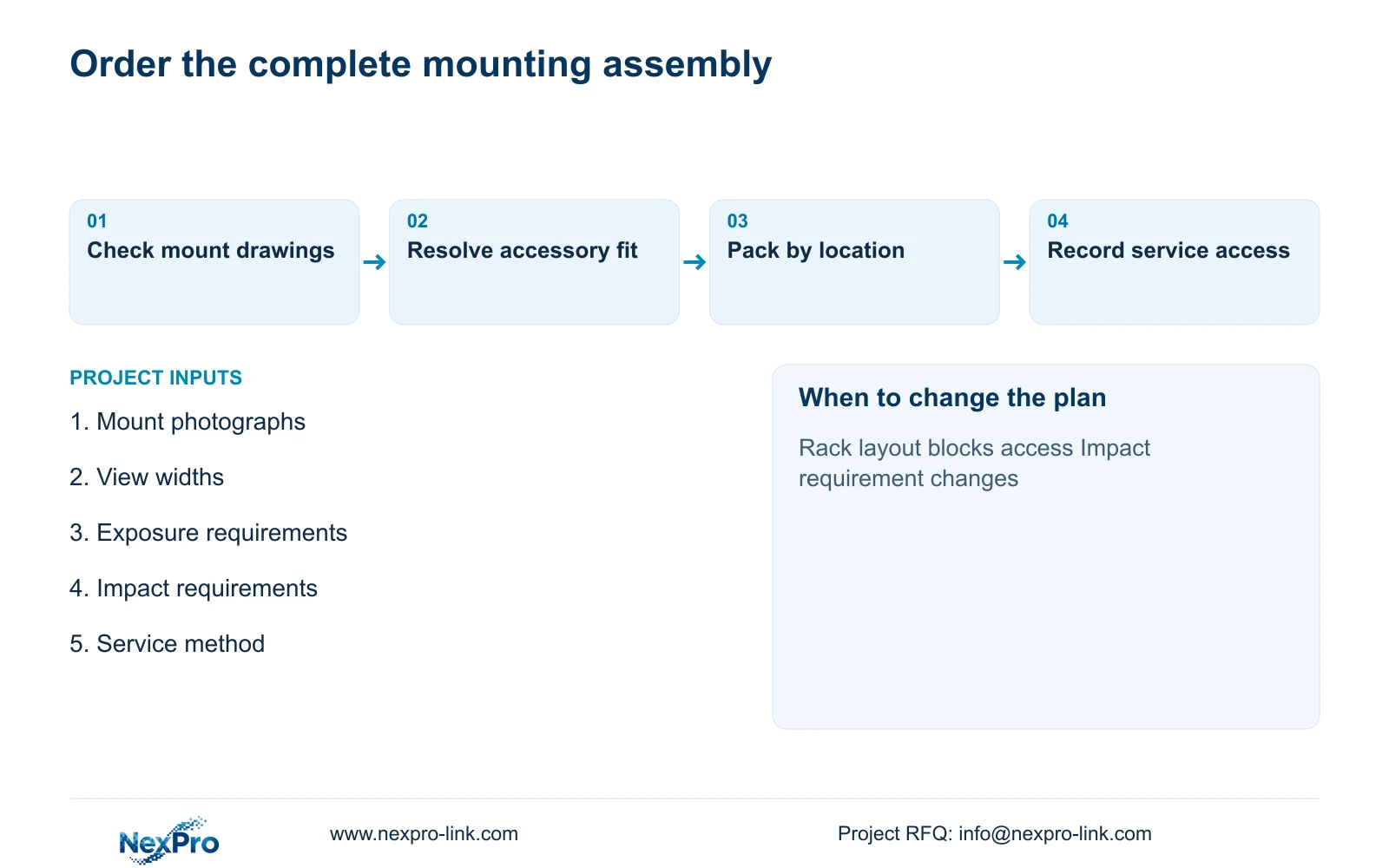
Release the camera schedule with mounting surface, approved housing, accessory reference, cable-entry arrangement and service method. Ask for unresolved accessory compatibility to be closed before shipment. A camera body without its required bracket or connection arrangement can leave the installer unable to reproduce the approved position.
NexPro-Link can discuss model matching, BOQ documentation and project supply for the ordinary CCTV scope. Location-labelled packing can keep different camera forms and their accessories together. Local mounting, safe access and environmental suitability remain assigned to the responsible project personnel.
At handover, retain photographs of the installed assembly and accepted recorded view. Include the maintenance access plan beside the asset entry. Future replacement decisions can then preserve both imaging and service conditions, instead of choosing a similar-looking camera that introduces a new mounting or cleaning problem.
Section 07
Buyer questions
Should a lower camera position be preferred for easier cleaning? Only if it preserves the required view and suits the site's interference and contact risks. Compare the complete installed position. Easier access is useful, but it should not remove evidence or create an unqualified protection requirement.
Can the Dome reference be offered as a turret equivalent? Retain its source name as Dome. A turret proposal needs its own exact model documentation and mounting qualification. Similar appearance or shared output dimensions do not establish interchangeability.
Section 08
Build a serviceable housing schedule
Send mounting-position photographs or drawings, exposure and impact requirements, required view widths and the proposed service-access method to info@nexpro-link.com for camera and accessory matching.
Engineering references
These sources support the general planning principles. Always use the selected product's current datasheet and applicable project standards for final design.