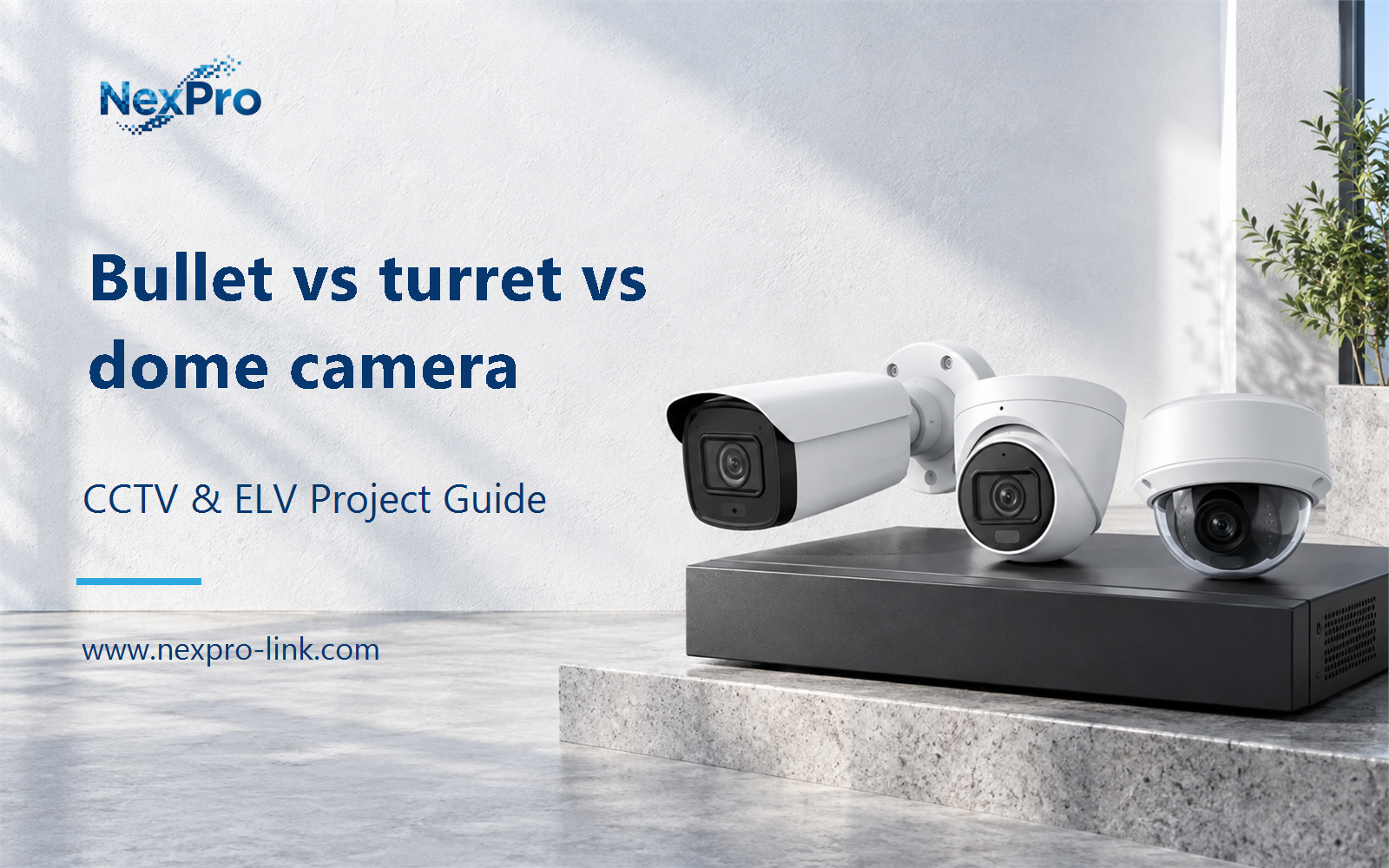
Plan bullet vs turret vs dome camera with practical guidance on name the housing by its physical structure and separate impact and ingress requirements. NexPro-Link project guide.
Section 01
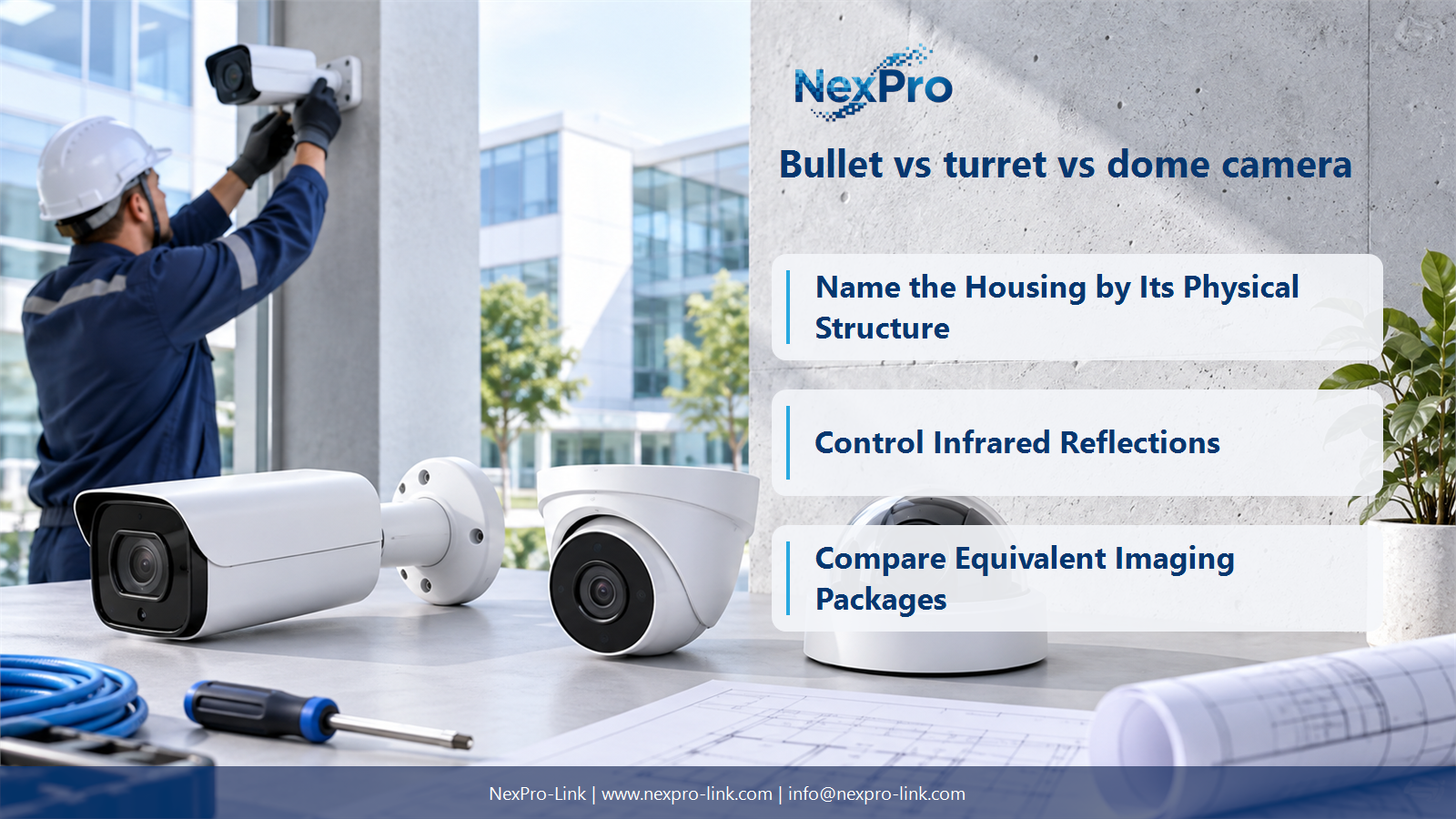
Name the Housing by Its Physical Structure
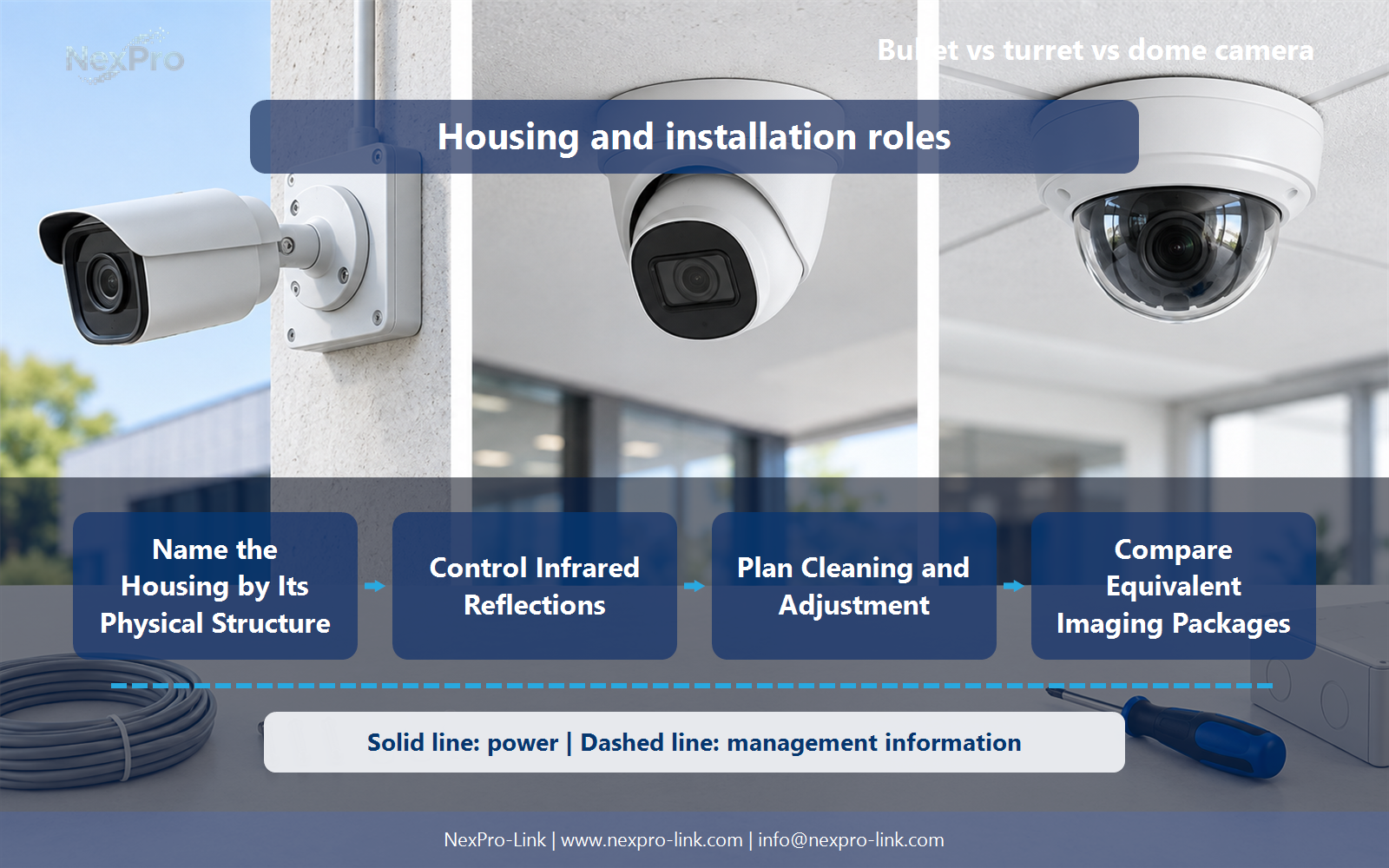
A bullet usually has an elongated body, a turret an adjustable exposed lens module, and a dome a protective cover around the imaging assembly. Product family names do not always follow the same convention. Examine the actual housing and mounting arrangement rather than assigning impact protection or infrared performance from the word dome alone.
Turn the answer into a working record using Form, Physical structure, Adjustment, Typical mounting concern.
| Decision area | Buyer question | Required output |
|---|---|---|
| Name the Housing by Its Physical Structure | What is the practical difference between bullet, turret and dome cameras? | A bullet usually has an elongated body, a turret an adjustable exposed lens module, and a dome a protective cover around the imaging assembly. |
| Match the Form to the Mounting Surface | Which form factor suits wall and ceiling installation? | Choose the housing and accessory combination that can achieve the required angle without obstructing the lens or cable exit. |
| Control Infrared Reflections | Why can a dome camera show a washed-out night image? | Light can reflect from a dirty or damaged cover, nearby surfaces or an unsuitable installation arrangement. |
Section 02
Match the Form to the Mounting Surface
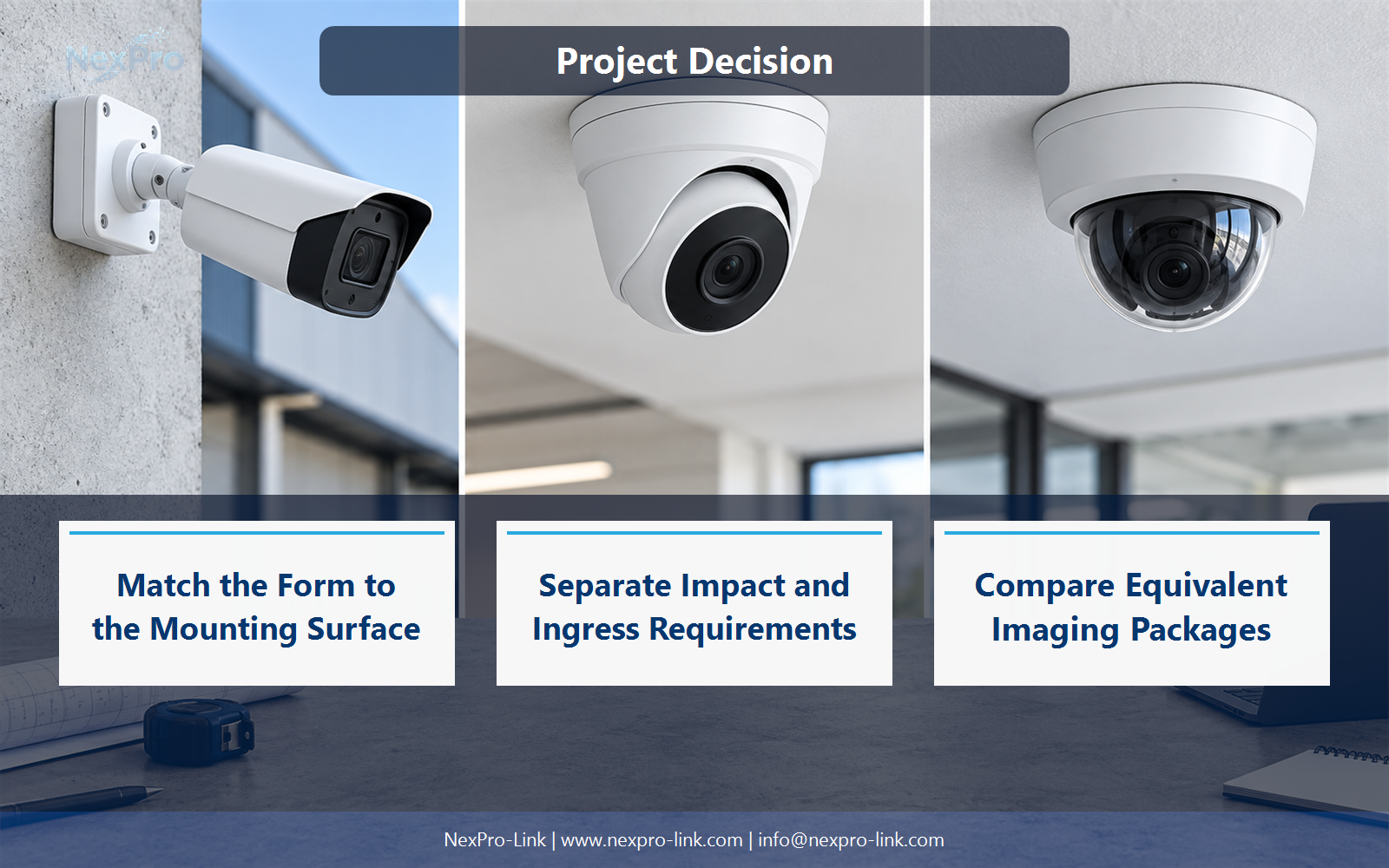
Choose the housing and accessory combination that can achieve the required angle without obstructing the lens or cable exit. A wall-mounted camera may need a different bracket from the same camera on a ceiling. Compare service access, mounting strength and route concealment as well as appearance before selecting the form.
Use Surface, View angle, Mount, Cable exit, Access to compare options on the same basis. Keep product capability, project assumption and operating responsibility in separate columns.
Section 03
Control Infrared Reflections
Light can reflect from a dirty or damaged cover, nearby surfaces or an unsuitable installation arrangement. The issue is not solved simply by specifying more infrared range. Check cover condition, lens isolation, nearby reflections and the real night scene; housing design and maintenance can matter as much as the illumination specification.
The project output should make Symptom, Possible reflection path, Position change, Maintenance traceable from input to acceptance.
- Confirm the answer to: Why can a dome camera show a washed-out night image?
- Record the project fields: Symptom / Possible reflection path / Position change / Maintenance.
- Keep product capability, project assumptions and site responsibility in separate records.
Section 04
Separate Impact and Ingress Requirements
No. A shape is not an impact rating, and impact resistance is separate from water and dust protection. Select the required mechanical and environmental performance for the installation height and exposure. The supplied varifocal series lists IP66, which should not be rewritten as an unlisted impact classification or a different ingress rating.
Record Exposure, Ingress need, Impact need, Mounting consequence before selecting a product family. That makes later substitutions possible without silently changing the operational requirement.
Section 05
Plan Cleaning and Adjustment
It depends on access, contamination and the adjustments required. Compare the time to clean the optical surface, refocus or aim the view, and replace the camera without disturbing cable terminations. In a dusty or frequently washed area, a visually discreet installation can become expensive if routine service requires special access equipment.
Review Form, Cleaning task, Access method, Adjustment, Downtime with the party that will operate or maintain the system.
Section 06
Compare Equivalent Imaging Packages
Compare the same viewing task and listed imaging parameters first, then select the housing for the site. The BL2812M and DM2812M documents provide 5MP and 8MP motorized-varifocal options. Keeping those settings comparable prevents a housing comparison from becoming an accidental comparison of different resolutions, lenses or recording profiles.
Use Brand, Exact model, Resolution, Lens, Housing role as the handoff between design and procurement.
Engineering references
These sources support the general planning principles. Always use the selected product's current datasheet and applicable project standards for final design.