Plan CCTV camera lens focal length with practical guidance on define target width before focal length and compare fixed and motorized varifocal lenses. NexPro-Link project guide.
Section 01
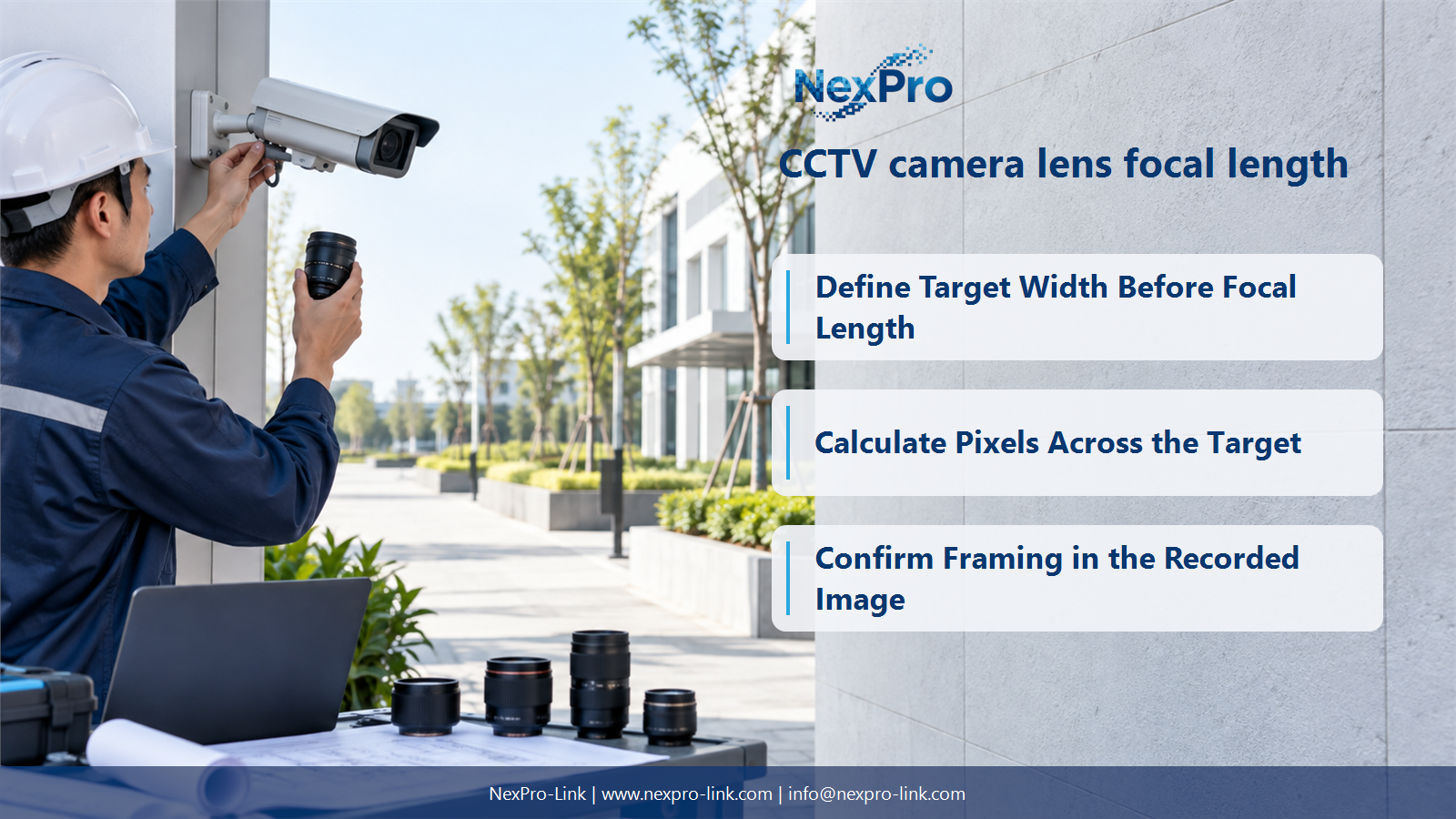
Define Target Width Before Focal Length
Measure the target distance and the scene width or specific area that must remain in view. Identify the detail needed at that plane and any obstruction or mounting constraint. Starting from a focal-length label reverses the design process; the task and geometry should determine which lens range is useful.
Turn the answer into a working record using Target, Distance, Scene width, Detail task, Mount.
| Decision area | Buyer question | Required output |
|---|---|---|
| Define Target Width Before Focal Length | What should be measured before choosing a CCTV lens? | Measure the target distance and the scene width or specific area that must remain in view. |
| Use Field-of-View Geometry Carefully | Can focal length alone determine a camera's viewing angle? | No. |
| Calculate Pixels Across the Target | How is pixels-per-metre related to camera placement? | For a defined target plane, divide the usable horizontal image pixels by the horizontal scene width in metres. |
Section 02
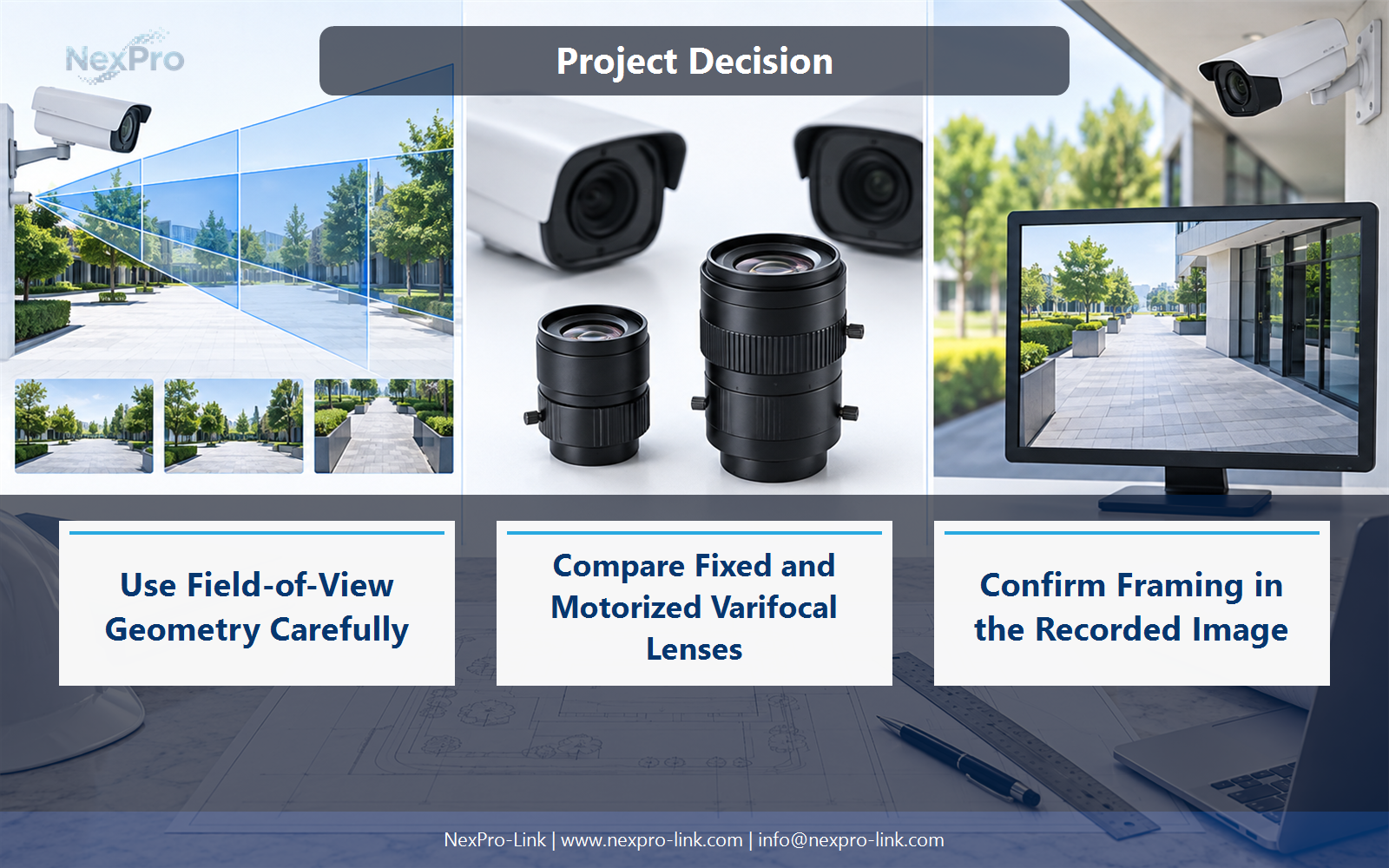
Use Field-of-View Geometry Carefully
No. Sensor geometry, lens design and the actual imaging mode influence field of view. Use the model's stated angle or an appropriate geometric calculation with the relevant sensor dimensions. A nominal optical-format label is not a direct physical sensor-width measurement, so avoid inserting it uncritically into a formula.
Use Sensor width basis, Focal length, HFOV, Scene width to compare options on the same basis. Keep product capability, project assumption and operating responsibility in separate columns.
Section 03
Calculate Pixels Across the Target
For a defined target plane, divide the usable horizontal image pixels by the horizontal scene width in metres. This is a geometric planning measure, not a guarantee of recognition under every condition. Lighting, focus, motion, compression and viewing quality can still prevent the captured detail from serving the intended task.
The project output should make Horizontal pixels, Scene width, Pixels per metre, Limiting factor traceable from input to acceptance.
- Confirm the answer to: How is pixels-per-metre related to camera placement?
- Record the project fields: Horizontal pixels / Scene width / Pixels per metre / Limiting factor.
- Keep product capability, project assumptions and site responsibility in separate records.
Section 04
Compare Fixed and Motorized Varifocal Lenses
It is useful when the installer needs to refine framing without physically changing lenses or when the initial geometry is uncertain within the lens range. It does not replace correct mounting or create a new view beyond that range. A fixed lens remains appropriate when the required framing is known and suitable.
Record Option, Framing flexibility, Access need, Installation trade-off before selecting a product family. That makes later substitutions possible without silently changing the operational requirement.
Section 05
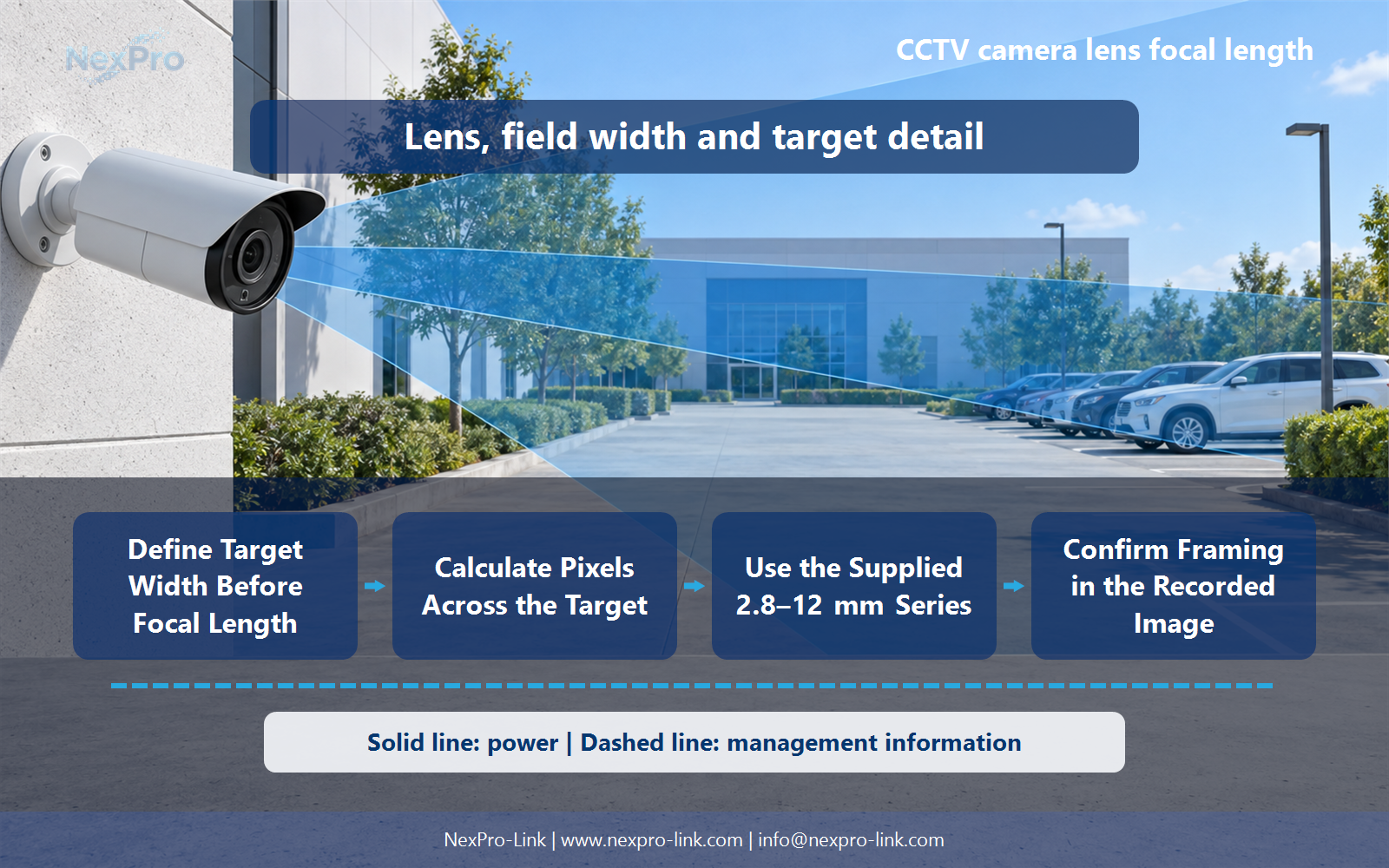
Use the Supplied 2.8–12 mm Series
Describe the supplied BL2812M and DM2812M models as 2.8–12 mm motorized-varifocal cameras, with the stated nominal 4× designation. Keep their exact model codes unchanged. Motorized focal adjustment is not pan-and-tilt movement, and the lens specification alone does not supply a universal identification or infrared distance.
Review Brand, Exact model, Lens range, Imaging option, Application with the party that will operate or maintain the system.
Section 06
Confirm Framing in the Recorded Image
Check the required target at the nearest and farthest useful positions in both representative day and night conditions. Confirm focus, motion detail and that the exported recording retains the intended framing. Save the lens and image settings with the camera schedule so a replacement or later adjustment can reproduce the design intent.
Use View, Lens setting, Focus, Recorded target, Saved setting as the handoff between design and procurement.
Engineering references
These sources support the general planning principles. Always use the selected product's current datasheet and applicable project standards for final design.