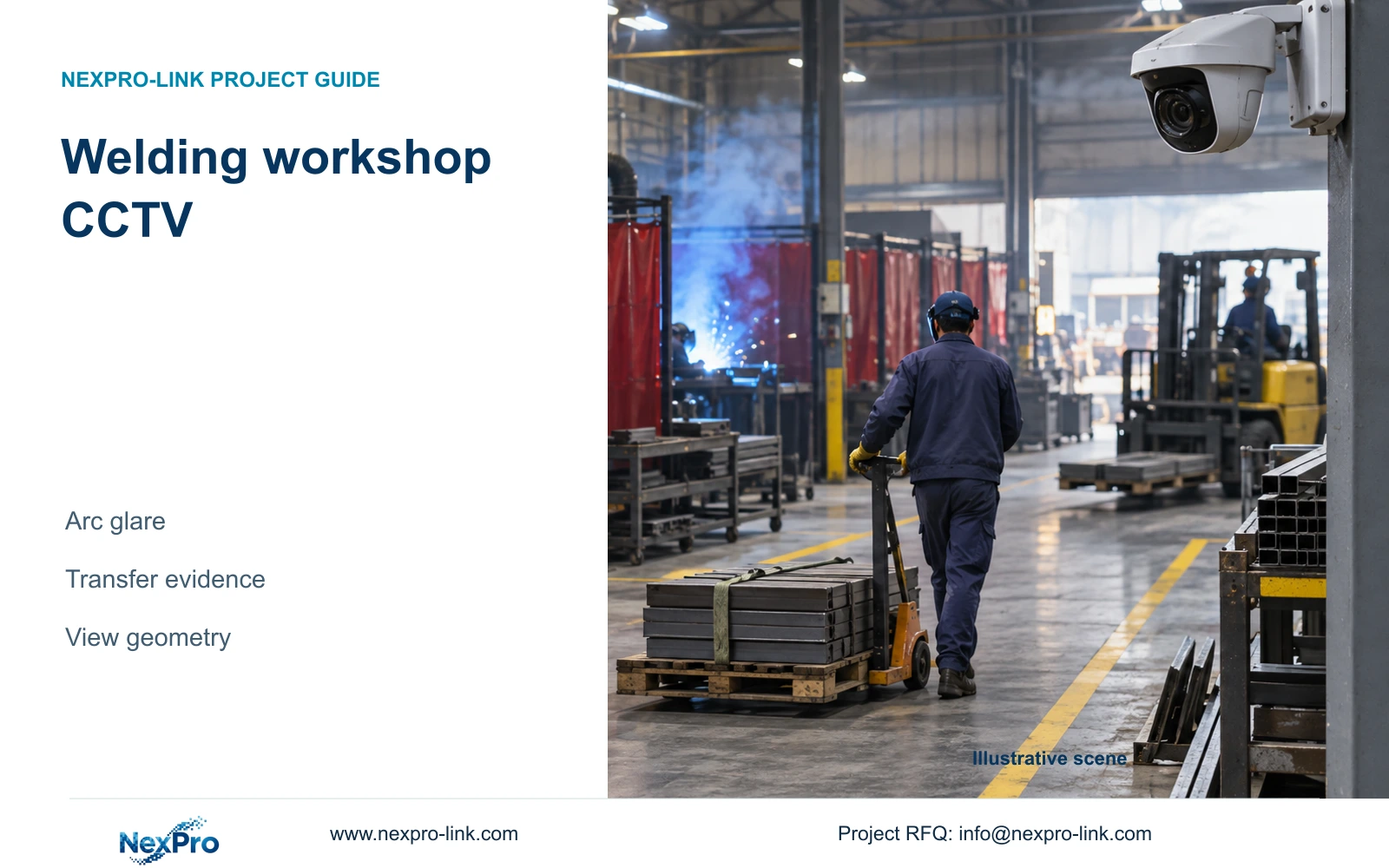
Welding workshop CCTV can document access and material movement from suitable positions. Define those events separately from weld inspection and test the recorded image during operation.
Section 01
Aim at the access event outside the welding task
Welding workshop CCTV should be positioned for the agreed access and material-transfer events, with direct arc exposure avoided as the default view. Surveillance WDR marketing does not establish weld-inspection capability or immunity to intense light. Start by locating the evidence task relative to the cell screens, working positions and transfer route, then assess candidate camera locations.
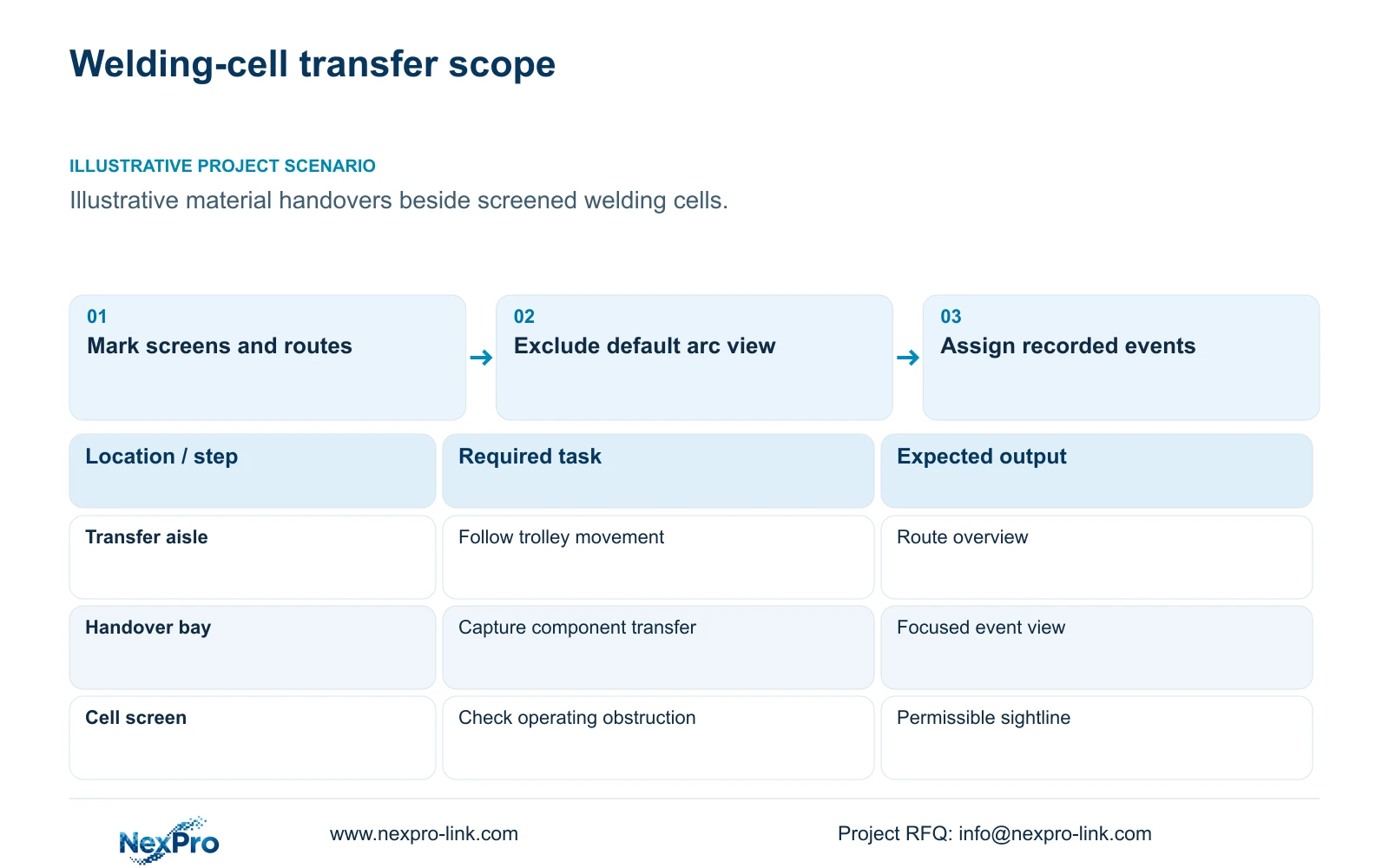
Illustrative project scenario: The workshop requests evidence of material movement beside welding cells rather than weld inspection. Assume the relevant event is a component trolley arriving at a handover bay and leaving after collection. A route overview and a focused bay view are provisional options. The scenario does not claim that either camera has been tested in a welding environment.
Map where screens, open cell entrances and smoke can affect each sightline during work. Keep mounting and servicing outside unsuitable process conditions. A position with a clear empty-workshop image may become unusable when welding starts or a trolley parks. Ask the owner to define the specific action that must remain visible before assigning a model.
Section 02
Compare the route overview with the handover angle
The overview should preserve approach direction and departure context. The handover view should show the component or container passing across the agreed boundary. Place both target planes on the drawing and compare camera angles with screens in their normal operating positions. Do not remove or alter protective arrangements to improve a security image.
A side angle facing along the transfer route may exclude direct views into the cell while retaining trolley movement. A focused view near the bay may reveal the handover but lose the approach. Evaluate whether one view can satisfy both tasks before adding a second camera. If the screen or parked load hides the decisive action, changing resolution leaves that geometric failure unresolved.
Record camera-location exposure and service constraints separately from image settings. Heat, deposits and cleaning access can change the permissible position. If the required event cannot be seen from a suitable ordinary location, identify a specialist front-end requirement for review rather than describing the ordinary camera as welding-resistant.
Section 03
Approve an actual recorded transfer sequence
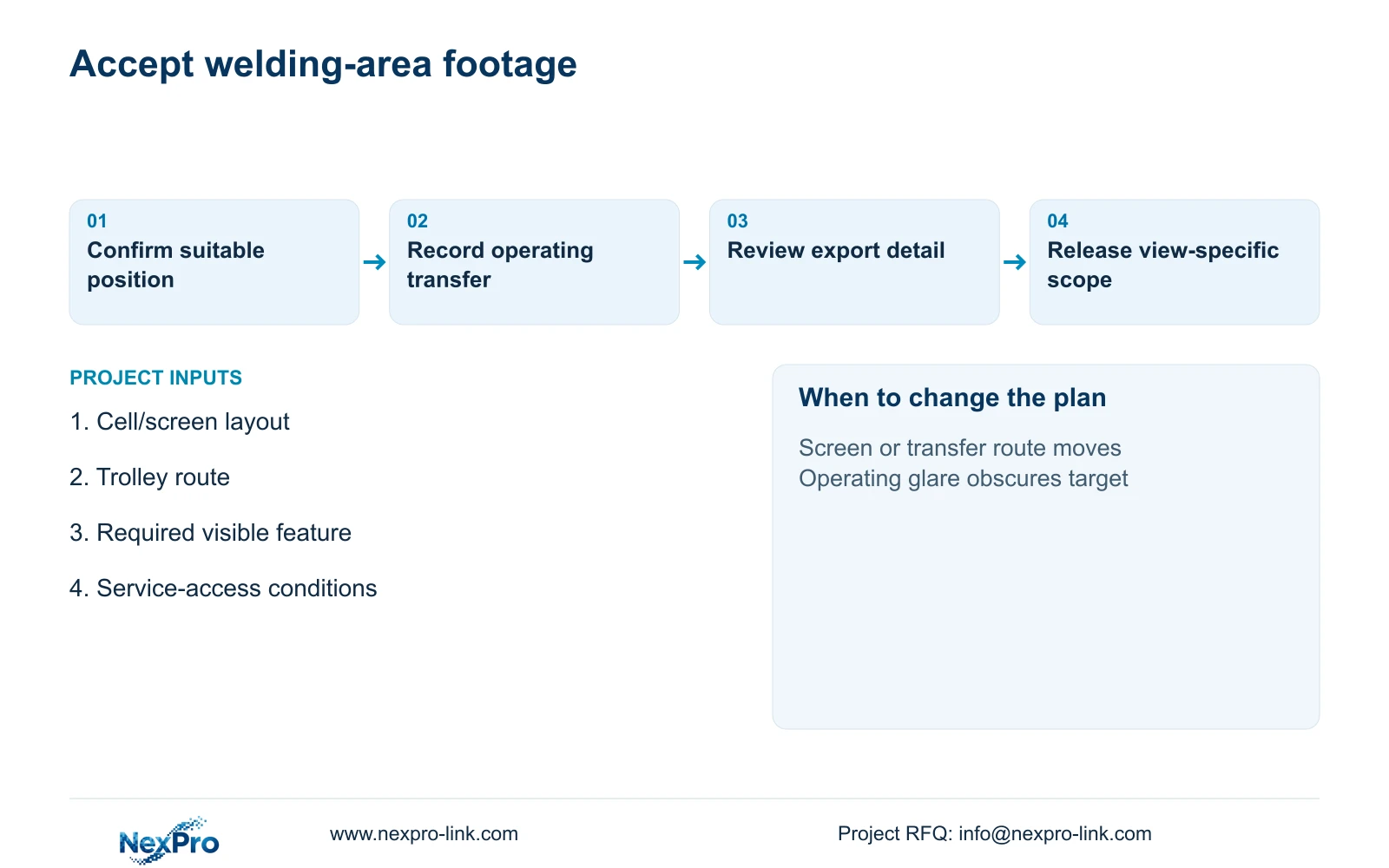
Set acceptance around a representative sequence: the trolley approaches, the transfer occurs and the trolley departs. Have the owner specify whether the footage must distinguish the container, component family or another visible feature. State the operating lighting and cell conditions for the test. A sharp still image between welding operations is insufficient evidence for the required recording task.
Review exports with welding active where the site's responsible team permits the exercise. Check whether glare affects the target, whether smoke hides it and whether the recorded detail remains usable through the event. Keep test settings and unresolved limitations in the location schedule. The purpose is to accept the security evidence, not to grade the weld.
The NexPro-BL2812M55-5MP-DIC-AI source lists 2880×1620 as a main output field and a 2.8–12mm motorized lens. The DM2812M55 source Dome family also lists that output. These specifications can support ordinary-position framing discussions, but neither source establishes protection from arc exposure or a weld-inspection result. Keep process inspection under its own specification.
Section 04
Use target width to distinguish context from detail
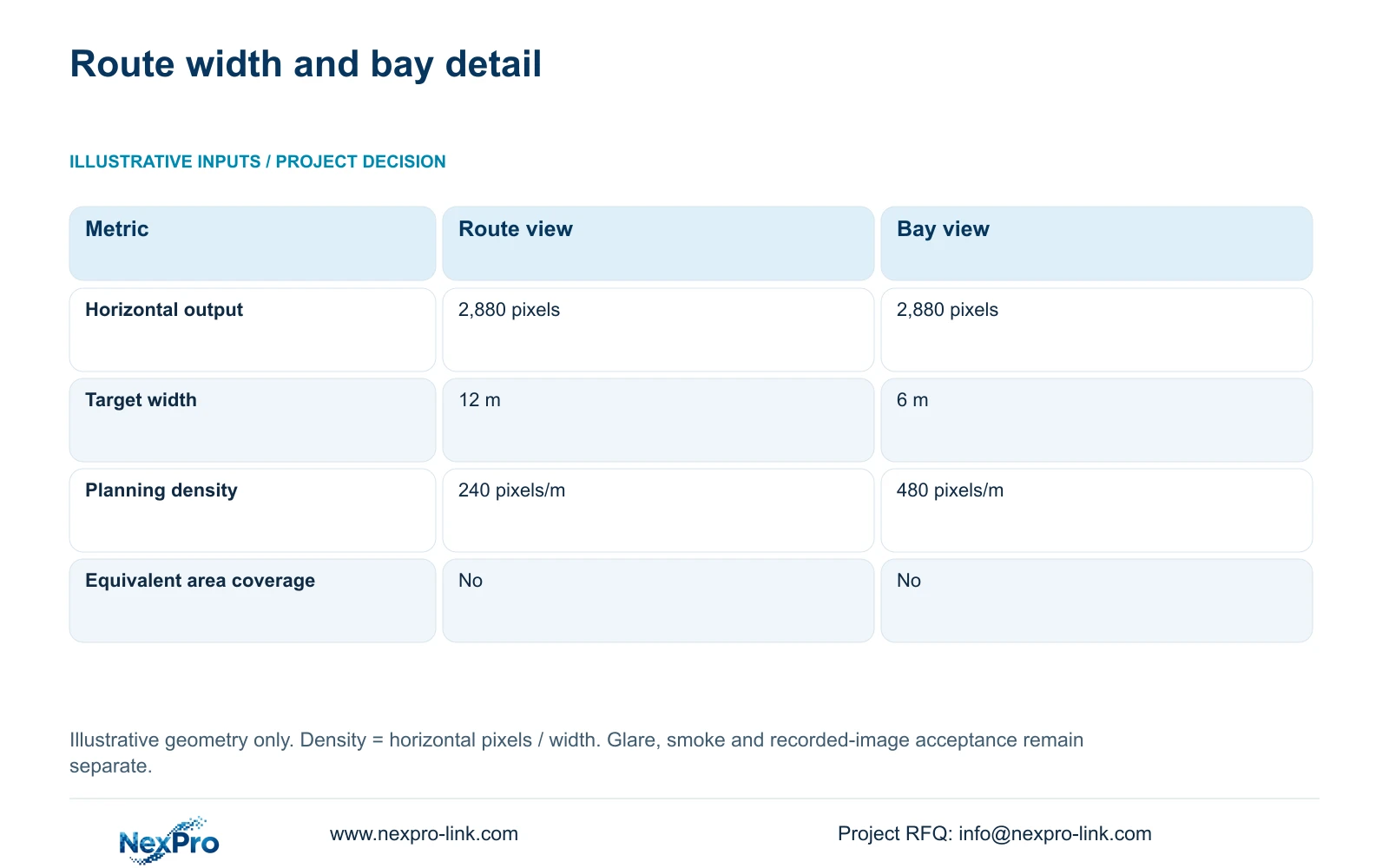
Compare the supplied illustrative widths using the same assumed 2,880 horizontal pixels. Option A covers 12 m at the target plane and Option B covers 6 m. The formula is planning_pixels_per_metre = horizontal_output_pixels / target_width_m. The results are 2,880 / 12 = 240 pixels/m and 2,880 / 6 = 480 pixels/m.
The decisive difference is the observation span. The 6 m view concentrates the available horizontal samples on the handover bay, while the 12 m view retains a broader route. The narrower option removes half the horizontal coverage and does not establish equivalent area coverage. Retain a separate overview when approach direction remains part of the evidence requirement.
These are planning results, not recognition guarantees or specified lens fields of view. Geometry, motion, light, compression and obstruction remain relevant. A higher density cannot recover an item hidden by a screen or smoke. Use the calculation to select the candidate angle and then test its recording under the agreed workshop conditions; no universal DORI threshold is assigned.
| Metric | Option A: route | Option B: bay |
|---|---|---|
| Horizontal output | 2,880 pixels | 2,880 pixels |
| Target width | 12 m | 6 m |
| Planning density | 240 pixels/m | 480 pixels/m |
| Equivalent area coverage | No | No |
Section 05
Retain context and qualify the difficult view
Recommend the suitable route position as the baseline and add the bay view only when its detail is required and demonstrated. If the wider view already retains the complete accepted transfer, the second camera remains optional. Change the recommendation when screens or smoke prevent the event from being recorded, or when the proposed location exceeds the ordinary equipment's documented suitability.
Use CASE01 as an ordinary-security capacity reference rather than a welding qualification. Its hypothetical 32 streams at 4 Mbps each produce 128 Mbps input and 41.472 TB of video over 30 days. Four 16 TB drives provide a 48.64 TB illustrative recording budget after the stated formatting allowance and reserve. Actual welding-area footage needs representative bitrate assessment before that budget is adopted.
Compare proposals with equal recording tasks, operating conditions and service boundaries. Preserve a required specialist system or mandatory platform when evaluating a NexPro-Link alternative. List additional brackets, lighting-related work and access arrangements separately. No matched arc-glare trial or price comparison is supplied, so the decision rests on accepted scope rather than an unsupported brand-performance ranking.
Section 06
Turn the accepted angle into a deliverable package
Prepare location records with cell screen position, handover plane, required recorded feature, environmental limits and service access. Identify which views are retained, supplied or optional. Include the conditions that require review, such as a moved screen or a changed trolley route. This gives the installer an explicit basis for alignment and prevents a clear view at installation from being mistaken for operating acceptance.
Carry camera changes into recording, power and cabling schedules. Verify actual peak camera demand and the selected switch's port and total power capabilities. UPS protection must include the camera supply path and recorder dependencies at their actual electrical nodes. Keep the viewing monitor or optional LCD wall as a separate client branch; display improvements cannot restore missing source footage.
NexPro-Link can discuss camera matching, BOQ deviations, technical documents and project-labelled supply through its published project-support scope. Make local mounting approval, site tuning and recorded-image acceptance separate responsibilities. If specialist weld observation is later added, retain its separate product and interface requirements rather than extending the ordinary security supply description.
Section 07
Buyer questions
Can WDR be accepted from a datasheet alone? A specification can inform candidate selection, but acceptance should use the required recorded event under representative conditions. A WDR claim alone does not establish usable welding-cell footage or protection from intense light.
Should smoke be treated as a camera-resolution issue? First determine whether smoke obstructs the sightline. Repositioning may preserve the event; increasing resolution does not reveal a target that is hidden. Have the site team confirm any change to the observation arrangement.
Can the security camera also document weld quality? Informal review does not establish inspection capability. A weld-quality requirement needs separate equipment qualification and acceptance criteria, with its own responsible process specialist.
Section 08
Scope welding-area security views
Email the cell/screen layout, material handover route, required recorded detail and operating exposure/service conditions to info@nexpro-link.com to discuss suitable security-view candidates.
Engineering references
These sources support the general planning principles. Always use the selected product's current datasheet and applicable project standards for final design.