Separate stable network and recording infrastructure from programme-specific viewpoints, then price camera additions against local storage, switching and power limits.
Section 01
Anchor shared transfer views to stable operating tasks
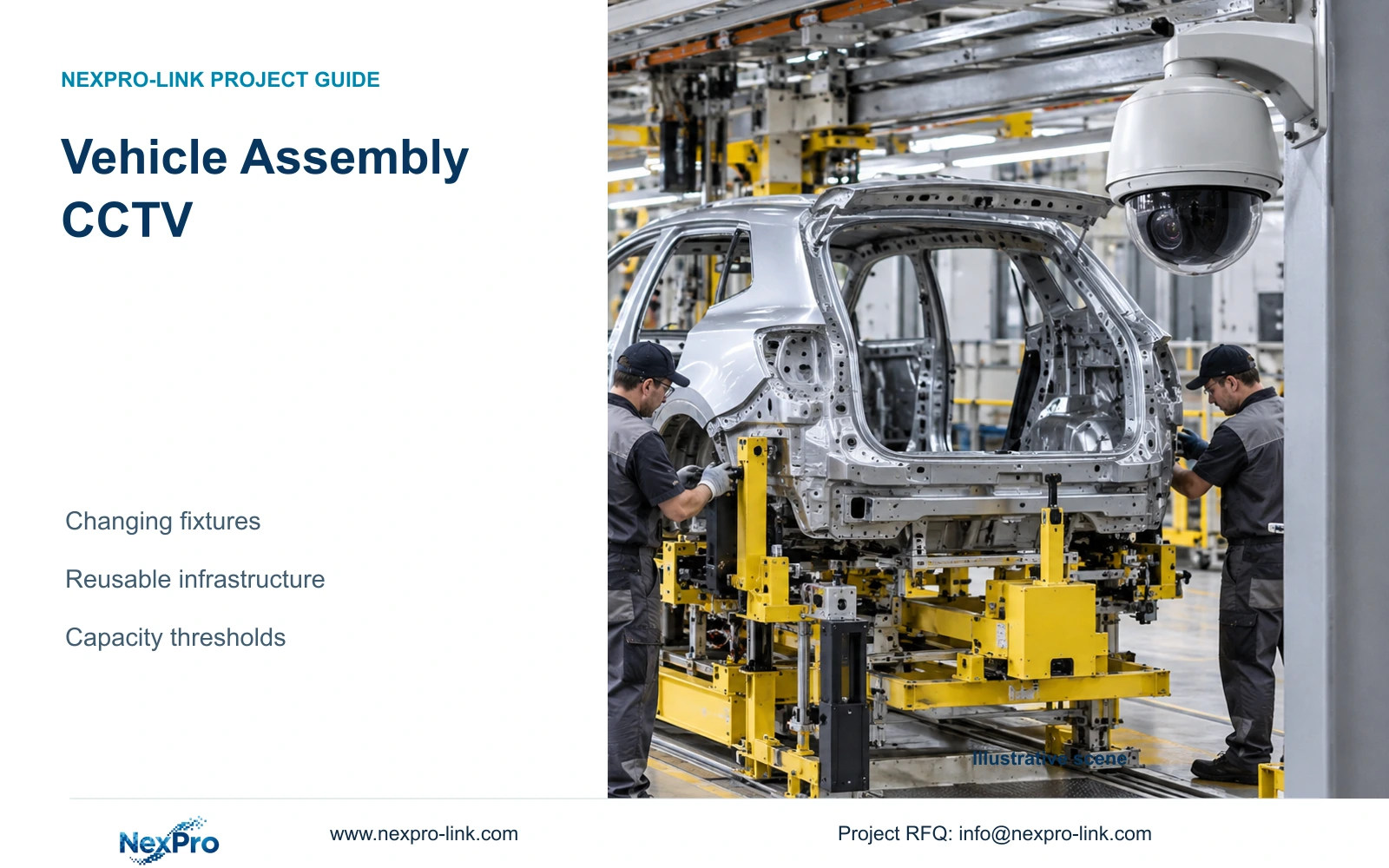
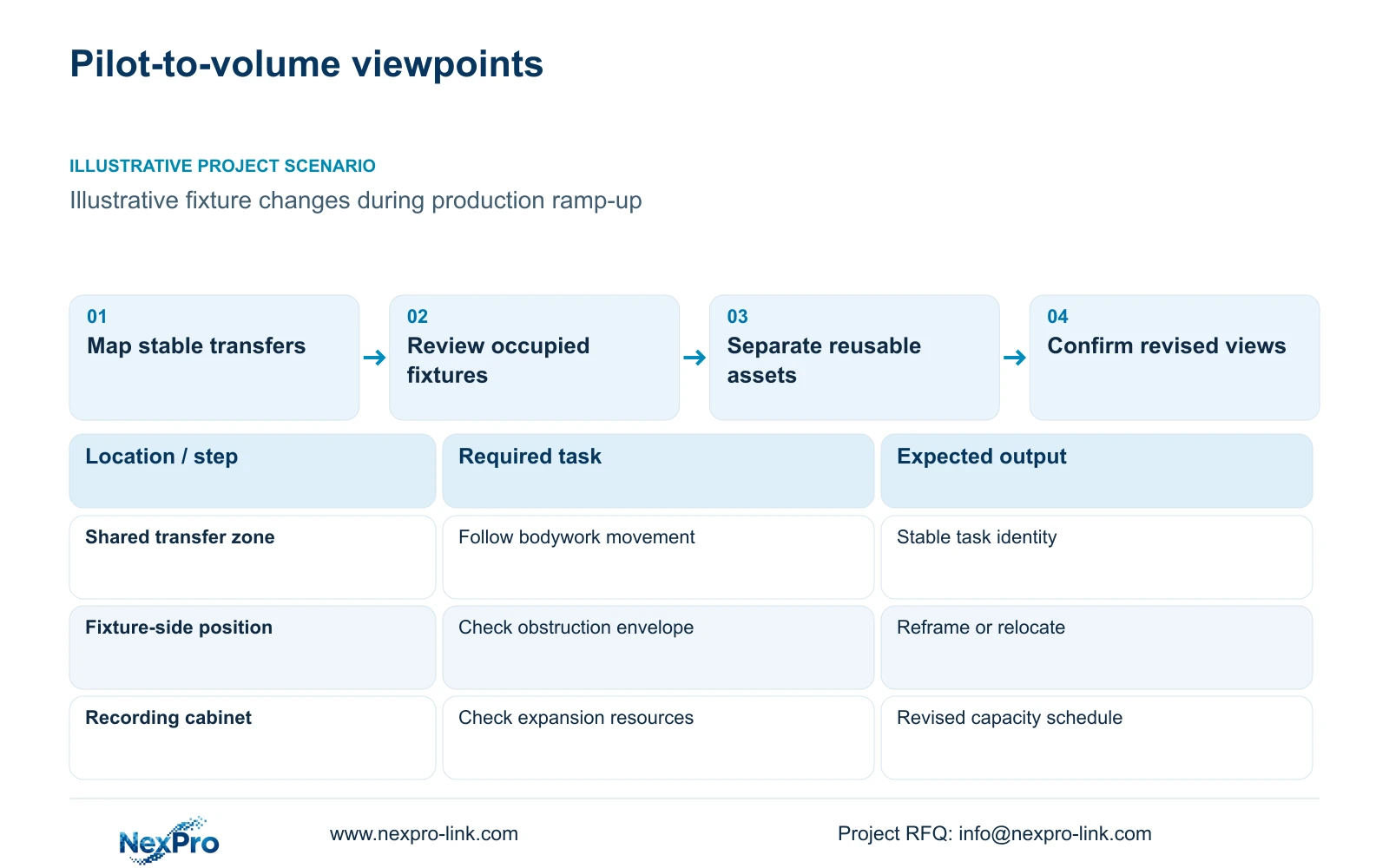
Vehicle assembly CCTV should retain a common recording and network foundation while treating final viewpoints as programme-specific. Start with shared transfer zones that remain meaningful as fixtures change: material entry, bodywork movement between areas and completed-unit release. Freeze those tasks before freezing every camera position.
Illustrative project scenario: Assembly fixtures change as a vehicle programme moves from pilot to volume production. Assume the project team has a pilot layout and a proposed production layout, but some trolley positions and fixture envelopes remain provisional. Both drawings should inform the camera schedule; neither should be presented as a surveyed final arrangement.
The project manager should identify the movement being reviewed, its direction and the information needed at each exchange. Distinguish security observation from robot control and component inspection. A stable task name can survive a physical camera relocation, provided the channel mapping and drawing revision are updated. This allows phased procurement without pretending that a pilot sightline will remain clear throughout production.
Section 02
Review fixtures in their occupied positions
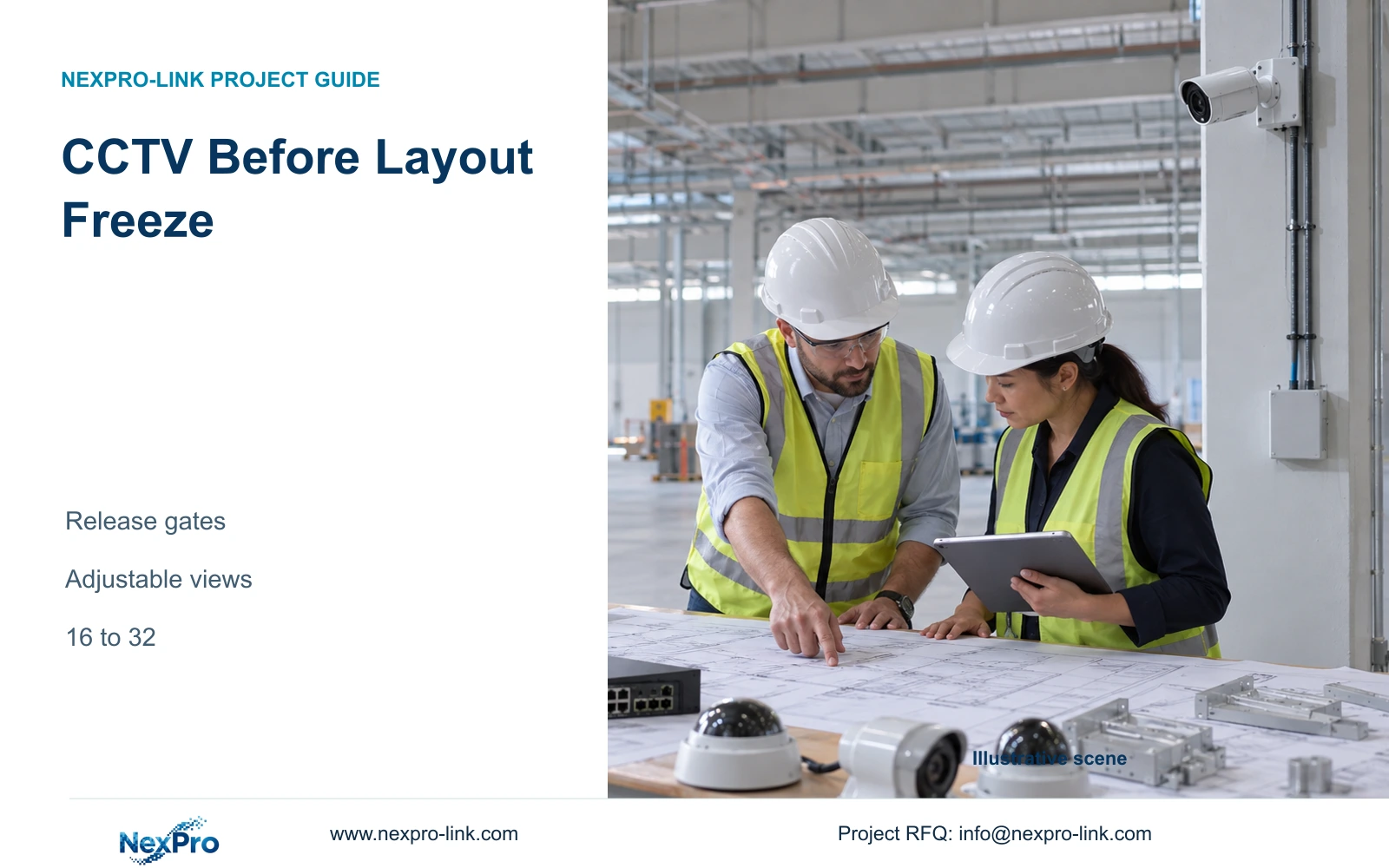
Evaluate sightlines with bodywork, racks and personnel in their normal working positions. An empty assembly hall is a poor acceptance condition for a transfer view. Show the expected obstruction envelope on the drawing and identify whether the exchange remains visible when a fixture is occupied or a trolley waits nearby.
A motorized lens provides adjustment within its documented range. NexPro-BL2812M55-5MP-DIC-AI lists a 2.8–12mm motorized lens and a 2880×1620 output in its 5MP-family source. These fields make it a normal-area candidate for adjustable framing. They do not provide remote pan-and-tilt movement or a way to see through a newly installed jig.
Compare retaining and reframing the viewpoint with relocating it or adding a second angle. Reframing is appropriate when the required target remains within a clear line of sight. Relocation becomes necessary when the obstruction is geometric. A second view is justified when two simultaneous tasks cannot remain visible from one position. Record the choice before the next procurement release.
Section 03
Freeze reusable infrastructure with explicit change allowances
Separate infrastructure decisions from viewpoint decisions in the programme register. Cabinet locations, approved network boundaries and backbone routes may be ready for release before fixture-side brackets and final lens settings. Identify the owner of each release so a late layout change does not reopen unrelated equipment selections.
Use the supplied CASE01 as an illustrative resource baseline, not as an automotive installation template. It groups 32 cameras into four eight-device PoE load groups and uses one local recorder. A vehicle plant must map its own additions to cabinets and routes. Spare channels at the recorder cannot compensate for a full access switch or an unsuitable cable path.
Keep a separate interface list for production systems and a view schedule for security transfers. Show fixed infrastructure as supplied, existing approved links as retained, programme-specific mounts as provisional and additional integration as optional. Cable drops need actual continuous lengths and termination details. Leave maintenance access outside moving fixture envelopes, and protect each electrical node through its actual power circuit.
Section 04
Test six-camera expansion against the installed storage budget
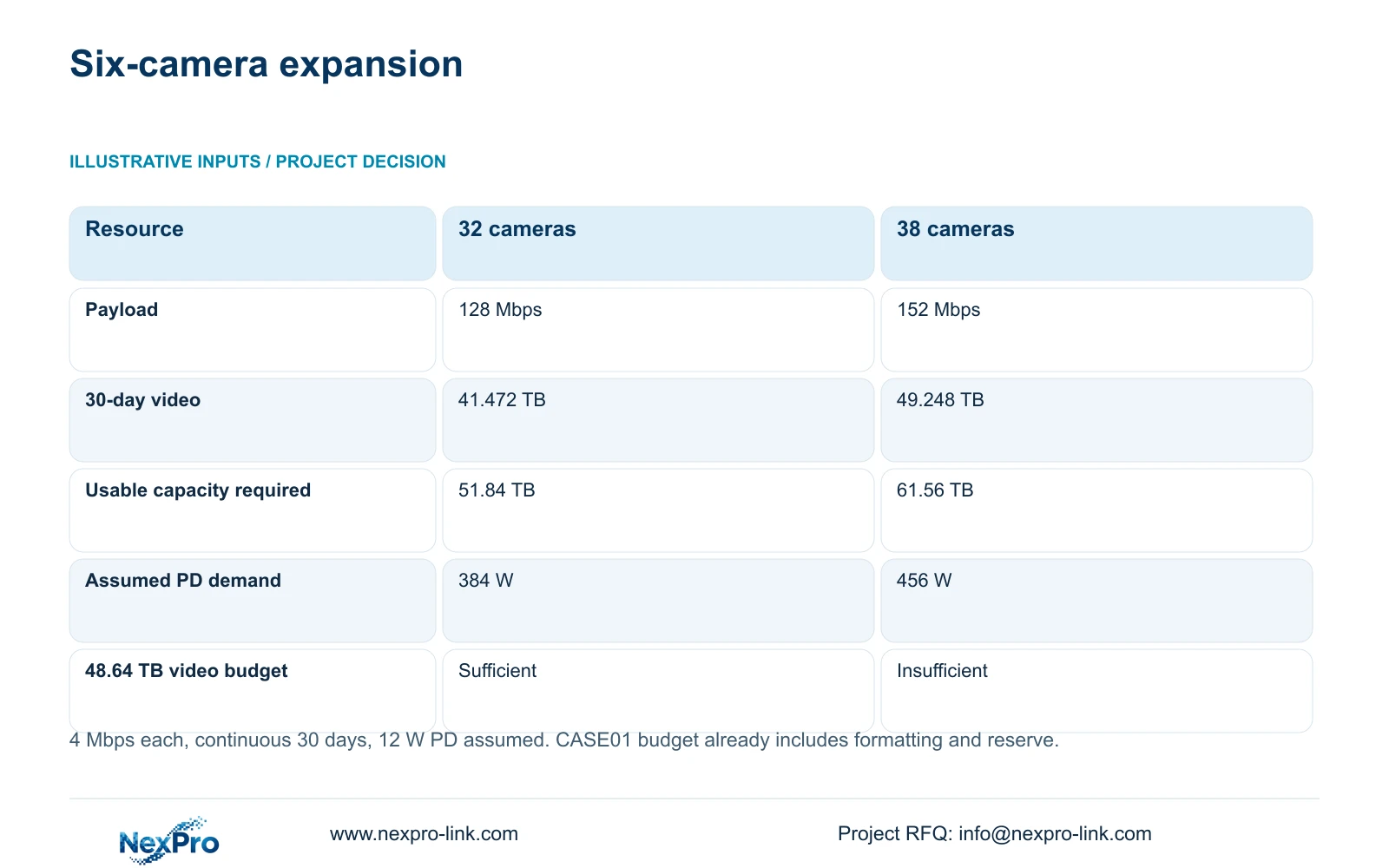
The illustrative comparison assumes 32 cameras initially and 38 after expansion, each averaging 4 Mbps with continuous recording for 30 days. Each camera also has an assumed 12 W device-side demand. The formulas are Mbps = n × 4; video_TB = 0.0108 × n × 4 × 30; PD_W = n × 12. Required usable capacity equals video_TB / 0.8 to retain 20% free space.
Six additions raise recording payload from 128 to 152 Mbps, video volume from 41.472 to 49.248 TB and assumed camera-side demand from 384 to 456 W. The important threshold appears in CASE01: four 16 TB drives give 64 TB raw, 60.8 TB at the assumed 95% usable factor and 48.64 TB of recording budget after reserve. The expanded 49.248 TB video requirement exceeds that budget.
A larger compatible disk arrangement may resolve storage, but it does not resolve every other resource. NexPro-NVR4449-4K lists four bays up to 18 TB each and 320 Mbps input, with separate 5MP and 4K summary modes. Verify the selected streams and drives independently. Recalculate each affected switch and UPS from complete AC demand; the 72 W device-side increase is not the UPS increase.
| Resource | 32-camera basis | 38-camera expansion |
|---|---|---|
| Recording payload | 128 Mbps | 152 Mbps |
| 30-day video | 41.472 TB | 49.248 TB |
| Required usable capacity | 51.84 TB | 61.56 TB |
| Assumed camera-side demand | 384 W | 456 W |
| CASE01 recording budget | 48.64 TB: sufficient | 48.64 TB: insufficient |
Section 05
Release stable equipment before programme-specific viewpoints
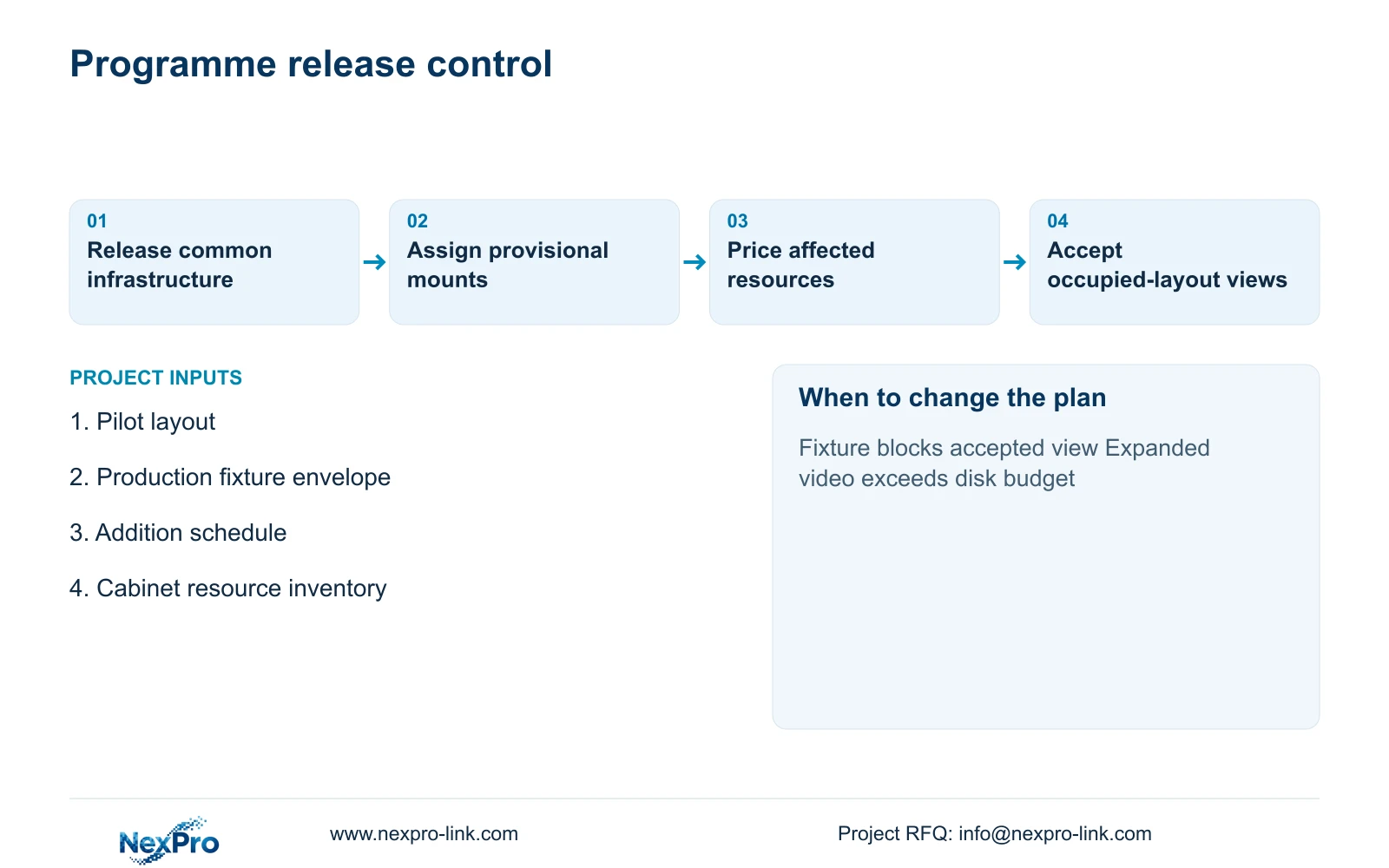
Prefer a staged release: approve reusable recording and network requirements, then confirm final views against the occupied production layout. Price the six-camera expansion as an affected-resource package. It may include drives, switch capacity, cable drops, brackets and recommissioning, rather than six identical camera line items.
Retain an existing platform when the owner requires its operational functions and a replacement cannot demonstrate them. A NexPro-Link alternative should preserve the same transfer tasks, retention and local service boundary. Model substitutions need documented deviations and a recorded acceptance exercise; brand names alone do not explain whether a revised view remains useful.
For operator access, keep a suitable search display unless concurrent monitoring tasks justify more screens. Adding an LCD wall introduces a separate decoding, power and cooling scope. It does not improve the recorder's storage allowance. Similarly, reserve UPS capacity and battery configuration for the protected node rather than assume that any increase within the recorder's channel count is electrically free.
Section 06
Link shipment configuration to the layout revision
Issue an equipment schedule that states the programme revision, stable task ID, provisional or final mounting status and assigned cabinet. Keep the physical camera identity separate from the task so replacement units can be tracked without renaming the operational view. Configuration records should show which channels were prepared for the pilot and which were added for production.
NexPro-Link's BOQ and tender support can coordinate model matching, technical submissions and a quotation that separates fixed equipment from programme-dependent work. Project packing can group units by installation phase. Local contractors remain responsible for agreed route construction, mounting and site alignment; production-system interfaces need their own appointed owner.
Before the production phase is accepted, repeat the transfer-view trial with the revised fixtures, then verify recording continuity, export and the updated capacity schedule. Preserve unresolved viewpoints as explicit items. A procurement release is easier to control when each change names the drawing, resource and acceptance task it affects.
Section 07
Buyer questions
Should we buy all final cameras during the pilot? Release final quantities only where the observation tasks and mounting conditions are sufficiently stable. A staged order can retain a common equipment family while leaving uncertain fixture-side positions for confirmation.
Does a spare recorder channel mean an addition needs no infrastructure work? No. Check its assigned switch, cable route, storage allowance, supported stream mode and protected power node. The limiting resource may be local even when recorder channels remain available.
How should a moved camera be documented? Retain its asset identity, revise the location and view mapping, record the new lens setting and repeat the affected acceptance task. Update the installation schedule before preparing the next shipment.
Section 08
Price the next assembly-programme change
Send your pilot and volume-production layouts, proposed camera additions, installed cabinet and storage schedule, and shift-based viewing requirements to info@nexpro-link.com for a revision-specific equipment quotation.
Engineering references
These sources support the general planning principles. Always use the selected product's current datasheet and applicable project standards for final design.