Extending factory CCTV backup requires a supported battery configuration, not just a larger Wh total. Compare two runtime objectives and check charging, BMS limits, installation space and maintenance responsibilities before ordering.
Section 01
Confirm a supported battery configuration before ordering
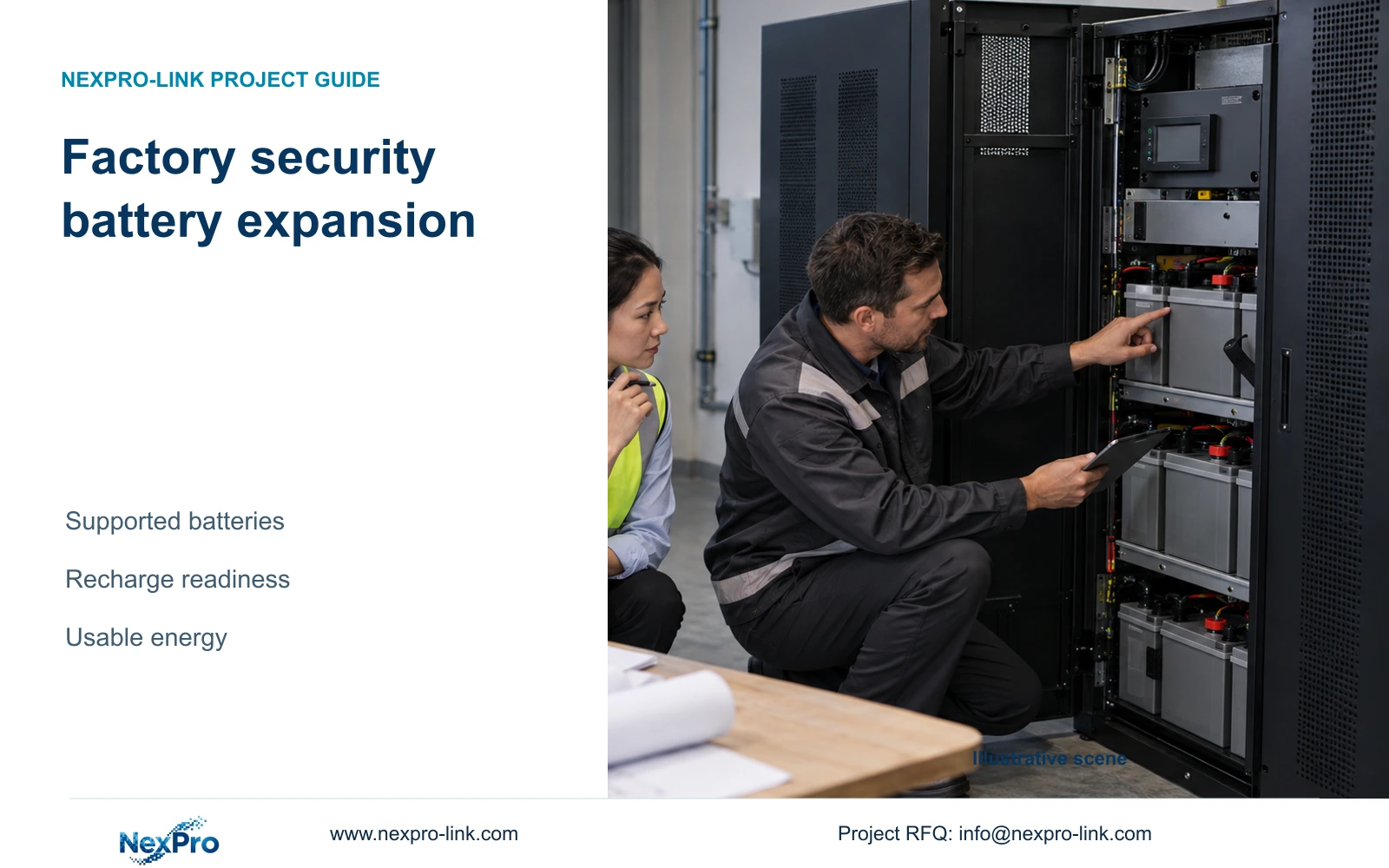
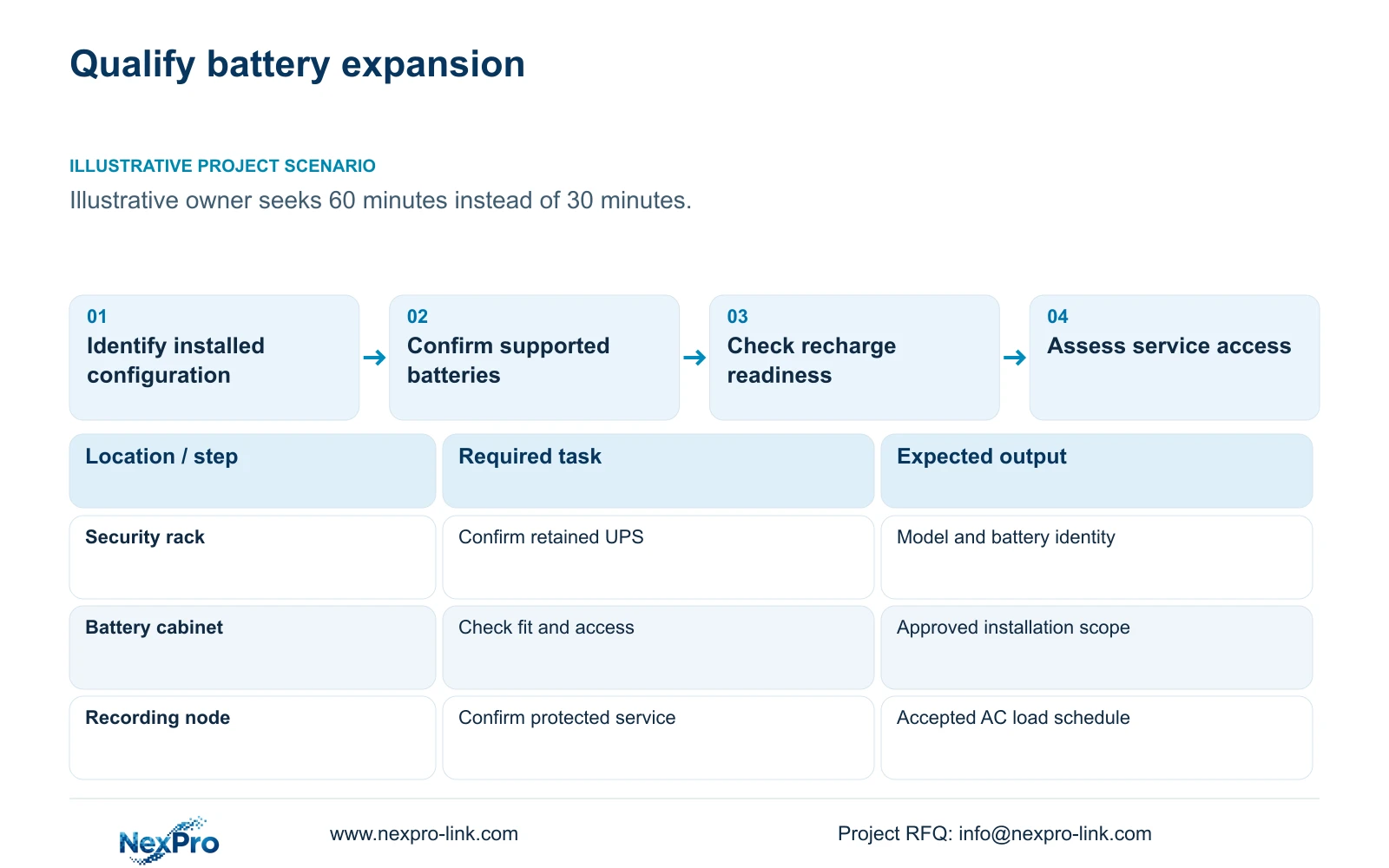
For UPS battery expansion in factory security, request a manufacturer-supported configuration covering battery voltage, BMS compatibility, charging and installation conditions. Additional nominal Wh does not establish usable AC output energy or a particular operating duration. Identify the existing UPS and its battery arrangement first, then ask whether that exact combination supports expansion.
Illustrative project scenario: The owner wants to double runtime by adding batteries to an existing UPS. Assume the operational goal changes from 30 to 60 minutes while the protected security equipment remains unchanged. This article uses a separate illustrative 650 W AC load for the energy comparison. The supplied 32-camera CNC factory reference provides the recording and power-path context, but its 682.7407 W baseline must not be substituted silently into this calculation.
Photograph the equipment identification labels and collect the installed battery part numbers, configuration records and service history. Ask the supplier to identify an approved expansion arrangement or state that replacement is required. Do not purchase loose batteries from the calculated Wh figure or improvise connections when a supported arrangement has not been established.
Section 02
Check whether the system can recharge between outages
A longer discharge objective creates a charging question as well as an energy question. Ask for the recharge behavior of the complete proposed configuration under its specified conditions, including the starting state of charge and the readiness level used for the stated recovery time. A proposal that addresses only the first outage leaves the owner without an answer for another interruption before recovery.
The engineer should document the expected outage pattern and the normal operating load during recharge. The supplier then needs to confirm the charger arrangement, permitted battery configuration and any relevant operating limits. If the factory expects closely spaced interruptions, compare the supported recovery performance with that pattern rather than assuming a larger battery automatically restores readiness quickly.
Check the installed environment against the selected system's requirements. Temperature, initial charge, ageing, discharge rate, BMS limits and UPS self-consumption affect the runtime assessment. Record the actual cabinet location and ventilation conditions as inputs, without assigning unsupported special-temperature capability. Any change to the charger or electrical installation should be separately identified in the proposed work.
Section 03
Account for battery space and service access
Inspect the cabinet before treating battery expansion as a simple accessory order. Establish available mounting space, equipment weight limits, cable routing and access for replacement. A battery assembly that fits the unused rack height may still obstruct recorder disks, switch connections or ventilation. The local installation team should confirm that the proposed arrangement can be installed and serviced at the actual location.
Build a maintenance schedule around identifiable components. Record the existing UPS as retained, the supported battery assembly as added, and any mounting or distribution work as a separate installation item. Assign the supplier responsibility for configuration documents and battery specifications, and name the site party responsible for access, inspections and service records. Replacement scope should remain traceable after the original project team leaves.
Compare the full service footprint of expansion with replacement. Existing battery condition, permitted combinations and supplier support may alter the choice; do not assume old and new assemblies can be combined. Ask for applicable battery and UPS warranty terms separately. Labour, transport and temporary protection during future service also need quotation lines rather than being treated as included by default.
Section 04
Translate 30 and 60 minutes into distinct energy requests
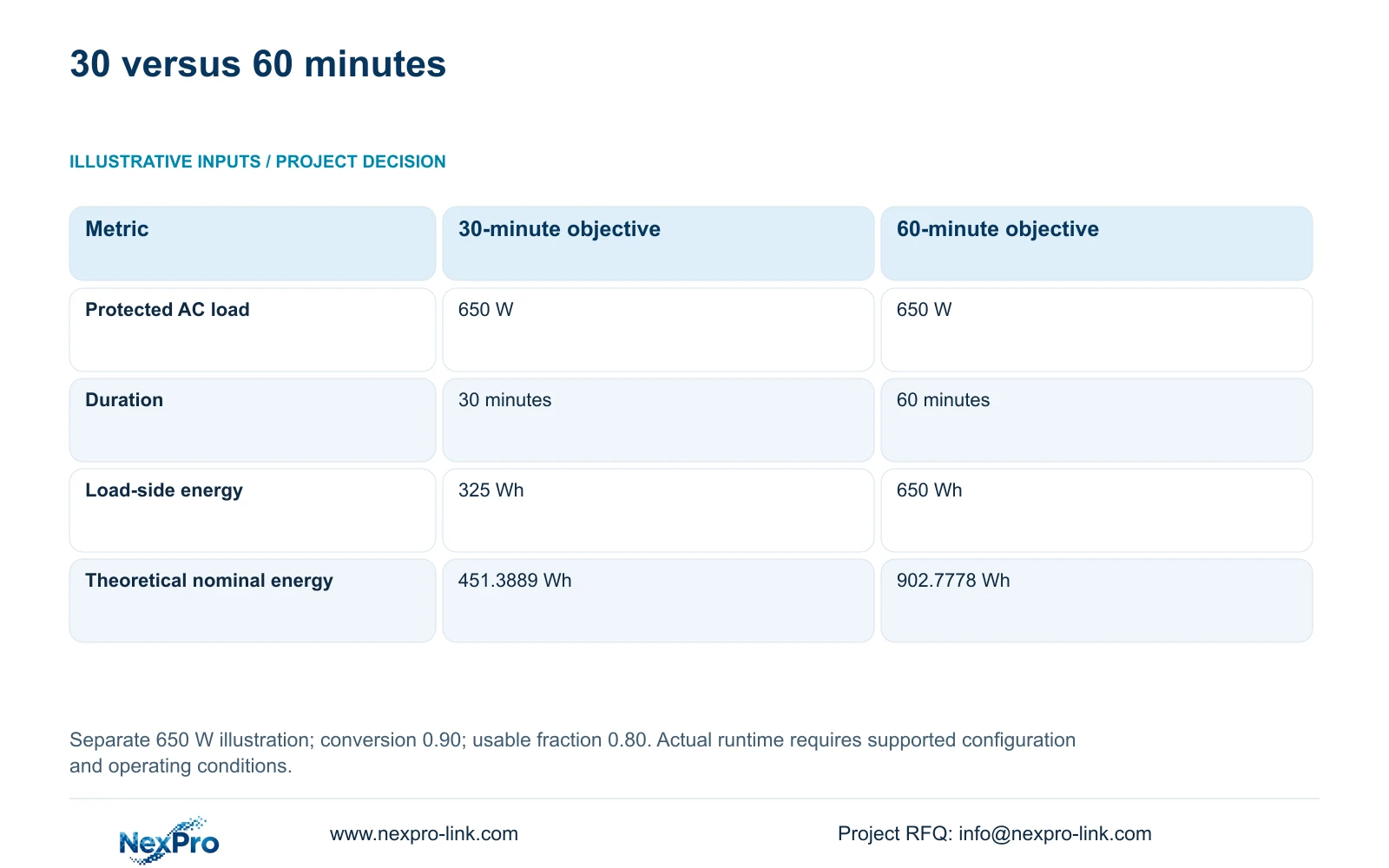
For the illustrative 650 W protected AC load, use load_Wh = P_W × minutes / 60. Thirty minutes requires 650 × 30 / 60 = 325 Wh delivered to the loads; 60 minutes requires 650 × 60 / 60 = 650 Wh. These figures describe the requested load-side energy. They do not describe installed battery capacity or prove that an existing battery delivers either duration.
For a teaching estimate only, assume a battery-to-load conversion factor of 0.90 and a usable stored-energy fraction of 0.80. Then nominal_battery_Wh = load_Wh / (0.90 × 0.80), giving 451.3889 Wh for 30 minutes and 902.7778 Wh for 60 minutes. These factors are illustrative assumptions, not measured performance or guaranteed allowances for ageing and temperature.
The decisive comparison is a doubled energy request at unchanged operating demand. UPS output W and VA still need checking, but the longer objective primarily asks for a qualified battery and charging arrangement. Obtain the actual runtime curve for the proposed combination at the accepted load and stated conditions. The numerical estimate alone cannot identify a battery SKU or establish that doubling installed nominal energy doubles runtime.
| Metric | Option A: 30 minutes | Option B: 60 minutes |
|---|---|---|
| Protected AC load | 650 W | 650 W |
| Target duration | 30 minutes | 60 minutes |
| Energy delivered to loads | 325 Wh | 650 Wh |
| Theoretical nominal battery energy | 451.3889 Wh | 902.7778 Wh |
Section 05
Choose expansion only when it preserves the required service
Prefer supported battery expansion when the existing UPS remains suitable for the accepted W/VA load, the supplier confirms the battery arrangement, and the site can accommodate charging and maintenance requirements. Consider replacement when expansion is unsupported, the existing unit lacks suitable output capacity or the proposed service arrangement is impractical. Request comparable offers against the same 60-minute objective before making a price decision.
The NexPro-Link rack online source lists SP1KR(S) at 1 kVA / 900 W, SP2KR(S) at 2 kVA / 1800 W and SP3KR(S) at 3 kVA / 2700 W. Those ratings are capacity references, with exact electrical and battery configurations still to be matched. They do not establish that every variant accepts external expansion, and a default webpage battery-energy field must not be transferred between models.
Review what remains powered throughout the longer interval. The CNC reference includes camera-powered switches and recording equipment within the security node; a remotely powered cabinet would need its own protection assessment. If an optional display wall, new cameras or another electrical node enters the scope, revise demand and the battery request together. Extending recorder runtime alone cannot preserve camera streams whose switches lose power.
Section 06
Release a configuration schedule and acceptance method
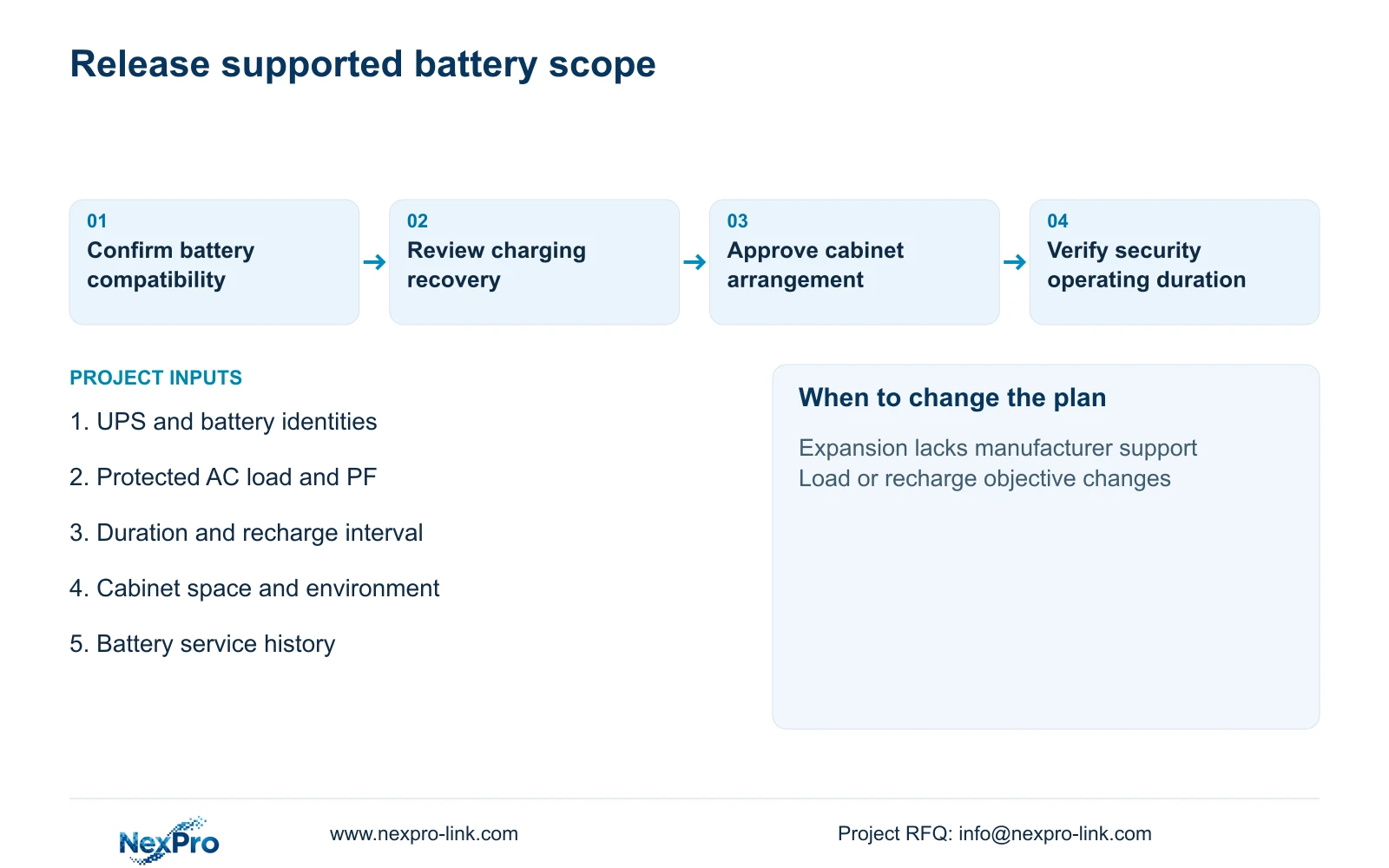
The procurement package should identify the retained UPS, exact proposed batteries, supported interface arrangement and installation accessories. Include protected AC demand and PF, target duration, cabinet conditions and recharge expectations. Require the supplier to state which information supports compatibility and runtime, with unresolved conditions visible before order approval.
Plan the acceptance check around the security service. Agree how the test will be conducted without an unplanned loss of recording, what starting battery condition applies and which camera, playback and operator functions will be observed. Record the configuration and results together. A battery-status display or an estimated remaining-time value should not replace verification of the agreed operating task.
NexPro-Link can discuss a coordinated security equipment quotation and relevant technical submittal through its project support scope. Battery options should be presented only for configurations confirmed as supported. Keep local installation and maintenance responsibilities explicit, and label battery assemblies by configuration so that project packing does not create uncertainty about which UPS they belong to.
Section 07
Buyer questions
Can we buy batteries with matching nominal voltage? Matching nominal voltage alone does not establish compatibility. The exact assembly also needs manufacturer-supported BMS, charging, interface and installation conditions. Request a supported configuration rather than using voltage as the purchase criterion.
Should we use the UPS display's remaining minutes as acceptance evidence? Treat the display as an operating indication. Agree acceptance conditions and verify that the required recording and access functions remain available for the specified objective, documenting the actual load and battery starting condition.
What if the runtime target increases but the equipment does not change? Keep the accepted load schedule, revise the energy and recharge requirements, and qualify the new battery configuration. A larger UPS output rating is not automatically needed, although the retained unit's suitability still requires confirmation.
Section 08
Request a supported extended-runtime configuration
Send the existing UPS and battery identification, protected AC load with PF, desired duration and recharge interval, and cabinet space/environment details to info@nexpro-link.com to discuss a supported factory security battery proposal.
Engineering references
These sources support the general planning principles. Always use the selected product's current datasheet and applicable project standards for final design.