Ask the owner for the relevant repeat-outage scenario and the supplier for supported readiness under that battery condition. Compare options at the same load and recovery assumption.
Section 01
Choose the operating window from the outage task
Ask the owner for the relevant repeat-outage scenario and the supplier for supported readiness under that battery condition. Compare options at the same load and recovery assumption. Keep the second-event duration unresolved when charging evidence is absent; a first fully charged demonstration cannot establish repeated-outage coverage.
Choose 15, 30 or 60 minutes of factory CCTV backup by defining what staff must accomplish during loss of normal power. Compare the durations at the same protected load, then qualify battery and recharge requirements. Fifteen minutes may suit a verified short bridging task; longer observation needs a longer supported configuration. These are project choices, not universal runtime recommendations.
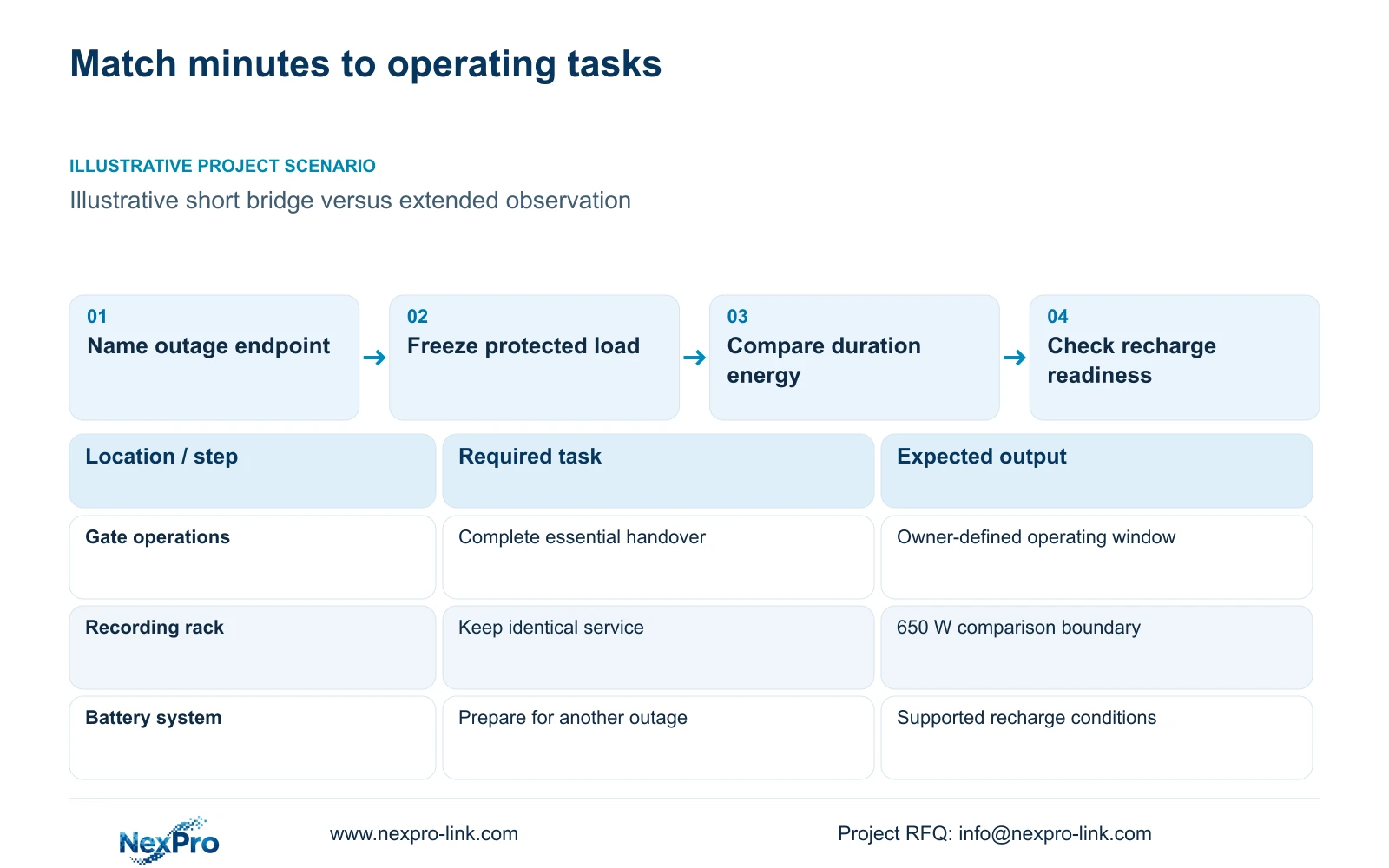
Illustrative project scenario: An owner is choosing between bridging short interruptions and extended local observation. The supplied CNC factory reference provides the background security tasks, including gates, stores and dispatch. For duration comparison, assume a complete protected AC load of 650 W. Its demand is held constant across all three choices.
Ask the owner to name the last required action in the operating window: continued recording until an alternative supply is accepted, completion of a gate handover, or continued guard observation while the site responds. Identify the responsible person and what happens if power remains unavailable. A duration with no defined endpoint is difficult to evaluate or accept.
Section 02
Keep the protected service identical in each comparison
Use one load schedule for the three alternatives. It should contain loaded PoE switch AC inputs, recorder and disks, required network equipment and any essential viewing device. Camera power included within complete switch input must not be added again. Record the actual electrical nodes so the comparison covers the same endpoints.
The 650 W module is separate from CASE01's recording-first 682.7407 W total. CASE01 includes four eight-camera PoE groups, recorder and four disks, core, router and a 40 W screen. If the owner adopts that full schedule, recalculate every duration from its actual total rather than preserving the smaller teaching number.
A supplier may offer longer runtime by removing display or remote-node loads. That can be a useful alternative, but describe the changed service explicitly. It is no longer a duration-only comparison. Similarly, adding a display wall or another switch group changes both output-capacity and energy checks even if the requested minutes stay the same.
Section 03
Compare readiness after an outage as well as duration
For each battery option, request supported recharge information under the proposed operating conditions. Normal load may continue while the battery is replenished, so the charging arrangement and upstream supply need review. Do not infer a fixed recharge time from nominal energy alone or promise full readiness immediately after mains returns.
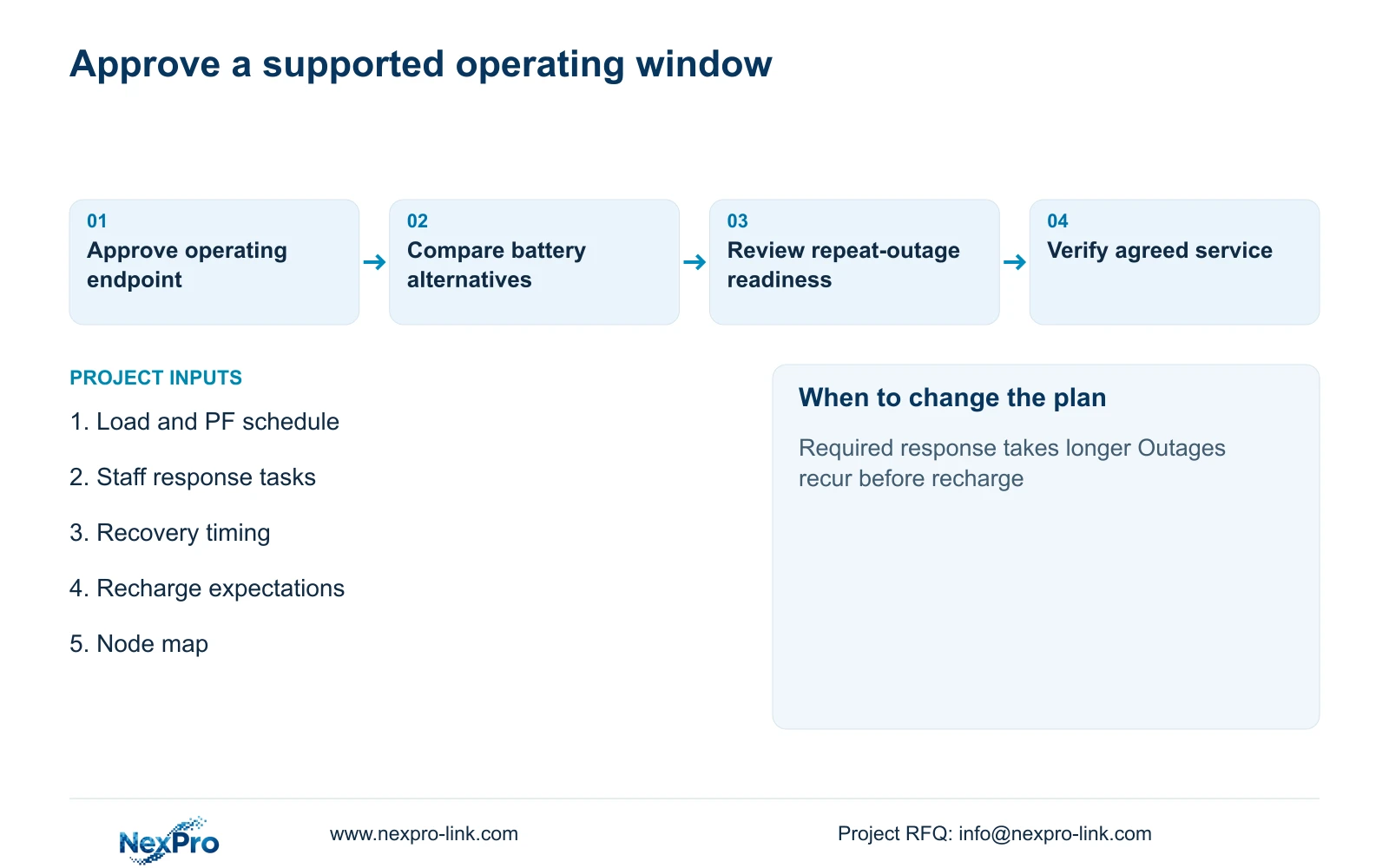
Ask the owner whether interruptions tend to recur before recovery is complete. The project needs a stated initial battery condition for its runtime claim and a policy for a second outage. A longer first discharge can be valuable, but it may leave the site with a different readiness state afterward.
Compare the complete supported battery scope: compatible modules, connections, placement, service access and required monitoring. Review temperature, ageing basis, discharge rate, BMS limits and UPS self-consumption with the supplier. The same output-rated UPS might support different duration configurations, but compatibility and charging capability must be established for each offer.
Section 04
Quantify the three durations without changing demand
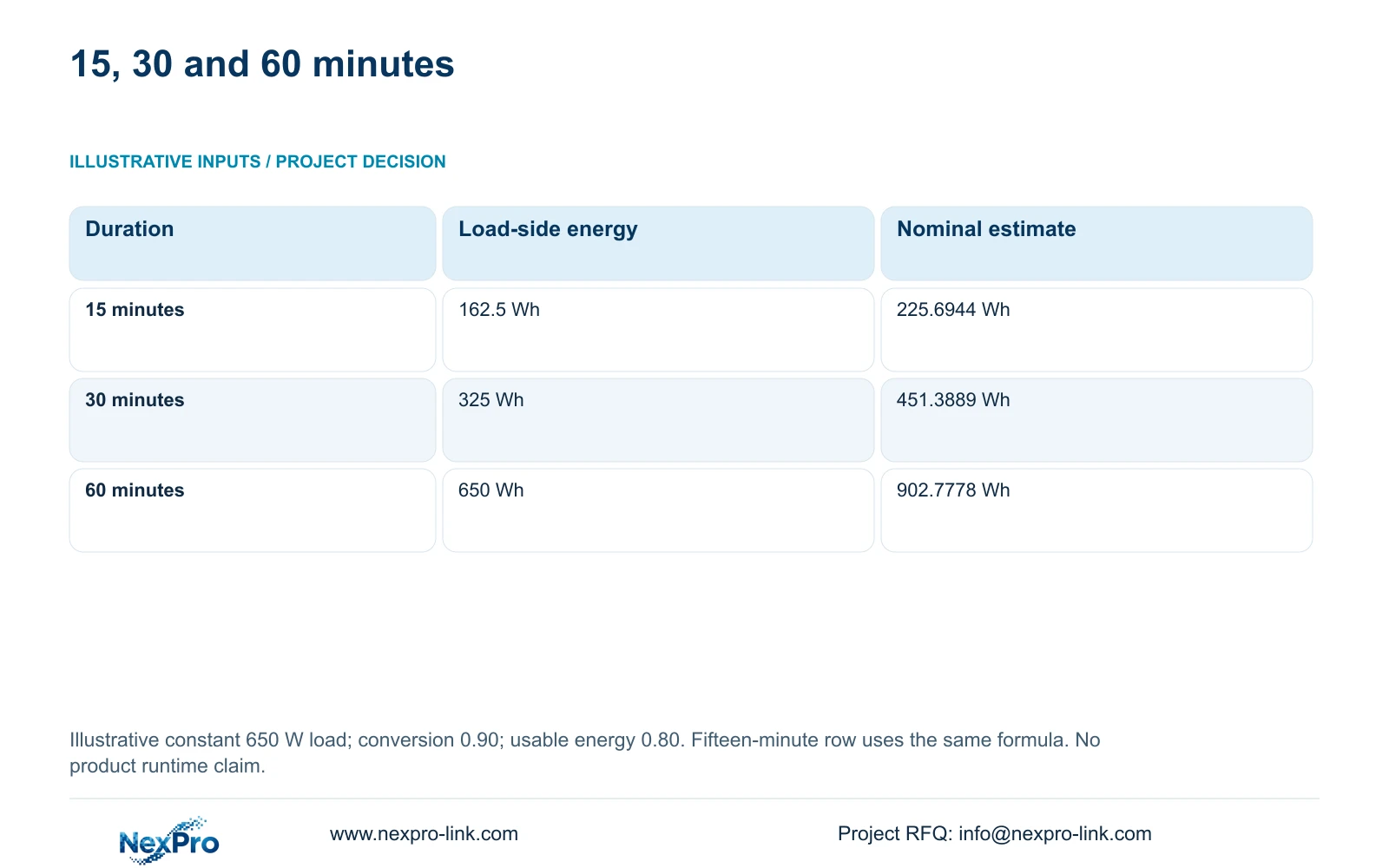
Use load_Wh = P_W × minutes/60. At the illustrative 650 W load, 15 minutes requires 162.5 Wh, 30 minutes requires 325 Wh and 60 minutes requires 650 Wh delivered to equipment. The supplied 30- and 60-minute figures are retained; the 15-minute row is derived using the same formula.
With illustrative conversion factor 0.90 and usable stored-energy fraction 0.80, nominal_battery_Wh = load_Wh/(0.90 × 0.80). The theoretical nominal estimates are 225.6944 Wh, 451.3889 Wh and 902.7778 Wh respectively. These figures support a request for configurations; they are not product runtime results.
The decisive difference is energy and operating time. Moving from 15 to 60 minutes quadruples this theoretical energy requirement while leaving continuous AC demand at 650 W. Output W and VA still need independent checks. Battery packaging, charging and site provisions may change, so neither purchase cost nor recharge time should be assumed to scale in the same ratio.
| Target duration | Load-side energy | Theoretical nominal battery energy |
|---|---|---|
| 15 minutes | 162.5 Wh | 225.6944 Wh |
| 30 minutes | 325 Wh | 451.3889 Wh |
| 60 minutes | 650 Wh | 902.7778 Wh |
Section 05
Select the shortest supported window that completes the task
Recommend the shortest configuration that completes the approved outage task with the project's agreed contingency. Choose 15 minutes only when the bridging or recovery process can be supported within that window. Use 30 minutes where a longer local response is required. Choose 60 minutes when the owner needs sustained observation or recording beyond the shorter windows.
This scenario does not contain outage records or verified recovery timing, so it cannot establish which duration is sufficient. Obtain those inputs before final approval. A provisional 30-minute basis can be quoted alongside a 60-minute alternative, but the owner must still resolve the required operating endpoint rather than accepting the middle option by habit.
The NexPro-Link rack series ratings of 1 kVA/900 W, 2 kVA/1800 W and 3 kVA/2700 W are output-capacity references. They do not map automatically to 15, 30 and 60 minutes. For every shortlisted output class, request a compatible battery configuration at the same demand and conditions, preserving mandatory brand or site requirements where applicable.
Section 06
Make the alternatives comparable at quotation and acceptance
Issue one base service schedule and request separately identified duration alternatives. Require each offer to state its UPS variant, battery arrangement, supported runtime basis and recharge conditions. Price added battery hardware, distribution accessories and commissioning separately so a longer-runtime offer does not hide changes in installation scope.
Agree the acceptance task before purchasing. The local team should verify required cameras, saved footage and viewing availability across the approved interval, then check recovery and recharge status. Record any load exclusions. Ordinary security backup remains separate from production machinery and life-safety power, even when their outage procedures occur at the same time.
NexPro-Link can discuss coordinated CCTV and UPS equipment, model matching and technical documentation through its project supply and BOQ support scope. Local electrical work and operating procedures remain assigned to the site team. A clear duration decision gives procurement a usable configuration request and prevents the longest advertised runtime from becoming the default purchase criterion.
Section 07
Buyer questions
Is 60 minutes always better than 30 minutes? It provides a longer requested window only when the selected configuration supports the same service. Its value depends on whether the site needs that window and can accommodate the battery, recharge and maintenance scope.
Can gates receive longer backup than optional displays? Yes. Define separate load groups and operating intervals, with an approved distribution or shedding method. Show the resulting service differences rather than comparing them as identical loads.
What should a second-outage requirement include? State the expected interval after the first discharge, the required remaining service and the battery state assumed for that event. Ask the supplier to support the proposed recharge and runtime conditions.
Section 08
Compare duration options for the actual outage task
Send the protected load with PF, required staff actions and timing, interruption/recharge expectations and electrical node map to info@nexpro-link.com for comparable backup-duration options.
Engineering references
These sources support the general planning principles. Always use the selected product's current datasheet and applicable project standards for final design.