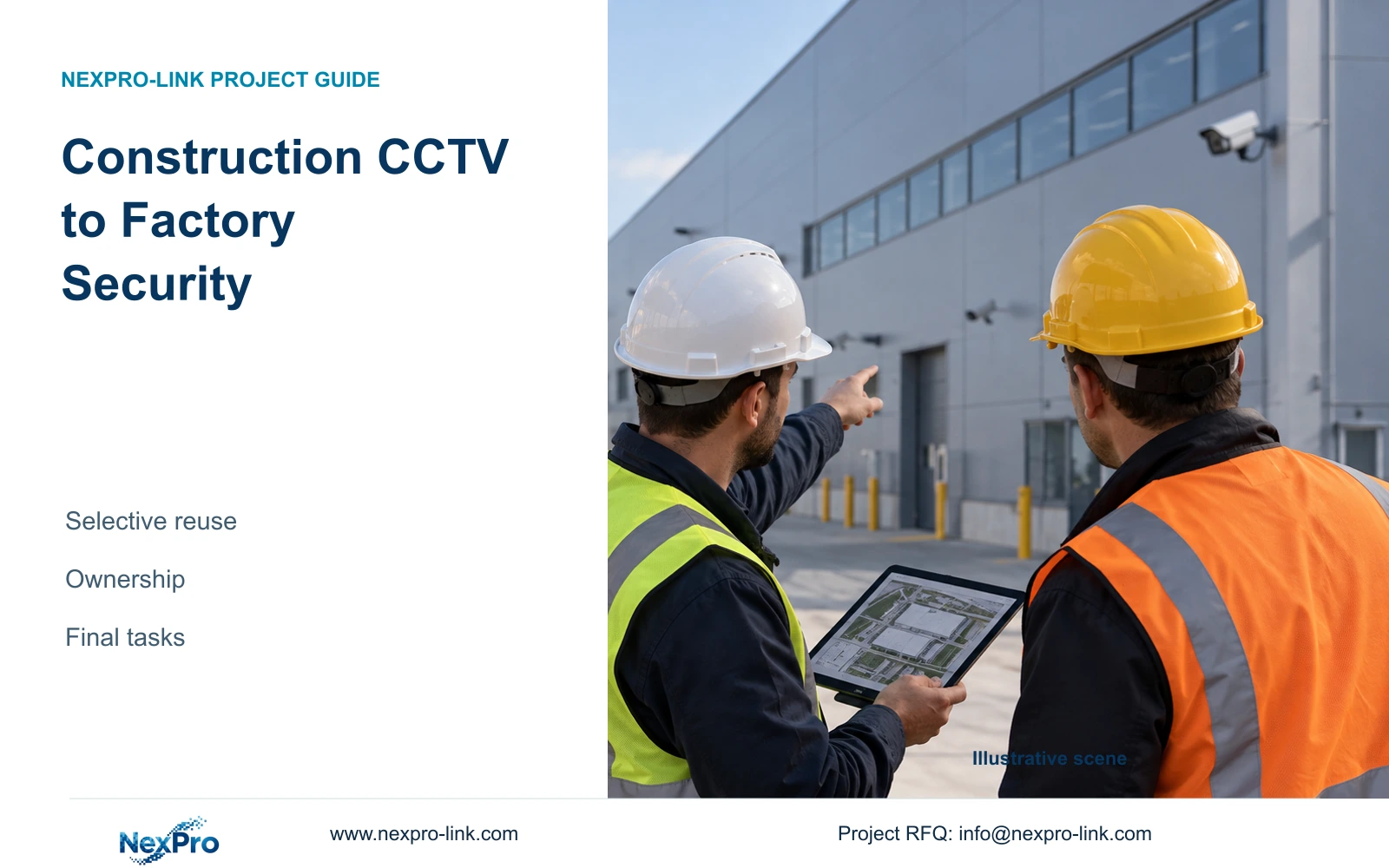
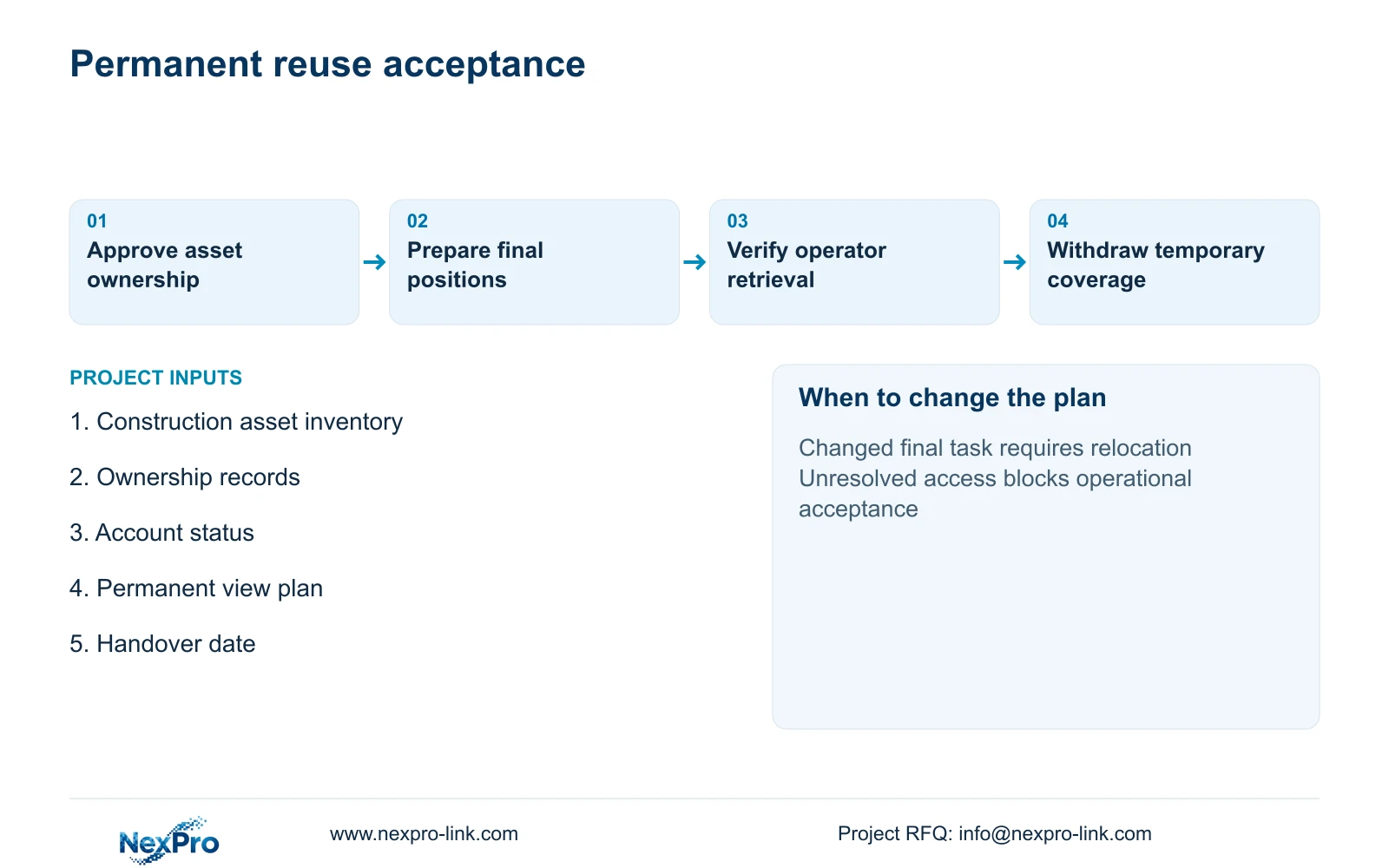
Reconcile contractor-held accounts, remote registrations and recovery contacts against the permanent operator's approved control. Retain necessary construction footage under its agreed authority before reassigning equipment.
Section 01
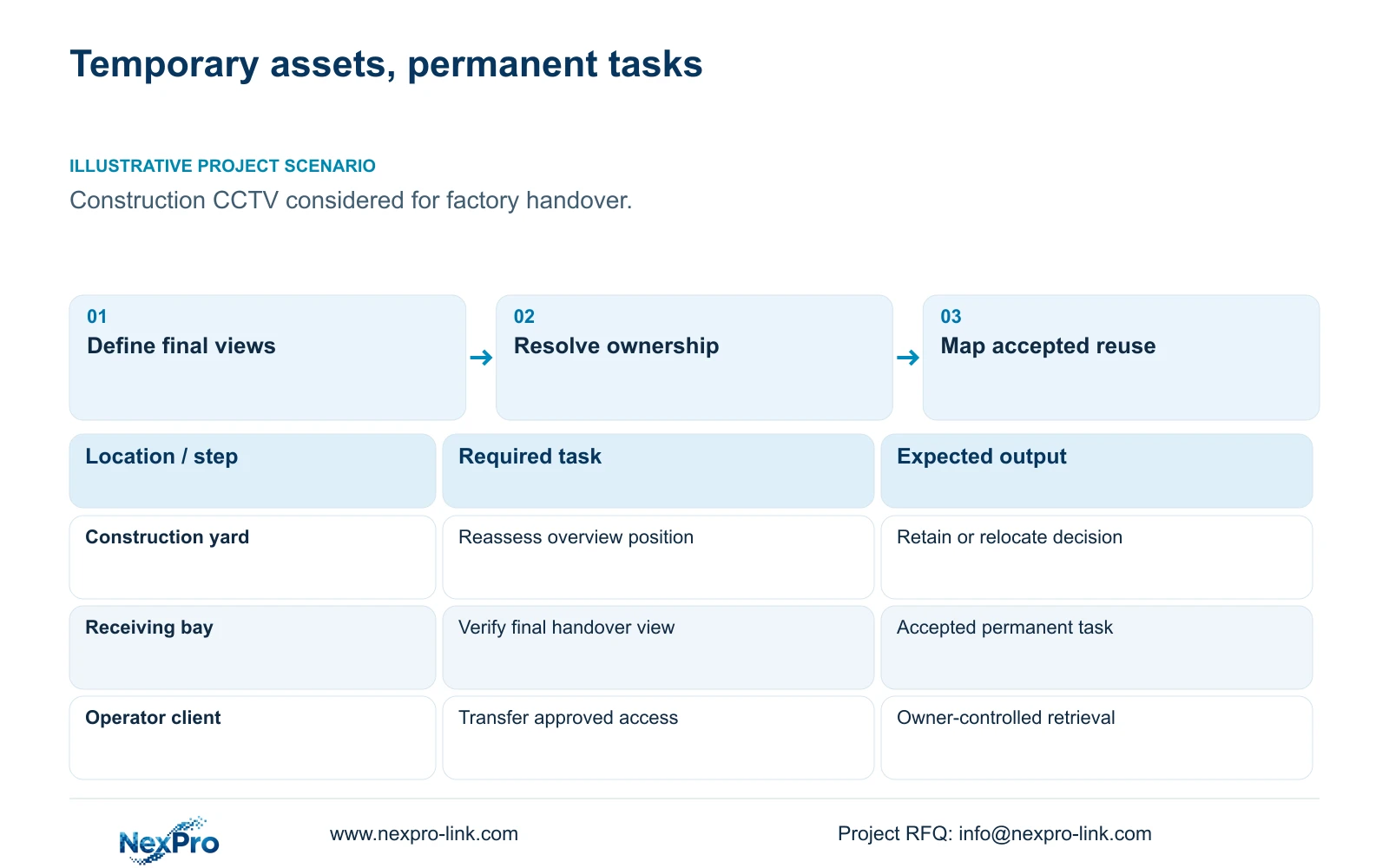
Judge each temporary asset against the permanent factory task
Reconcile contractor-held accounts, remote registrations and recovery contacts against the permanent operator's approved control. Retain necessary construction footage under its agreed authority before reassigning equipment. Verify operator recovery separately from a successful login. An asset can be technically reusable while its ownership or access transfer remains unresolved.
Reuse construction CCTV for permanent factory security only when the equipment, route and access arrangements satisfy the final operating task. Start with the permanent view schedule, then map suitable assets into it. A temporary camera position should remain only if it provides the required evidence after doors, machinery and storage areas enter normal use.
Illustrative project scenario: A developer wants to retain site-construction cameras after the factory is handed over. Assume temporary views cover material deliveries, contractor access and an unfinished yard. The permanent operator instead needs receiving handovers, dispatch evidence and common-route access review. Those task changes are plausible planning assumptions, not a reported client conversion.
Walk through the final operating routes with the owner and installer. Identify temporary views that remain useful, views that need relocation and tasks with no suitable existing asset. Record each decision by camera ID. A working overview of construction activity may provide too little detail at a permanent goods handover, even when the camera itself remains serviceable.
Section 02
Resolve asset and account ownership before transfer
Confirm whether each camera, recorder, switch and storage device belongs to the developer, contractor or another supplier. Record the agreement that permits permanent retention. Physical possession does not settle the asset boundary, and a technically suitable camera should remain conditional if its ownership or support records are unresolved.
Map local administrator access, remote account binding and recovery arrangements separately. The permanent operator needs approved control of the intended workflow without relying on a departing contractor's personal account. Plan an authorized account transfer or reconfiguration, preserve required construction footage first and verify the operator's access afterward.
NexPro-Link's Seetong system page provides app and PC-client context, not a promise of universal mixed-brand functions. Identify the exact retained devices and required retrieval tasks before selecting the permanent client arrangement. Hardware branding or project labels do not establish ownership of third-party software, account-transfer rights or an integration entitlement.
Section 03
Put approved retained infrastructure into the final schedule
Classify infrastructure as retained in place, retained after rework, replaced or temporary for removal. Check supports, routes, terminations and cabinet conditions against their permanent use. A temporary cable may be intact yet unsuitable for the final routing or maintenance arrangement. Assign the local installer responsibility for proving the retained link rather than marking it accepted from appearance alone.
CASE09 gives a concrete procurement distinction: its 20 retained cameras and links require approval, while 12 new links total 742 m with a feasible three-reel plan. If all links were replaced, the hypothetical baseline becomes 1,872 m and seven reels. Construction-to-factory reuse should adopt that conditional logic without assuming that 20 assets are automatically available or suitable.
A useful schedule row names the item, final task, supply status and responsible party. For example, an approved retained receiving camera can serve the permanent unloading view; a new recorder can be supplied for the accepted retention task; the local contractor can provide permanent supports; an optional management interface can remain excluded until the owner defines its purpose.
Section 04
Separate the usable recording package from added integration
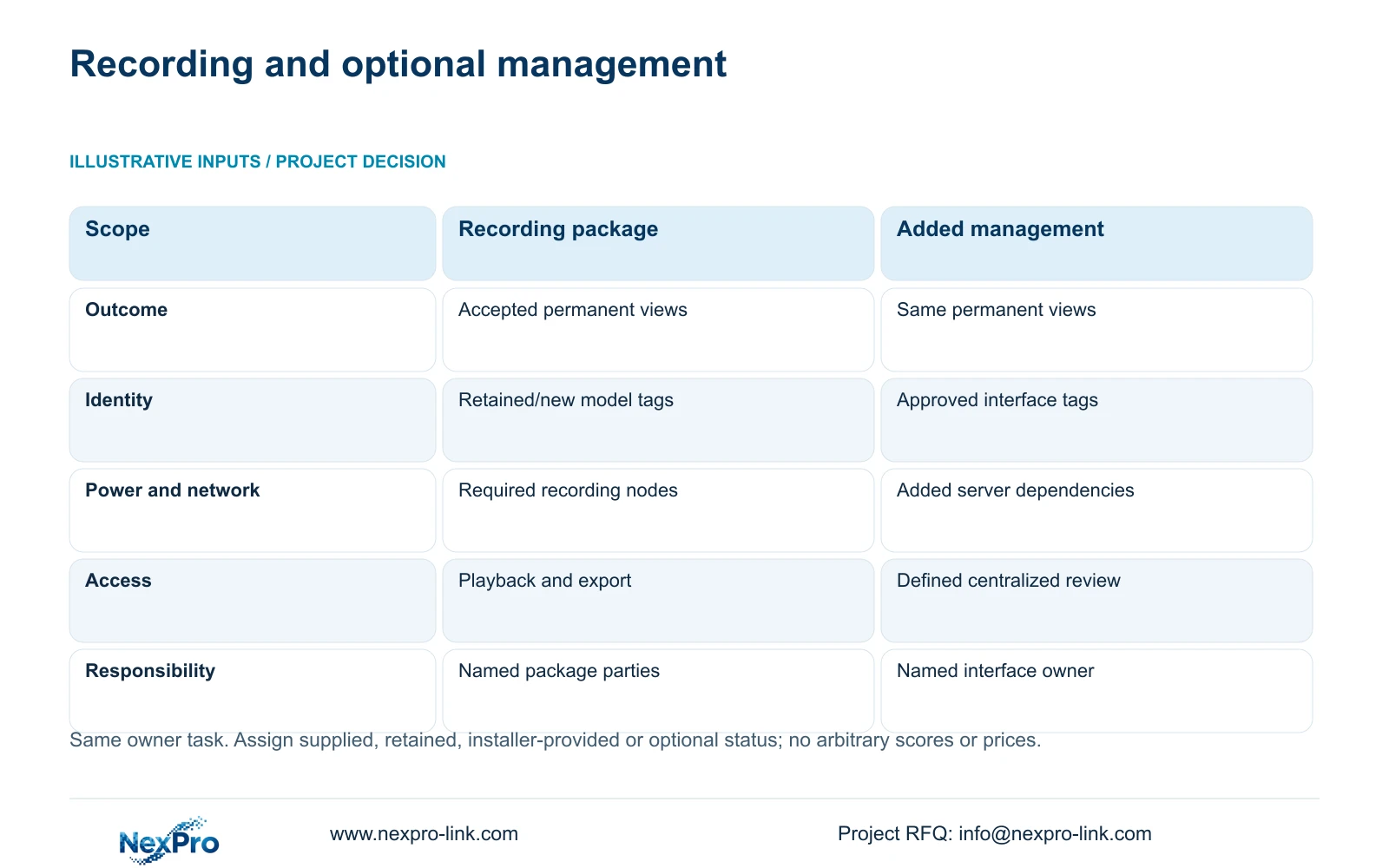
Hold the permanent recording outcome constant while comparing a minimum operational package with added management scope. The baseline must include every required camera-to-recording dependency and the operator's playback/export role. Additional integration belongs in the second option only when it answers a defined task, such as an approved centralized review workflow.
The decisive difference in the matrix is the additional interface responsibility. The integrated option retains the same recording task but may add servers, network paths, power and support work. Assign every row to supplied, retained, installer-provided or optional, with one named party accountable for each interface. Blank fields require clarification and should never be read as zero-cost items.
CASE09's 32-camera retention example requires 41.472 TB of video at 4 Mbps over 30 days. Its 64 TB raw storage arrangement yields 48.64 TB of video budget after the declared formatting and reserve factors. This is a possible operating-package reference; added software does not make its storage or power dependencies disappear.
| Decision | Operational recording | Added management |
|---|---|---|
| Recording outcome | Accepted receiving, dispatch and route views | Same accepted views |
| Hardware identity | Exact retained/new models and project tags | Same plus approved interface identities |
| Network and power | All camera-to-recorder nodes included | Added server/interface dependencies included |
| Software and access | Operator playback and export roles | Defined centralized review task |
| Procurement responsibility | Supplier, installer and owner boundaries | Additional interface owner named |
Section 05
Retain suitable assets and reject unsuitable inherited positions
Prefer selective reuse within a complete permanent recording package. Retain a serviceable camera in place when its final task is demonstrated; relocate it when suitable hardware serves a different permanent position; replace it when required evidence, environment or support cannot be met. Keep unresolved ownership as a separate hold condition, rather than disguising it as a technical failure.
For ordinary-area replacements, NexPro-BL2812M55-5MP-DIC-AI and the source Dome family NexPro-DM2812M55-5MP-DIC-AI list 2880×1620 output and 2.8–12mm motorized lenses. Use those fields to select a trial view. Neither lens adjustment nor housing shape establishes guaranteed recognition distance, an IK rating or suitability for a specialist factory area.
Change the baseline if the operator requires a mandatory platform, supported integration or a different retention policy. Compare other brand proposals on the same permanent task and transfer boundary. Include account work, relocation, route rework and acceptance in the installed scope. No supplied quotation establishes that retaining construction equipment always saves money.
Section 06
Accept the permanent package before removing temporary coverage
Sequence the transition so permanent views are verified before their temporary coverage is withdrawn wherever the site arrangement permits. Book approved change windows for shared recorder and network work. Preserve construction recordings required by the owner before account resets or disk changes. Define a restoration arrangement where the accepted transition depends on retained operating equipment.
NexPro-Link can discuss model matching, technical submittals and project equipment coordination for the approved new scope. Project labels and packing can distinguish retained assets, replacements and optional interfaces. These services support an intelligible final equipment schedule without implying common software across all devices or inclusion of local installation.
The permanent handover should contain exact asset identities, ownership records, accepted view tasks, access responsibilities and maintained routes. Check that the operator can retrieve a permanent event after the contractor's access is removed. Close temporary items individually, including redundant supports and unused equipment, so the final system does not retain undocumented construction dependencies.
Section 07
Buyer questions
Can suitable equipment be accepted while account transfer remains unresolved? It can be identified as a technical reuse candidate, but permanent operational acceptance should wait until the operator has the agreed access and recovery control. Keep the ownership/access hold visible.
Must retained cameras stay at their construction positions? No. Their final location should follow the permanent observation task. Include relocation, accessories and alignment in the scope when suitable hardware needs another position.
Does one-stop supply mean one software platform? No. Coordinated equipment and document supply can contain distinct systems. Specify any required common viewing or integration workflow and verify the exact supported combination.
Section 08
Turn temporary assets into a permanent schedule
Send the construction asset inventory, ownership/account status, permanent view plan and handover date to info@nexpro-link.com to discuss selective reuse and the new equipment needed for a complete factory package.
Engineering references
These sources support the general planning principles. Always use the selected product's current datasheet and applicable project standards for final design.