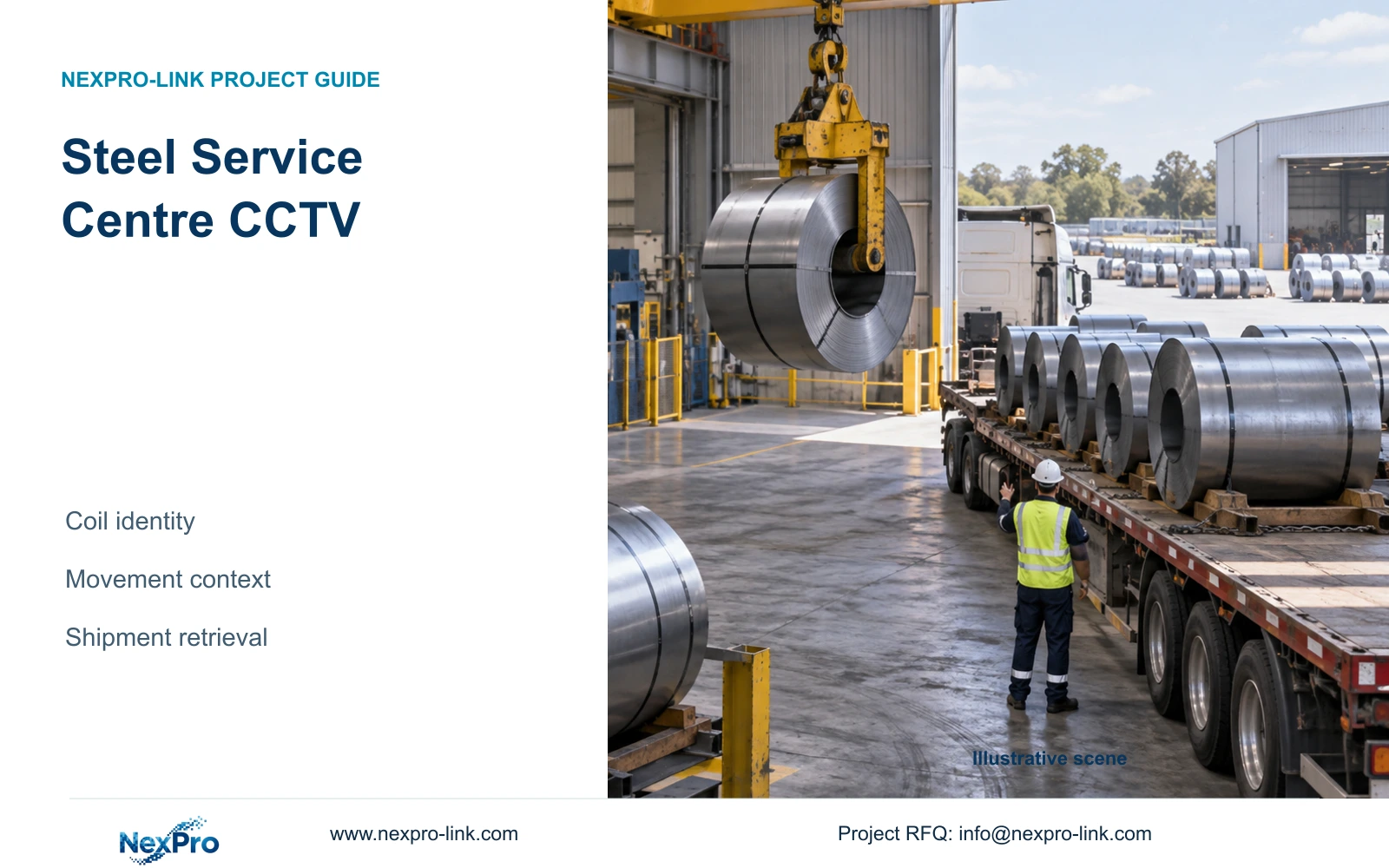
Steel service centre CCTV should connect coil handovers to shipment records without confusing vehicle plates with material identity. Detail and overview views need separate acceptance tasks.
Section 01
Choose the material identifier at a stable transfer point
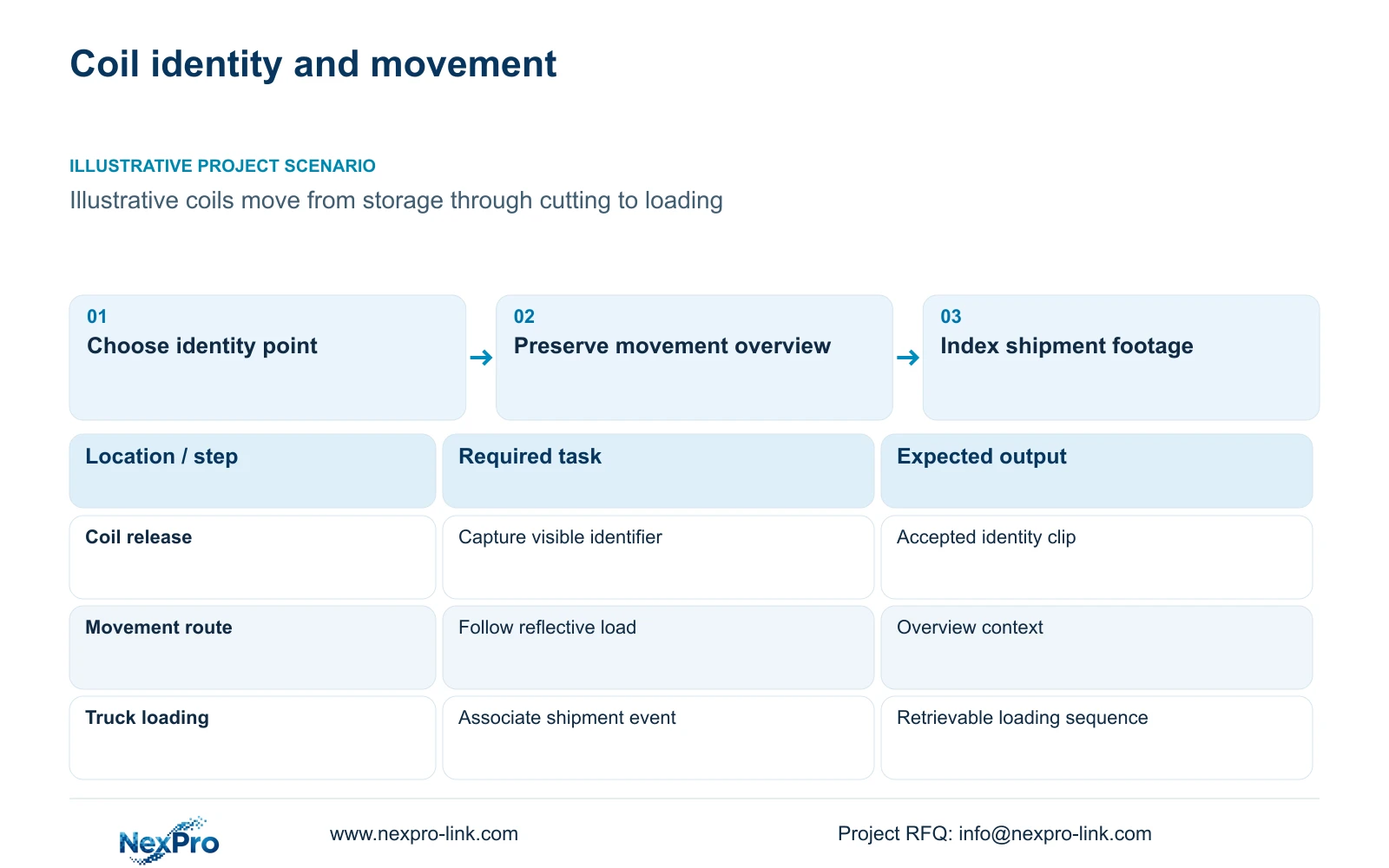
Use separate identity and overview tasks for steel service centre CCTV. First identify the coil or shipment reference the reviewer needs, then choose a transfer point where it is visible. A vehicle plate identifies a vehicle within an agreed workflow; it does not establish which coil was loaded. Keep production and dispatch records as the primary identity source unless a camera trial proves the required detail.
Illustrative project scenario: Steel coils are moved between storage, cutting and truck loading positions. Assume the design review includes a coil release point, a movement route and a loading position. Large reflective loads may obscure labels during handling. The proposed task is to associate recorded events with a shipment, not provide automatic coil recognition.
Obtain sample identifiers, their physical sizes, usual placement and possible orientations. Ask when the identifier faces the proposed camera and whether operators or lifting equipment cover it. If the label is never visible at loading, capture the association earlier at a stable release point and preserve the subsequent movement context.
Section 02
Preserve movement context around reflective and obstructing loads
An overview should show the path between release, storage and loading without being judged by label readability alone. Review typical loaded positions and crane or forklift movement. The identity view should retain its own acceptance event rather than being widened until it becomes an indistinct version of the overview.
Test proposed angles with representative reflective surfaces and lighting. A narrow detail view can lose the event when a coil rotates or a lifting attachment passes in front of it. If that happens routinely, adjust the observation point or keep a complementary view at the handover boundary.
Record the stock and vehicle envelopes used for approval. Include dust, cleaning and any radiant heat near the proposed mount as separate qualification inputs. The supplied ordinary camera ratings do not establish process-facing suitability. A revised coil storage arrangement can require a sightline review even when the environmental conditions remain unchanged.
Section 03
Make shipment retrieval work without assumed integration
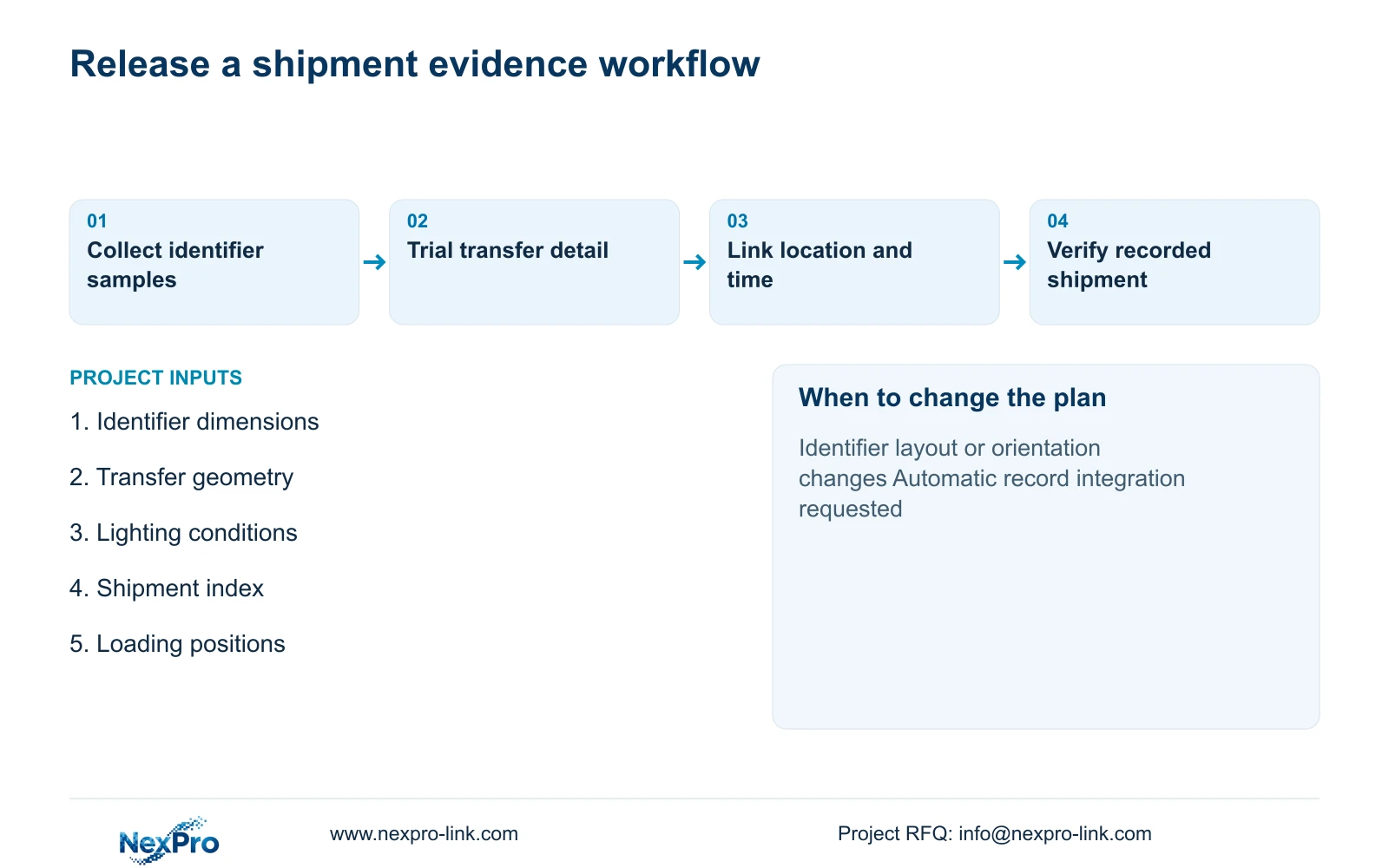
Agree a retrieval index using shipment reference, loading position and time. The dispatch team supplies the record and the CCTV team provides location names and recorded access. Start with an explicit manual procedure if that meets the buyer's task. Automatic search by shipment or scanner event requires a separately supported interface.
Have commissioning demonstrate a sample shipment: locate its release event, follow the movement overview and retrieve loading footage. Verify time consistency across the relevant devices and record the authorised export steps. A successful live view is insufficient evidence that the reviewer can recover the complete sequence later.
Assign responsibility for changes to loading-bay names and shipment records. Camera location labels and project packing should follow the approved schedule, while account permissions govern who can review or export footage. Keep a separate requirement for vehicle plate reading if needed; the ordinary human and vehicle classification field does not establish plate or coil identification.
Section 04
Compare candidate outputs at the same target width
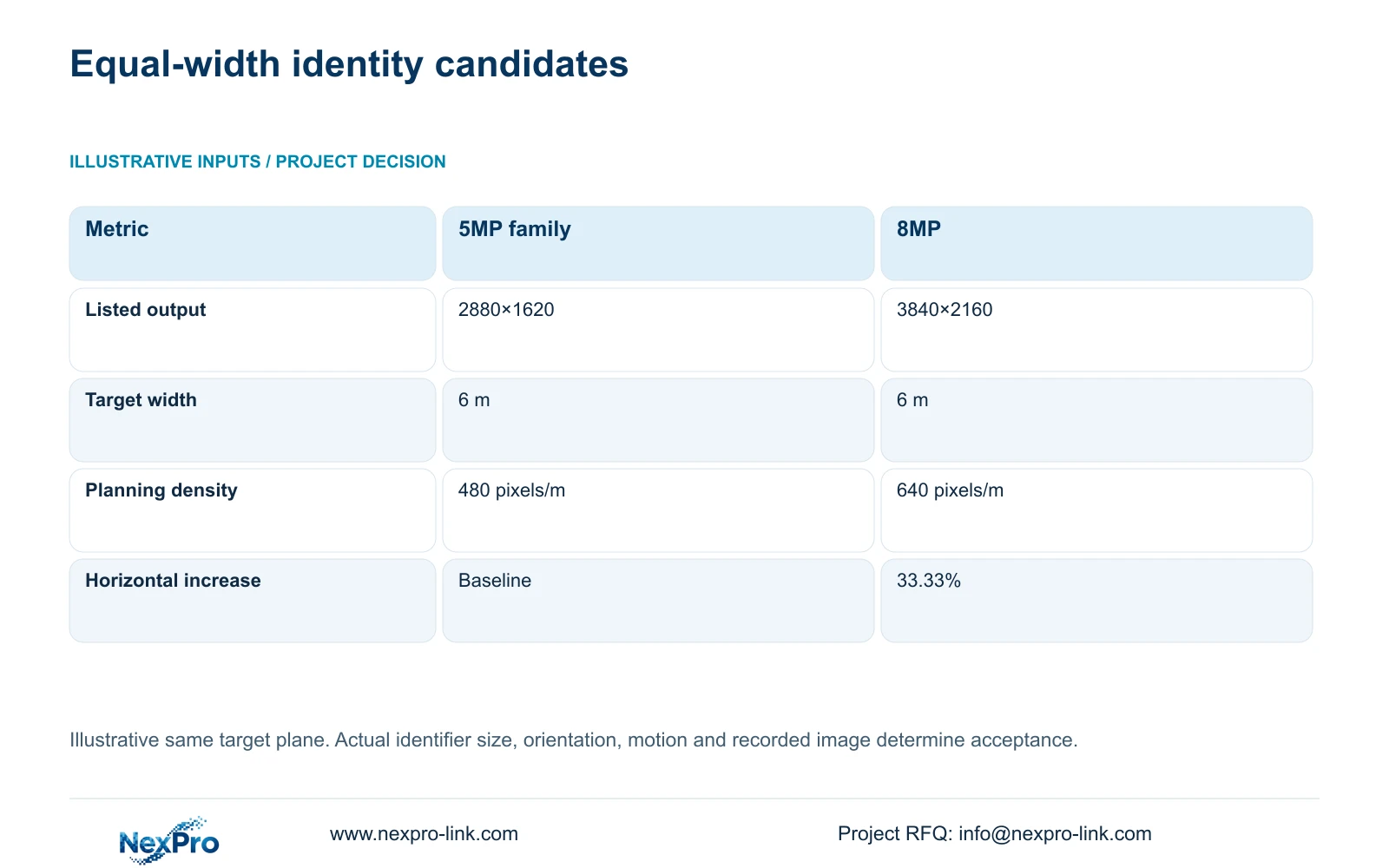
The supplied BL2812M55-5MP reference lists 2880×1620 output, while the BL2812M88-8MP reference lists 3840×2160. At the illustrative 6 m target plane, ppm = horizontal_pixels / 6. The resulting planning densities are 480 pixels/m and 640 pixels/m. Relative_increase = (3840 / 2880 - 1) × 100 = 33.33%.
This is a horizontal-density comparison under equal assumed geometry. It does not establish a 60% increase in useful detail from the family labels, nor does it demonstrate night performance or guaranteed label readability. Preserve the source dimensions instead of substituting another output for the 5MP-family reference.
For coil identity, the practical next step is a recorded trial with the actual identifier and handling state. If the identifier is too small, obscured or poorly oriented, more output pixels may not resolve the task. Change framing or the capture point and repeat acceptance rather than declaring either model suitable from arithmetic alone.
| Metric | 5MP-family candidate | 8MP candidate |
|---|---|---|
| Listed output | 2880×1620 | 3840×2160 |
| Horizontal output | 2,880 pixels | 3,840 pixels |
| Target width | 6 m | 6 m |
| Planning density | 480 pixels/m | 640 pixels/m |
| Relative horizontal increase | Baseline | 33.33% |
Section 05
Keep the identity decision compatible with the recording package
Recommend dedicated identity capture at the proven handover point and an overview that preserves the movement path. Select an 8MP candidate where its recorded trial and supported system configuration justify it, without assuming every overview needs the same upgrade. Compare bids using the same identifier, geometry and loading conditions.
CASE01 supplies an illustrative 32-camera ordinary-area recording model, using supported 5MP-class streams averaging 4 Mbps each. Its resulting 128 Mbps input is a declared design assumption, not a fixed bitrate for these cameras. A mixed steel-centre schedule needs actual stream modes, representative bitrates and retention inputs before recorder selection.
Place recording, switches and batteries in serviceable qualified rooms. Calculate local PoE demand and the complete protected load without counting camera power twice within switch AC input. Keep remote link endpoints and their power supplies visible. The operator display is a client branch; any wall or additional workstation must have its own supported viewing scope.
Section 06
Procure the accepted identity workflow and its accessories
Release a camera schedule that identifies overview, material identity and any separate vehicle-identity role. Attach the accepted target width, output mode and sample-event procedure to each detail point. Include mounts, route protection, connection accessories and local installation rather than comparing camera goods in isolation.
NexPro-Link's factory project supply and BOQ support can assist with model matching, coordinated lists and technical deviations. Packing by release point and loading bay helps preserve those decisions during installation. Project labels should remain useful for playback and maintenance, not merely identify the purchaser's brand.
Before final acceptance, retrieve a representative shipment sequence from recorded footage and confirm export access. Record unresolved label conditions honestly. If the buyer changes identifier layout, handling orientation or loading location, reopen the relevant view and system inputs rather than assuming the original density figure still represents the task.
Section 07
Buyer questions
What if the coil identifier cannot be seen at truck loading? Use an earlier stable capture point and an agreed record linking that coil to the loading event. Preserve the movement sequence; do not claim the loading camera reads an identifier it never sees.
Do we need automatic scanner integration? Only if the required retrieval workflow justifies it. A manual shipment-time and location index may be sufficient. Quote and test automatic integration separately against exact systems.
Can an ANPR view replace material-detail recording? No. Vehicle identity and coil identity are different evidence tasks. Keep both where required and associate them through the shipment record.
Section 08
Match the coil identity task to a camera view
Send sample coil identifiers and dimensions, transfer and loading geometry, representative lighting conditions, and your shipment retrieval workflow to info@nexpro-link.com for a task-specific camera package discussion.
Engineering references
These sources support the general planning principles. Always use the selected product's current datasheet and applicable project standards for final design.