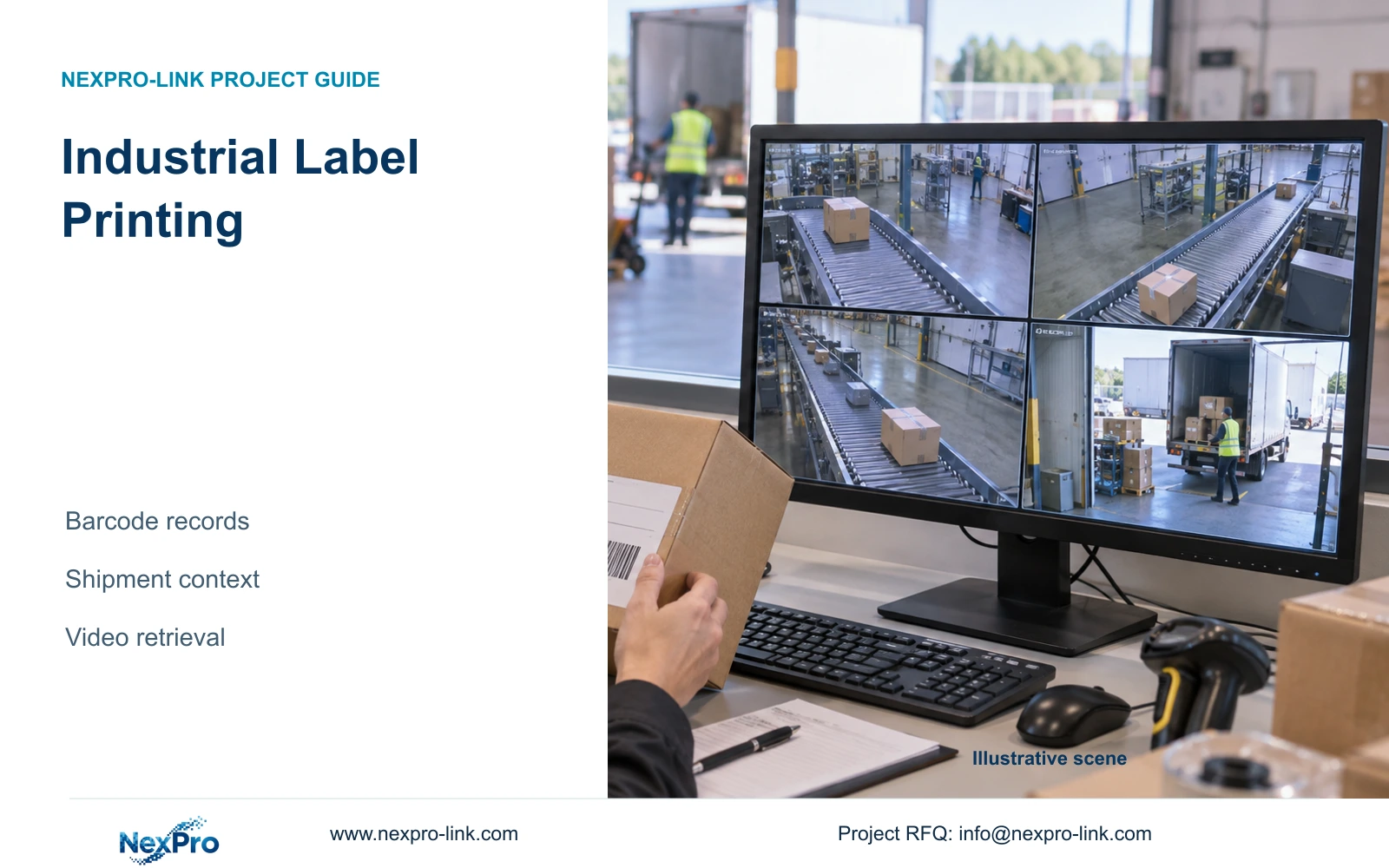
Industrial label printing records can guide CCTV retrieval when job identifiers, event times and camera locations are mapped consistently. Define that relationship before buying integration.
Section 01
Make the shipment record the starting point
For industrial label printing, link footage to an authoritative job or shipment identifier through a documented time-and-camera map. Keep barcode production records responsible for identity and use CCTV to review the associated handling. A software interface becomes worth specifying when its fields, ownership and retrieval behavior are agreed. Overview footage alone should not carry a promise of automatic barcode reading or OCR.
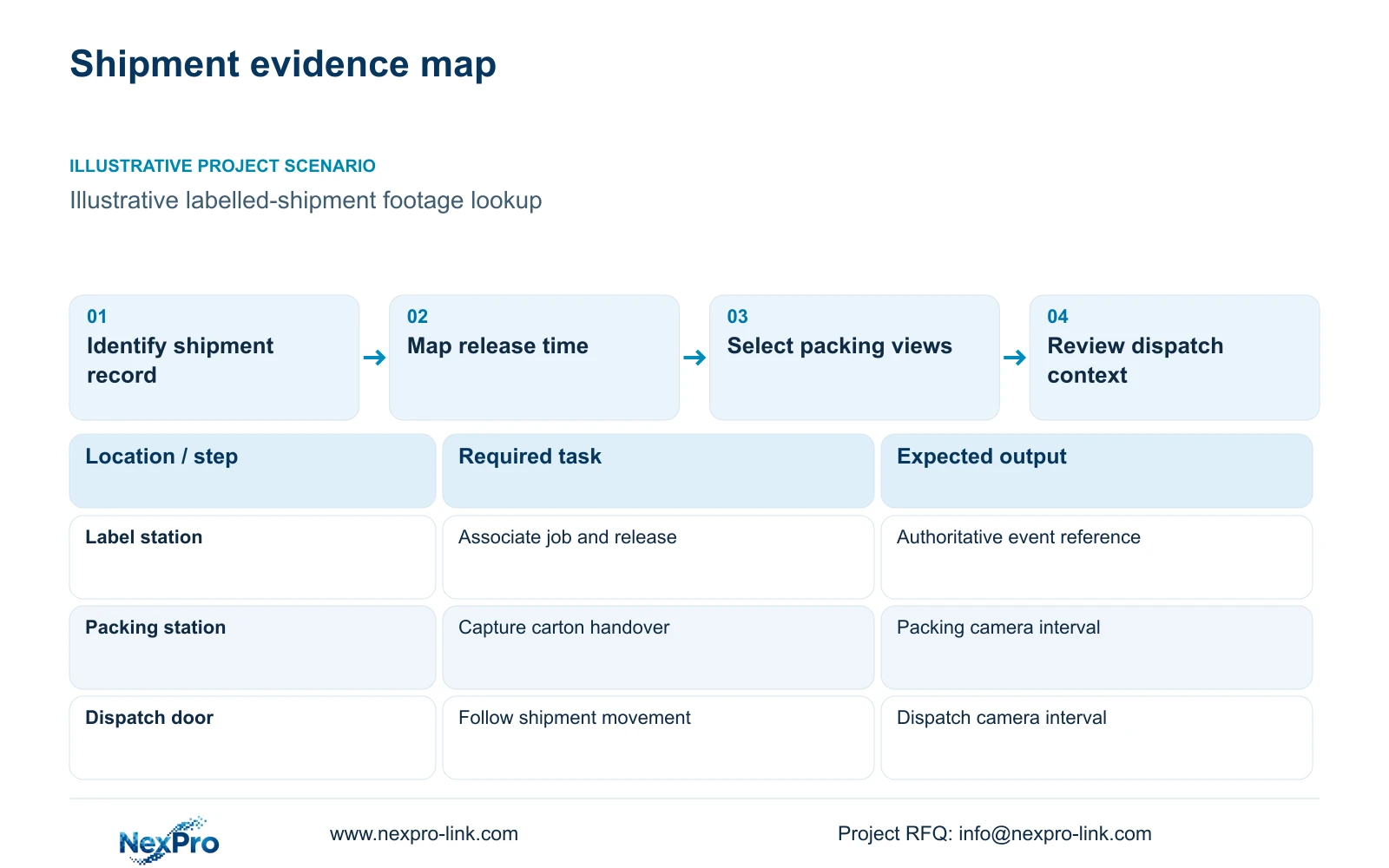
Illustrative project scenario: The customer wants to locate the footage corresponding to a labelled shipment. Assume, for planning, that labels are printed against a job record, cartons pass a packing station, and a dispatch operator records their release. The proposed CCTV task is to show the handover and subsequent movement. These are hypothetical operating conditions, not a completed customer installation.
Ask the operations team which identifier survives reprints, split shipments and carton consolidation. Record the shipment reference, event type, event time, time zone, station and associated cameras. If one job produces several releases, each release needs its own event reference. Otherwise, a valid job number may still return an ambiguous stretch of video, leaving the reviewer to reconstruct the shipment manually.
Section 02
Capture the handover and its surrounding movement
Place views around the actual packing and dispatch sequence. A packing view should show the carton entering the handover position, the operator's relevant handling and its departure. A dispatch view should show the next transfer into staging or loading. Agree whether the objective is movement context, carton association or readable label detail, since each requires a different field of view.
Survey transfer speeds, label orientation, lighting and temporary obstructions using representative cartons. A stationary presentation point may support a closer view; a fast-moving conveyor requires a separate image trial. Where barcode verification is essential, specify the scanner or specialist inspection system separately. CCTV may document the surrounding activity without confirming print quality or every encoded character.
The NexPro-BL2812M55-5MP-DIC-AI is a normal-area camera candidate with a listed 2880×1620 main output, 25fps@5MP and a 2.8–12mm motorized lens. Those fields allow a view to be proposed, but establish no guaranteed barcode-reading distance. Map dust exposure, solvent boundaries and cleaning access before approving mounting positions. Ordinary surveillance equipment does not provide machine protection or hazardous-area approval.
Section 03
Price the record-to-video interface separately
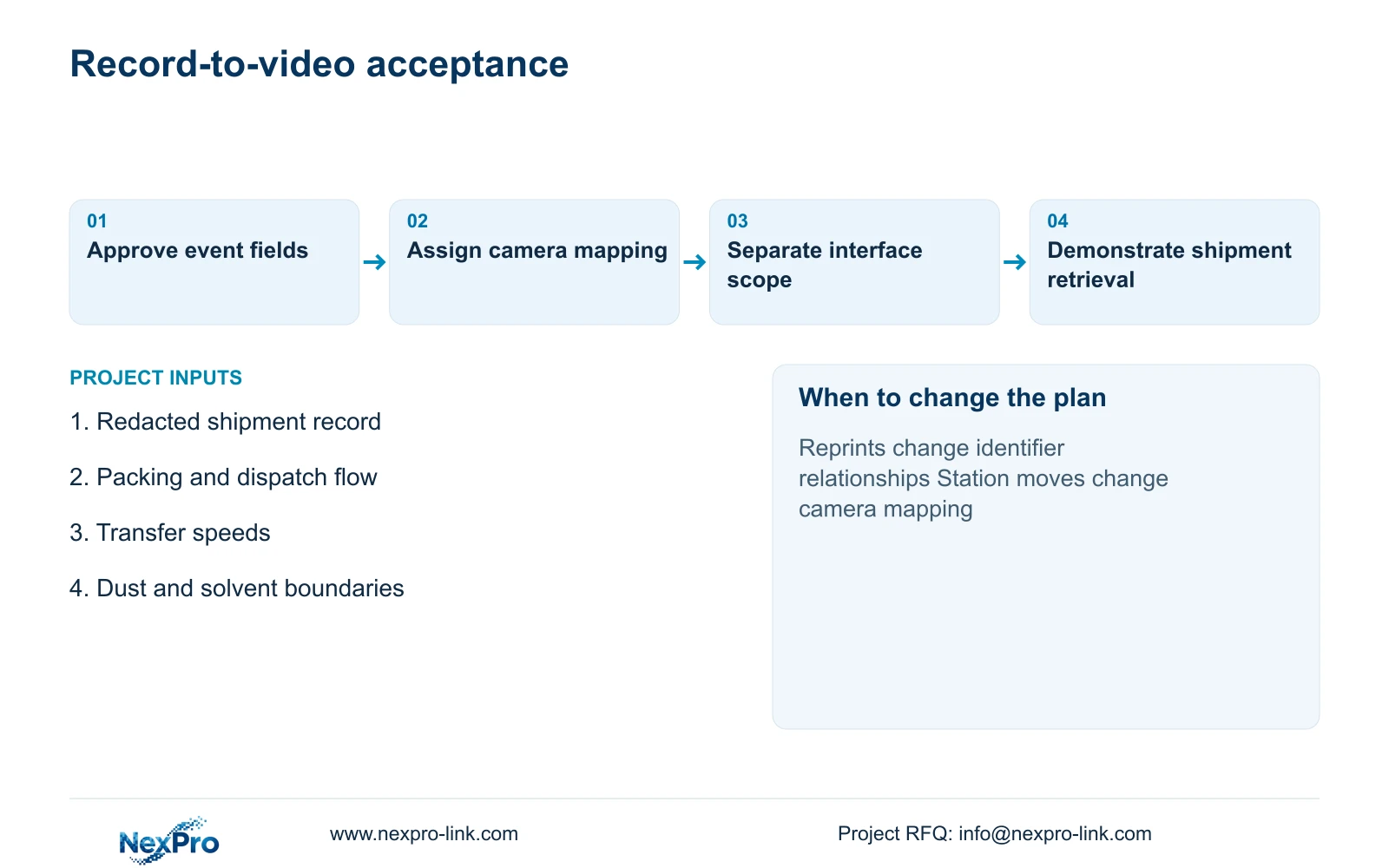
Begin with a manual retrieval map that an authorized operator can follow: shipment record, release event, station, camera IDs and a justified time window. The operations owner supplies the event fields, the CCTV integrator maintains camera names and recording access, and the project manager approves the combined handover map. This provides a usable baseline before commissioning software development.
An optional interface needs a written behavior specification. Decide how it handles corrected timestamps, duplicate identifiers, missing scans and a shipment moving between stations. Identify who maintains the station-to-camera relationship after equipment moves. A link that opens the wrong camera after a layout change can appear functional while directing the reviewer away from the event.
Separate the commercial lines for CCTV equipment, event-data extraction, interface development, permissions and acceptance testing. Define whether the interface merely displays a lookup reference or opens playback in a supported client. ONVIF profile information concerns device and client functions; it does not establish a native barcode database integration. Require a demonstrated workflow on the selected recorder and firmware before accepting automated retrieval.
Section 04
Measure the footage selected for review
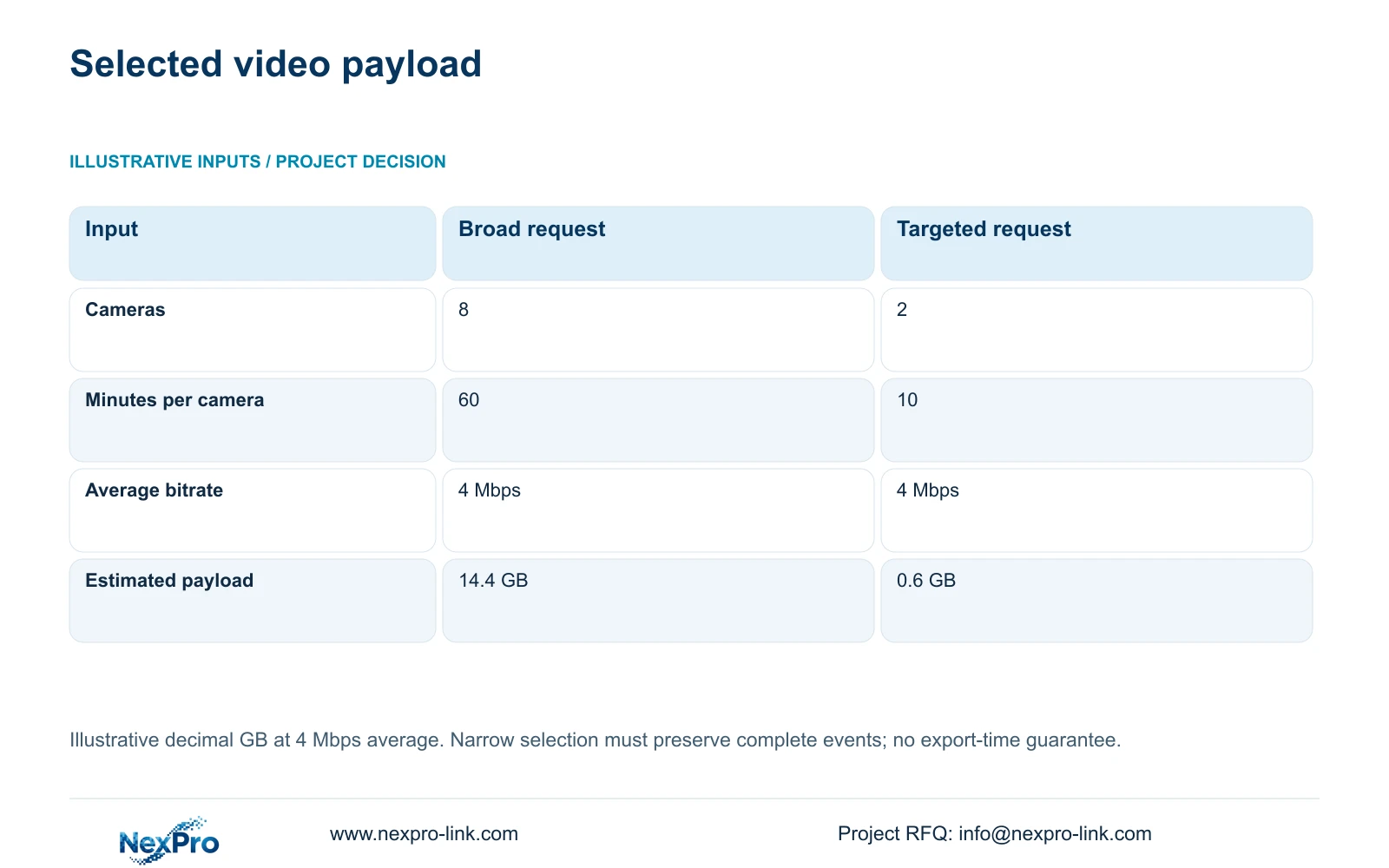
The illustrative export comparison assumes Option A selects eight cameras for 60 minutes each and Option B selects two relevant cameras for 10 minutes each. Both use an assumed average payload of 4 Mbps. With decimal GB, the formula is GB = cameras × Mbps × seconds / 8 / 1000. Option A gives 8 × 4 × 3600 / 8 / 1000 = 14.4 GB; Option B gives 2 × 4 × 600 / 8 / 1000 = 0.6 GB.
The decisive difference is the event selection supported by the mapping. Two relevant views and a defensible interval exclude unrelated material. Adopt the smaller selection only when it includes the complete required handover, preceding context and subsequent movement. If cartons queue, a scan occurs late or dispatch moves to another door, extend the interval or add cameras.
These figures estimate selected video payload, not guaranteed file size or export duration. Actual bitrate, audio and export packaging may change the delivered files. Record the cameras, interval and selection reason with the export. A smaller payload does not establish staff-time savings or legal evidence status, and it does not authorize deletion of the underlying recording.
| Selection input | Broad request | Targeted request |
|---|---|---|
| Cameras selected | 8 | 2 |
| Minutes per camera | 60 | 10 |
| Assumed average bitrate | 4 Mbps | 4 Mbps |
| Estimated video payload | 14.4 GB | 0.6 GB |
Section 05
Keep retrieval improvements separate from retention
Recommend the documented mapping as the initial procurement basis. It preserves shipment context without making a software dependency part of every camera purchase. Add an interface when the agreed operating workflow requires it and a sample transaction can demonstrate correct retrieval. Keep a manual fallback for missing event records, and retain owner-mandated platforms or specialist inspection functions where they are required.
CASE01 supplies an illustrative whole-system reference rather than a label-printing installation. Its 32 cameras at an assumed 4 Mbps, continuously recorded for 30 days, produce 41.472 TB. Four 16 TB drives provide 64 TB raw; applying the case's 95% usable factor and 20% reserve gives a 48.64 TB video budget. The 41.472 TB video requirement fits that budget. Targeted exports do not reduce this retention requirement.
The NexPro-NVR4449-4K reference has 49 channels, 320 Mbps input and four SATA bays supporting up to 18 TB per drive. Confirm the actual stream modes and concurrent playback task separately; channel count establishes neither RAID nor decoding performance. A retrieval workstation is sufficient unless operators require simultaneous wall viewing. Protect the recording and camera-power path independently of the display decision.
Section 06
Issue a scope that can be accepted and maintained
Prepare a security handover map listing each packing station and dispatch door, its event reference, camera IDs, recorder location and retrieval owner. Mark ordinary camera positions separately from any specialist positions requiring additional environmental assessment. Include the approved observation task so later maintenance does not replace a close handover view with a convenient but unhelpful overview.
For acceptance, use an agreed sample shipment record and retrieve its packing and dispatch sequence. Check time alignment, permissions, playback and an exported copy. Include a reprint or corrected-event example if those occur in the real workflow. Record limitations against the relevant task, rather than accepting the system solely because live images are visible.
NexPro-Link's BOQ and tender support can help turn this schedule into model matching, technical documents and a coordinated quotation. Its factory project supply scope can cover relevant equipment preparation and project packing. Keep software implementation, local installation and specialist approval assigned to the parties undertaking them. Compare competing offers against the same retrieval demonstration and retention basis, with interface support shown as a separate priced obligation.
Section 07
Buyer questions
Can we start without changing the label-printing software? Yes, if existing records provide usable identifiers, event times and station references. Pilot a controlled lookup sheet or record export first. Confirm that operators can maintain it consistently before deciding whether automation is needed.
What happens if the scanner and recorder clocks disagree? Use a documented alignment check to establish the discrepancy and widen the retrieval window where necessary. Correct the time configuration through the responsible teams, then repeat the sample lookup. Do not silently alter the original event record.
Should the smallest export always be preferred? Only when it preserves the necessary event context. An unresolved handover may need additional views or a longer interval. The selection reason and handling record matter more than achieving the smallest file.
Section 08
Define your shipment-to-video scope
Send your printing-to-dispatch flow, a redacted sample job or shipment record, transfer speeds, and dust or solvent-area information to info@nexpro-link.com to discuss the camera map and separately priced integration scope.
Engineering references
These sources support the general planning principles. Always use the selected product's current datasheet and applicable project standards for final design.