When a packing station loses power, the things worth preserving are the order state, the last scan, and the label that was mid-print when the lights went out.
Section 01
Define the warehouse task that must finish
When a packing station loses power, the things worth preserving are the order state, the last scan, and the label that was mid-print when the lights went out. A supervisor who knows those three facts can reopen the shift in minutes. A supervisor who does not has to reconcile partial work by hand.
A packing station may need to finish a label, close a shipment record or keep a queue intact long enough for a controlled stop. State the useful outcome and the maximum acceptable interruption before listing equipment.
Trace local dependencies such as the terminal, scanner, printer, small switch and wireless bridge. A powered workstation cannot complete the task when its required network path has already stopped.
| Device | Operating state | Power question |
|---|---|---|
| Terminal and display | Normal transaction | Can it save and stop? |
| Scanner | Short active event | Bus-powered or separate supply? |
| Label printer | Printing peak | What is the measured peak demand? |
| Local network | Required communication | Which device keeps the path available? |
Section 02
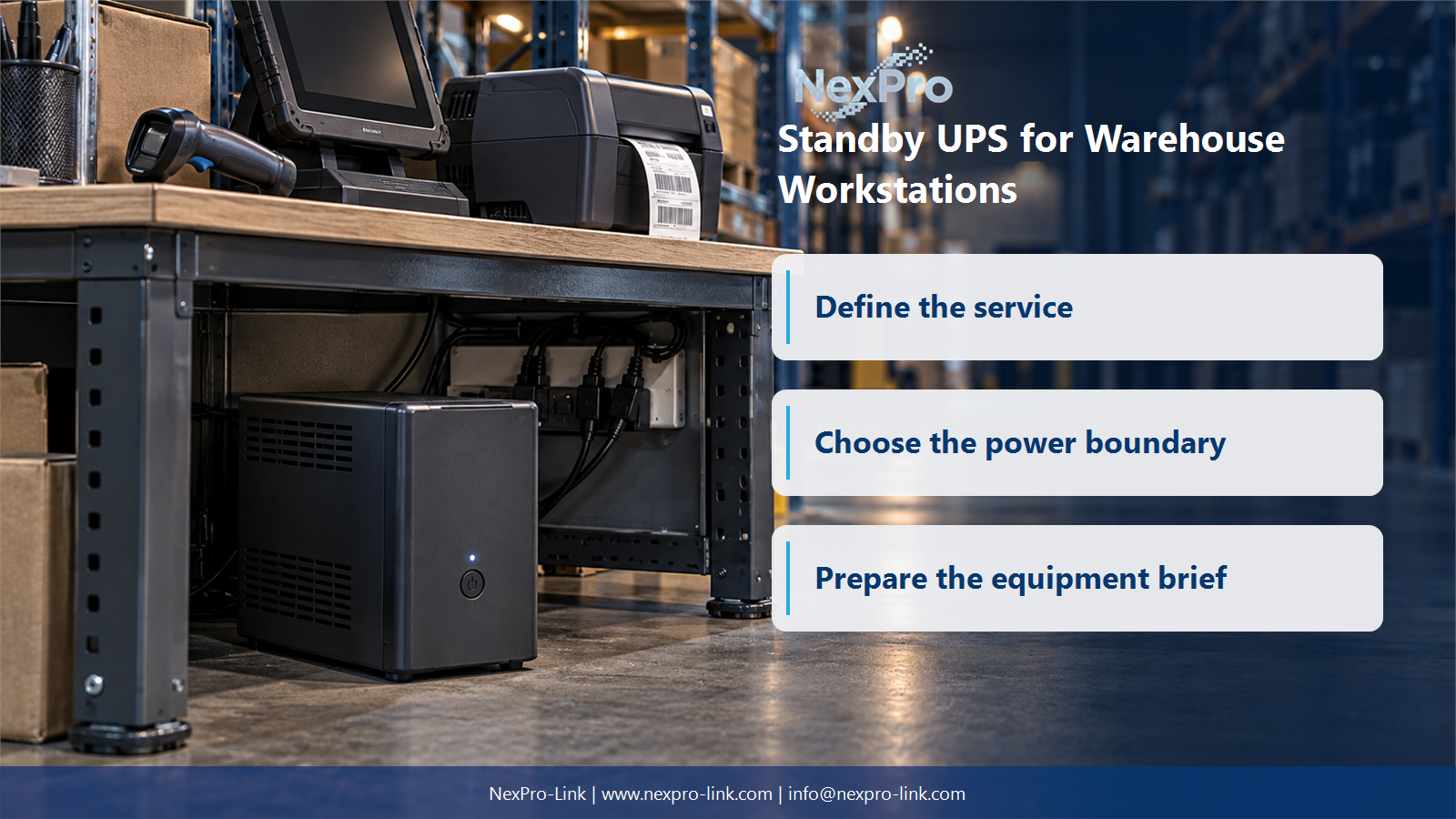
Separate active and peak loads
Measure the station while it scans, prints and updates the warehouse application. A label printer can have a different peak from its idle demand, so average watts alone may miss the load that determines UPS output capability.
Keep conveyors, heaters and unrelated bench outlets outside the workstation group. Label battery-backed sockets so later equipment does not consume the reserve.
- Record watts and VA during a representative task.
- Check the printer peak and power-supply input separately.
- Include only the local network device needed for recovery.
Section 03
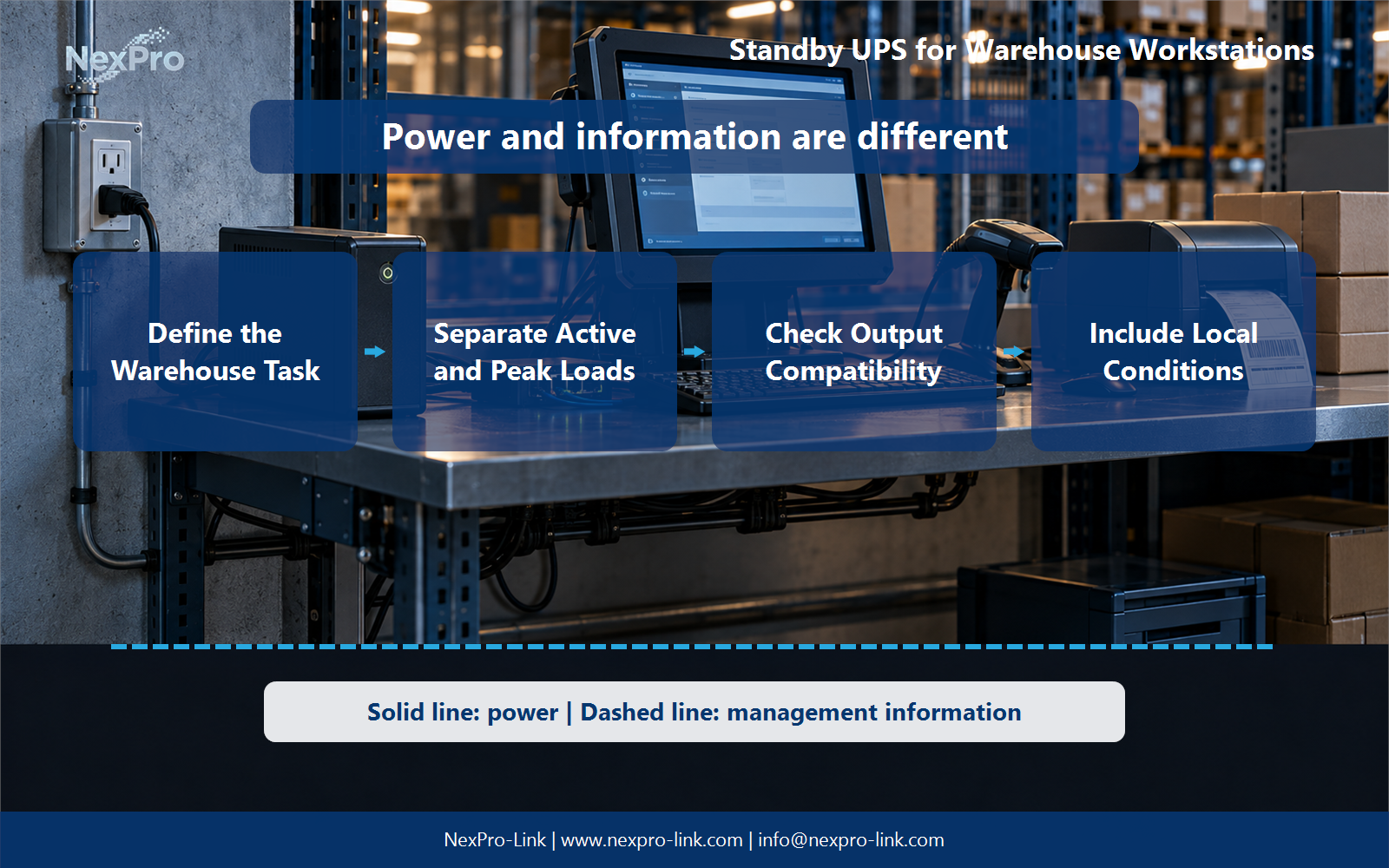
Check output compatibility and local conditions
A standby UPS transfers to its inverter when the source leaves the accepted range. Confirm transfer and battery-mode waveform compatibility for the terminal, printer and network supplies as a group.
Warehouses add dust, temperature variation, vibration, impacts and accidental disconnection. Provide airflow, cable restraint and service access, and keep the UPS away from traffic and floor-cleaning exposure.
Section 04
Write a local recovery workflow
Define the operator message, task-closing action, shutdown trigger and restart check. If the station is unattended, verify that the terminal and network device follow the intended automatic behavior.
After supply returns, confirm application connection, print queue and label state before releasing work. This avoids duplicate labels or a shipment record that does not match the physical parcel.
Section 05
Calculate an illustrative workstation group
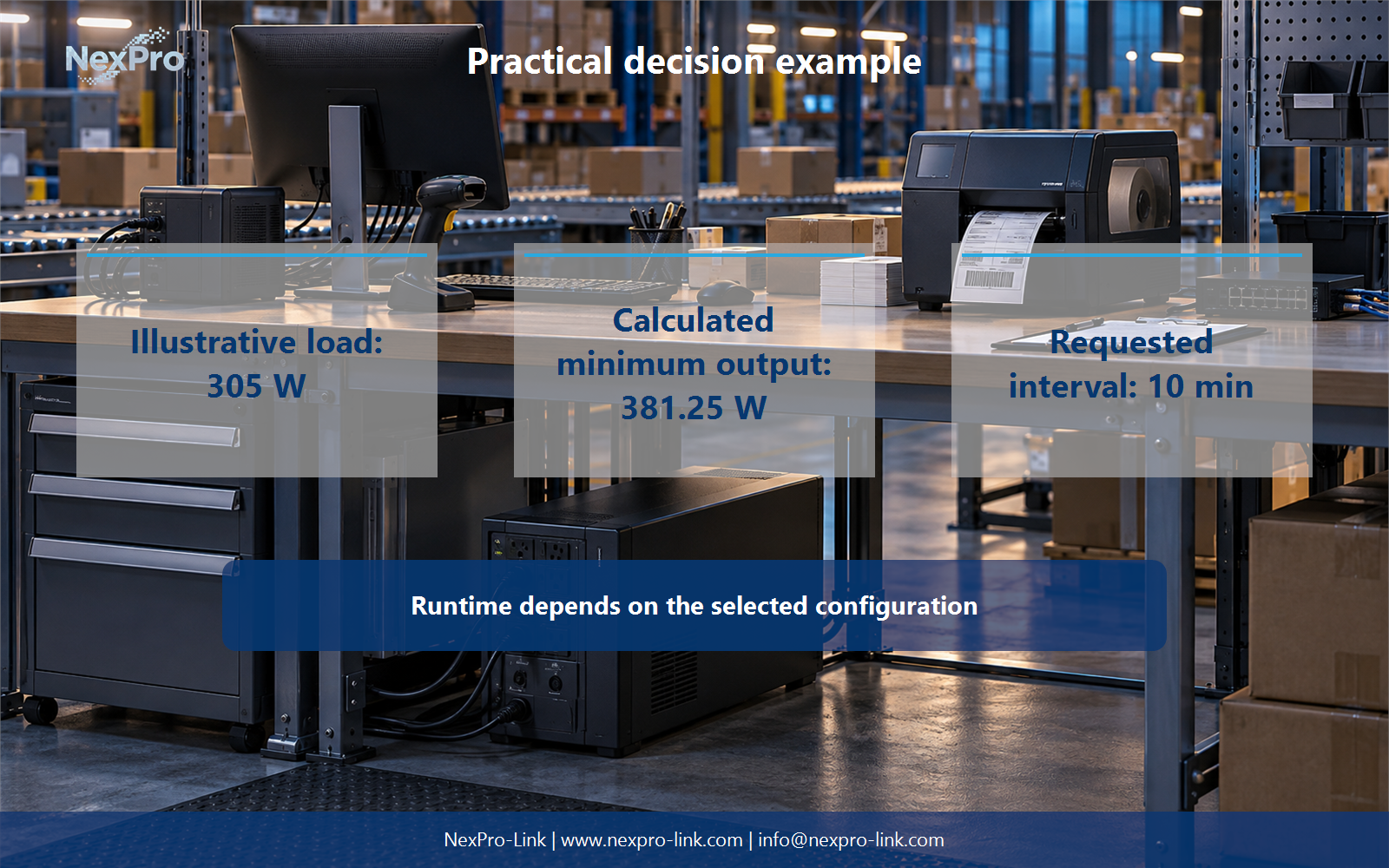
Assume 220 W for the terminal and display, 70 W for the label printer and 15 W for local networking. The total is 305 W, or 338.89 VA at 0.90 power factor. At an 80 percent operating ceiling, the planning minimum is 381.25 W and 423.61 VA.
A ten-minute idealized energy requirement is 50.83 Wh before losses, battery limits, aging and reserve. Use current runtime data for the selected UPS and test the complete workstation task.
Engineering references
These sources support the general planning principles. Always use the selected product's current datasheet and applicable project standards for final design.