The UPS protects the power window; the drives, controllers and database each own their persistence and recovery responsibilities.
Section 01
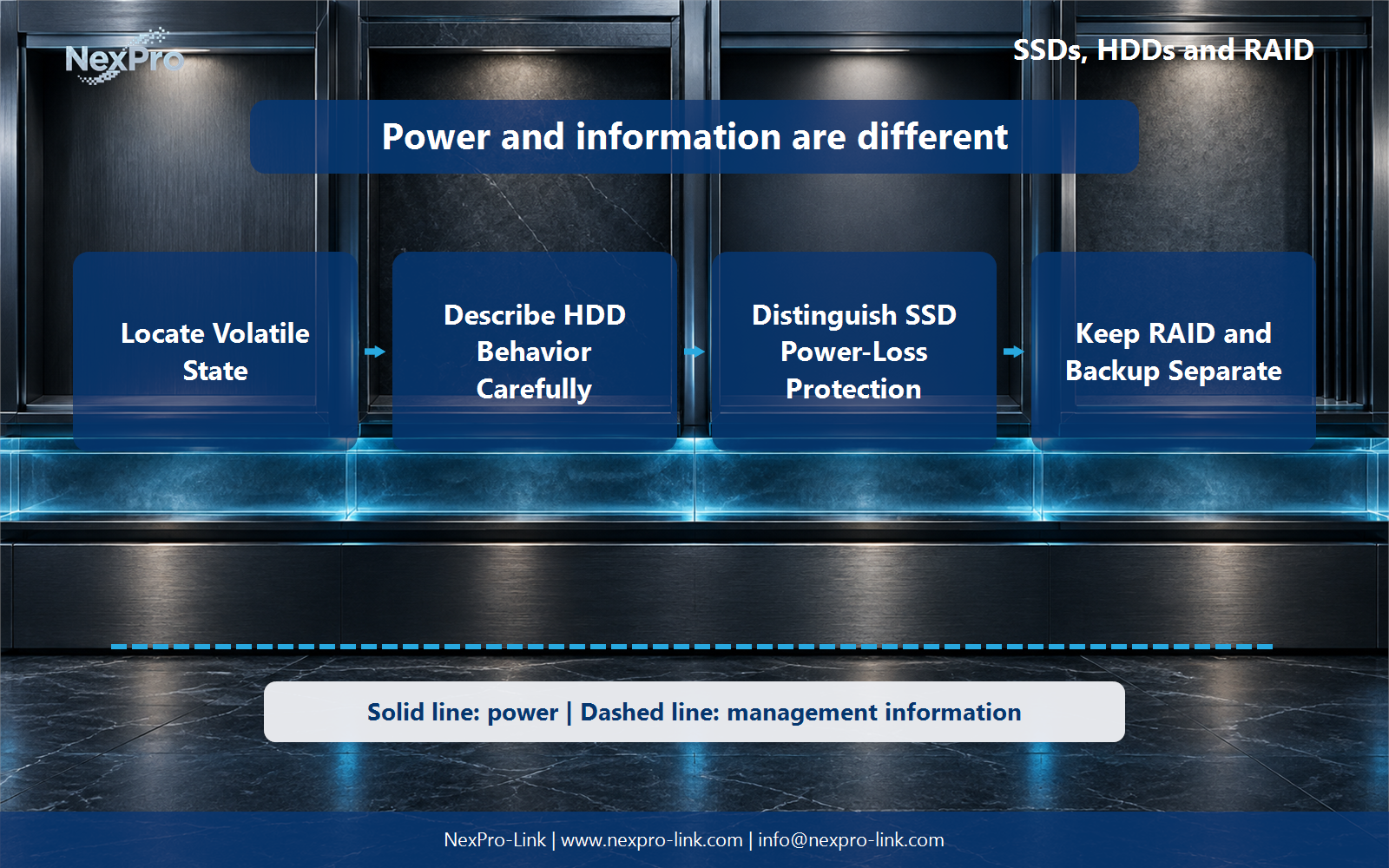
Locate volatile state before choosing protection
The immediate issue for storage and systems operations engineers is: Which parts of a storage system can still hold unwritten data? Application memory, operating-system buffers, controller caches and device caches can all be part of the write path. Identify which layers have independent protection and what completion acknowledgements mean. This provides a more accurate explanation than assuming the presence of an SSD or RAID automatically makes abrupt power loss harmless. This article turns that answer into write stack: layer / volatile state / protection / flush condition and a supplier brief based on storage controllers, drive types and shutdown sequence.
The UPS protects the power window; the drives, controllers and database each own their persistence and recovery responsibilities.
Unwritten data can sit in application memory, operating-system pages, controller RAM and a drive's internal cache. A write acknowledgement only becomes meaningful when the required durability boundary is understood. Map where each layer says the write is complete and what keeps that state safe during power loss.
The map should identify flush commands, protected controller cache, drive power-loss protection and filesystem behavior. This prevents one protected component from being presented as protection for the whole path.
| Layer | State | Completion condition |
|---|---|---|
| Application | Uncommitted transaction | Application commits or checkpoints |
| Operating system | Dirty page cache | Flush returns from storage |
| Controller | Pending cached writes | Protected cache writes to media |
| Device | SSD or HDD write cache | Drive confirms the flush |
Section 02
Describe HDD and SSD behavior carefully
An interrupted HDD write can leave inconsistent metadata or a lost cached block without proving that the head damaged the platter. Use journal behavior, controller logs and drive diagnostics to separate recovery work from a hardware fault.
SSD power-loss protection can preserve state inside the drive when the selected device and firmware support it. It does not stop the host, controller or network cleanly. Those layers remain part of the wider shutdown and UPS boundary.
- Call a hardware fault only when diagnostics support it.
- Confirm whether drive cache and controller cache are protected separately.
- Keep the host and management network powered until storage work is complete.
Section 03
Keep RAID, UPS and backup as separate mechanisms
RAID supports availability through some member-disk failures. A UPS provides temporary continuity and an orderly stop. Backup provides another copy that can be restored after deletion, corruption or site loss. None of these mechanisms replaces the other two.
Write the failure each mechanism covers and the recovery owner beside it. This makes gaps visible, especially when a resilient array is mistaken for a recovery copy or a long battery interval is mistaken for data durability.
| Mechanism | Handles | Does not handle alone |
|---|---|---|
| RAID | Selected member-disk failures | Deletion, corruption and site loss |
| UPS | Temporary continuity and clean shutdown | Long outages and recovery of another copy |
| Backup | Restoration from another copy | Instant availability without restore work |
Section 04
Sequence applications, hosts and storage
Applications stop new writes and checkpoint first. Hosts then quiesce and unmount filesystems. Storage arrays flush cache and complete pending work after the hosts release them. The management network remains available until status and completion have been recorded.
Follow the platform's supported shutdown procedure and test acknowledgement at each stage. A timer without status can move on while the previous step is still busy, which shortens the useful reserve when the system is under load.
Section 05
Match the battery objective to recovery work
Decide whether the battery bridges a source transfer, runs the service for a fixed interval or completes a shutdown. Measure hosts, storage, switches and management equipment as one protected group for the chosen outcome.
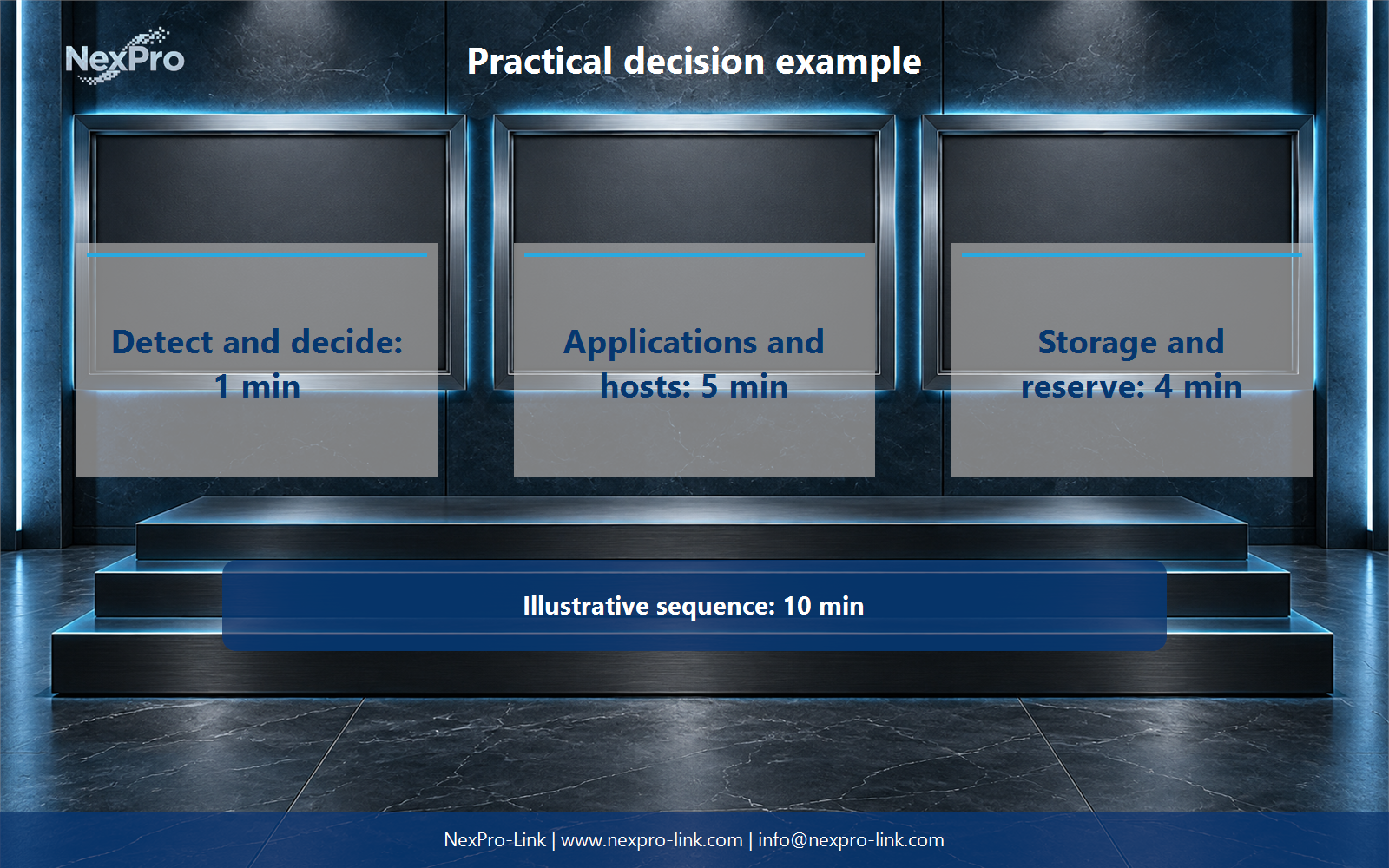
The ten-minute teaching sequence assigns one minute to detection, five minutes to applications and hosts, and four minutes to storage work plus reserve. It is a sequence budget, not a runtime claim. The selected UPS and battery configuration must be checked against the measured load and current runtime data.
Section 06
FAQ: SSD, HDD, RAID and UPS coordination
Where can unwritten data exist? In application memory, operating-system cache, controller cache and drive cache until the required durability boundary confirms it.
Does sudden shutdown always damage an HDD mechanically? No. Interrupted writes are a recovery issue; hardware damage needs diagnostic evidence.
Is SSD power-loss protection equivalent to a UPS? No. It protects state inside the drive, while the wider system still needs power and an orderly sequence.
Should storage stop before hosts? Usually applications and hosts release storage first. Follow the platform procedure and record the actual dependencies.
Engineering references
These sources support the general planning principles. Always use the selected product's current datasheet and applicable project standards for final design.