Shutdown order, completion confirmation and failure fallback, rather than simultaneous delayed shutdown of all hosts. Plan the project from the application dependency map, supported stop durations and management-power.
Section 01
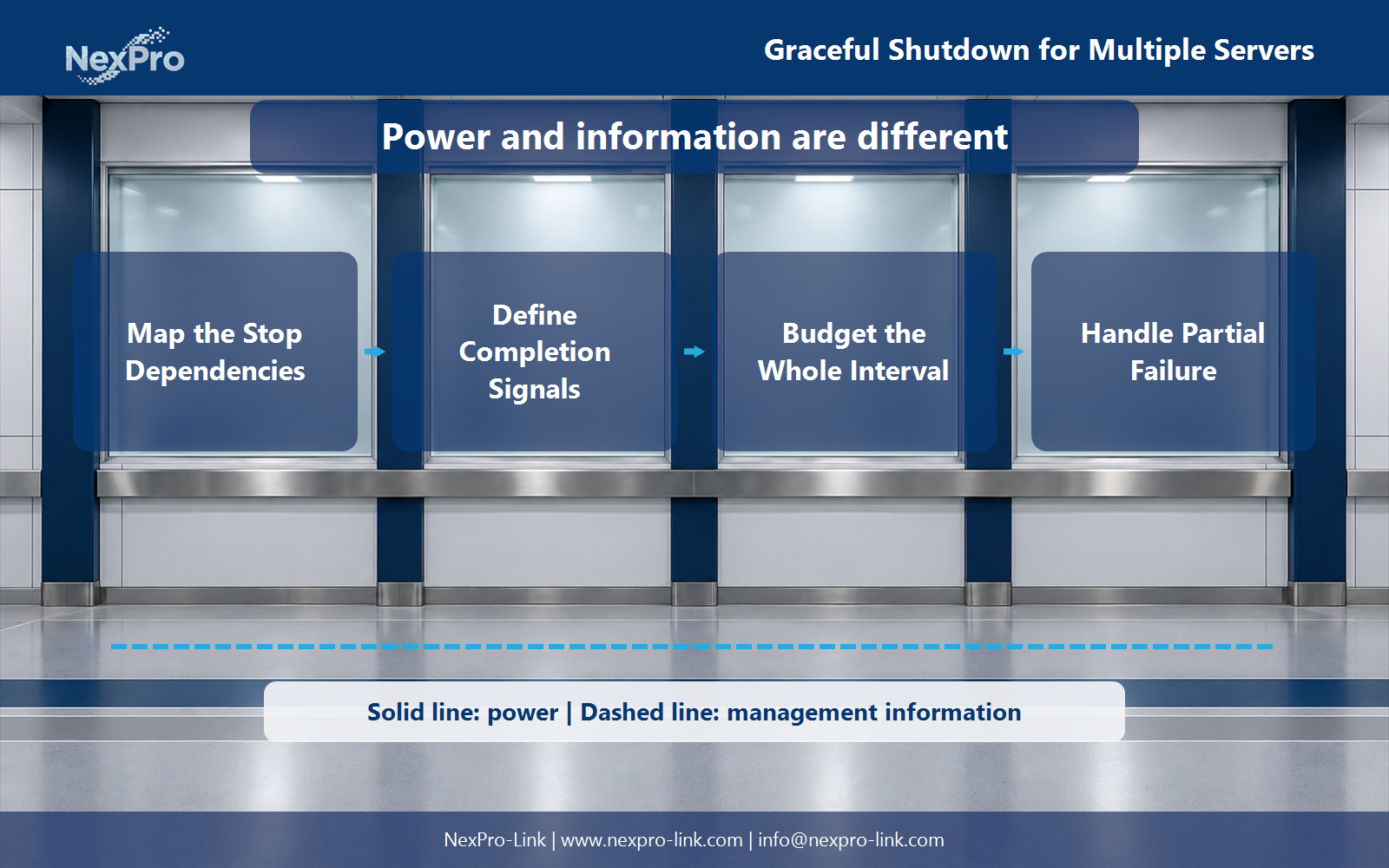
Map the point at which each service can stop
The immediate issue for IT operations, database and application teams is: Why should shutdown order follow dependencies? Applications may need storage, databases or network services while they stop. Identify those relationships before assigning timers. Simultaneous host shutdown can remove a dependency too early, while an excessively long sequence can consume the available backup interval. This article turns that answer into dependency table: service / prerequisite / stop confirmation / owner and a supplier brief based on application dependency map, supported stop durations and management-power path.
Shutdown order, completion confirmation and failure fallback, rather than simultaneous delayed shutdown of all hosts.
A shutdown sequence begins with dependencies, not timer values. An application may need a database, storage path, name service or network connection while it writes its final state. If an underlying service goes away too early, the application can be left in an unknown condition even though every host received a clean shutdown command.
Create a dependency record with the owner who can confirm each service state. The record is a practical way to decide which systems stay powered longest and where a management network, storage controller or hypervisor sits in the sequence. It also exposes services that need their own approved recovery procedure.
| Service | Required prerequisite while stopping | Completion evidence | Owner |
|---|---|---|---|
| Application service | Database and required network path | Application reports that it has stopped accepting work | Application team |
| Database service | Storage persistence path | Supported database or platform stop state | Database team |
| Virtual host | Guest shutdown and management access | Host state confirmed by the supported platform | Infrastructure team |
| Storage service | Final flush or controller procedure | Approved storage completion signal | Storage owner |
Section 02
Use completion signals beside time limits
A command being sent is not evidence that the action completed. Where the application or platform supports status reporting, use that confirmation in the sequence. A time limit still has value because it bounds the waiting period, but it should have a named fallback and owner rather than an automatic destructive response.
The chosen completion signal should match the system. It might be a supported service state, a controlled maintenance event, a confirmed host state or another approved indication. Avoid presenting one monitoring command or a generic network card as a universal integration for every operating system and application.
- Record the action, completion signal, maximum wait and accountable owner for each step.
- Keep timeouts short enough to preserve the remaining power budget, while allowing the supported service to finish its normal stop path.
- Define escalation in the application or infrastructure procedure before an outage occurs.
Section 03
Budget the entire runtime interval
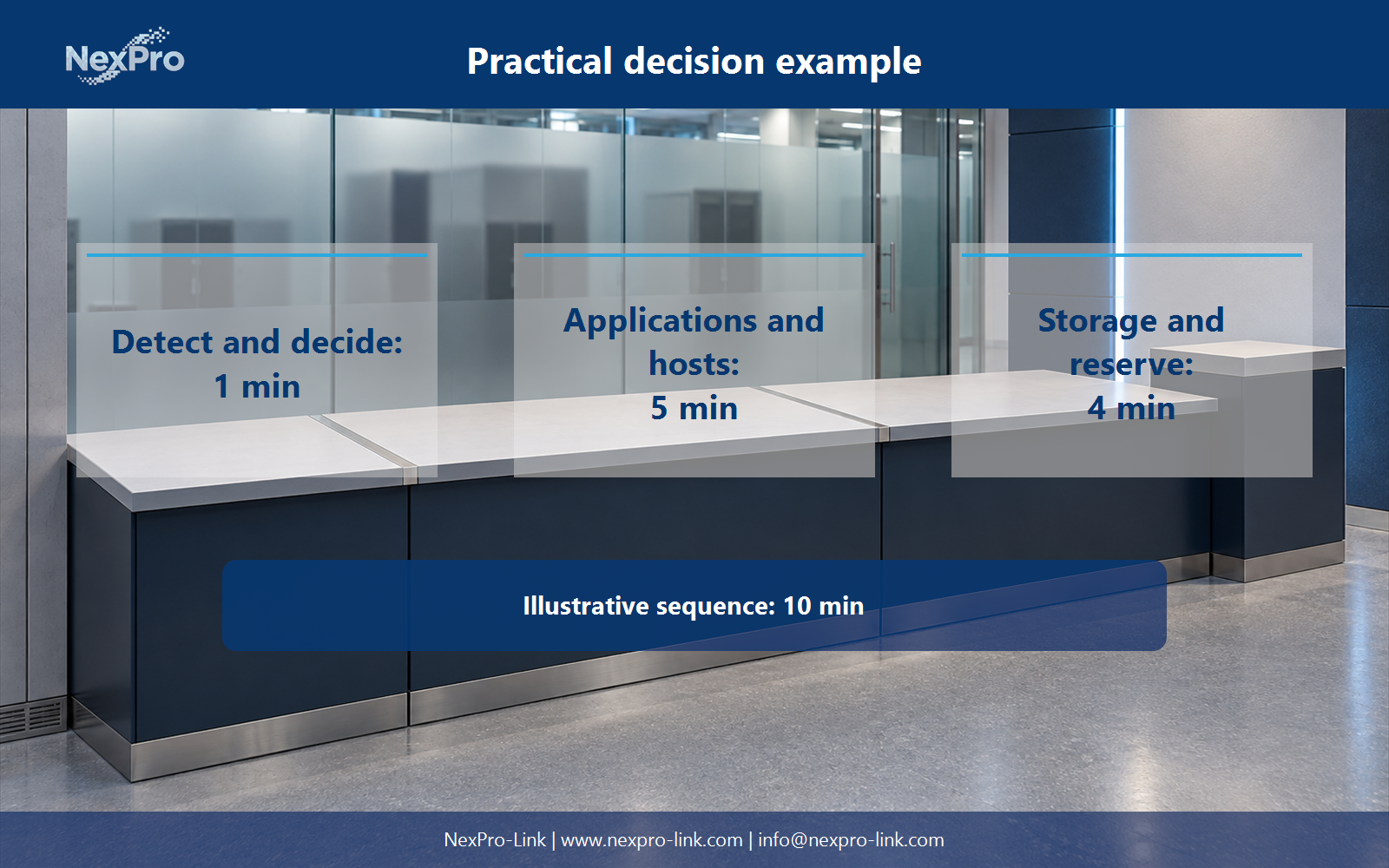
The UPS runtime objective must cover detection, decision time, supported application actions, host stopping, storage completion and reserve. Some steps can overlap and others cannot. The sequence owner should document that relationship rather than adding every nominal time together or assuming a migration will always finish within a fixed interval.
The example below has a 10-minute serial budget. At an illustrative 600 W retained load, the delivered load energy is 100 Wh. This is a load-side calculation only. It does not select a battery or promise that a particular UPS will provide 10 minutes under the actual project conditions.
| Non-overlapping step | Teaching duration | Reason to retain power |
|---|---|---|
| Detect and decide | 1 minute | Confirm the power event and start the approved sequence |
| Application stop | 3 minutes | Let applications finish their supported stop procedure |
| Host stop | 2 minutes | Retain management and network dependency until host state is confirmed |
| Storage completion | 2 minutes | Complete the approved persistence or controller procedure |
| Reserve | 2 minutes | Allow for defined delay within the planned sequence |
Section 04
Handle partial failure with a bounded response
A missed completion signal or a service that does not stop as expected needs a defined response. The workflow should identify the maximum wait, the owner who receives the escalation and the permitted next action for that particular system. It should not wait indefinitely while the available backup interval is consumed.
The response belongs to the responsible application and infrastructure teams because the safe action depends on the workload. For some services, the approved fallback is an additional observation period. For others, it may be a controlled operator decision. The UPS event supplies the timing constraint; it does not define every application's recovery policy.
| Failed step | Time limit | Permitted response | Escalation owner |
|---|---|---|---|
| Application reports no completion | Defined in the service runbook | Use the approved application fallback or operator decision | Application owner |
| Host state remains unknown | Defined infrastructure timeout | Confirm management access and follow the approved host procedure | Infrastructure owner |
| Storage completion is delayed | Defined storage timeout | Follow the storage team's approved response | Storage owner |
Section 05
Design restart as another dependency map
Restart follows its own readiness conditions. Utility power returning does not prove that the network, storage path, database state and application dependencies are ready to receive work. Write a supported start order that identifies the service condition required before the next layer begins.
A separate restart map prevents a shutdown document from quietly becoming an automatic power-on policy. It can also distinguish the components that start when power returns from those that need an operator or a platform-specific check. This is particularly useful where persistent storage, cluster services or external network dependencies are involved.
Section 06
Keep management power inside the protected boundary
The management interface, required switch and any host that coordinates the sequence must remain available for as long as the sequence needs them. Put those dependencies in the retained-load record. A shutdown tool cannot report or coordinate the final state if the network path that carries its messages stops first.
This does not mean every monitoring component must have the same backup objective. It means the team should state which management path is necessary for the selected procedure and test it against the load and runtime budget. Network UPS Tools documentation can help frame the role of drivers, data services and clients, while the site still needs its own supported configuration and runbook.
Section 07
Give the power supplier a shutdown-aware brief
A useful request includes the dependency map, retained load, operating systems, supported stop durations, signaling interfaces and required management-power path. It should also state the intended UPS location, distribution boundary and the point at which the project team expects the remaining runtime reserve to be held.
Share the application dependency map, supported stop durations and management-power path with NexPro-Link to discuss UPS equipment, interfaces and supply scope. Application automation stays tied to the actual supported integrations selected by the responsible teams.
Section 08
FAQ: multiple-server UPS shutdown order
Why should shutdown order follow dependencies? Applications can need storage, databases and network services while they stop. The dependency map decides what remains powered until each completion point is confirmed.
How should a step be confirmed? Use the supported application or platform status where available, together with a bounded wait and an approved fallback. A command submission alone is not a completion signal.
Which durations belong in the runtime budget? Include detection, decision, application action, host stop, storage completion and reserve. Document which steps overlap and which are serial.
Is restart simply the reverse sequence? It may share some relationships, but it has its own readiness conditions. Storage, network and application initialization should be checked before dependent workloads return.
Engineering references
These sources support the general planning principles. Always use the selected product's current datasheet and applicable project standards for final design.