Migration, HA restart and graceful shutdown are different actions that must be matched to the power event and independent resources.
Section 01
Separate the Recovery Mechanisms
The immediate issue for Virtualization and cloud engineers is: Are migration, HA restart and graceful shutdown equivalent? No. They represent different responses and have different prerequisites. Explain the intended action for the selected platform instead of treating a power event as an automatic migration command. For a project-specific decision, record migration, restart, shutdown and prerequisites in the mechanism table. This keeps the equipment inputs and intended service outcome aligned. This article turns that answer into mechanism table: migration / restart / shutdown / prerequisites and a supplier brief based on virtualization platform version, host dependencies and supported shutdown integration.
| Decision area | Project question | Required output |
|---|---|---|
| Separate the Recovery Mechanisms | Are migration, HA restart and graceful shutdown equivalent? | Approved service objective |
| Check Destination Independence | When is migration a useful outage response? | Defined load and dependency boundary |
| Keep Orchestration Powered | Which management components must remain available? | Reviewed power-path decision |
Section 02
Check Destination Independence
It is useful only when a suitable destination, storage path and network remain available long enough to accept the work. A destination affected by the same outage may not help. State capacity, independence and timing conditions before recommending the action.
Keep the load list, operating state and supporting dependencies in the same schedule. This makes omissions visible before runtime or capacity is discussed.
- Confirm the answer to: When is migration a useful outage response?
- Separate measured demand, nameplate limits and committed growth.
- Identify the owner of each external service or approval.
Section 03
Keep Orchestration Powered and Budget the Full Sequence
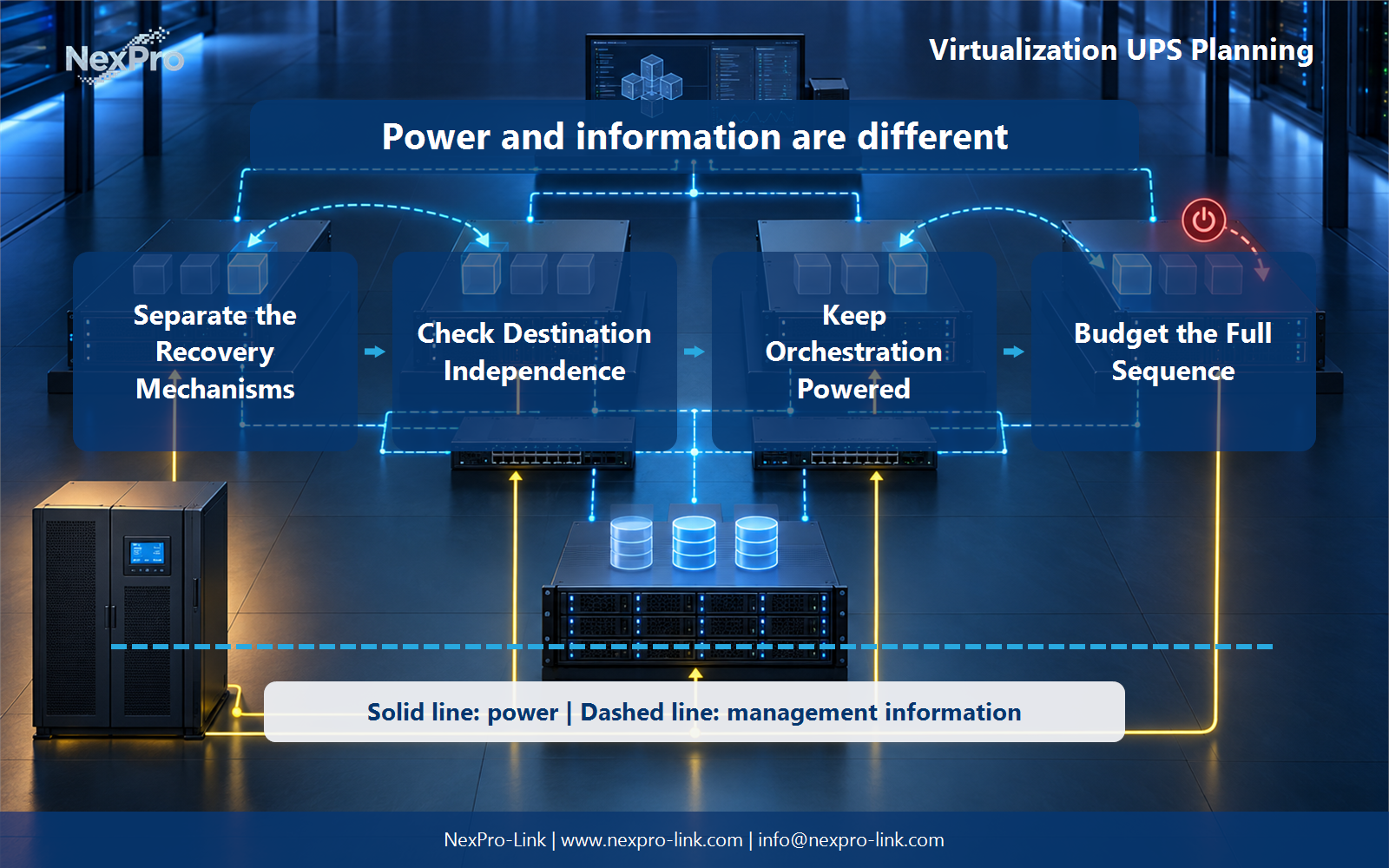
Identify the orchestration service, management network and storage dependencies needed to execute the chosen workflow. Their power path is part of the plan. A host can have battery power while losing the controller that was supposed to coordinate its shutdown.
Add the decision delay, supported workload actions, host stop and storage release, with reserve for variation. Use observed or approved durations rather than assuming every migration completes quickly. A finite fallback is needed when a planned action cannot finish in time.
Draw power delivery as a solid path and management information as a separate dashed path. That distinction prevents an alarm or software command from being mistaken for an electrical protection function.
Section 04
Test the Policy Safely
Check notification, permissions and a non-production or otherwise authorized execution scope. Define cancellation, failed-action handling and restart behavior. Do not deploy a generic power-off script to production solely because the equipment advertises SNMP or USB support.
Assign the action, acknowledgement, timeout and escalation owner before commissioning. The useful battery interval is the time needed for this approved sequence plus reserve, not an arbitrary marketing duration.
Section 05
Write an Integration-Aware RFQ
Provide the actual platform versions, desired workflow and management interface requirements together with the power load. NexPro-Link can discuss available equipment interfaces. Application automation and platform compatibility must be tied to the selected integration, not inferred from the UPS topology.
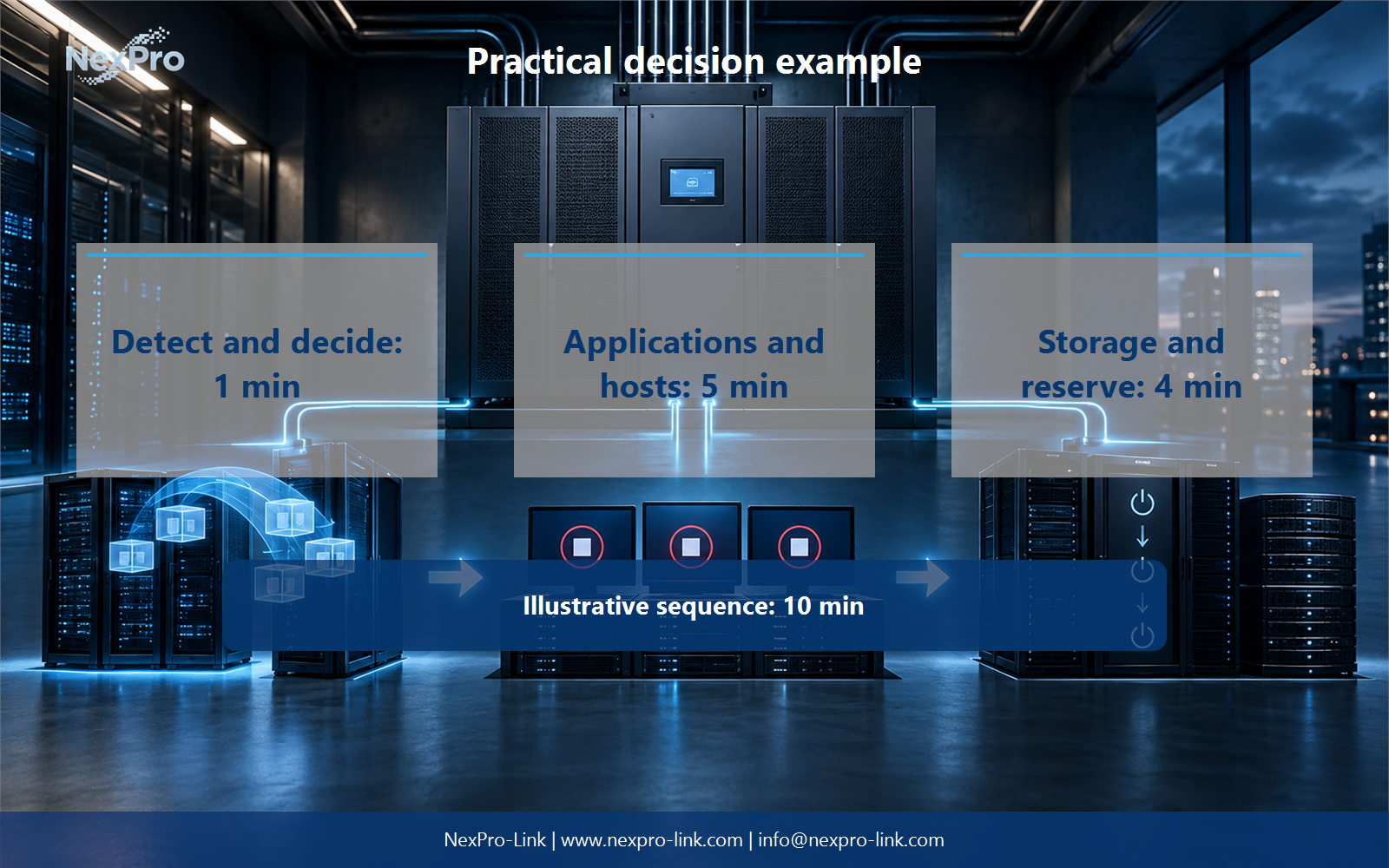
For the article's practical example, the stated teaching inputs are: Detect and decide: 1 min. Applications and hosts: 5 min. Storage and reserve: 4 min. Illustrative sequence: 10 min. Treat these figures as planning assumptions, then replace them with measured or manufacturer-supported project data.
Engineering references
These sources support the general planning principles. Always use the selected product's current datasheet and applicable project standards for final design.