
Discuss how a UPS buys time for a controlled shutdown without equating ACID reliability with battery run time. Plan the project from database dependencies, host and storage loads, and the approved stop procedure.
Section 01
Start with the database durability contract
Does database durability depend only on a UPS? For Financial IT and database administrators, the answer must stay inside the project boundary: No. Durability also depends on database configuration, the operating system and the storage stack honoring write guarantees. Use WAL or redo logging to explain recovery at a conceptual level. UPS runtime supplies an opportunity for orderly action, but it is not a substitute for durable-write settings or recovery-tested backups. The next step is transaction path: commit / log flush / acknowledgement / recovery, using database dependencies, host and storage loads, and the approved stop procedure.
Discuss how a UPS buys time for a controlled shutdown without equating ACID reliability with battery run time.
A transaction is safe only when the database has reached the durability point promised to the application. That point may involve a write-ahead log, an operating-system flush, a storage-controller acknowledgement and finally persistent media. The UPS brief should follow that complete path instead of treating the database server as one indivisible load.
Document where an acknowledged write can still be volatile. Protected controller cache, drive power-loss protection and synchronous replication can change the risk, but their presence must be confirmed from the actual design. A planning diagram should show the chain without assuming that every acknowledgement means the same thing.
| Checkpoint | Question | Evidence |
|---|---|---|
| Application | When is success returned? | Transaction and API behavior |
| Database log | Has the log record been forced? | Database durability settings |
| Host and controller | Can acknowledged data remain volatile? | OS and controller configuration |
| Storage media | What protects an interrupted write? | Current device technical data |
Section 02
Define the critical application window
The shutdown timer begins when the system recognizes a sustained power event, not when an operator notices an alert. Allow time for event confirmation, connection draining, transaction completion, application stop, host shutdown and a reserve for delay. If the application keeps accepting writes while the shutdown sequence is already running, the available window can disappear quickly.
Use measured stop times from a controlled test. The longest acceptable sequence should include a busy period, a retry path and the time needed for the final storage flush. Runtime curves still have to be checked for the selected battery configuration and the measured load.
- Define the point at which new transactions are rejected.
- Keep the management network powered until the last command is acknowledged.
- Reserve time for one failed step or a delayed host.
Section 03
Map the dependencies that must remain available
A database rarely shuts down alone. Authentication, name resolution, network switches, storage fabric, hypervisor management and quorum services may all be needed while applications close. Mark each dependency as required during detection, transaction drain, host stop or restart. This prevents a small unprotected service from breaking an otherwise adequate UPS sequence.
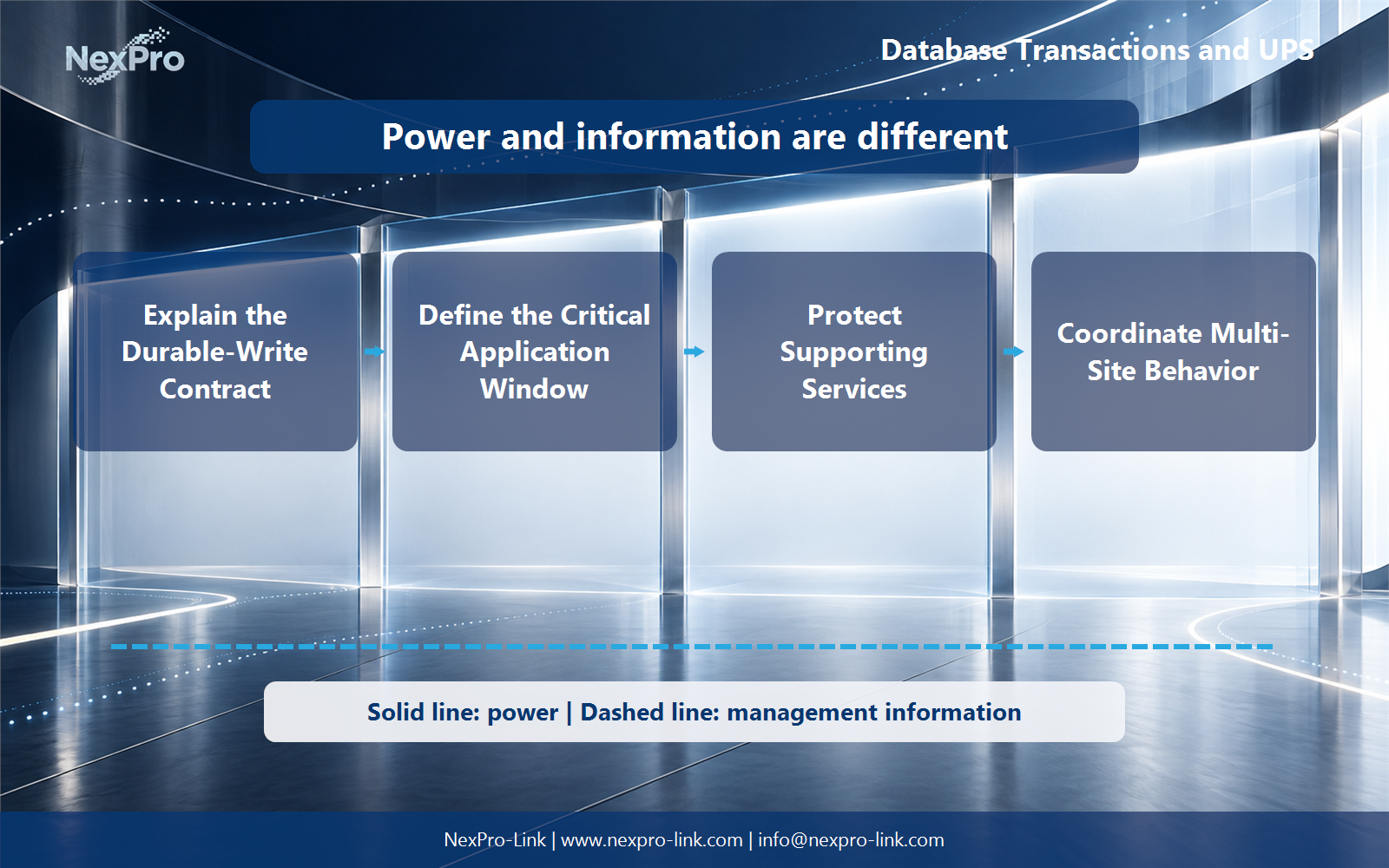
Power and information paths deserve separate lines. The UPS supplies energy through one path, while shutdown commands, status messages and acknowledgements travel through another. Both paths must survive long enough for the sequence to finish, but they are not interchangeable.
Section 04
Coordinate replication, failover and restart
For replicated databases, decide whether an affected site will drain, fail over, stop or continue briefly. The answer depends on quorum, application routing and recovery objectives. A UPS does not choose the database role; it provides time for the selected control action to complete.
Restart should also be dependency-led. Restore stable supply, network and storage before starting the database, then confirm replication health before opening application traffic. Record the checkpoints so the recovery procedure does not depend on one operator remembering the correct order.
Section 05
Build the equipment brief from a timed sequence
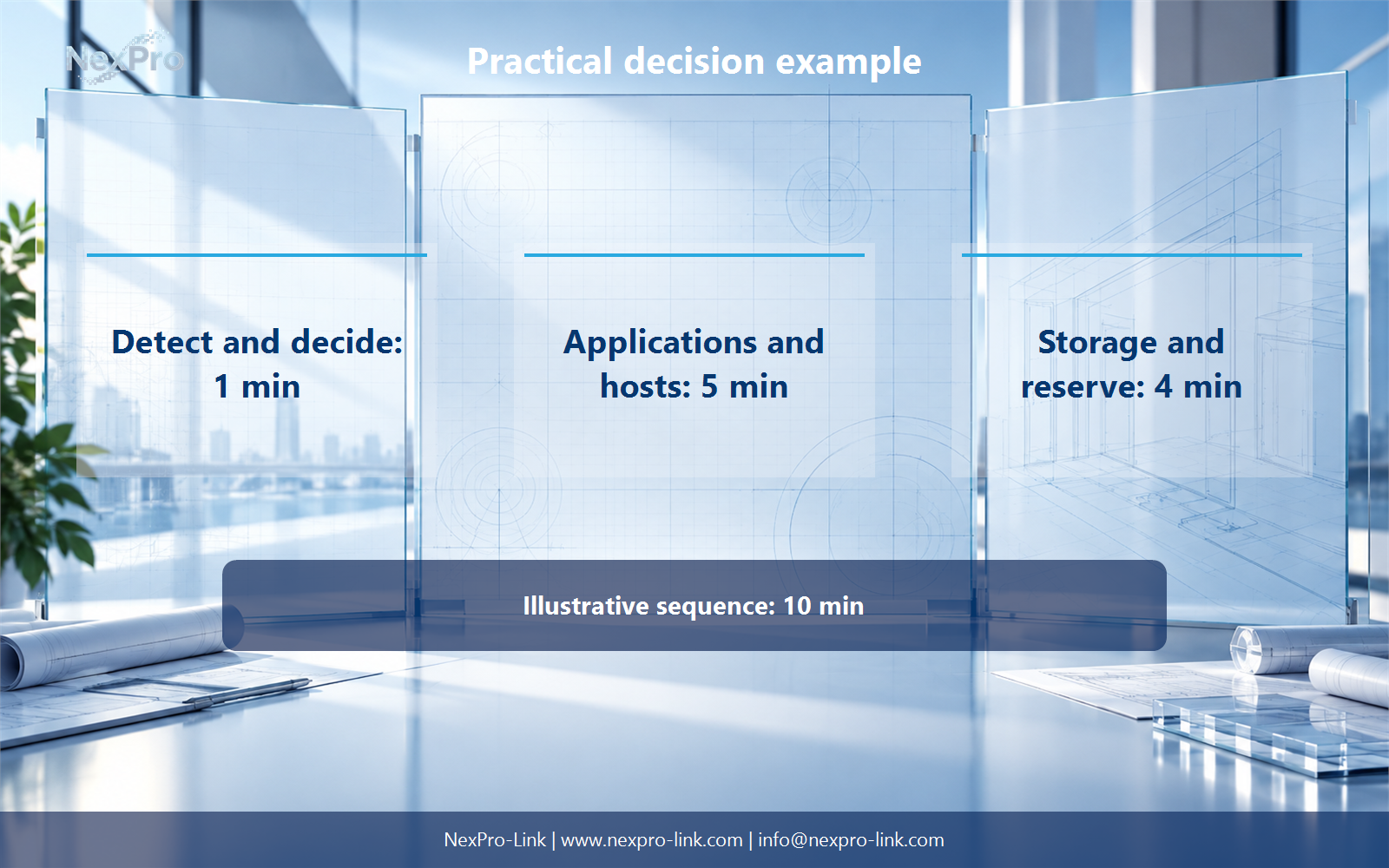
Consider an illustrative sequence with one minute to detect and decide, five minutes for applications and hosts, and four minutes for storage completion and reserve. The resulting ten-minute target is a service requirement. It is not a runtime claim for a particular UPS model.
The equipment brief should state measured watts and VA, voltage, phase, battery objective, required management interface and the list of supporting loads. A rack-mounted online UPS can then be evaluated against the actual load and current manufacturer runtime data.
Engineering references
These sources support the general planning principles. Always use the selected product's current datasheet and applicable project standards for final design.