Separate power continuity, data persistence and transaction compensation; do not claim a never-lose-a-transaction guarantee.
Section 01
Follow the Payment Chain
Separate power continuity, data persistence and transaction compensation; do not claim a never-lose-a-transaction guarantee.
No. Power continuity is only one part of the payment system. Software persistence, network availability and reconciliation processes also matter. For a project-specific decision, record terminal, network, gateway, database and reconciliation in the chain diagram. This keeps the equipment inputs and intended service outcome aligned.
The working question is simple: Can a UPS guarantee that no payment transaction is ever lost? Record the answer as a service requirement before comparing UPS ratings or battery options.
| Decision area | Project question | Required output |
|---|---|---|
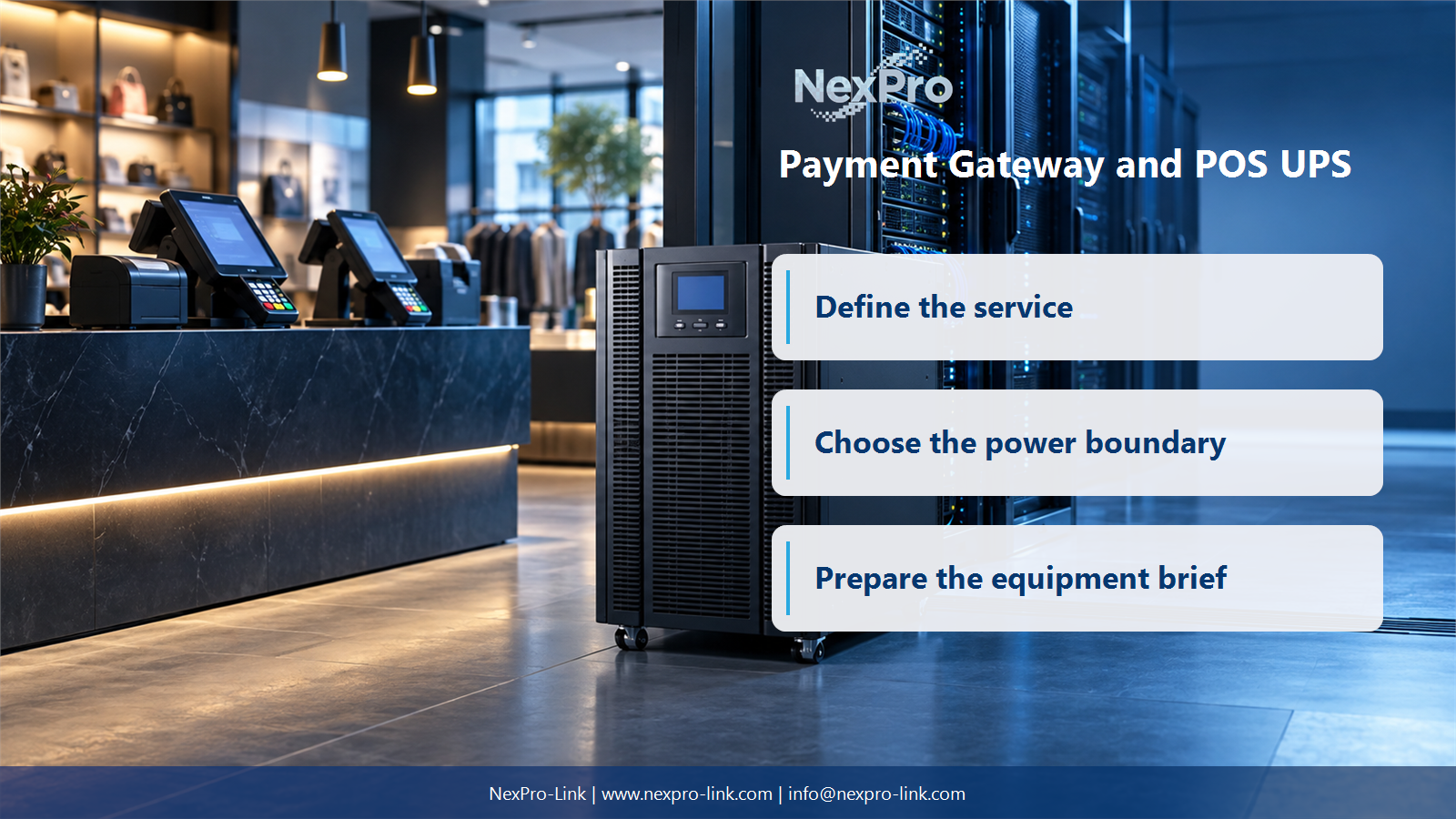
| Follow the Payment Chain | Can a UPS guarantee that no payment transaction is ever lost? | Approved service objective |
| Distinguish Pending and Committed Work | Why distinguish pending transactions from committed records? | Defined load and dependency boundary |
| Define a Bounded Drain Policy | What should the outage workflow aim to finish? | Reviewed power-path decision |
Section 02
Distinguish Pending and Committed Work
They can require different recovery actions. Explain application acknowledgement and durable storage conceptually, using the platform's process for interrupted work. Do not assume all interrupted transactions are deleted or that a UPS status signal is equivalent to a database commit.
Keep the load list, operating state and supporting dependencies in the same schedule. This makes omissions visible before runtime or capacity is discussed.
- Confirm the answer to: Why distinguish pending transactions from committed records?
- Separate measured demand, nameplate limits and committed growth.
- Identify the owner of each external service or approval.
Section 03
Define a Bounded Drain Policy and Include Communication Power
Use an approved policy for stopping new requests, handling outstanding work and releasing resources. Define timeouts and fallback behavior. The battery duration should support that finite sequence; it should not depend on an endlessly growing queue of new transactions.
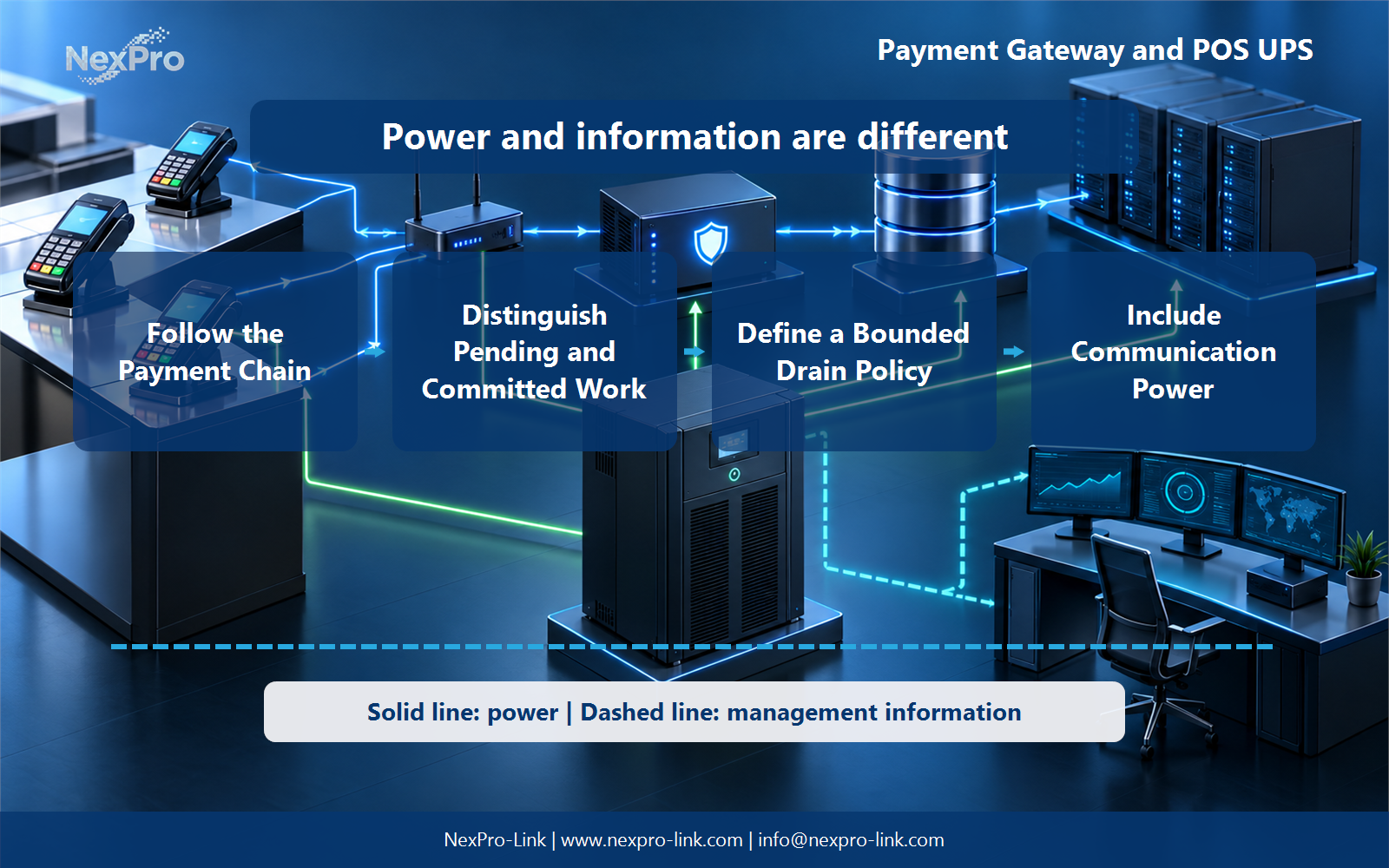
Include local devices needed for the approved completion or shutdown sequence, such as routers and switches. External connectivity remains a separate dependency. This keeps the power scope technically meaningful without claiming that local UPS equipment controls the wider payment provider's availability.
Draw power delivery as a solid path and management information as a separate dashed path. That distinction prevents an alarm or software command from being mistaken for an electrical protection function.
Section 04
Size from Operating States
No. Include relevant transaction, printing and startup states plus supporting network loads. Compare watts, VA and transient compatibility separately from runtime. An example five-to-ten-minute window can illustrate a policy but cannot establish battery performance for an unspecified configuration.
Assign the action, acknowledgement, timeout and escalation owner before commissioning. The useful battery interval is the time needed for this approved sequence plus reserve, not an arbitrary marketing duration.
Section 05
Create a Comparable RFQ
Send the device list, load states, supply interfaces and finite outage workflow. NexPro-Link can discuss UPS and battery options against those inputs. Keep payment-software integration and financial compliance acceptance with the responsible system owner rather than implying they are included in ordinary hardware supply.
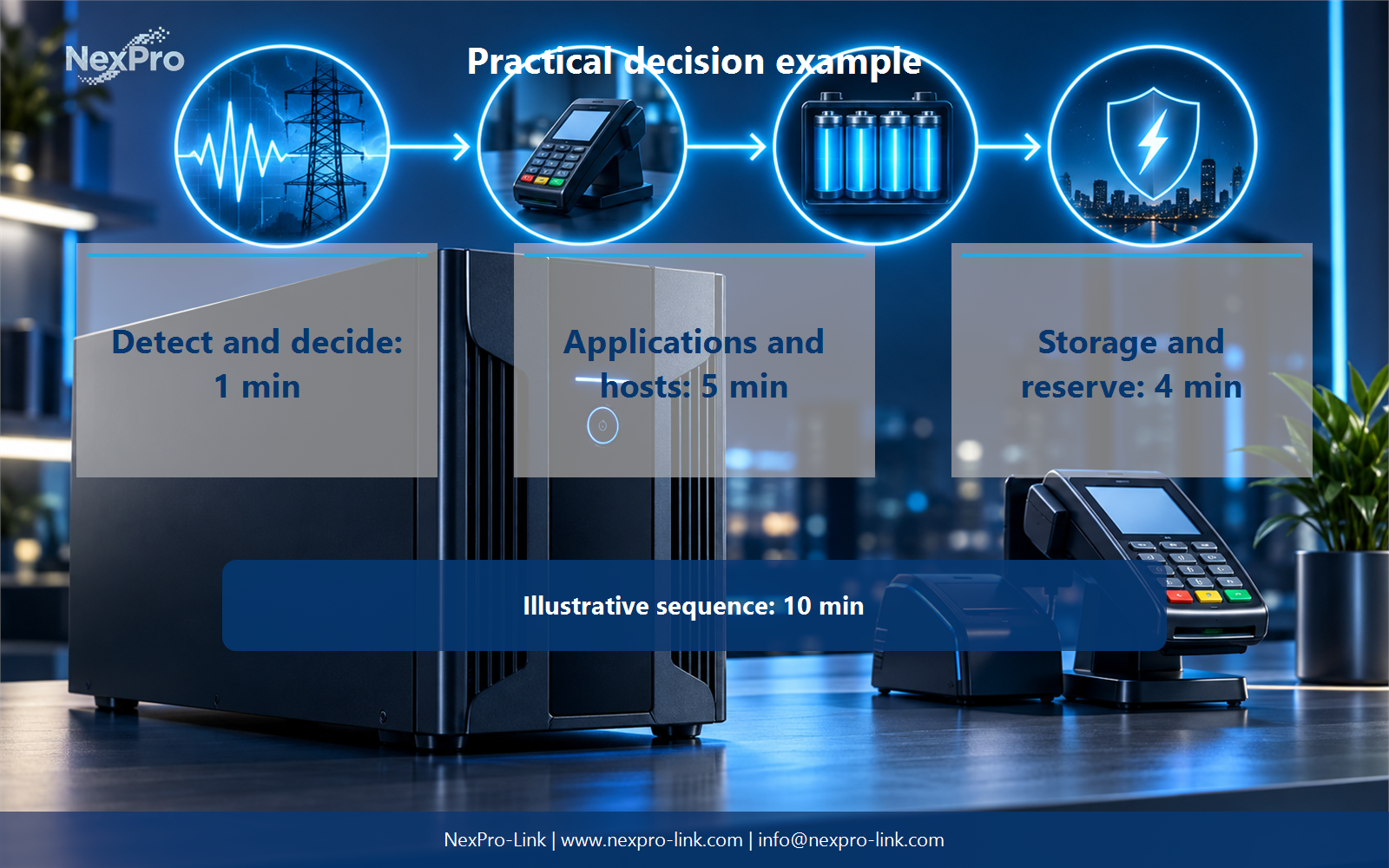
For the article's practical example, the stated teaching inputs are: Detect and decide: 1 min. Applications and hosts: 5 min. Storage and reserve: 4 min. Illustrative sequence: 10 min. Treat these figures as planning assumptions, then replace them with measured or manufacturer-supported project data.
Engineering references
These sources support the general planning principles. Always use the selected product's current datasheet and applicable project standards for final design.