Choose among SP1KR(S), SP2KR(S) and SP3KR(S) using documented output limits, one loading policy and the actual rack load. Battery configuration remains a separate model-specific decision.
Section 01
Select the output class from both documented limits
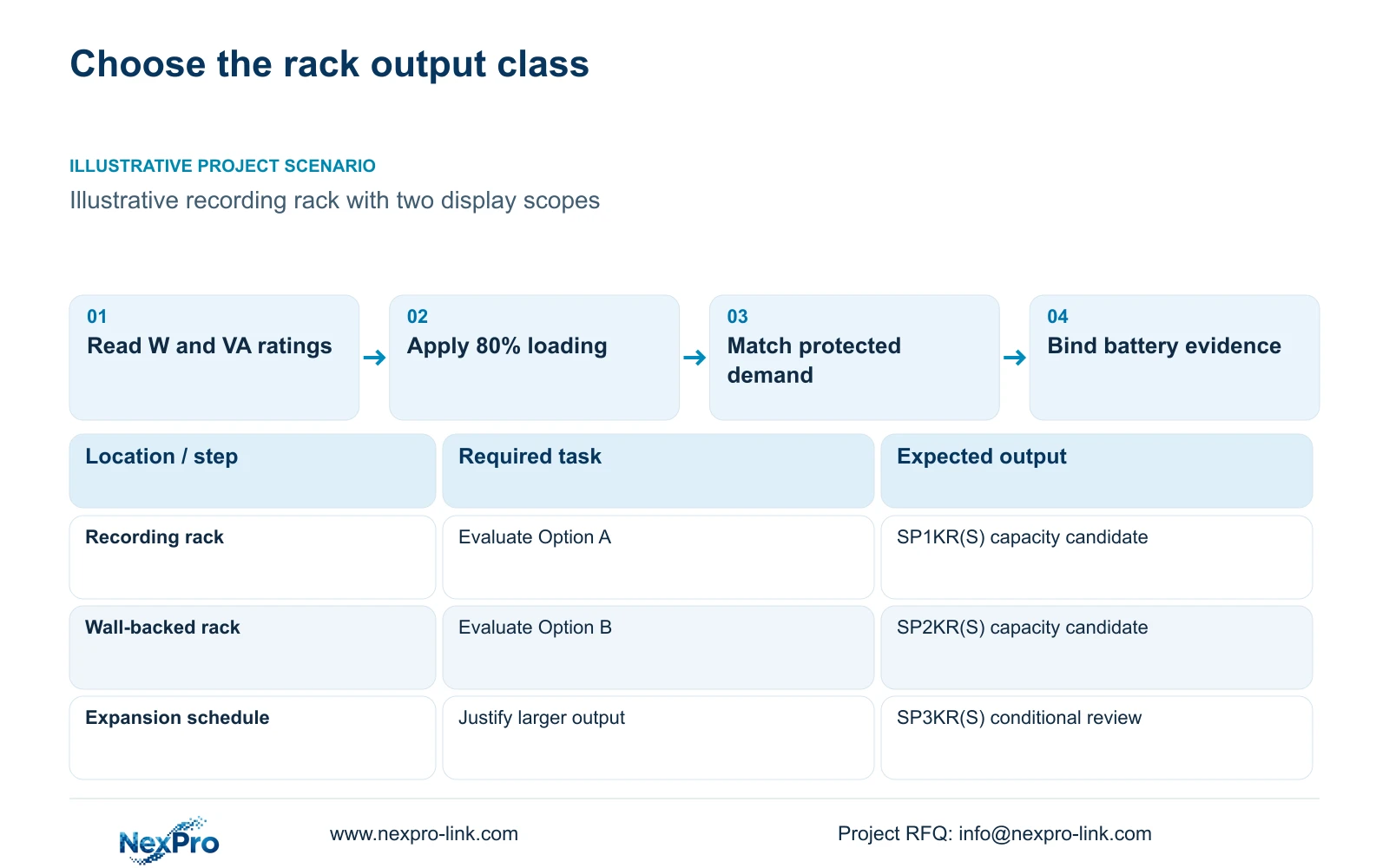
For the supplied factory rack calculation, SP1KR(S) is a capacity candidate for recording-first demand and SP2KR(S) is a capacity candidate when the four-panel wall is included. SP3KR(S) needs a further load or expansion justification. Compare published W and VA ratings against the same loading policy, then request a battery configuration specific to the selected variant.
Illustrative project scenario: An engineer is selecting among the NexPro-Link rack online LiFePO4 UPS series for two display options. The background is the supplied 32-camera CNC factory reference. One option retains the recorder, loaded PoE switches, network equipment and original operator screen; the other also protects four wall panels and a decoder.
The published output references are SP1KR(S), 1 kVA/900 W; SP2KR(S), 2 kVA/1800 W; and SP3KR(S), 3 kVA/2700 W. These values provide an initial capacity comparison. They do not define battery energy, operating duration or suitability for every electrical installation. Keep quoted ratings visibly separate from assumed demand in the selection worksheet.
Section 02
Use one loading policy across all three candidates
This illustration uses an 80% loading target for both rated watts and rated VA, with aggregate load PF assumed to be 0.9. Apply required_UPS_W = P_AC/0.8 and required_UPS_VA = P_AC/(0.9 × 0.8). Changing the utilization rule for only one candidate would make the comparison inconsistent.
Under that policy, the three models provide planning ceilings of 720 W and 800 VA, 1,440 W and 1,600 VA, and 2,160 W and 2,400 VA respectively. These are derived comparison limits, not additional manufacturer ratings. Actual demand must satisfy both limits, and a changed PF can alter which one governs.
Reserve capacity should have a stated purpose. Identify planned devices and their electrical location rather than describing all unused output as future-proofing. If expansion is likely but quantities remain unknown, obtain a separately priced alternative and retain the uncertainty. The owner can then approve a capacity allowance without treating it as a battery-duration guarantee.
Section 03
Bind the battery evidence to the selected variant
Request the exact UPS and battery configuration together. The response should identify supported battery voltage, battery arrangement, compatible connection and runtime evidence at the declared load. A default selected-model field on a product page cannot be carried across SP1KR(S), SP2KR(S) and SP3KR(S). In particular, do not infer a shared 960 Wh battery capacity.
For the CASE01 30-minute target, recording-first demand requires 341.3704 Wh delivered to the loads; the wall-backed option requires 631.3704 Wh. These values describe output energy. They do not specify which compatible battery system achieves the target after discharge-rate effects, UPS consumption and operating conditions are considered.
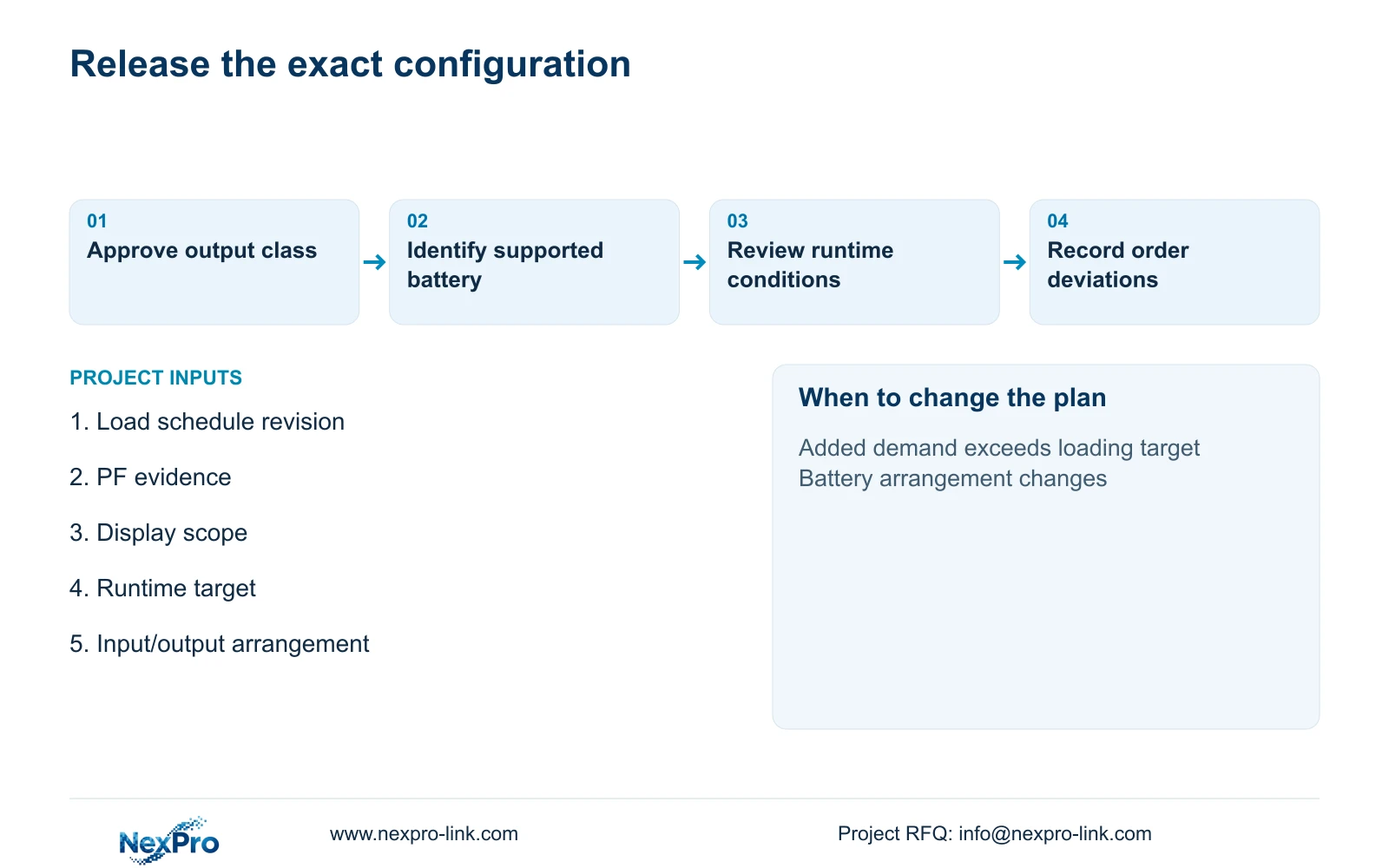
Make battery qualification a separate approval line. The supplier provides configuration-specific evidence, the engineer checks its stated conditions against the installation, and procurement retains the accepted configuration in the order. A change in UPS output class should trigger this review even when the product family name remains unchanged.
Section 04
Compare the two rack loads before choosing a model
The illustrative load uses 32 cameras at an assumed 12 W each, divided into four groups of eight. For each group, complete switch AC input is ((8 × 12)/0.90 + 15)/0.90 = 135.1852 W. The factors represent assumed cable delivery and PSU efficiency; 15 W represents switch electronics. Camera demand is already included at this AC boundary.
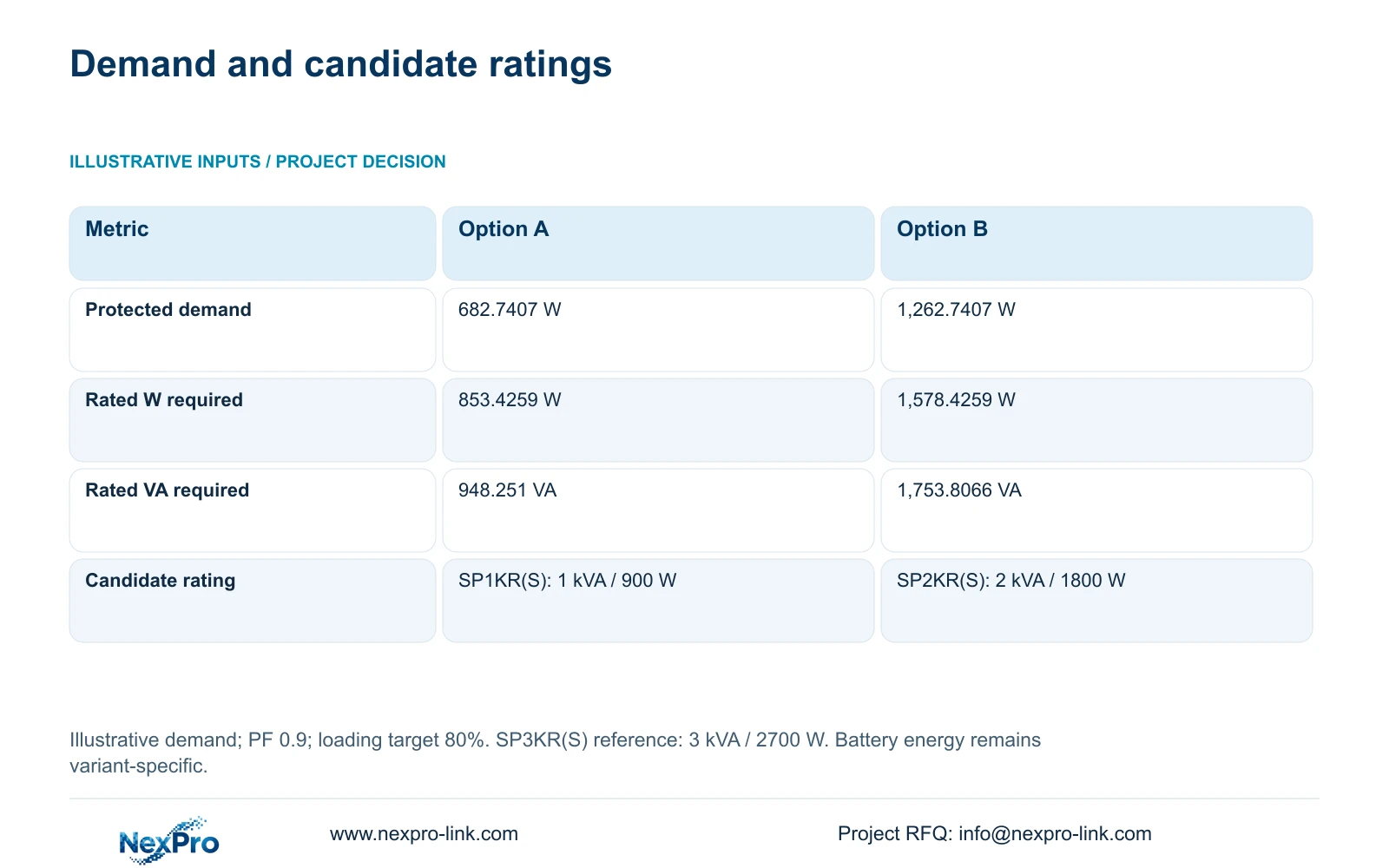
Add recorder electronics at 30 W, four disks at 8 W each, core equipment at 25 W, router at 15 W and the original screen at 40 W. Summing unrounded switch values produces 682.7407 W. Option B adds 4 × 120 W panels and a 100 W decoder, producing 1,262.7407 W while retaining the original equipment.
SP1KR(S) clears both required thresholds for A. It cannot supply B's 1,262.7407 W demand within its published 900 W output. SP2KR(S) clears B's illustrative W and VA thresholds. The decisive change is the 580 W wall increment; recorder channel count and display size do not substitute for that electrical calculation.
| Metric | Recording-first A | Wall-backed B |
|---|---|---|
| Protected demand | 682.7407 W | 1,262.7407 W |
| Required rated W | 853.4259 W | 1,578.4259 W |
| Required rated VA | 948.251 VA | 1,753.8066 VA |
| Capacity candidate | SP1KR(S): 1 kVA / 900 W | SP2KR(S): 2 kVA / 1800 W |
Section 05
Give SP3KR(S) a defined expansion role
Recommend the smallest output class that meets the accepted load and loading policy, subject to configuration and site checks. For the current illustration, that means SP1KR(S) for A or SP2KR(S) for B. Neither option needs SP3KR(S) merely because the project has 32 cameras.
Consider SP3KR(S) when a documented revised schedule exceeds the smaller candidates' planning limits, or when the owner approves specific near-term additions. Recalculate those additions as complete AC inputs. If new cabinets use separate local mains, their loads need a local power decision; spare capacity at the central rack does not protect them.
A larger model also needs its own physical and commercial review. Confirm cabinet fit, service access, supply connections, battery placement and required distribution accessories. Compare offers for the same load, runtime and service scope. Without matched quotations, there is no supported price ranking among these configurations, and unused capacity alone is not an economic result.
Section 06
Order a configuration rather than a series name
The procurement schedule should state the selected variant, minimum required W and VA, protected load revision and required duration. Attach the accepted battery response to the same schedule. This prevents a quotation for the correct output class from arriving with an unspecified battery arrangement or a runtime claim based on another load.
Before release, replace the illustrative camera, panel, decoder and disk consumption inputs with suitable evidence. The wall references remain LCD panels and a decoder role; their model names do not establish operating watts or simultaneous decoding capability. Confirm the requested signal workflow separately from the UPS selection.
NexPro-Link can coordinate model matching and technical documentation through its BOQ and project supply scope. The local team retains responsibility for circuit design, installation and site acceptance. Request any deviations explicitly, especially a different battery system or outlet arrangement, so the commercial team can approve the exact configuration without silently changing the operating objective.
Section 07
Buyer questions
Can a larger model be selected solely to obtain longer runtime? Only if configuration-specific evidence supports that result. A higher output rating does not establish a larger battery or longer operation at the project load. Compare actual supported runtime configurations.
What if measured power factor is lower than 0.9? Recalculate the VA requirement using the confirmed aggregate value. Keep the same watt requirement and loading policy. The VA limit may become the controlling selection constraint.
Should an expansion allowance include devices on other mains circuits? Include them only if the proposed protected distribution actually supplies them. Otherwise, show their separate node requirements rather than using spare central capacity as evidence of protection.
Section 08
Compare exact rack UPS configurations
Send your rack AC load and PF schedule, selected display scope, required runtime and input/output arrangement to info@nexpro-link.com for a model-specific output and battery comparison.
Engineering references
These sources support the general planning principles. Always use the selected product's current datasheet and applicable project standards for final design.