
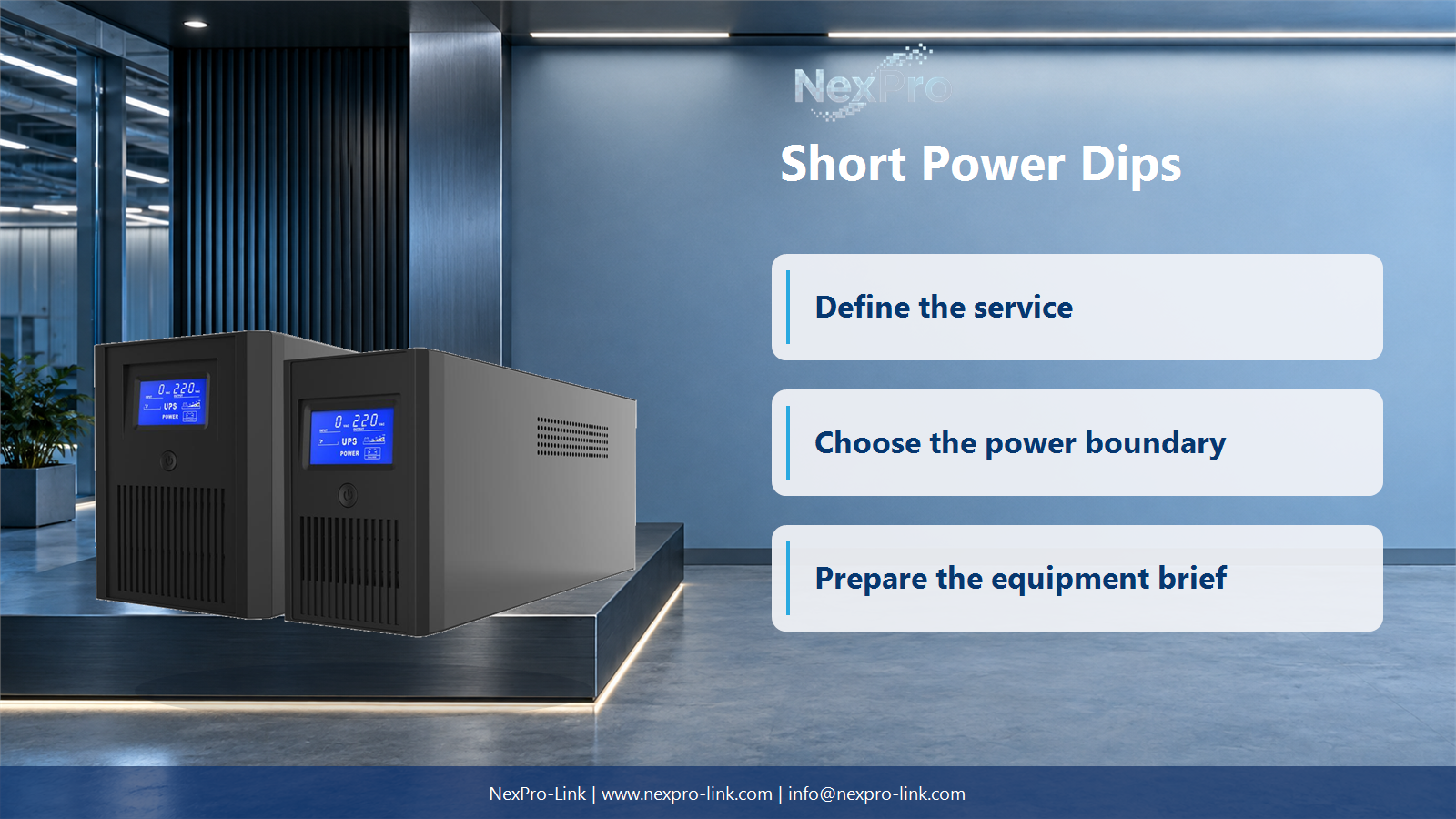
A ten-millisecond power dip does not restart every server the same way. Some loads shake it off. Others drop and take minutes to come back, leaving behind a rebooted server, an alarmed operator, and a row.
Section 01
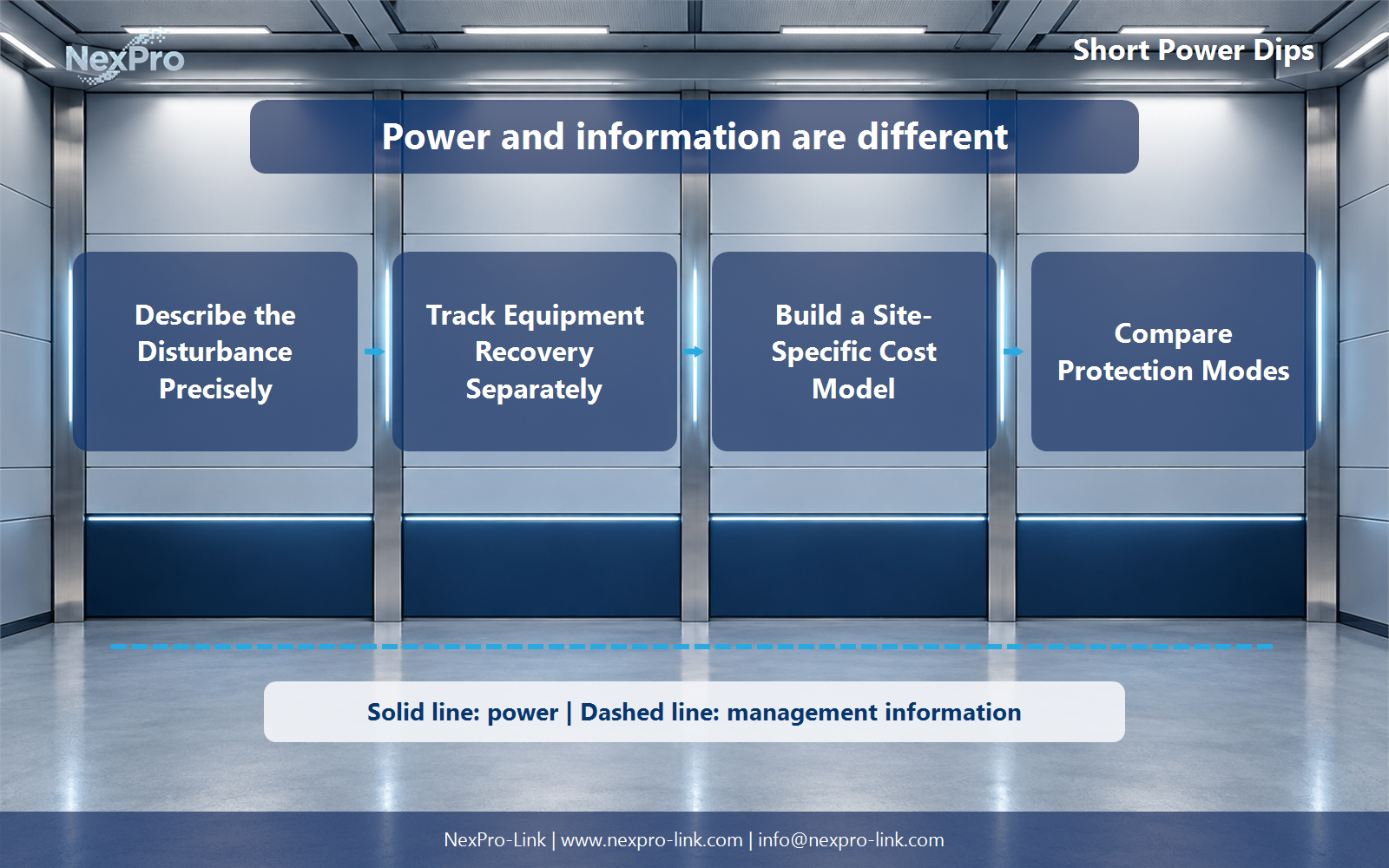
Describe the disturbance precisely
A ten-millisecond power dip does not restart every server the same way. Some loads shake it off. Others drop and take minutes to come back, leaving behind a rebooted server, an alarmed operator, and a row of transactions that need checking. What actually happens depends on the dip depth, how the power supplies hold up, the load at that moment, and the protection settings. The useful response is to treat the ten-millisecond event as an illustrative input rather than a fixed threshold, then measure the real disturbance and the time the business lost. This guide does both, with a worked example and the inputs a supplier needs.
A phrase such as dirty power is too broad for equipment selection. Record the remaining voltage, event duration, affected phase, load at the time and the response of each device. A ten-millisecond event at 60 percent of nominal is a different design input from a two-second outage or repeated generator transfer.
Use logs from the power source, UPS, server and switch on the same timeline. If one device restarts while another continues, their input tolerance and loading may differ. That observation is more useful than assuming the whole rack saw the same functional outcome.
| Field | Illustrative entry |
|---|---|
| Depth | Voltage falls to about 60 percent of nominal |
| Duration | About 10 ms |
| Load condition | One rack at about 1,200 W |
| Observed response | Application server restarts; access switch rides through |
Section 02
Track equipment and service recovery separately
The electrical event may last only milliseconds while the interruption lasts minutes. Measure boot time, application startup, data checks, administrator validation and client reconnection as separate stages. This shows where the service is actually waiting.
A recovery timeline also exposes dependencies. A server may finish booting but remain unusable until authentication, DNS, storage or a database becomes available. Protecting the server without those shared services can leave most of the business interruption unchanged.
- Timestamp each recovery stage from event start to usable service.
- Separate automatic recovery from work that needs an operator.
- Include validation and client reconnection, not only operating-system boot.
Section 03
Build a site-specific cost model
Use contribution at risk, recovery labor and documented rework. Avoid adding lost revenue and lost margin for the same transaction. If the site cannot support one input, mark it as unknown rather than borrowing an industry average.
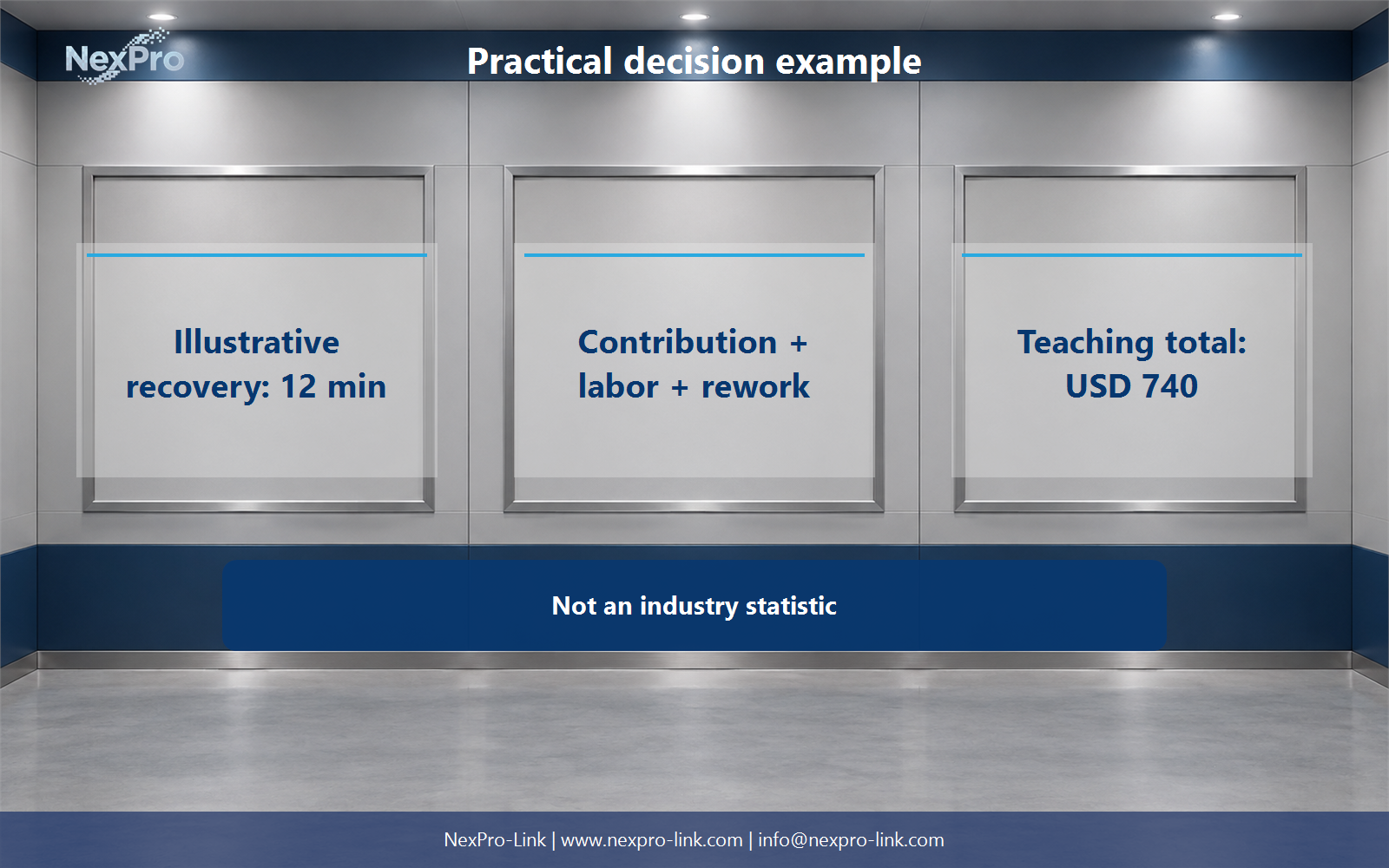
The example assumes twelve minutes of lost service at USD 50 per minute, one hour of combined recovery labor at USD 40 per hour, and USD 100 of verified rework. The resulting USD 740 is a teaching total for comparing options, not an industry statistic.
| Input | Calculation | Amount |
|---|---|---|
| Contribution at risk | 12 min x USD 50/min | USD 600 |
| Recovery labor | 2 people x 0.5 h x USD 40/h | USD 40 |
| Documented rework | One verified task | USD 100 |
| Illustrative total | 600 + 40 + 100 | USD 740 |
Section 04
Compare protection modes against the measured event
An online double-conversion UPS supplies the load through its inverter during normal operation and moves to stored energy when input conditions leave its operating window. Bypass, overload behavior and downstream distribution still matter. The protection discussion should include all relevant operating states.
A line-interactive or other topology may also be suitable when the event profile, connected equipment and continuity requirement support it. Compare the recorded disturbance with current product data and the load's real response instead of assigning a topology from building type alone.
Section 05
Measure the cause before adding capacity
A restart can come from transfer behavior, an input threshold, a load transient, wiring, an exhausted battery or an overloaded output. A larger kVA number addresses only some of those causes. Match the corrective action to the evidence.
The project brief should carry the event log, affected loads, measured watts and VA, current protection path, generator information and required continuity outcome. Those inputs allow a supplier to discuss equipment while a power-quality survey remains a clearly separated site service.
Section 06
FAQ: short power dips and recovery cost
Can a ten-millisecond dip always restart a server? No. Depth, load, power-supply hold-up and protection settings determine the outcome.
Why can a brief dip cause a long interruption? Boot, service startup, data checks and user reconnection continue long after voltage returns.
Does double conversion solve every disturbance? No. It changes the normal power path, but overload, bypass, installation and downstream dependencies still need review.
Should the buyer simply select a larger UPS? Only after measurement shows that output capacity is the problem. Other causes need different corrections.
Engineering references
These sources support the general planning principles. Always use the selected product's current datasheet and applicable project standards for final design.