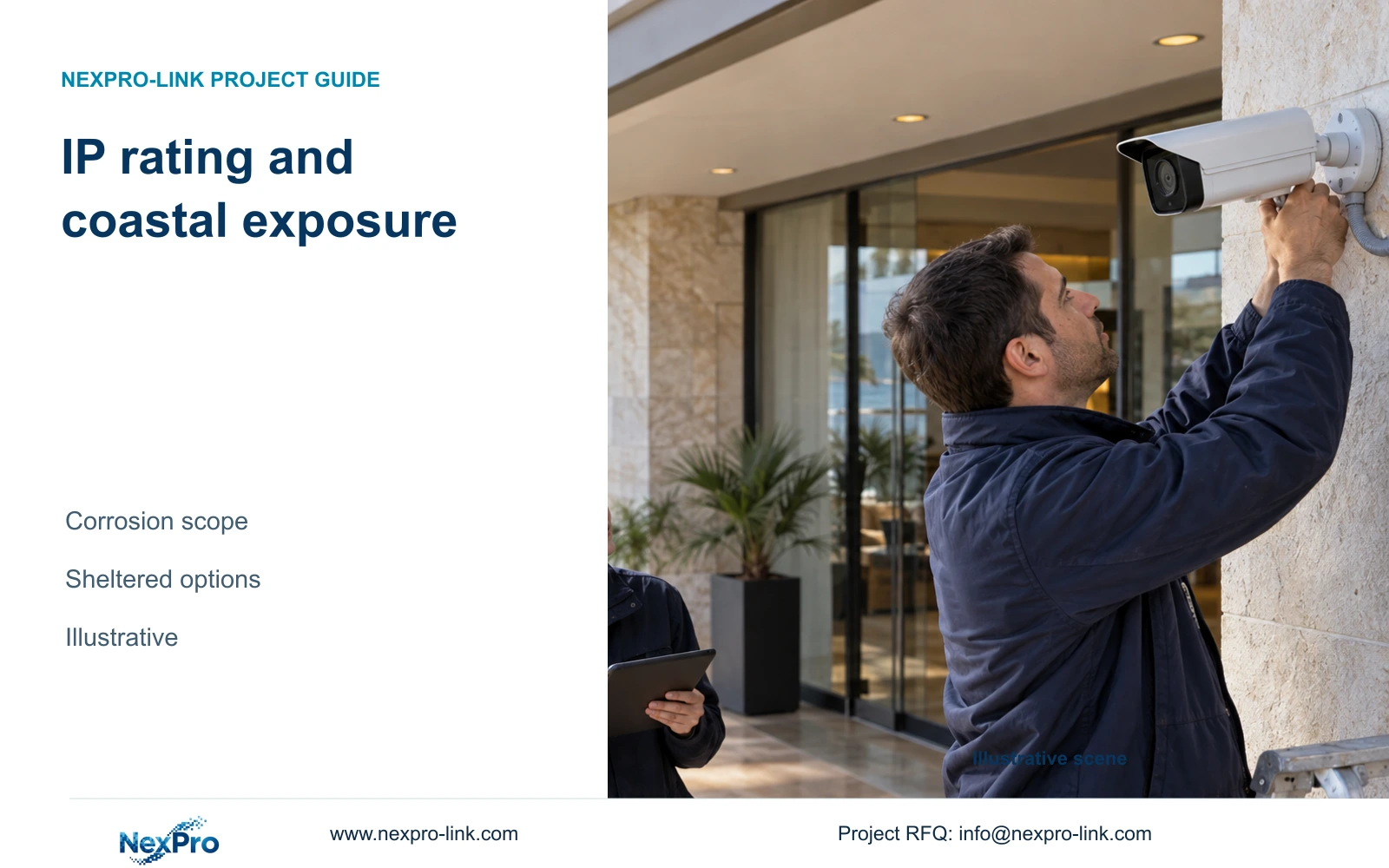
An IP66 camera should not be approved for salt-exposed hotel positions on that rating alone. Classify the exposure, evaluate a sheltered location and request model-specific corrosion evidence where exposure remains.
Section 01
Classify exposure before approving outdoor positions
Do not approve an ordinary IP66 camera for a salt-exposed position solely from its ingress rating. First compare a location that avoids direct exposure with equipment supported by relevant corrosion documentation. Retain a standard camera candidate only where the installation conditions and its documented capabilities justify that choice.
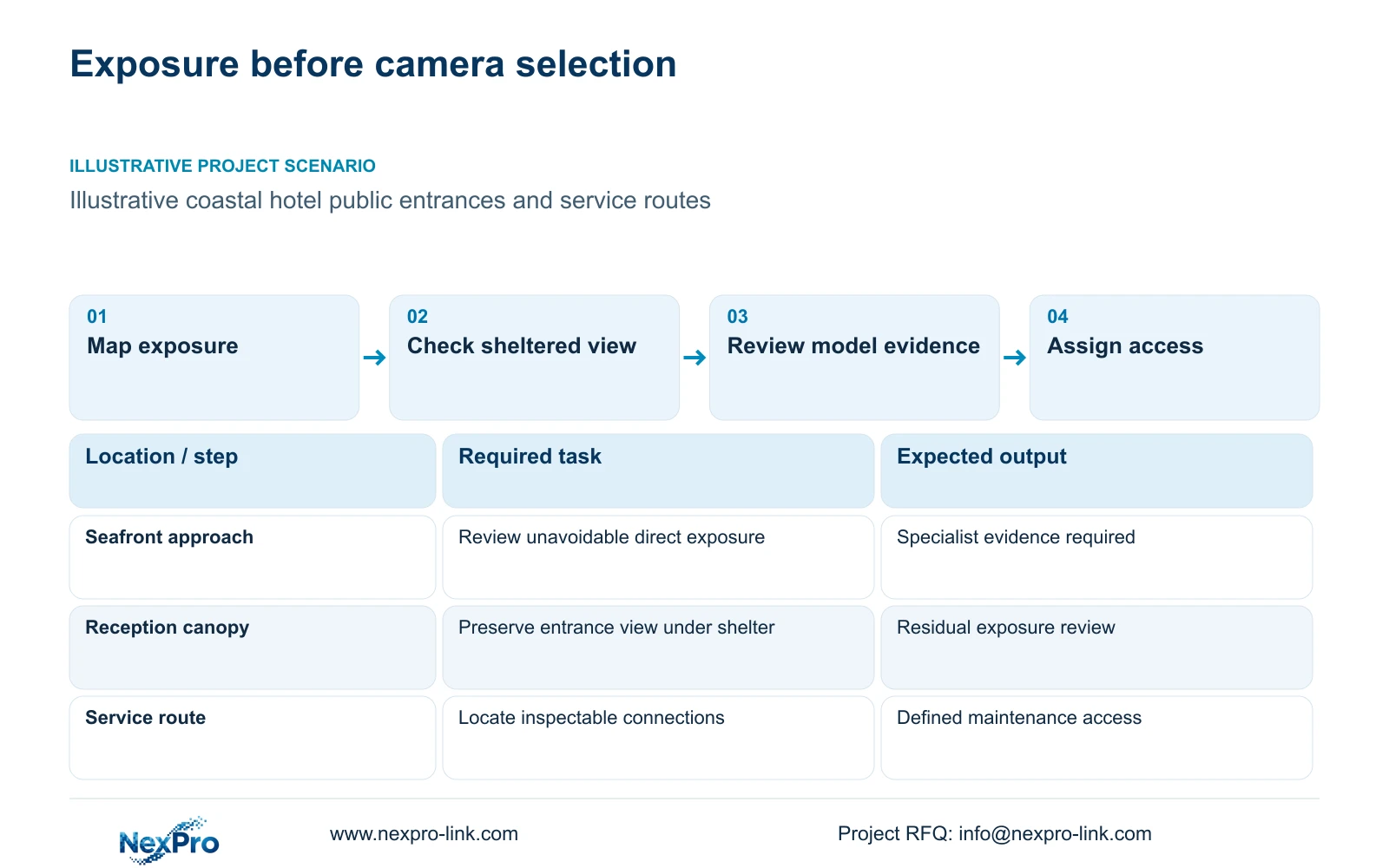
Mark the proposed public-zone positions on the coastal layout. An open seafront approach, a sheltered reception entrance and an inland service route present different design questions. Record shelter, water exposure and the maintenance route for each position. These are project classifications, not universal exposure grades or a claim that every sheltered point is free of salt.
Keep the observation task attached to the position. Moving a camera under cover may change the angle at which a person crosses the view or hide an entrance behind a column. The engineer must preserve the required action and detail when reducing exposure. CASE04 provides an illustrative resort context, but its ordinary public-zone camera candidates do not establish suitability for coastal positions.
| Required task | Given information | Decision still needed |
|---|---|---|
| Observe public seafront approach | Open position faces coastal exposure | Seek relevant environmental evidence or relocate |
| Observe reception entrance | Sheltered alternative exists | Confirm view, residual exposure and access |
Section 02
Separate ingress protection from corrosion evidence
An enclosure ingress rating and a corrosion specification answer different questions. For procurement, keep them in separate fields. Record the published ingress rating exactly, then identify the environmental documentation that supports the proposed exposure. A higher ingress number cannot fill an empty corrosion-evidence field.
The supplied BL2812M product PDF lists IP66 for NexPro-BL2812M55-5MP-DIC-AI and NexPro-BL2812M88-8MP-DIC-AI, with a temperature range of -20 to +60°C. It does not supply a corrosion qualification for this application. Those documented fields can support an ordinary outdoor review, but they cannot establish a coastal service life or resistance to a particular salt exposure.
Treat the approved installation as an assembly. The camera housing, bracket and cable entry may have different documentation and maintenance requirements. A product claim for one component should remain attached to that component. Ask the supplier to identify the precise model and accessories covered, including any installation conditions that limit the environmental claim.
Section 03
Compare a specialist camera with a sheltered installation
For a position that remains exposed, request documentation for the complete proposed assembly. Dahua's CEEN page for IPC-HDW3849H-ZAS-PV-PRO-ATC lists IP67 and separately describes anti-corrosion design using NEMA 4X and C5-H. These are manufacturer-published fields for that exact regional model, not a test performed by NexPro-Link or approval of this hotel's mounting point. Confirm the supplied revision, accessories, installation limits and cleaning instructions before accepting the assembly. The page does not establish a guaranteed coastal service life for this project.
For a sheltered alternative, compare mounting position and recorded task before comparing camera price. A change in position can alter reflections, required target width and lighting. Include the bracket or mounting work in the cost comparison. Specialist equipment should not become the default price opponent for every economical hotel camera where the environmental task differs.
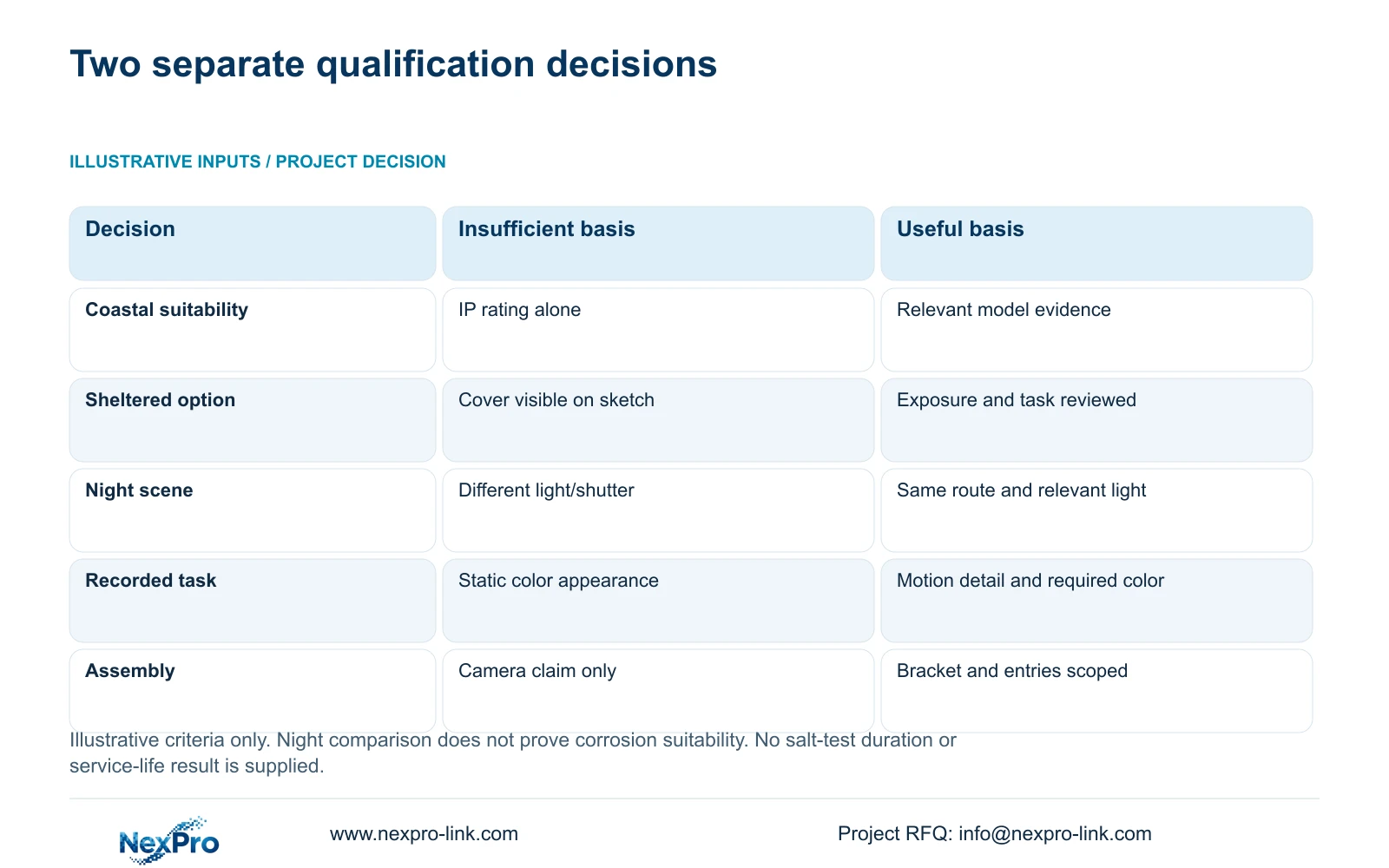
After environmental suitability is addressed, compare night operation using the supplied matrix below. It is an illustrative comparison method with no numeric performance score. The inputs are the target route, relevant light and required recorded detail. No low-lux headline establishes either corrosion suitability or a winner in moving-subject recording.
| Criterion | Single low-lux headline | Task-matched night comparison |
|---|---|---|
| Scene | Different light and shutter conditions | Same target route and relevant light |
| Image task | Static color appearance | Motion detail plus required color/overview |
| Light control | Assumed by marketing family | Exact model and selected mode |
| Decision | No defensible winner | Choose after recorded task comparison |
Section 04
Review brackets and cable entries as part of the package
Request the mounting and termination arrangement with the camera proposal. Identify which party supplies the bracket, enclosure or cable-entry accessories and which party installs them. An equipment-only quote can leave these interfaces unresolved even when the camera itself has suitable documentation.
Review access to connections without assuming that an enclosure label qualifies every installed joint. The proposed location should allow inspection and replacement without unnecessary disturbance to the camera alignment. Record cable routes and termination locations on the layout so the local installer can resolve installation details under the project's requirements.
The sheltered option also needs an optical check. Glass, reflective finishes and nearby surfaces can affect the recorded view, while visible illumination may spill toward accommodation. Compare infrared, visible light or event illumination only in modes supported by the exact camera. Capture the agreed route under relevant lighting conditions; a stationary color image cannot establish usable moving detail.
No maximum camera power is supplied in the BL2812M PDF. If the selected lighting mode changes the power requirement, obtain the applicable model data before qualifying the PoE group. Do not assign a hypothetical power figure to the product merely because it appears elsewhere in the resort teaching case.
Section 05
Plan cleaning and replacement around reachable positions
Include maintenance access in the location decision before approving a specialist or sheltered option. The hotel needs a practical way to inspect the viewing surface, assess the installation and replace a camera. Ask for the manufacturer's applicable cleaning instructions and define the local team's responsibility; no universal cleaning interval is established by the supplied evidence.
Compare the complete service task. Relocating beneath shelter may reduce direct exposure yet create difficult access above a busy entrance. Keeping an exposed location may require different equipment and a more demanding maintenance arrangement. Quote access work and replacement support separately so the buyer can evaluate the retained view against the continuing service burden.
For operational spares, select a supported replacement scope for important entrance or service-route views. Matching resolution or housing appearance does not establish interchangeability. Preserve model and configuration records, and obtain RMA authorization before return shipment. Guest footage and credentials should be handled through the hotel's approved process, not included casually with returned equipment.
Section 06
Keep the environmental recommendation tied to each position
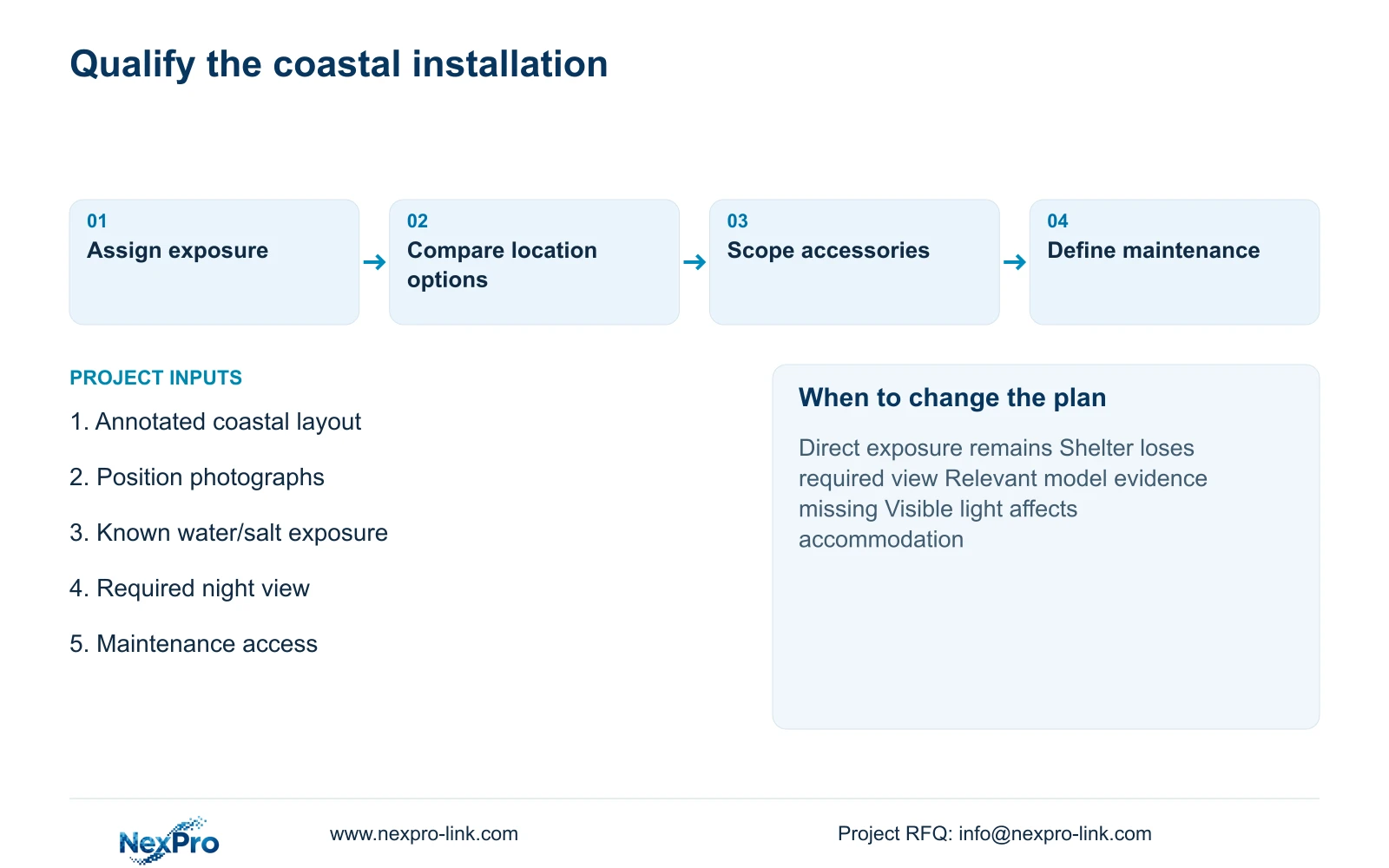
Use a sheltered installation with a standard candidate where the required view remains achievable and the documented equipment conditions support the residual exposure. Change to an appropriately documented specialist option when direct exposure remains or when relocation loses the required observation task. If neither option has sufficient evidence, leave environmental qualification unresolved in the proposal.
Keep warranty scope visible alongside the environmental recommendation. The supplied public policy record gives applicable main equipment a 24-month limited hardware baseline from receipt. Accessories and specific orders have their own scope, and the baseline does not establish that an unsupported coastal application is covered. Historical longer terms should not be substituted for the controlling written terms.
Email info@nexpro-link.com with an annotated public-zone layout, photographs of the proposed positions without guest imagery, known exposure conditions and maintenance-access constraints. Add the destination and required night task. Through hotel project equipment support and BOQ and tender support, NexPro-Link can discuss model matching and coordinated accessories, while local installation and environmental acceptance remain explicitly allocated.
Section 07
Buyer questions
Is a sheltered IP66 camera automatically suitable beside the sea? No. Shelter changes the installation exposure but does not supply missing corrosion evidence. Identify the residual conditions and confirm the selected model and accessories against them before approving the position.
Which environmental documents belong in the quotation? Request the exact model's relevant environmental statement and its scope, plus the proposed bracket and termination details. Keep unsupported fields visible; an unrelated model's document cannot qualify the quoted assembly.
Can the first enquiry be made before every outdoor position is fixed? Yes. Send representative exposed and sheltered positions with the required views. The response can separate ordinary candidates from positions needing specialist evidence, without turning provisional locations into an approved equipment schedule.
Engineering references
These sources support the general planning principles. Always use the selected product's current datasheet and applicable project standards for final design.