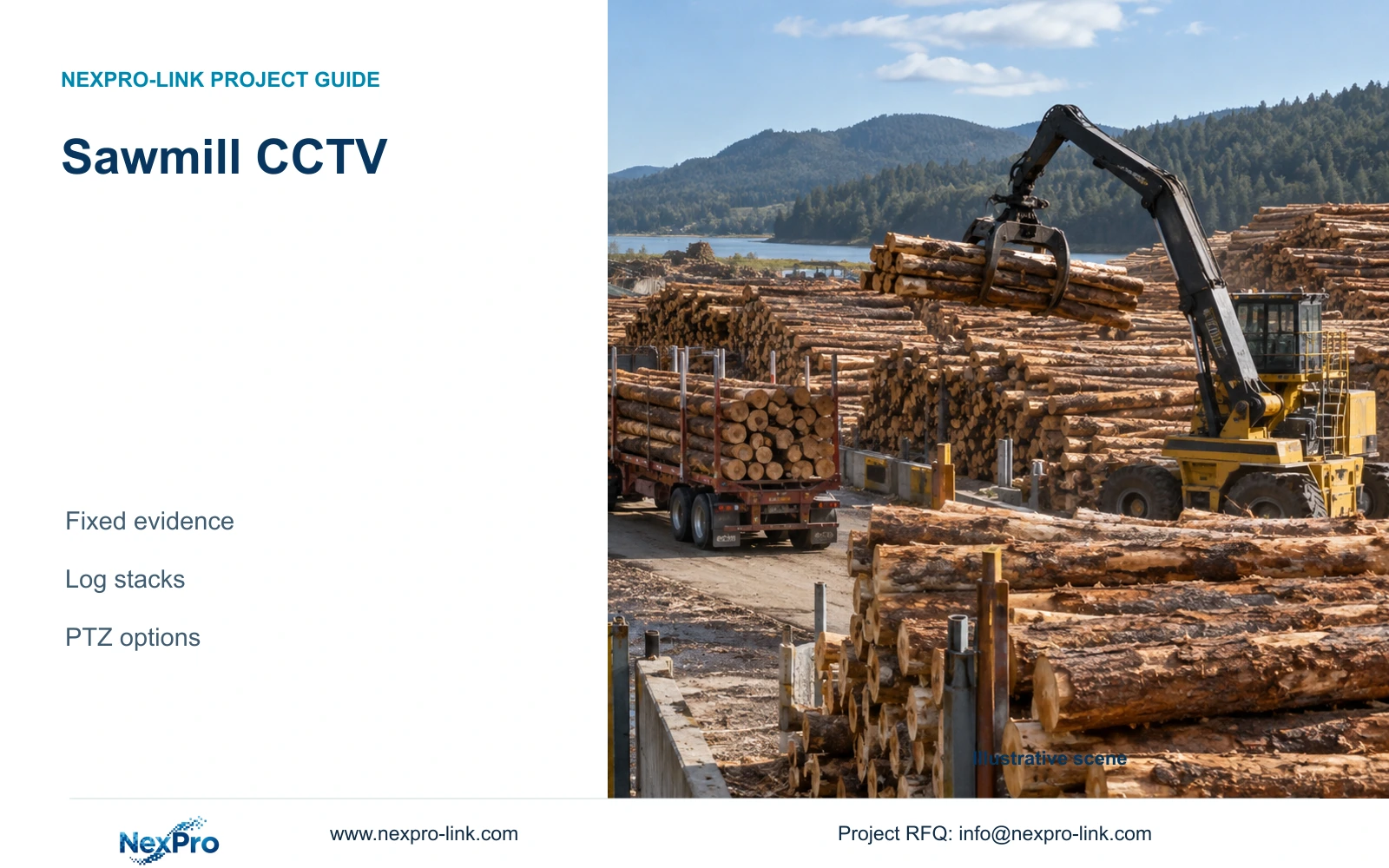
Changing log piles can invalidate an outdoor camera plan. Sawmill CCTV procurement should preserve continuous handover views, price maintenance access and treat PTZ inspection as an additional task.
Section 01
Design sightlines for the largest permitted log stacks
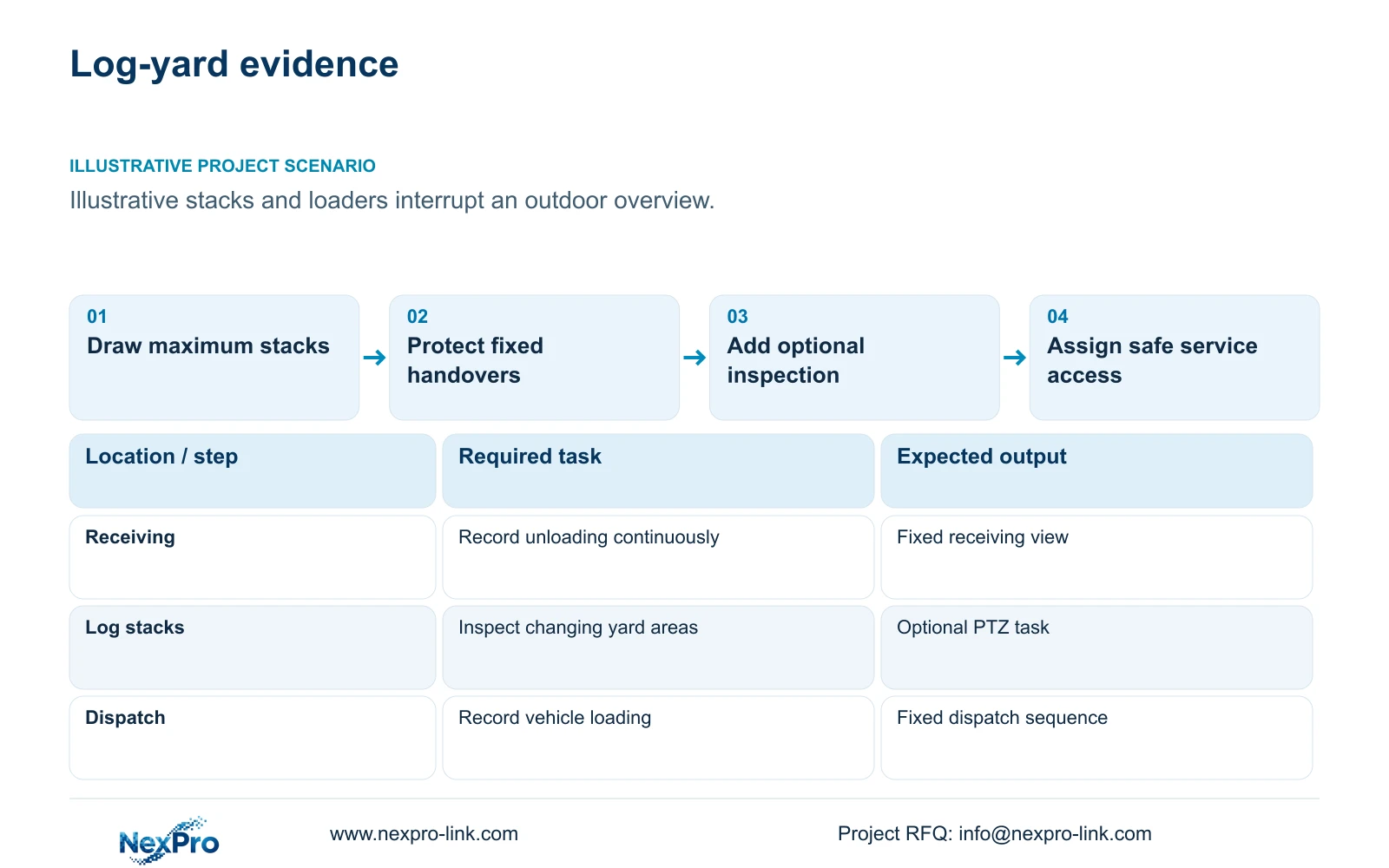
Sawmill CCTV should maintain fixed recording views at critical receiving and dispatch handovers, checked against maximum permitted log-stack geometry. Use PTZ as an additional inspection tool when operators need to examine different parts of the yard. A steerable camera cannot continuously record several separated handover points at once when those points require different viewing directions.
Illustrative project scenario: Log piles and handling equipment block portions of an outdoor overview. Assume, for planning, that receiving, storage movements and vehicle loading occur at distinct locations and that stack positions change during normal operations. The quantity surveyor needs a scope that remains useful under those conditions, rather than a camera count based on an unusually empty yard.
Ask operations to mark maximum stack height, stack footprint, loader travel and temporary parking on the plan. The engineer should check each critical sightline against that envelope. Record whether a missing view results from a permanent obstruction, a moving vehicle or an operating practice that could be changed. Each cause leads to a different quantity or installation allowance.
Section 02
Keep fixed evidence separate from operator inspection
Write a fixed-view schedule for events that must remain available without intervention. A receiving view might establish unloading sequence, while a dispatch view shows which vehicle received the material. Their framing should remain stable during ordinary shifts. Record the accepted scene and exclude any claim that a yard overview will identify every log or hidden bundle.
Specify PTZ inspection separately: who operates it, which areas may be inspected and whether preset tours are useful. A tour spends only part of its time on each location. If continuous evidence is required at a loading point, a preset visit does not satisfy the same task. Keep the fixed camera in the base price and show PTZ equipment, control and power as optional or separately required scope.
The BL2812M55 ordinary bullet reference has a 2.8–12mm motorized lens and a listed 2880x1620 output in its 5MP-family specification. Motorized varifocal adjustment changes framing; it does not establish PTZ pan-and-tilt capability. Use that reference for suitable fixed positions and request a separately documented PTZ model if steering is required.
Section 03
Price maintenance access before choosing pole positions
A pole location must provide both an accepted view and a workable service approach. Mark the space needed to reach the camera, the permitted access equipment and any interruption to loader operations. A position beside a convenient cable route may become expensive to maintain if every cleaning visit closes a principal handling lane.
Assign responsibility in the scope schedule. The equipment supplier provides the approved camera and mounting interface; the local contractor confirms supports, installation and access arrangements; the yard operator controls service windows. Identify retained poles separately and require their suitability to be checked. Existing height and spare brackets do not establish structural acceptance.
Keep ordinary cameras and network cabinets away from unsuitable dust-handling locations. Obtain actual extraction and classified-area information where those processes affect the proposed installation, and have the responsible designers verify local requirements. Dust deposits, weather exposure and cleaning methods also affect visibility and maintenance even where specialist explosion protection is not required.
Section 04
Calculate what a narrower handover view gives up
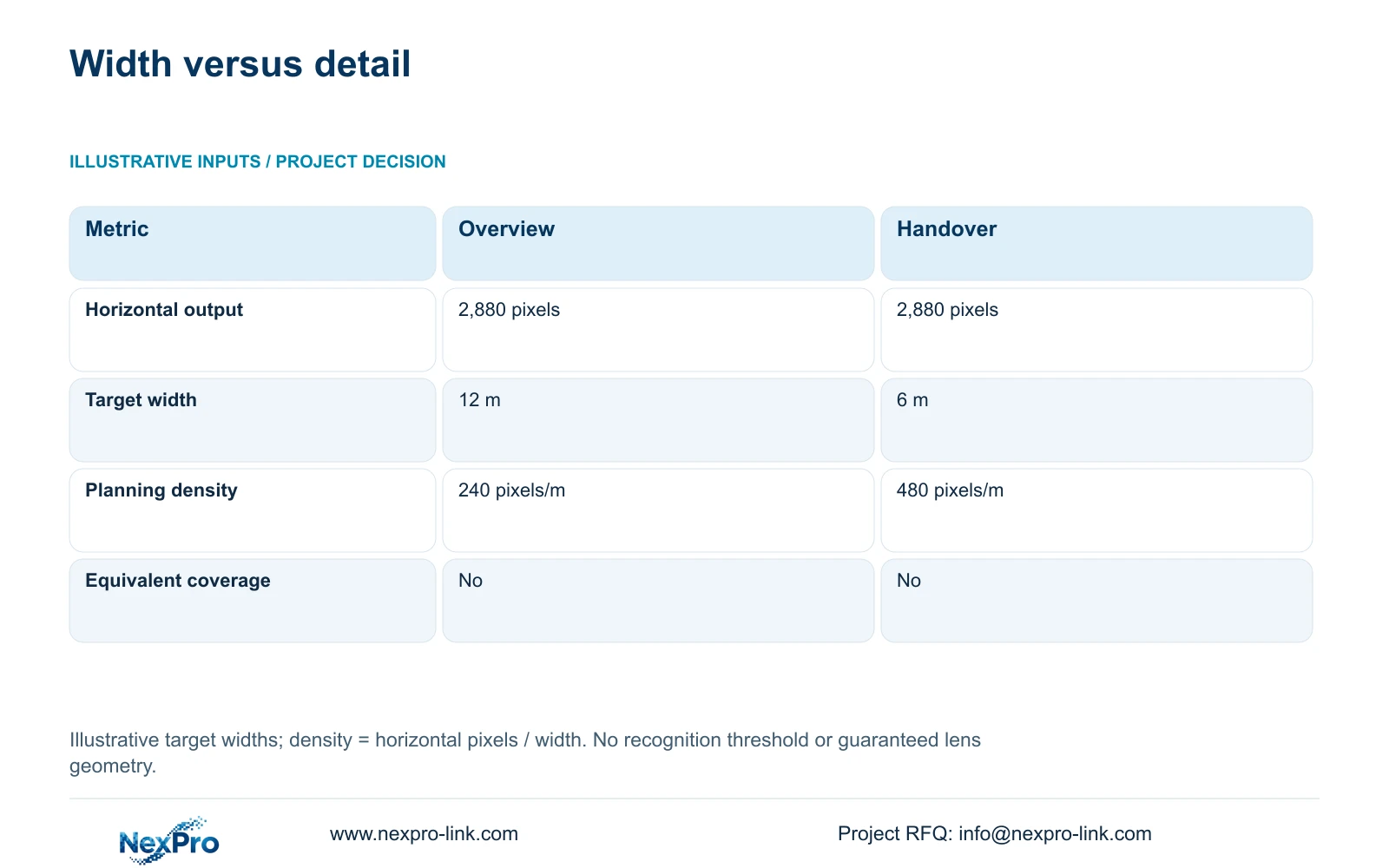
For an illustrative coverage comparison, assume 2,880 horizontal output pixels. Option A covers 12 m at the target plane; Option B covers 6 m. Planning_pixels_per_metre = horizontal_output_pixels / target_width_m. The results are 2,880 / 12 = 240 pixels/m and 2,880 / 6 = 480 pixels/m. These widths are assumed scene geometry, not guaranteed fields of view from a particular focal length.
The decisive difference is that the tighter view doubles planning density while removing half the horizontal coverage. It can serve a defined transfer opening, but it no longer gives the same movement context. If both tasks matter, retain an overview and a dedicated detail view, then price the additional channel, cable and installation work.
Pixel density alone does not guarantee usable identification. Log surfaces, motion, lighting, compression and partial obstruction still affect recorded detail. Check the selected view during representative handling and lighting conditions. Avoid substituting digital enlargement for an optical view that never captured the necessary information.
| Metric | Option A: overview | Option B: handover |
|---|---|---|
| Horizontal output | 2,880 pixels | 2,880 pixels |
| Target-plane width | 12 m | 6 m |
| Planning density | 240 pixels/m | 480 pixels/m |
| Coverage task | Wider movement context | Narrower transfer detail |
| Equivalent horizontal coverage | No | No |
Section 05
Compare the complete fixed-view package
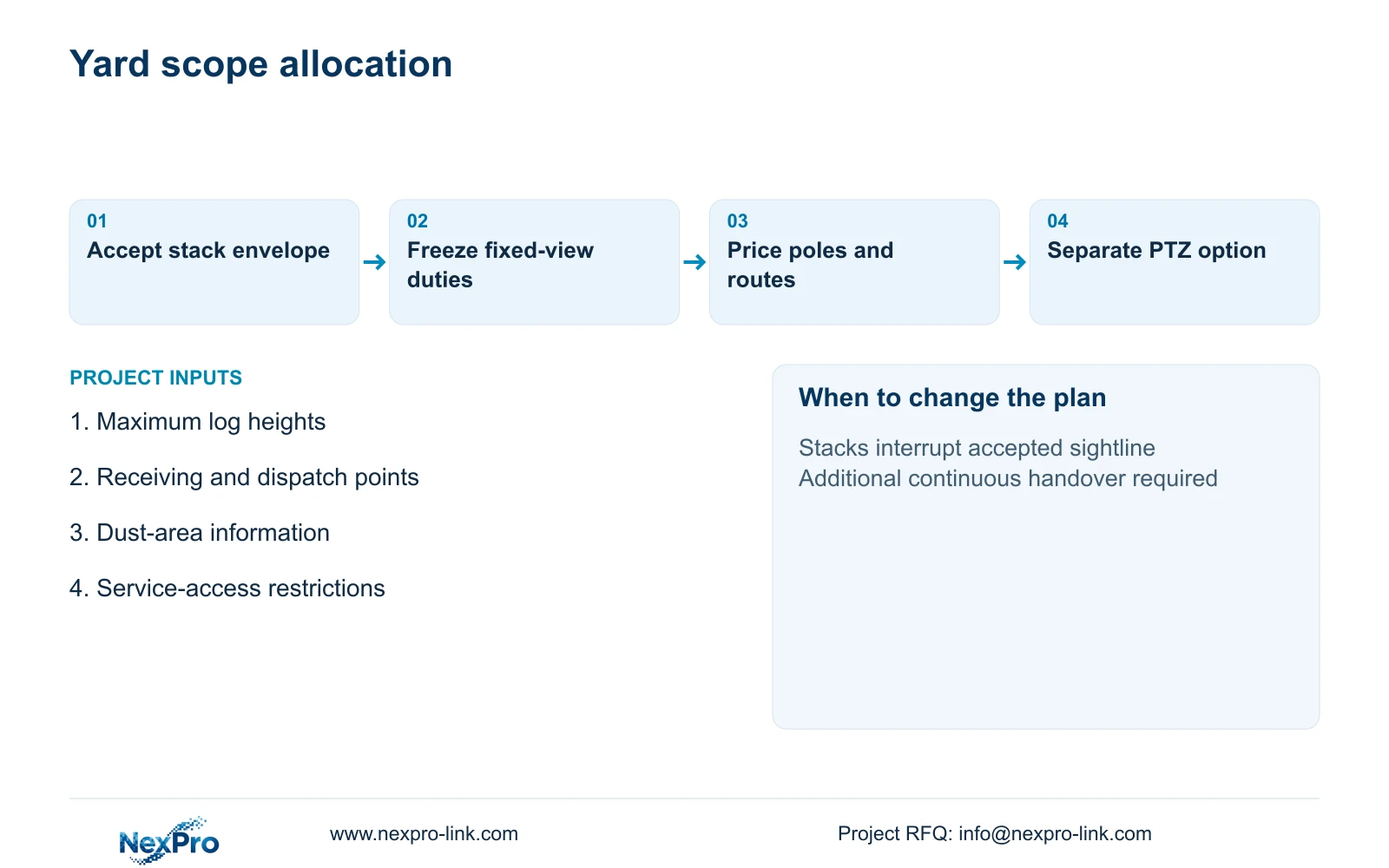
Recommend fixed views for accepted handovers, with PTZ added only for a defined inspection workflow. Change that arrangement if stack relocation removes the agreed sightline, an additional transfer route becomes active, or the owner needs continuous evidence at another location. A higher-resolution replacement may improve available detail but does not resolve physical occlusion.
Use CASE01 as an illustrative resource reference rather than a sawmill design. Its 32 cameras at an assumed 4 Mbps require 128 Mbps recorder input. Four 16 TB disks give 64 TB raw capacity and a 48.64 TB video budget after the stated 95% formatting factor and 20% reserve. That exceeds its 41.472 TB video requirement for 30 days; the reserve is already included.
The NexPro-NVR4449-4K lists 320 Mbps input and four SATA bays up to 18 TB per drive, but recording support and simultaneous viewing need separate checks. Added PTZ or detail streams may change modes and demand. Price local PoE groups, backbone links and power nodes accordingly, using actual device power instead of borrowing the reference case's assumed 12 W camera demand.
Section 06
Turn uncertain yard geometry into explicit quotation items
Organize the BOQ by receiving, storage movement and dispatch locations. Each line should identify the observation task, accepted mounting basis, cable route and supply status. Put unresolved pole work, trenching, fibre endpoints and service-access provisions into identifiable allowances or separately quoted items. Unknown work should not disappear inside a camera price.
For power continuity, identify which local switch and recording equipment must remain operating. The SP1KR(S) reference is rated 1 kVA / 900 W; its rating alone establishes no outage duration. Battery configuration and load conditions must be matched separately. A UPS in the main office cannot protect a remote yard switch without an actual protected electrical path.
NexPro-Link can coordinate ordinary CCTV model matching, technical documents and related project equipment through its BOQ and project-supply scope. Compare that offer with other bids using the same fixed evidence, PTZ inspection, retention and installation responsibilities. Keep required environmental protection and local support intact, and use current matching quotations before drawing any price conclusion.
Section 07
Buyer questions
Can a PTZ preset tour justify deleting fixed cameras? Only where the owner accepts intermittent observation instead of continuous evidence. Document dwell periods and gaps as part of that changed task. Do not treat a tour as equivalent to several simultaneous fixed views.
How should bidders price a yard without a final stack plan? Use a declared maximum stack envelope and provisional mounting plan. Separate confirmed equipment from route and support allowances, with clear conditions for quantity adjustment when operations approve the final geometry.
Does higher planning density prove that fewer cameras are needed? No. Density addresses detail within the framed scene. Camera quantity also follows continuous coverage, obstruction and separate handover events; narrowing a scene may require another view to preserve context.
Section 08
Price stable sawmill evidence
Send the maximum log-stack plan, critical handover locations, proposed cable routes, and maintenance-access restrictions to info@nexpro-link.com for discussion of a fixed-view base package and separately scoped PTZ options.
Engineering references
These sources support the general planning principles. Always use the selected product's current datasheet and applicable project standards for final design.