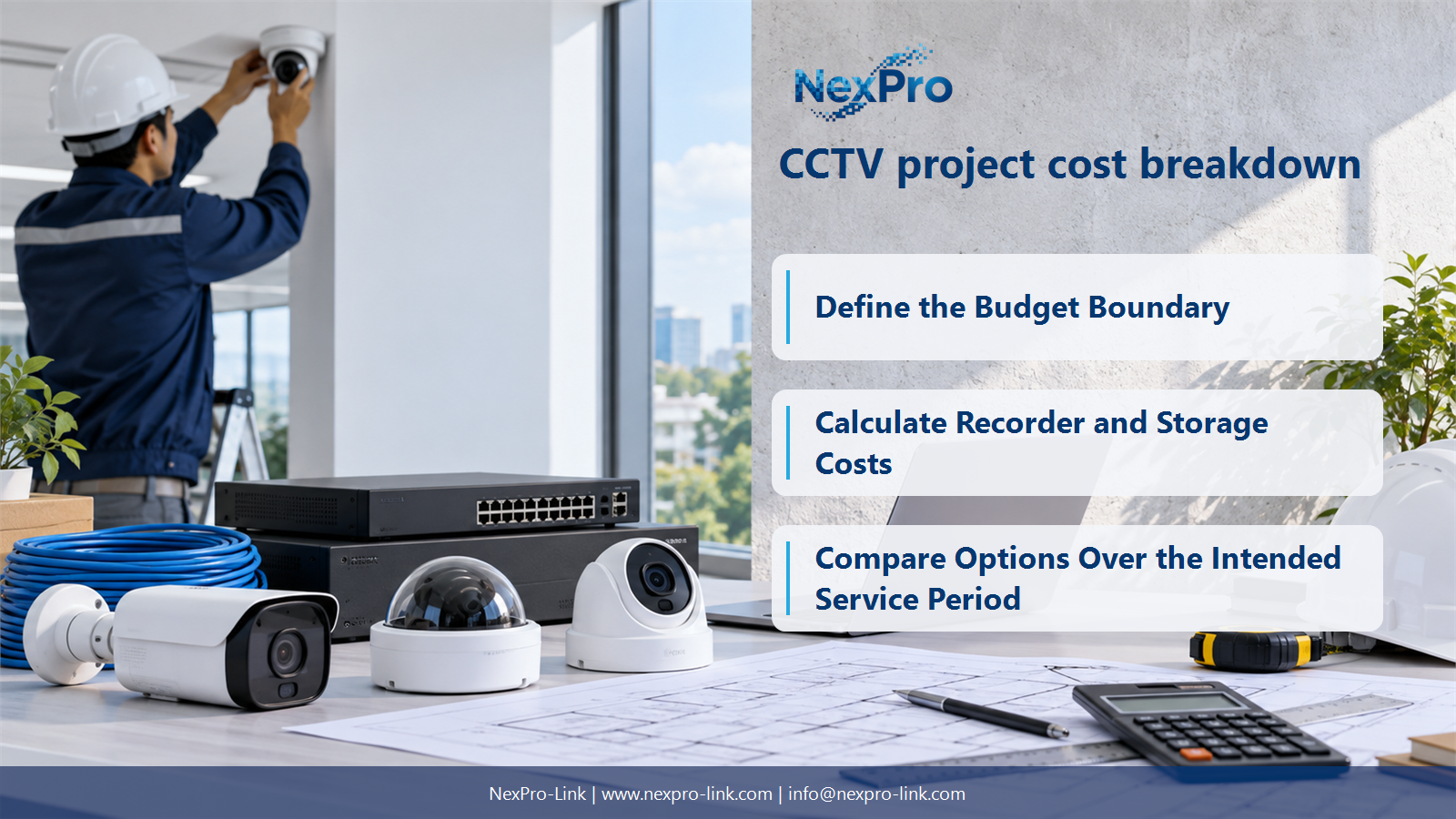
Plan CCTV project cost breakdown with practical guidance on define the budget boundary and expose site infrastructure costs. NexPro-Link project guide.
Section 01
Define the Budget Boundary
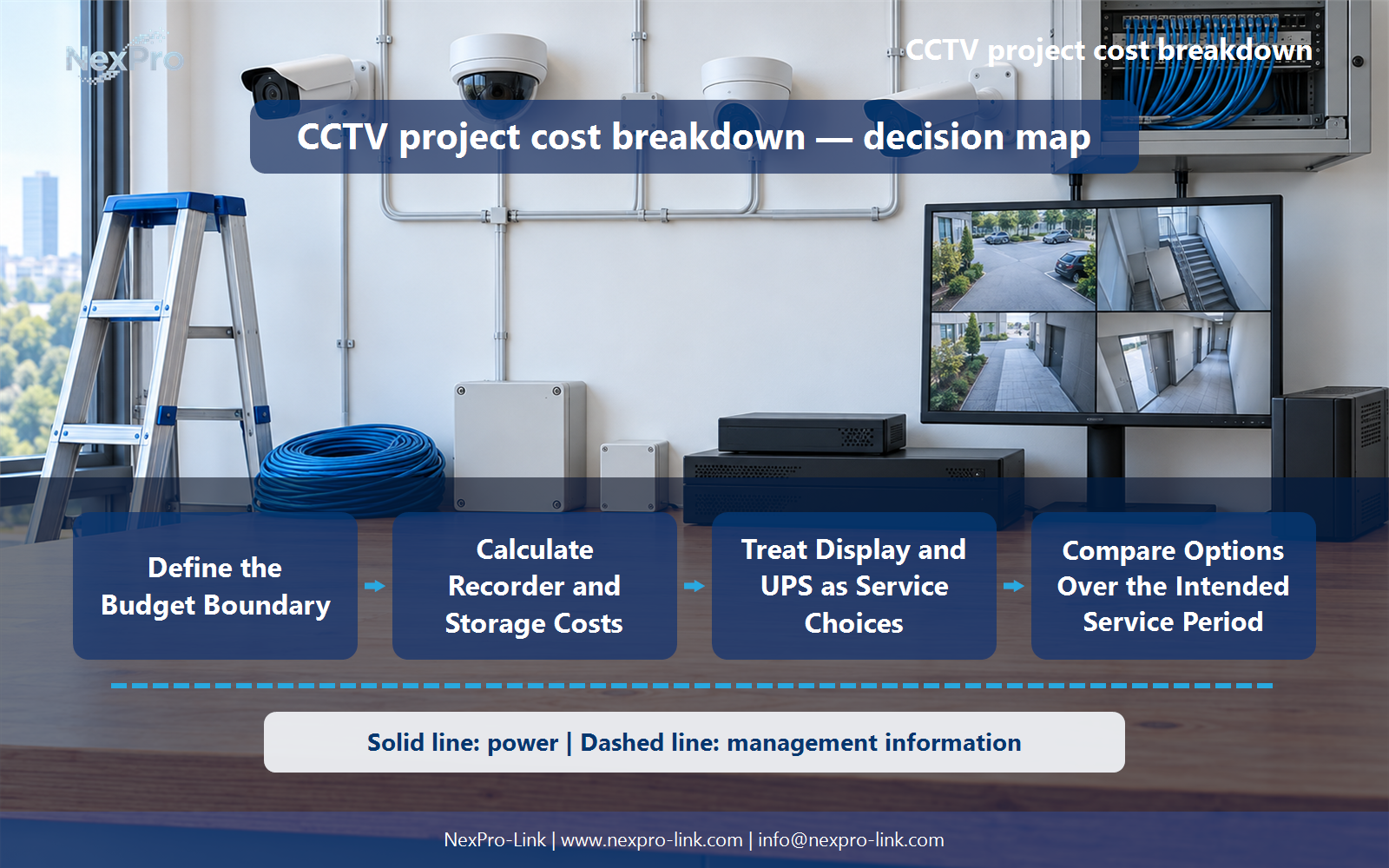
Define whether it covers equipment only or also design, installation, configuration, testing and support. Include relevant logistics and commercial scope explicitly. Two totals cannot be compared fairly when one includes cabling and labor while the other quotes only cameras and a recorder.
Turn the answer into a working record using Cost category, Included, Excluded, Pricing basis.
| Decision area | Buyer question | Required output |
|---|---|---|
| Define the Budget Boundary | What should a CCTV budget include? | Define whether it covers equipment only or also design, installation, configuration, testing and support. |
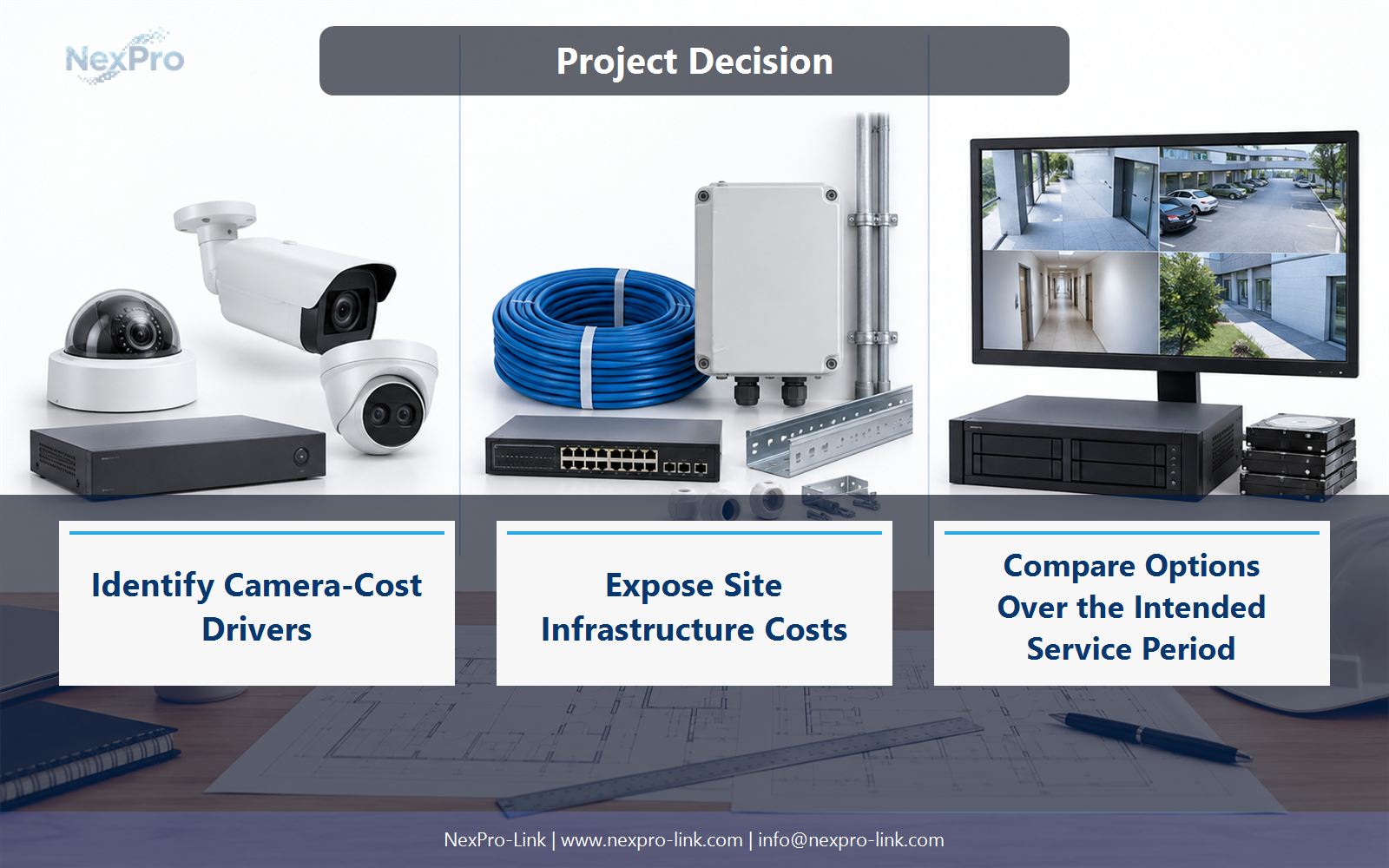
| Identify Camera-Cost Drivers | Why can camera costs vary within one project? | Different views may need different optics, environmental arrangements, illumination or specialized functions. |
| Calculate Recorder and Storage Costs | How does retention change the budget? | Longer recording periods increase required storage for a given workload and may require a different supported recorder or server arrangement. |
Section 02
Identify Camera-Cost Drivers
Different views may need different optics, environmental arrangements, illumination or specialized functions. Compare the required task and supported configuration rather than resolution alone. A generic camera percentage cannot describe a project with many standard indoor views and one with demanding perimeter or plate-capture roles.
Use Camera role, Quantity, Specification driver, Unit cost to compare options on the same basis. Keep product capability, project assumption and operating responsibility in separate columns.
Section 03
Calculate Recorder and Storage Costs
Longer recording periods increase required storage for a given workload and may require a different supported recorder or server arrangement. Protection and spares change usable capacity and cost. Calculate those layers rather than assuming one recorder price remains adequate as retention increases.
The project output should make Retention, Recording TB, Platform, Drives, Protection traceable from input to acceptance.
- Confirm the answer to: How does retention change the budget?
- Record the project fields: Retention / Recording TB / Platform / Drives / Protection.
- Keep product capability, project assumptions and site responsibility in separate records.
Section 04
Expose Site Infrastructure Costs
Long routes, civil works, access restrictions, outdoor power and shared-trade coordination can add substantial project scope. Quantify those conditions instead of assuming one camera installation rate applies everywhere. Infrastructure should be priced from routes and responsibilities, not concealed under a generic accessory allowance.
Record Route, Length, Work method, Site constraint, Cost basis before selecting a product family. That makes later substitutions possible without silently changing the operational requirement.
Section 05
Treat Display and UPS as Service Choices
No. Their scope follows the operator and outage requirements. Compare a suitable local display with a larger wall, and define the protected load and runtime before selecting backup equipment. Optional features should be visible instead of silently included in every package.
Review Service option, Equipment, Added value, Added cost with the party that will operate or maintain the system.
Section 06
Compare Options Over the Intended Service Period
Include relevant licences, maintenance, spares, expected configuration changes and expansion work. Use stated assumptions rather than fabricated failure probabilities or guaranteed savings. A useful comparison explains which requirements each option meets and which costs remain outside its scope.
Use Option, Initial, Recurring, Expansion, Scope difference as the handoff between design and procurement.
Engineering references
These sources support the general planning principles. Always use the selected product's current datasheet and applicable project standards for final design.