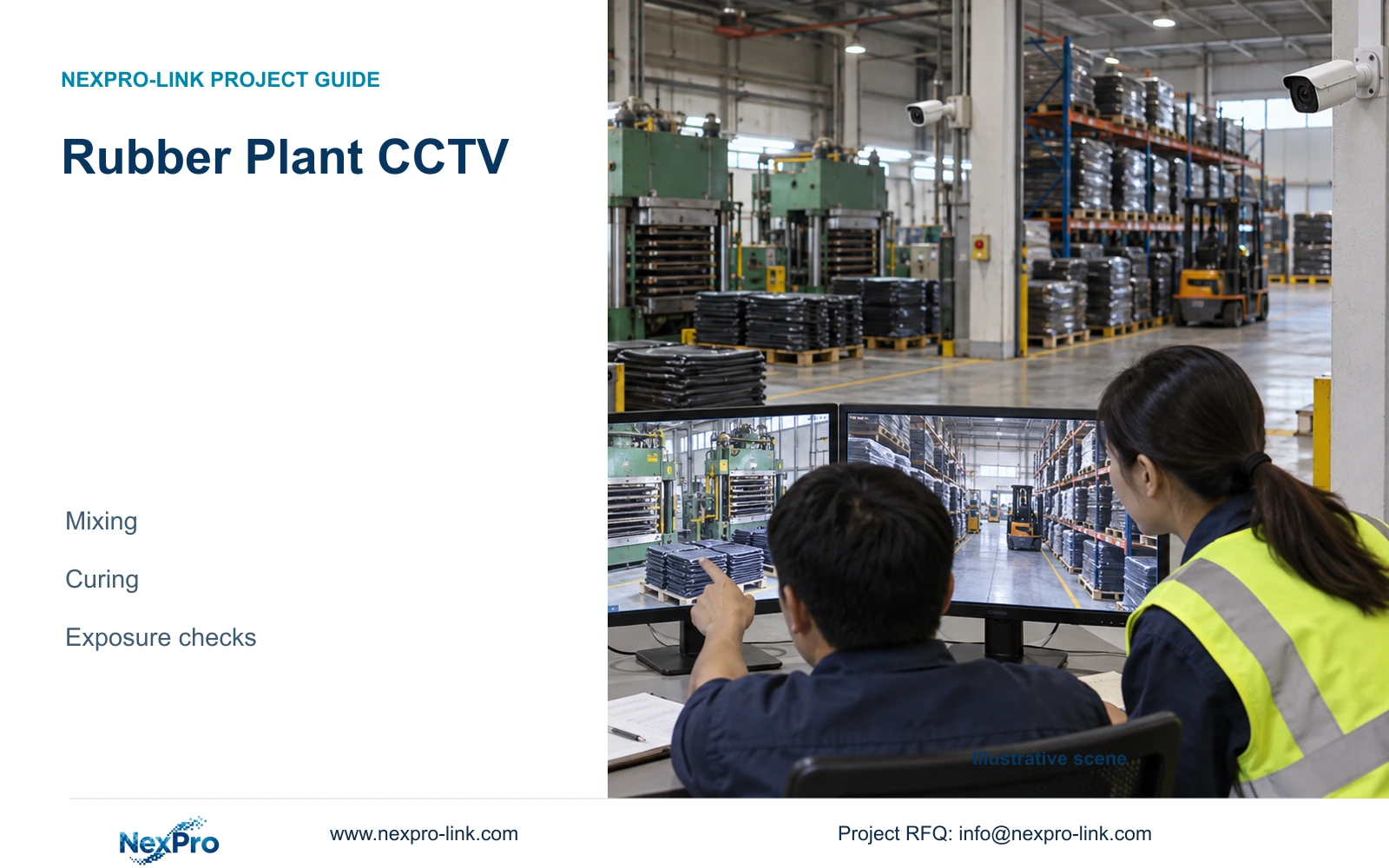
Collect conditions at rubber-plant camera mounts during production, cleaning and maintenance access. An idle survey does not define the exposure or specialist quantity for an operating mixing or curing area.
Section 01
Classify mounting conditions before assigning models
Before pricing a rubber-plant camera near mixing or curing, build an operating-state exposure brief for the proposed mount and connections. Record normal production, cleaning and maintenance-access conditions separately, using the site's actual information. An idle walk-through can leave those states unknown. Release an ordinary position only when its complete conditions fit the documented equipment scope; keep unresolved process views in a separate assessment list instead of assigning a specialist quantity from the room name.
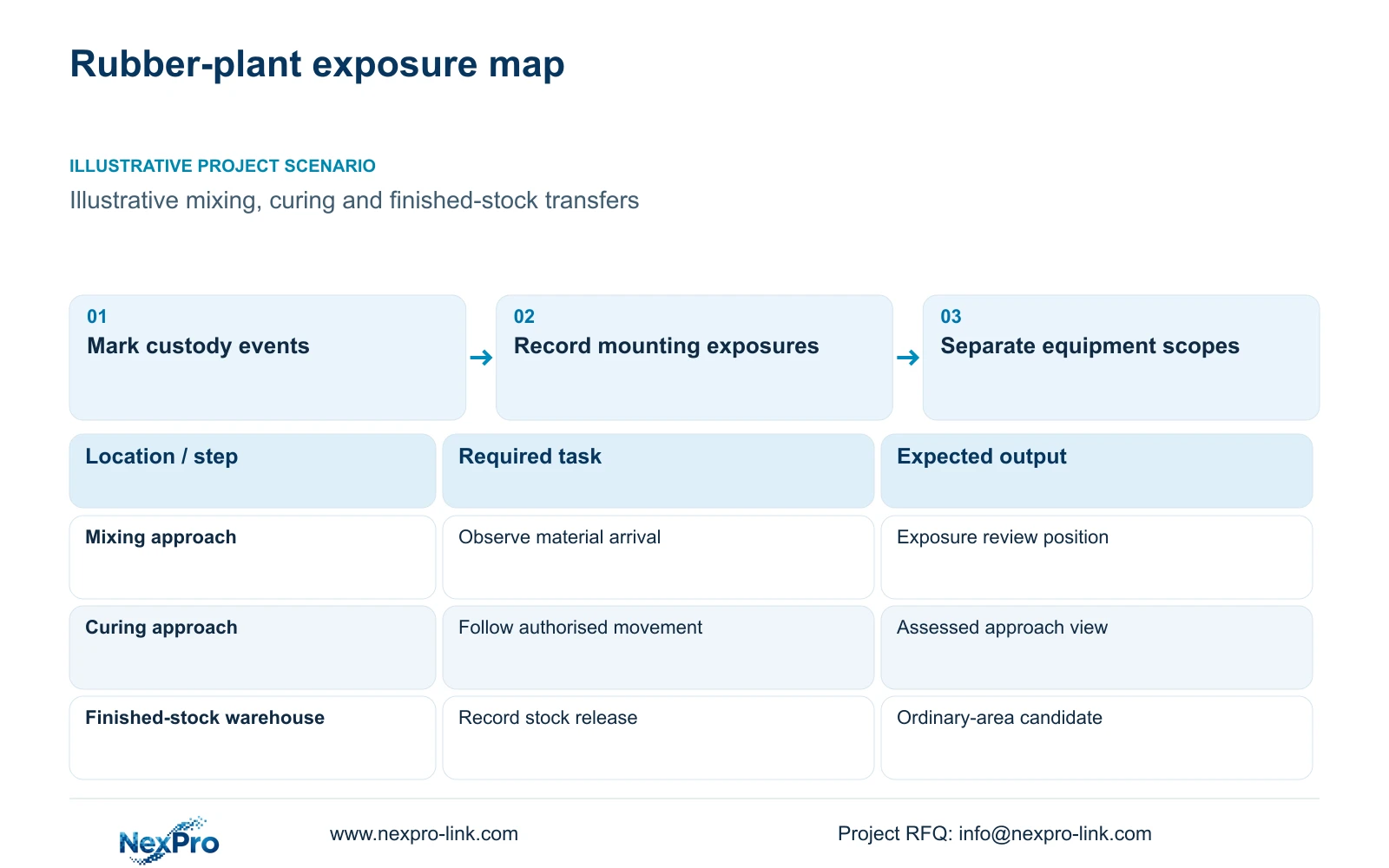
Illustrative project scenario: A rubber plant requires handling records across process and finished-stock areas. Assume the intended events are material arrival near mixing, movement past curing-area approaches and finished-stock release. No temperature, chemical concentration or hazard classification is supplied for these hypothetical positions. The engineer therefore separates confirmed ordinary locations from positions awaiting exposure assessment, preserving the requested security coverage without filling the unknown locations with a standard camera by default.
Section 02
Use ordinary cameras only within their documented scope
For each candidate position, obtain local temperature conditions, cleaning methods, condensation history, dust exposure and relevant chemical or hazard information. Record conditions at the mounting surface and connection point, including operating states that may differ from an idle walk-through. Ask maintenance staff how the lens will be cleaned and how technicians can reach it without entering an unsuitable process position. A service-access problem can change the mount even when the nominal temperature field appears acceptable.
The ordinary NexPro-BL2812M55-5MP-DIC-AI and NexPro-DM2812M55-5MP-DIC-AI sources list IP66 and an operating range of -20 to +60°C. Their listed 2880×1620 output and 2.8–12mm motorized lens can support framing discussions in suitable locations. These fields do not establish chemical resistance, washdown compatibility or explosion protection. Retain them as candidates for assessed ordinary warehouse or approach views, with the final mounting geometry checked separately. The Dome family name also provides no basis for an inferred impact rating.
Section 03
Convert operating-state evidence into position scope
Create one schedule line for every view that cannot be achieved from a confirmed suitable ordinary location. State the security task, proposed location, unresolved exposure and responsible assessor. For example, a material-transfer view may remain achievable from an assessed approach position, while a view inside a process enclosure requires its own specialist selection. Do not assign a specialist-camera quantity simply because a room is called a mixing room or remove that room's requested coverage because ordinary equipment is unsuitable.
Compare the complete front-end scope for each such position, including the approved camera configuration, connection method, supports and service arrangements. Moving a camera outside an unsuitable area may reduce specialist equipment, but only if the resulting recorded view still captures the required event. Ask the owner to approve that changed observation boundary. A lower specialist quantity has no procurement value if it leaves the transfer unseen, and a generic protective housing does not establish the suitability of the combined assembly.
Use the same position ID for the exposure brief, sightline and maintenance route. Ask the operations owner to identify the states that change conditions there, and record each source rather than estimating temperature or chemical concentration from a room label. A relocation can change both exposure and usable transfer detail. Compare those two outcomes before removing the original position from the supply scope. This brief is an input-collection and release method, not a report of measured process conditions.
| Condition / stage | Required input | Decision and evidence |
|---|---|---|
| Normal operating state | Actual conditions at mount and connection | Compare complete documented scope, not the room name |
| Cleaning or other changed state | Method, exposure and responsible source | Keep the position unresolved if a relevant condition is absent |
| Maintenance/replacement state | Permitted approach and service access | Revise location if routine service needs unsuitable access |
Section 04
Require all environmental checks to pass together
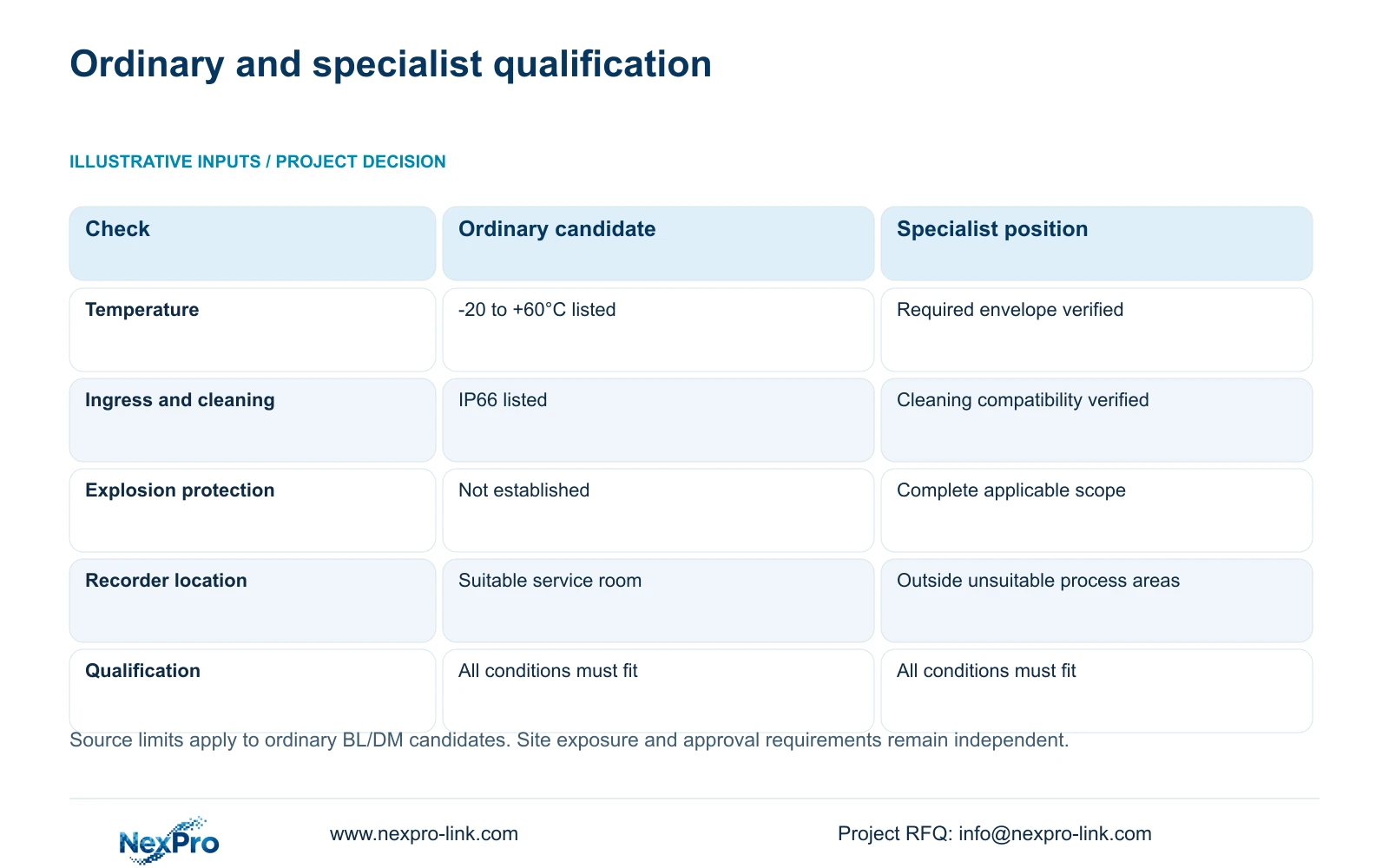
Apply the supplied decision rule: location conditions AND complete product scope AND approved installation requirements must fit. Qualification is conjunctive; passing one field does not override a failure or unknown elsewhere. The comparison below translates that rule into mixing, curing and warehouse decisions. It uses documented ordinary-model limits and project information still required, without assigning arbitrary scores or assumed specialist prices.
The decisive distinction is between a documented product field and a complete location qualification. IP66 remains an ingress field; it does not answer the cleaning-fluid, corrosion or hazard questions. Likewise, an ambient value inside -20 to +60°C does not settle nearby heat exposure or material compatibility. Keep ordinary recording infrastructure in suitable accessible service rooms. Responsible qualified designers must establish relevant protective requirements and verify current local rules. This matrix is a purchasing boundary, not instructions for designing or assembling a hazardous-area installation.
| Check | Ordinary warehouse or approach | Process position requiring assessment |
|---|---|---|
| Temperature | Documented -20 to +60°C range | Confirm actual operating envelope |
| Ingress and cleaning | IP66 source field | Verify cleaning and material compatibility |
| Explosion protection | Not established by ordinary PDFs | Complete applicable equipment scope required |
| Recording location | Accessible suitable service room | Keep ordinary infrastructure outside unsuitable areas |
| Price comparison | Accepted ordinary security task | Retain required specialist scope |
Section 05
Keep mixed front ends connected to a verified system
Recommend ordinary-area cameras for assessed warehouse and approach tasks, with specialist positions retained as separate scope. Change that recommendation when the desired event requires a closer view inside an unsuitable location or the owner's approved platform demands a different interface. Compare suppliers on the same view, environmental qualification and maintenance access. An ordinary camera is not a like-for-like substitute for a specialist position merely because its nominal resolution matches.
CASE01 is an illustrative ordinary-area system with 32 cameras and no specialist cameras. It is useful for organizing recording, PoE, storage and cable responsibilities, but its assumed 12 W camera demand cannot be transferred to a specialist front end. Nor can its supported 5MP-class recording assumption establish compatibility with a newly selected device. Obtain actual stream formats, bandwidth and power requirements for each addition. Verify the intended recording, playback and export workflow, and keep UPS protection tied to the actual powered node. Displays remain a separate client branch rather than a required link in recording.
Section 06
Release ordinary and specialist scopes separately
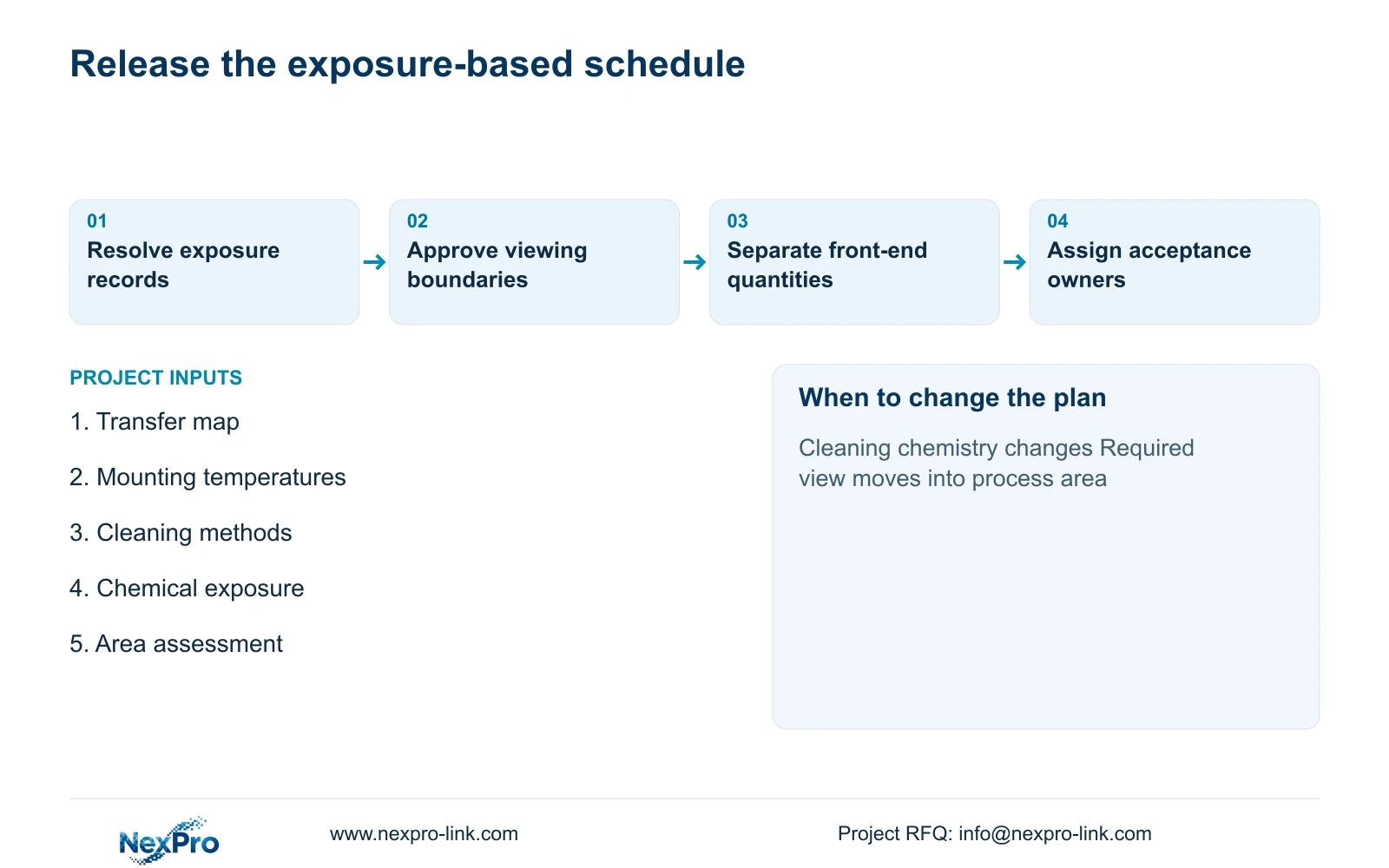
The handover map should distinguish supplied ordinary warehouse cameras, any retained specialist equipment and unresolved process-area positions. Assign environmental assessment to the owner's qualified design team, model evidence and supply documents to the supplier, and installation and local testing to the appointed contractor. Use the same location IDs in the drawing, equipment schedule and acceptance recordings. This lets procurement obtain comparable offers without silently moving an unresolved responsibility into the camera supplier's package.
NexPro-Link's factory-project and BOQ support can help coordinate relevant ordinary-area equipment, model matching and technical submittals. Specialist selections and final approvals must stay explicit rather than being absorbed into a general factory package. Before release, review the material-transfer demonstration, maintenance route and exposure record for every position. If cleaning practice or process layout changes, reopen the affected line and identify whether the camera, mount, cable or service method needs revision. Unresolved chemical and hazard inputs should remain visible in the quotation.
Section 07
Buyer questions
Does every camera near curing equipment need specialist construction? The decision depends on its actual mounting-point conditions and required approvals. A suitable approach view may use ordinary equipment, while a closer process position may require a different scope.
Can a protective housing make an ordinary camera suitable? Do not assume so. The complete configuration, connections and installation conditions need applicable evidence. A housing description alone does not qualify the combined equipment.
Can ordinary and specialist cameras share a recorder? Potentially, but confirm the exact streams and required functions. Demonstrate recording, playback and export for the selected models rather than relying on generic connectivity claims.
Section 08
Separate your rubber-plant camera scopes
Send the mixing-to-stock transfer map, mounting-point exposure information, cleaning methods, and required specialist approvals to info@nexpro-link.com for an ordinary-area equipment schedule with explicit specialist boundaries.
Engineering references
These sources support the general planning principles. Always use the selected product's current datasheet and applicable project standards for final design.