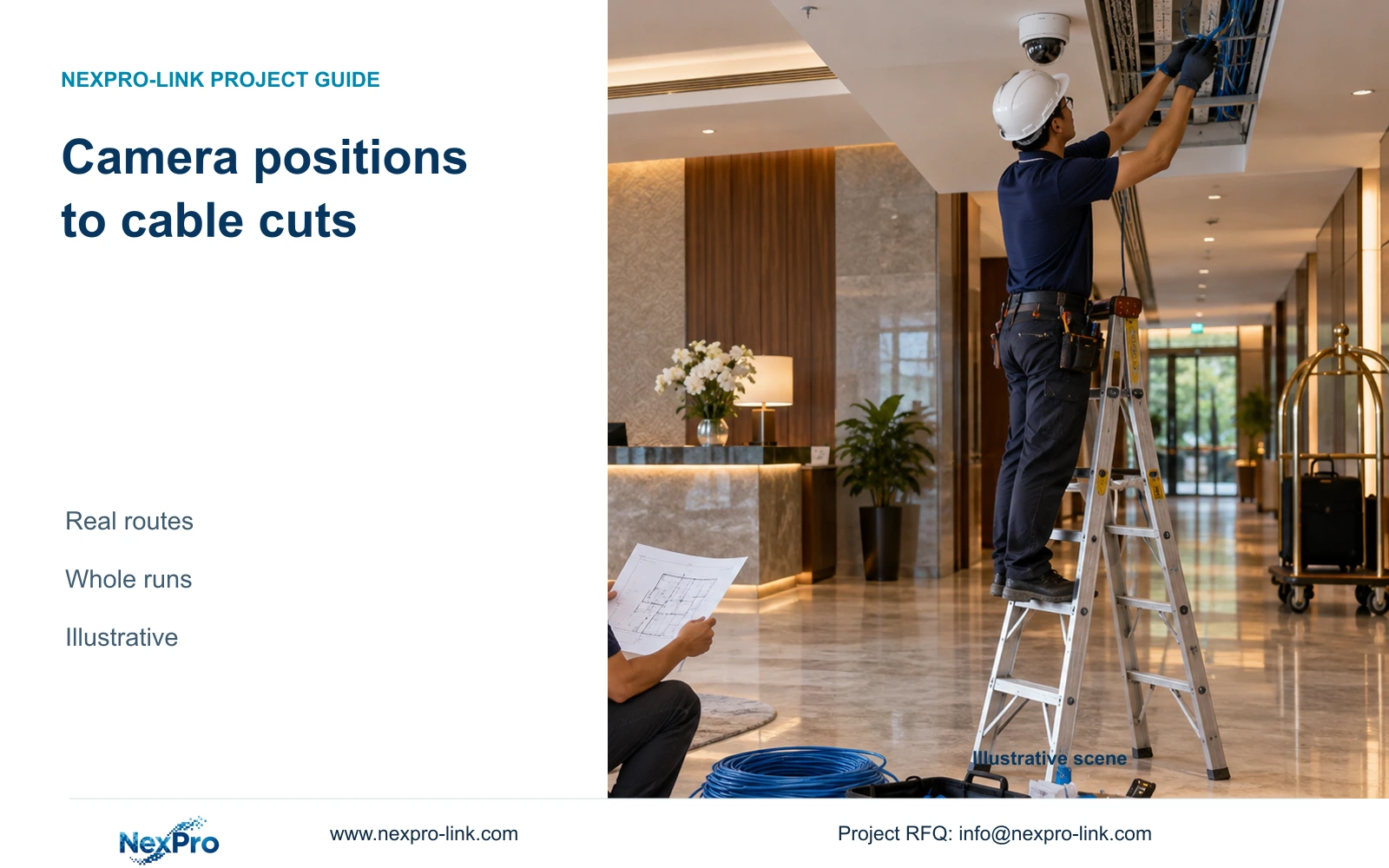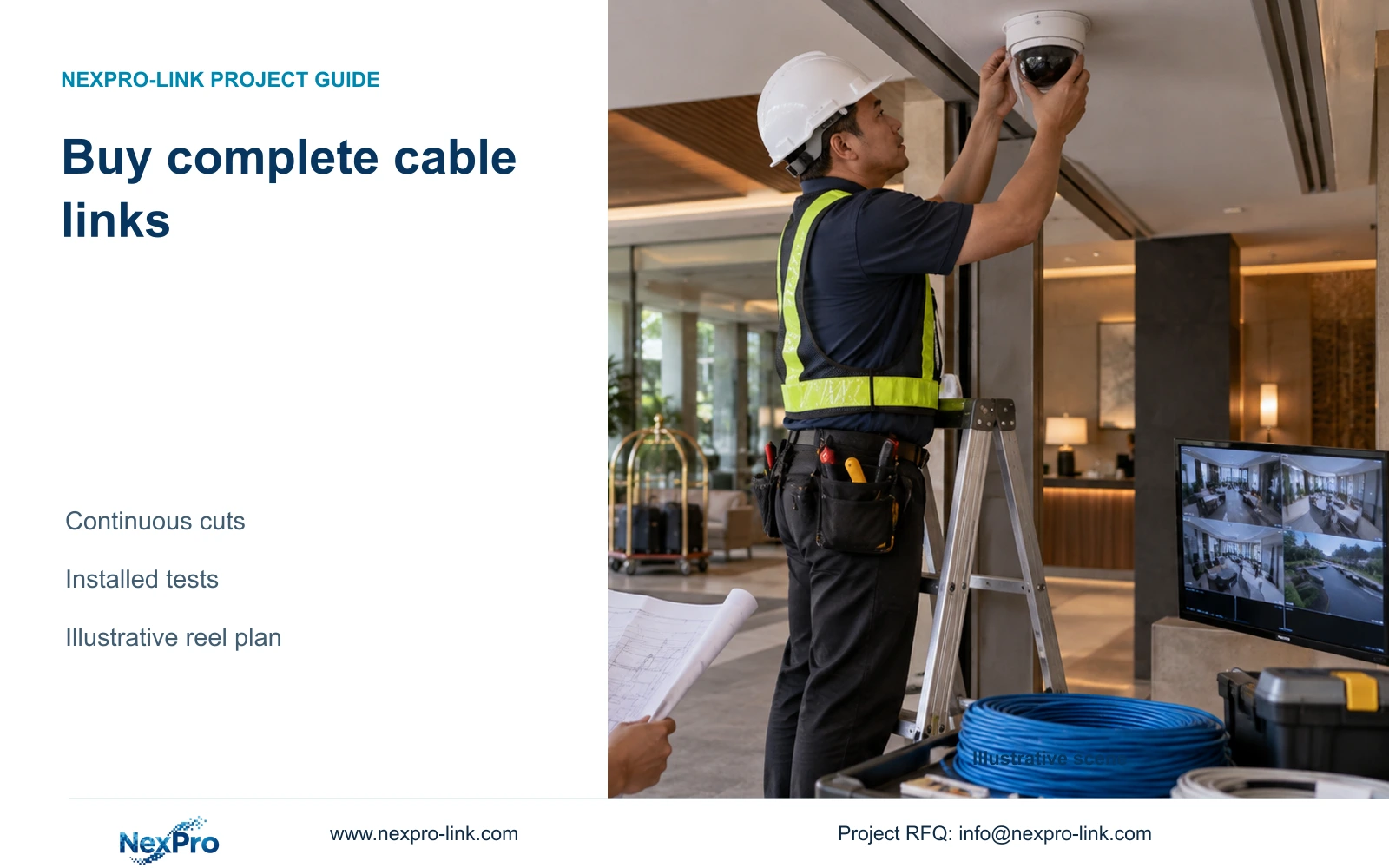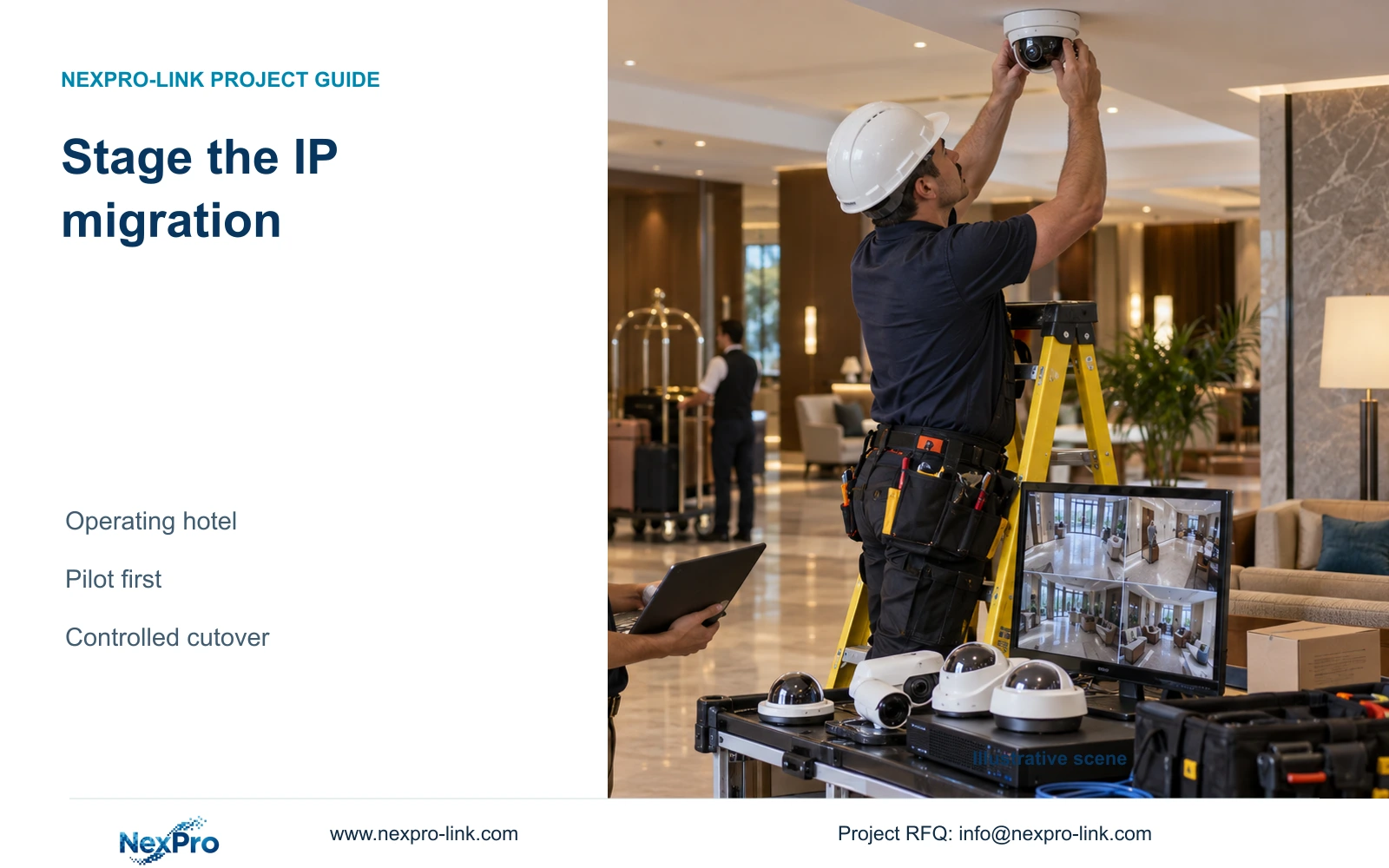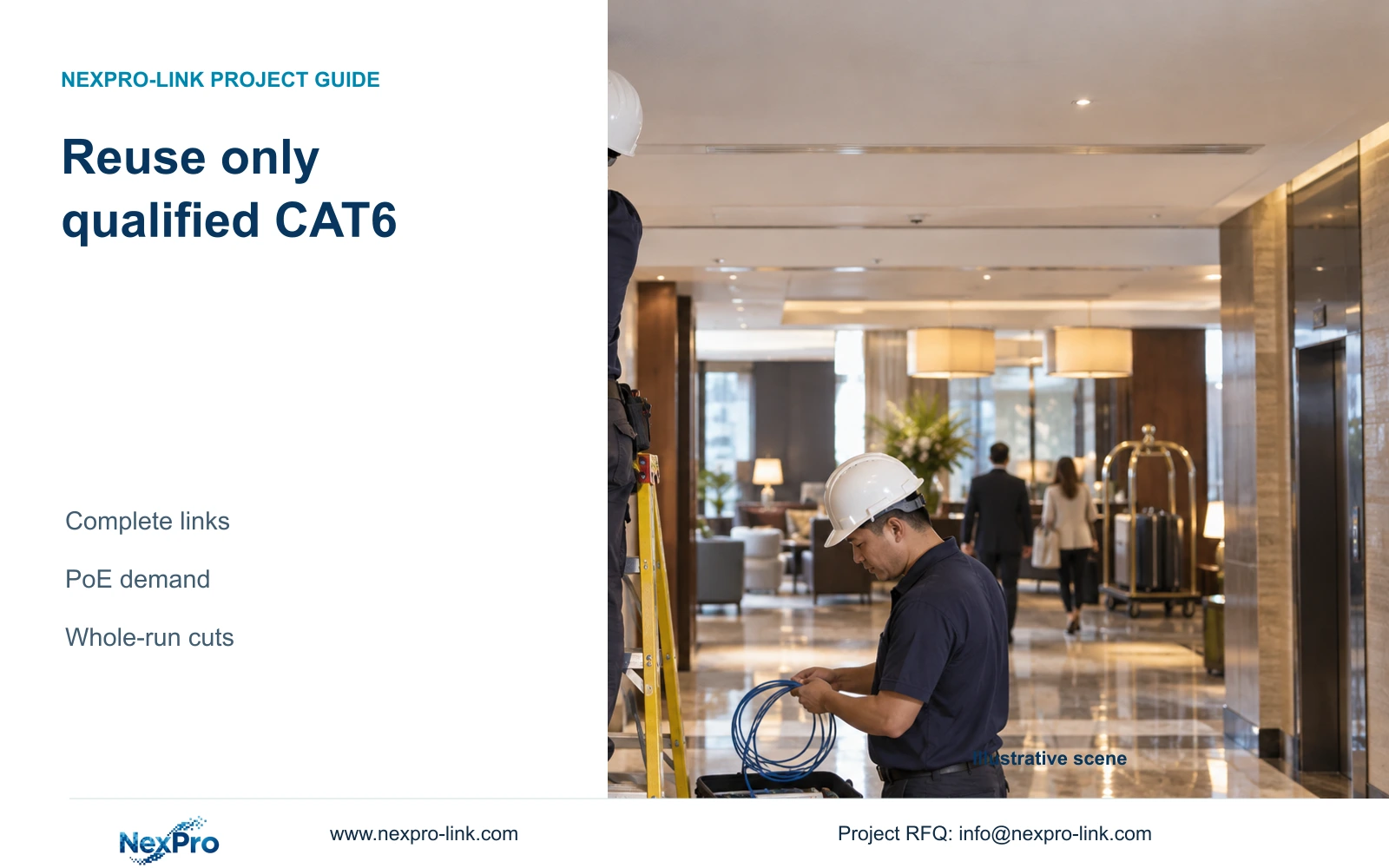
Reuse hotel CAT6 only after the complete link supports the new data and power task. Separate qualification work from replacement cable purchasing.
Section 01
Decide which existing links are reuse candidates
Reuse existing hotel CAT6 only when its complete route, connections and test information support the proposed camera's data and PoE requirements. A cable that powers an old camera is a candidate for assessment. Keep replacement links in the plan where identity, condition or required performance cannot be established.
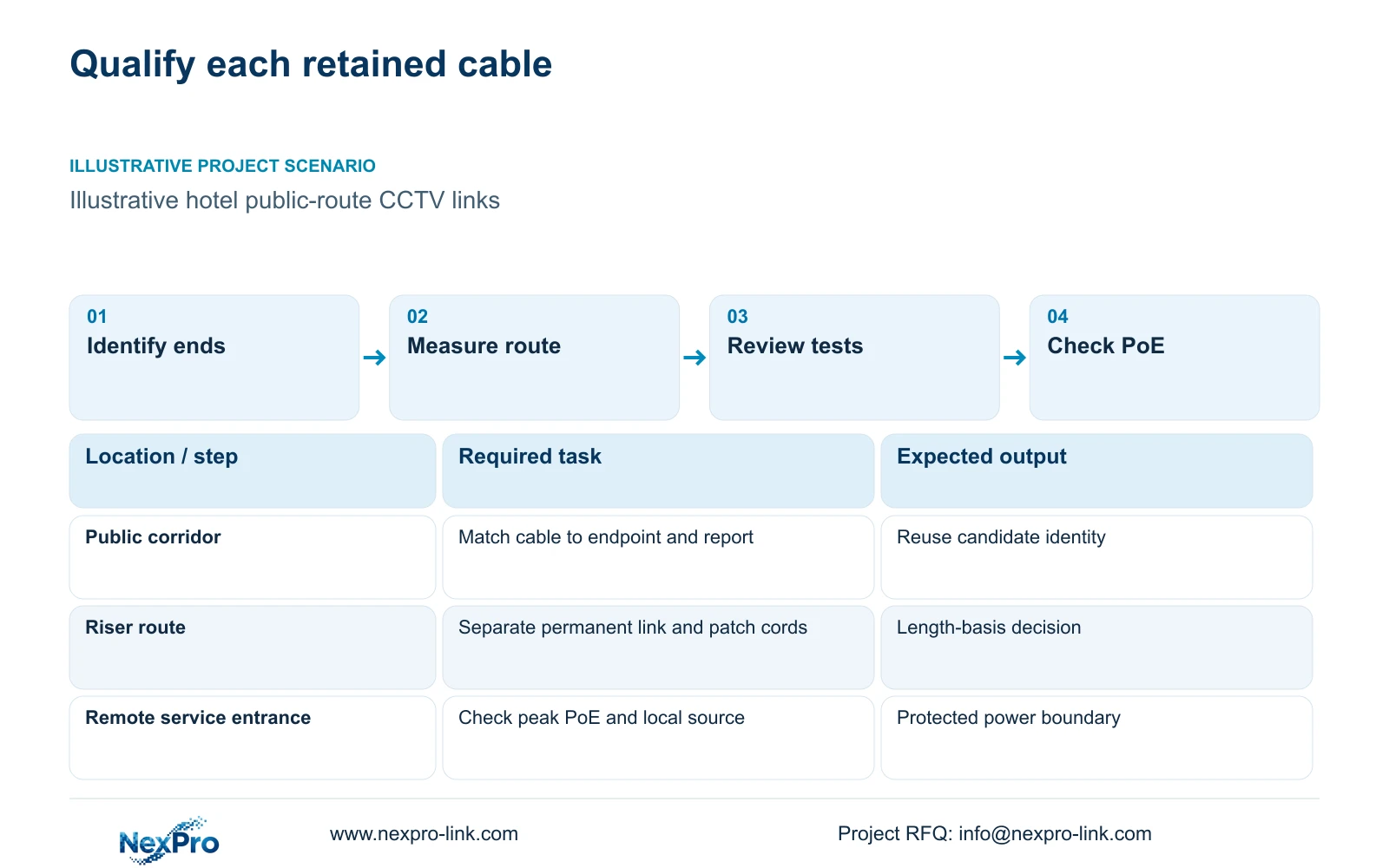
Identify both ends of every proposed retained link. Record the cable category and available conductor and jacket information, then map the patch panel, outlet, module and patch cords. A CAT6 label on one component cannot establish the category or condition of the installed combination.
SP5648 is a Cat6 48-port data patch panel, and DT968MX is a Cat6 tool-free module in the supplied structured-cabling record. Neither is a reel of cable. Replacing a termination with one of these candidates does not, by itself, qualify the existing permanent cable.
Divide the schedule into retained candidates, links requiring remedial work and planned replacements. Tie those classifications to endpoint identities rather than a percentage of the hotel. This allows the project manager to price uncertainty without declaring all old cabling usable or replacing it solely because of age.
| Required task | Given information | Decision still needed |
|---|---|---|
| Carry new camera data | Cable marked CAT6 | Full link identity and test basis |
| Supply new PoE load | Old camera powers up | New peak demand and connection condition |
Section 02
Measure the actual installed route
Measure the route between terminations, including risers, detours and the installation allowances already present. A straight-line drawing distance cannot establish the installed length. Record permanent-link and patch-cord lengths separately so the acceptance basis remains clear.
The supplied Fluke guidance uses the typical 90 m permanent-link and 100 m full-channel distinction. Final category, connection arrangement and project test requirements still need to match the installation. A route at the stated length boundary is not a complete qualification result.
The separate teaching path example totals 82 m horizontal, 12 m vertical and 4 m termination allowance, producing 98 m. That exceeds the stated typical permanent-link basis. Moving access closer can shorten a copper tail, but introduces a remote switch, local power and maintenance dependency.
If fiber is selected for the backbone, budget power at the remote node independently. Fiber does not supply the camera's PoE load. An extension or cascade changes fault scope and support responsibility, so compare its complete arrangement with route replacement.
Section 03
Review link-test information against the new task
Match each test record to the actual endpoint and the installed configuration it describes. Check whether its basis is a permanent link or a complete channel and whether later termination changes have altered that arrangement. A report for an unidentified cable cannot qualify the route serving a specific camera.
Where evidence is incomplete, include investigation and testing as explicit work before approving reuse. Record the unresolved condition and responsible party. After remediation, repeat the relevant check and update the endpoint record; administrative closure does not demonstrate restored service.
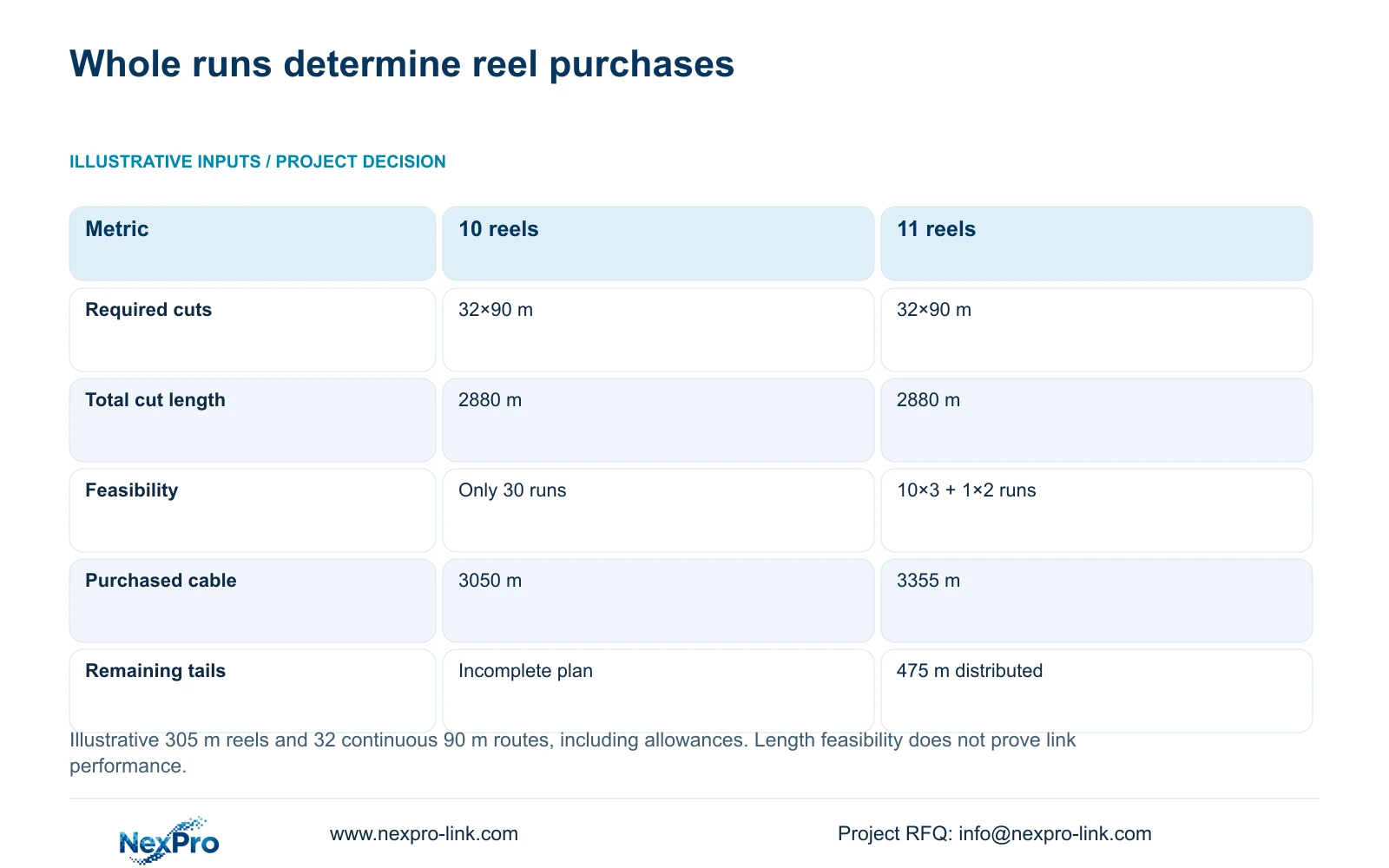
Qualification also affects procurement quantities. The supplied replacement calculation assumes 32 separate continuous cuts of 90 m, each already including its full permanent-route allowance. Total required length is 32×90 = 2880 m. Dividing by an assumed 305 m reel and rounding up gives a ten-reel arithmetic lower bound.
Each reel supplies only three whole 90 m runs because floor(305/90) = 3. Ten reels therefore supply 30 runs. Eleven reels supply all 32, with ten reels cut into three runs and one into two. The table is a purchasing calculation, not a field-test result or a statement that every 90 m link passes.
| Metric / condition | Rounded length lower bound | Feasible whole-run plan |
|---|---|---|
| Total cut length | 2880 m | 2880 m |
| 305 m reels | 10 | 11 |
| Can all runs be cut? | No: only 30 runs | Yes: 10×3 runs + 1×2 runs |
| Purchased length | 3050 m | 3355 m |
| Remaining tails | Not a feasible complete plan | 475 m distributed |
Section 04
Compare the new PoE demand
Collect the new camera's peak powered-device demand for its intended operating modes. Night illumination or other supported peak states need consideration. Match both the individual switch port and the total usable switch budget to the assigned camera group.
The separate teaching PoE example uses eight hypothetical cameras at 12 W each and 90% cable delivery efficiency. The 96 W PD group requires 106.67 W at the PSE output boundary. Retaining 20% of that budget free requires 133.33 W. These are planning inputs; the camera PDFs do not verify a 12 W maximum.
NexPro SW-POE1618G lists 16 PoE access ports and two uplinks, but the supplied record contains conflicting access-speed descriptions and no numerical total PoE budget. Keep it as an inquiry candidate until the required fields are established. An af/at description does not demonstrate simultaneous full-group capacity.
For UPS planning, use the correct AC boundary. If measured switch input includes its downstream cameras, adding those camera watts again overstates the load. Route qualification and sufficient source power are separate requirements.
Section 05
Price reuse and replacement work separately
A reuse allowance should include tracing, test review, accessible repairs, retermination where needed and retesting. A replacement allowance should include continuous cable cuts, connectors, route work and the permitted interruption. Keep locally executed work separate from coordinated equipment supply.
Use the feasible cut plan for purchasing. Eleven 305 m reels provide 3355 m in the teaching example, leaving 475 m in separate tails. Those pieces are not one continuous spare cable and should only reduce later purchases when a legitimate shorter route fits an identified piece.
Do not combine this replacement example with CASE07's independent cable schedule. CASE07 uses varied 38-78 m teaching routes, totaling 1826 m with a feasible seven-reel allocation. Its quantities cannot be transferred to a hotel whose actual replacement routes are 90 m.
Compare the same required outcome in both quotations. Avoid a low reuse price that excludes necessary testing, or a replacement price that counts terminations already included elsewhere. No source price or brand failure rate establishes which option costs less for the actual hotel.
| Retained outcome | Extra scope | Worth buying when | Counter-condition |
|---|---|---|---|
| Qualified existing link | Investigation and remediation | Accessible link can meet the task | Required performance remains unproven |
| New continuous route | Cable and installation work | Existing route fails or is unsuitable | Qualified reuse meets the same task |
Section 06
Keep only qualified links in the released plan
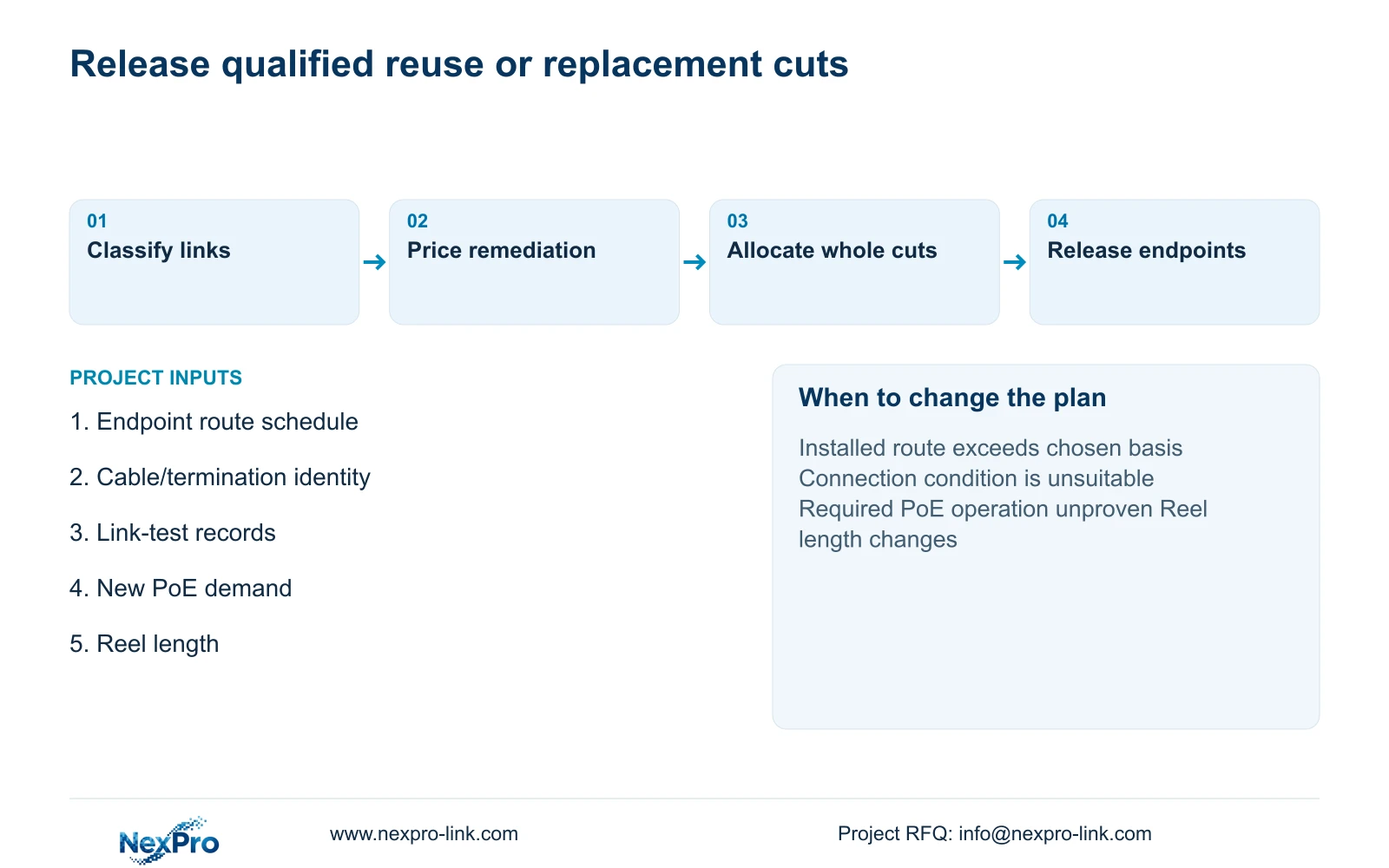
Release retained links with an endpoint record, applicable test basis and the supported camera and power arrangement. Keep provisional links visible as unresolved work. The final materials schedule should distinguish retained cable, replacement cuts and terminations.
Recommend reuse where the complete link is identified, suitable and demonstrated for the new task. Change to replacement or a revised access topology when the route is too long, damaged, inadequately documented or unable to support the required operation. A shorter copper tail still requires a designed remote power boundary.
Send the route schedule, available link reports, proposed camera power requirements and allowed work windows to info@nexpro-link.com. Include the destination cable specification and intended reel length. NexPro-Link's hotel project and BOQ support can help coordinate materials while local professionals define installation and acceptance responsibilities.
Section 07
Buyer questions
Can remaining reel tails be joined to complete a long camera run? Do not assume that splicing distributed tails produces the specified continuous link. Allocate a whole cut to each planned route; use shorter remnants only where a permitted complete route and its connection arrangement fit.
Does a new CAT6 patch panel make the old cable CAT6? No. SP5648 identifies a Cat6 patch panel. The cable, modules, patch cords and installed connections still determine the complete link, which needs the project's applicable qualification.
Can a reuse quotation remain provisional? Yes. Separate confirmed reusable endpoints from those awaiting tracing or testing, and identify the replacement trigger and affected materials. That gives the buyer a controlled allowance without converting uncertainty into a pass.
Engineering references
These sources support the general planning principles. Always use the selected product's current datasheet and applicable project standards for final design.