A cheaper CAT6 reel may leave the hotel with an incomplete cutting plan or excluded termination work. Compare the cost of complete specified links, with destination requirements explicit.
Section 01
Define the installed-link requirement
Select cable through a feasible continuous-run plan and a complete installed-link specification. A lower box price is useful only when the offer can complete the same routes with the required conductor, jacket, connectors and tests. In the illustrative 32-run calculation here, ten 305m reels cannot supply all the required cuts; eleven can. Compare qualified offers using that feasible quantity.
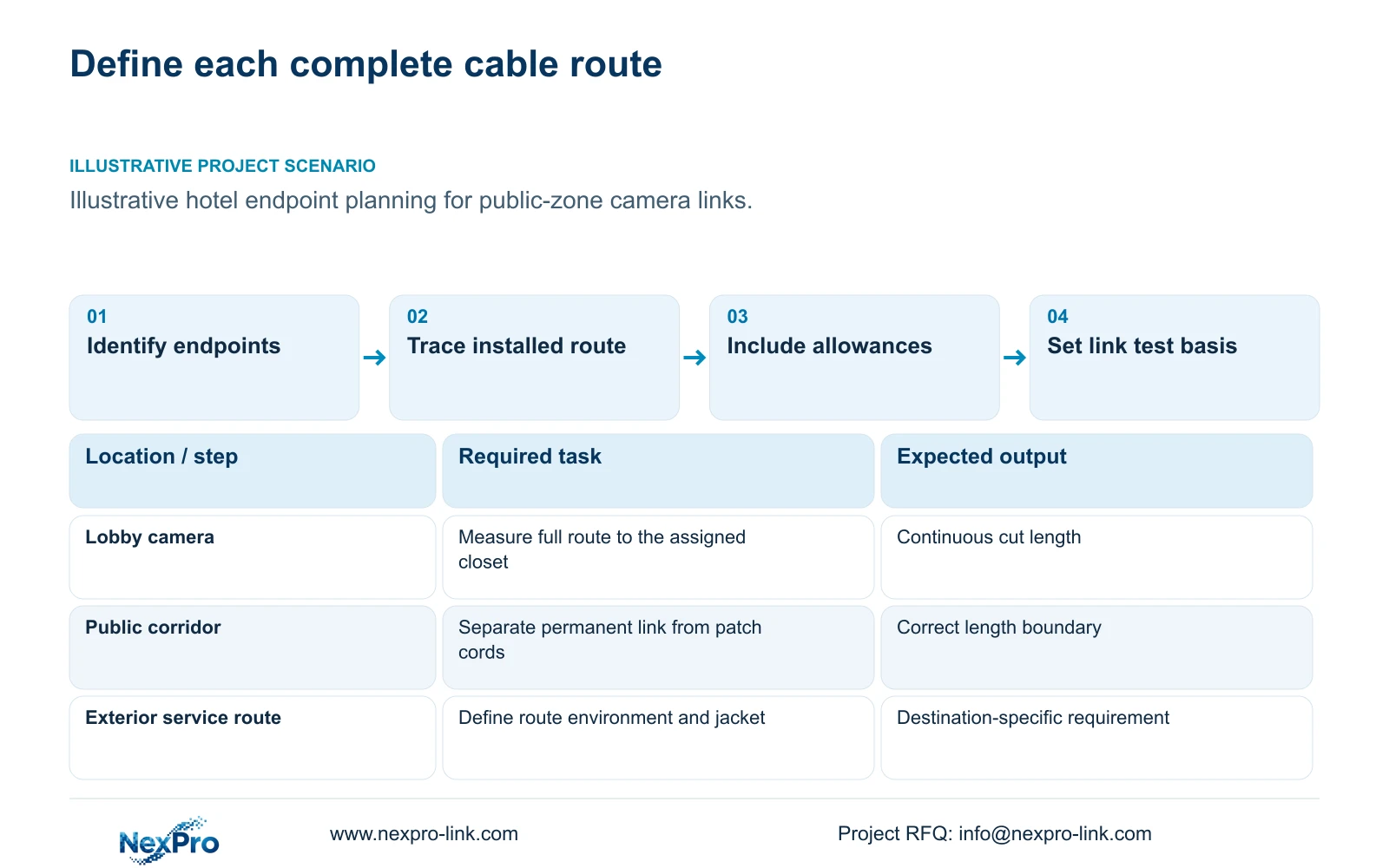
Create a route schedule for individual endpoints, such as lobby cameras, public-corridor views and exterior service-route equipment. Measure the installed path, including vertical sections, turns and justified termination allowances. A straight line on a floor plan is insufficient for a final cutting schedule. Identify which allowances are already included so they are not added again during procurement.
Keep permanent-link and full-channel boundaries distinct. The supplied Fluke Networks record uses the typical 90m permanent-link and 100m channel basis, with the latter including patch cords. Final category, connections and test configuration depend on the project. A route that fits the length basis still requires the specified components and installed-link assessment.
| Required task | Given information | Decision still needed |
|---|---|---|
| Connect public-corridor camera | Endpoint and closet identified | Full permanent route with included allowances |
| Connect exterior service view | Data and power path required | Route environment and suitable cable specification |
Section 02
Normalize conductor and jacket specifications
Put the required conductor construction and cable category into the enquiry before comparing brands. Record the offered construction against that requirement and identify deviations explicitly. A Cat6 description on a box does not by itself establish the performance of the completed route or suitability for the hotel's chosen application.
Treat the jacket requirement as a separate field. Indoor public routes, service spaces and exterior sections may have different installation conditions. The responsible project team must define the applicable destination and route requirements. Do not assume that a familiar brand name or a jacket description used in another country proves acceptance for this installation.
Normalize reel length and the exact cable identity alongside the material specification. The 305m reel is a purchasing assumption in this article, not a verified NexPro-Link bulk cable SKU. If a supplier offers a different reel length, calculate its own continuous cutting plan. Retain the connector and patch-cord specification in the comparison so cheaper cable is not evaluated against a different complete link.
Section 03
Plan continuous cuts from reels
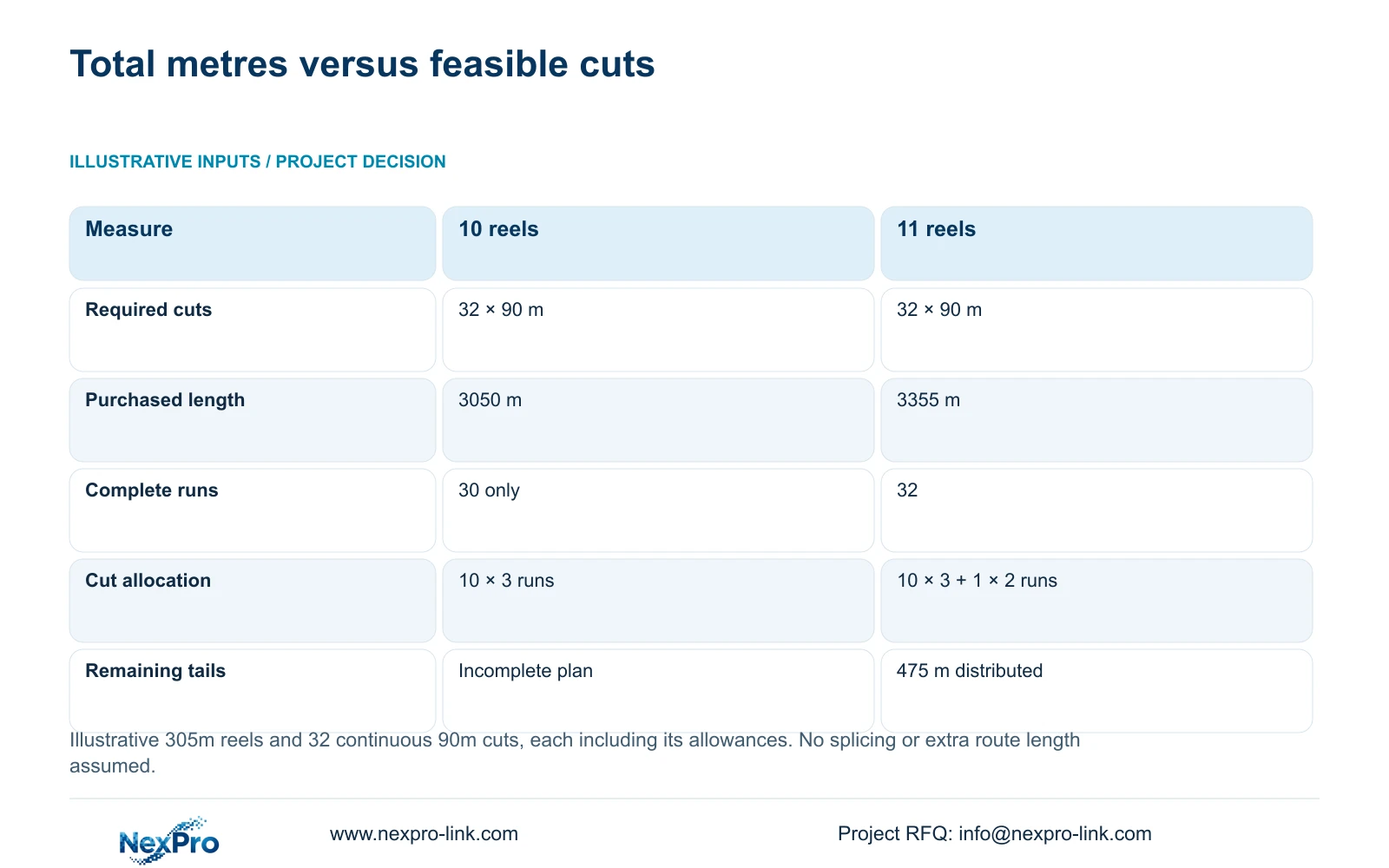
Assume 32 independent continuous cuts of 90m, each representing the full planned permanent route with its allowances already included. Total cut length is 32 × 90 = 2880m. Dividing by the assumed 305m reel length and rounding upward gives a ten-reel arithmetic lower bound. That calculation checks aggregate material quantity, but does not demonstrate that the cuts fit.
Each reel can supply floor(305 ÷ 90) = three complete runs, leaving 35m. Ten reels therefore supply only thirty runs. An eleventh reel supplies the remaining two, leaving 125m. The feasible purchase is 11 × 305 = 3355m, with 3355 − 2880 = 475m of distributed tails.
Issue the cut allocations with the reel quantity. The remaining pieces may be useful for separately specified shorter routes, but they cannot be treated as one continuous cable or casually joined to complete a required run. If route lengths or reel size change, recalculate feasibility. The eleven-reel result belongs only to these equal 90m cuts.
| Metric / condition | Total-length lower bound | Feasible continuous-run plan |
|---|---|---|
| Total cut length | 2880 m | 2880 m |
| 305m reels | 10 | 11 |
| Can every run be cut? | No: ten reels fit only thirty runs | Yes: ten × three runs plus one × two runs |
| Purchased length | 3050 m | 3355 m |
| Remaining tails | Not a feasible complete plan | 475 m distributed across reels |
Section 04
Include termination and testing
The cable quantity supplies the routes; it does not complete their endpoints. Include the specified patch panels, modules, cords and labels, with labour and test scope shown separately. Allocate these components by actual closet and endpoint, rather than assuming one central accessory count covers every distributed location.
SP5648 is a Cat6 48-port data patch panel, and DT968MX is a Cat6 tool-free module. Neither is a bulk cable model. Their category descriptions do not prove the complete installed channel, whose outcome also depends on cable, cords, connections and construction. Keep their identities in the BOM without using them as substitutes for the missing cable specification.
Define the installed-link test basis and associate results with the route identifiers used in the schedule. The comparison should state who tests, who corrects unsuccessful links and which records form the handover. Cable purchase alone cannot establish a passed installation. The illustrative 90m cuts are already at the typical permanent-link length basis, so unlisted extra length would change the design.
Section 05
Compare evaluated route costs
Evaluate the feasible reel quantity at the actual quoted rate, then add the same termination, installation, testing and delivery scope. Keep unquoted items open instead of entering zero. No supplied price data establishes which cable brand offers the lowest complete cost. The calculation identifies the quantity a comparable quotation must cover.
Check route alternatives before adding an extender or another active node. A revised closet location can shorten copper paths but introduce local power, protected-power and maintenance responsibilities. Fibre can address a data-path issue, yet does not automatically power remote cameras. Compare those additional dependencies and their outage behaviour alongside material savings.
The linked complete hotel reference uses a different route list totalling 1826m and a feasible seven-reel plan. It is independent of the 2880m example here. Neither total should be copied into a real BOQ without the corresponding route schedule. That distinction prevents a plausible hotel scenario from becoming an unsupported cable purchase quantity.
| Retained outcome | Additional scope | Change condition |
|---|---|---|
| Continuous specified copper links | Feasible reels, terminations and tests | Use when actual routes fit the specified link basis |
| Remote camera connectivity | Backbone, remote node and protected local power | Review when route length or environment changes the topology |
Section 06
Keep destination requirements explicit
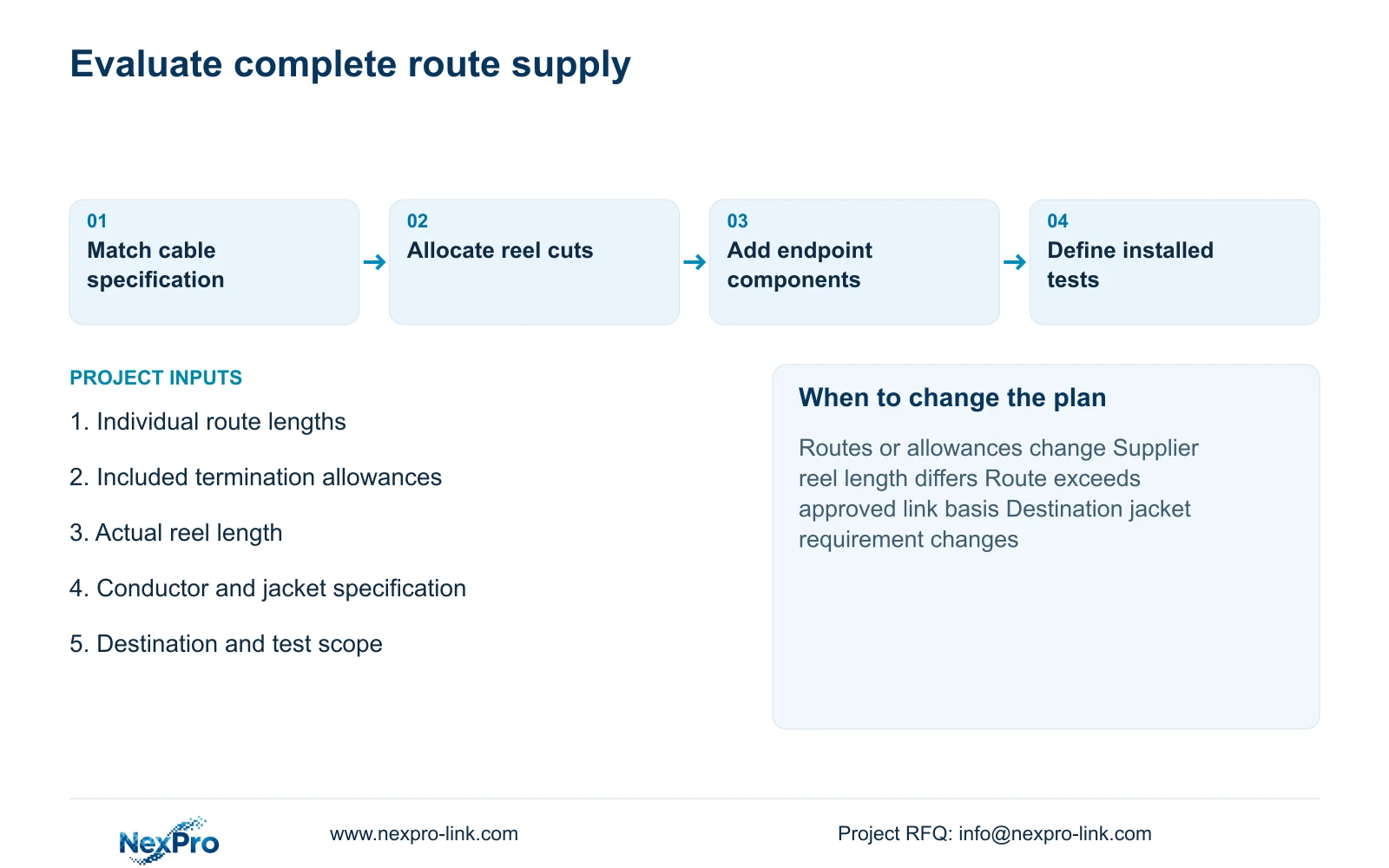
Recommend the eleven-reel plan only for the stated 32 continuous 90m runs and 305m reels, subject to the specified link construction and tests. Change the material plan when measured routes, reel lengths or permitted installation arrangements change. Reconsider the topology when a route exceeds its approved link basis; buying more copper does not resolve a length issue.
Require the offer to identify conductor, category and jacket requirements, destination, endpoint components and testing responsibilities. Cable and accessory warranty scope belongs in the written order and must not be assumed from the main-equipment policy. NexPro-Link can coordinate cabling components and BOQ inputs as part of hotel equipment supply; that does not establish that every supplied category is manufactured in-house.
Email info@nexpro-link.com with the route-length schedule, included termination allowances, proposed reel lengths and destination cable specification. Add the competing offers' termination and testing exclusions. These inputs allow BOQ and tender support to compare a complete scope without requiring unrelated security footage, credentials or a full confidential tender package.
Section 07
Buyer questions
Can we buy ten reels now and use the tails for the last two runs? Not in this example. Every remaining tail is shorter than the required 90m continuous cut. The ten-reel aggregate quantity exceeds 2880m, but the cutting arrangement still cannot complete all thirty-two runs.
Does a Cat6 panel make the entire link Cat6? No. SP5648 identifies a Cat6 patch-panel component. Cable, modules, patch cords, connections and installed-link testing must also match the specified link or channel requirement.
What is enough information for an initial cable comparison? Provide individual route lengths, the allowances already included, actual reel lengths, conductor and jacket requirements, destination, and termination/testing scope. A total metre figure can support an early estimate but cannot establish the final cuts.
Engineering references
These sources support the general planning principles. Always use the selected product's current datasheet and applicable project standards for final design.