Choose a recording-first package for this illustrative 32-camera hotel, with the same 30-day retention and protected recording path in both display options.
Section 01
Set the required recording and outage tasks
Choose the essential recording-first package if one operating screen supports the hotel's incident work. Add the display wall only when sustained observation by several operators justifies its equipment, power and maintenance scope. Both options must preserve the same required public-area views and approved 30-day recording target.
Illustrative project scenario — not a customer installation or measured project result. This illustrative 100-room city hotel has 32 camera tasks. Room count supplies background; it does not determine coverage. Guest-room interiors, toilets and changing spaces are excluded. Public-route views also need boundaries that avoid unnecessary views through open room doors. Audio requires a separate authorized decision even when camera hardware includes it.
Define the outage requirement as an operating state: the required cameras continue sending usable video through protected network nodes to the recorder. Decide separately whether local viewing and remote access must continue. The 30-day policy and the proposed 30-minute battery planning target are scenario choices, not universal hotel requirements.
| Required task | Given information | Decision still needed |
|---|---|---|
| Public-area recording | 32 assigned views | Approve positions and image tasks |
| Routine retention | 30 days continuously | Confirm actual stream profiles |
| Outage operation | Preserve recording path | Approve protected zones and runtime |
Section 02
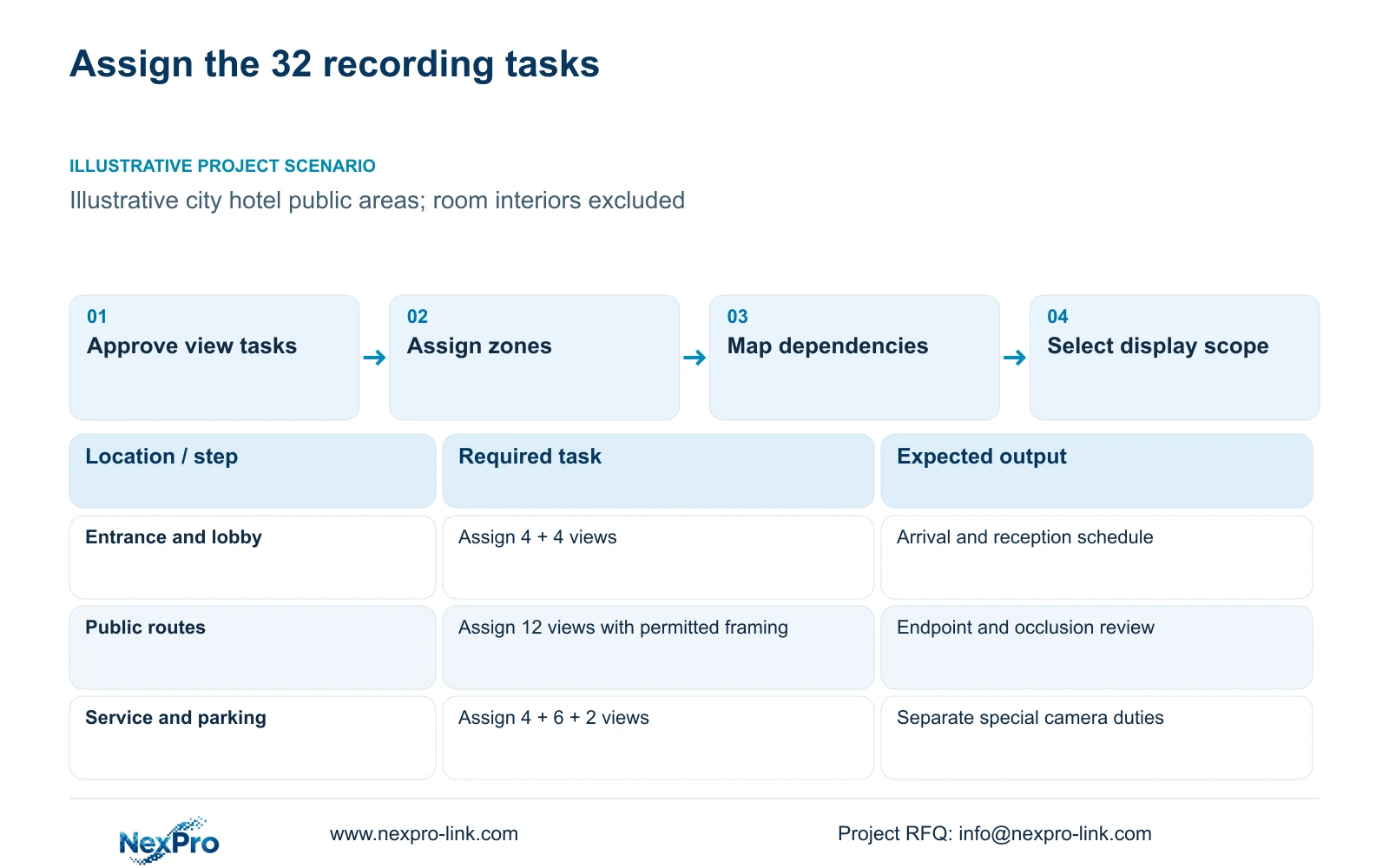
Assign each view to a zone and observation task
The schedule allocates four views to the main entrance, four to lobby and reception, twelve to guest-floor public routes, four to back-of-house areas, six to parking and two to the exterior service route. Entrance views should cover agreed arrival details; lobby views need the required reception activity without unnecessary collection. Corridor endpoints and service handovers require positions that account for occlusion.
The supplied BL2812M and DM2812M PDFs identify NexPro-BL2812M55-5MP-DIC-AI and NexPro-DM2812M55-5MP-DIC-AI as 5MP motorized-varifocal candidates with a 2.8 to 12 mm range. Use adjustment where the permitted framing needs refinement. Select suitable ordinary views elsewhere after checking mounting and maintenance access.
Keep dedicated tasks separate. Human or vehicle detection does not establish number-plate recognition, and a Dome series name does not establish an impact rating. An 8MP substitution also changes the recording-mode review; it cannot inherit the entire 5MP proposal without checking the recorder.
Section 03
Calculate the recording and network envelope
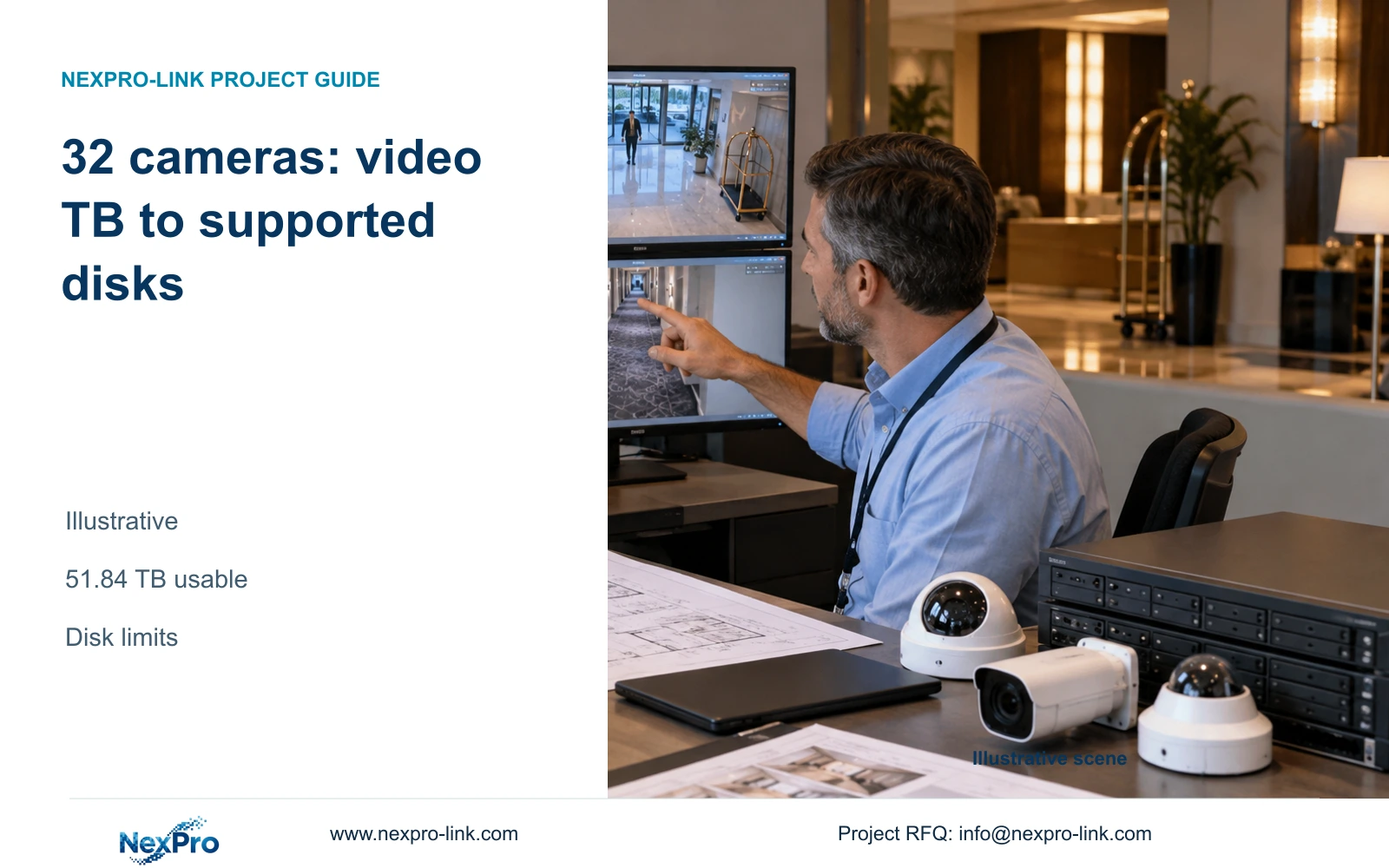
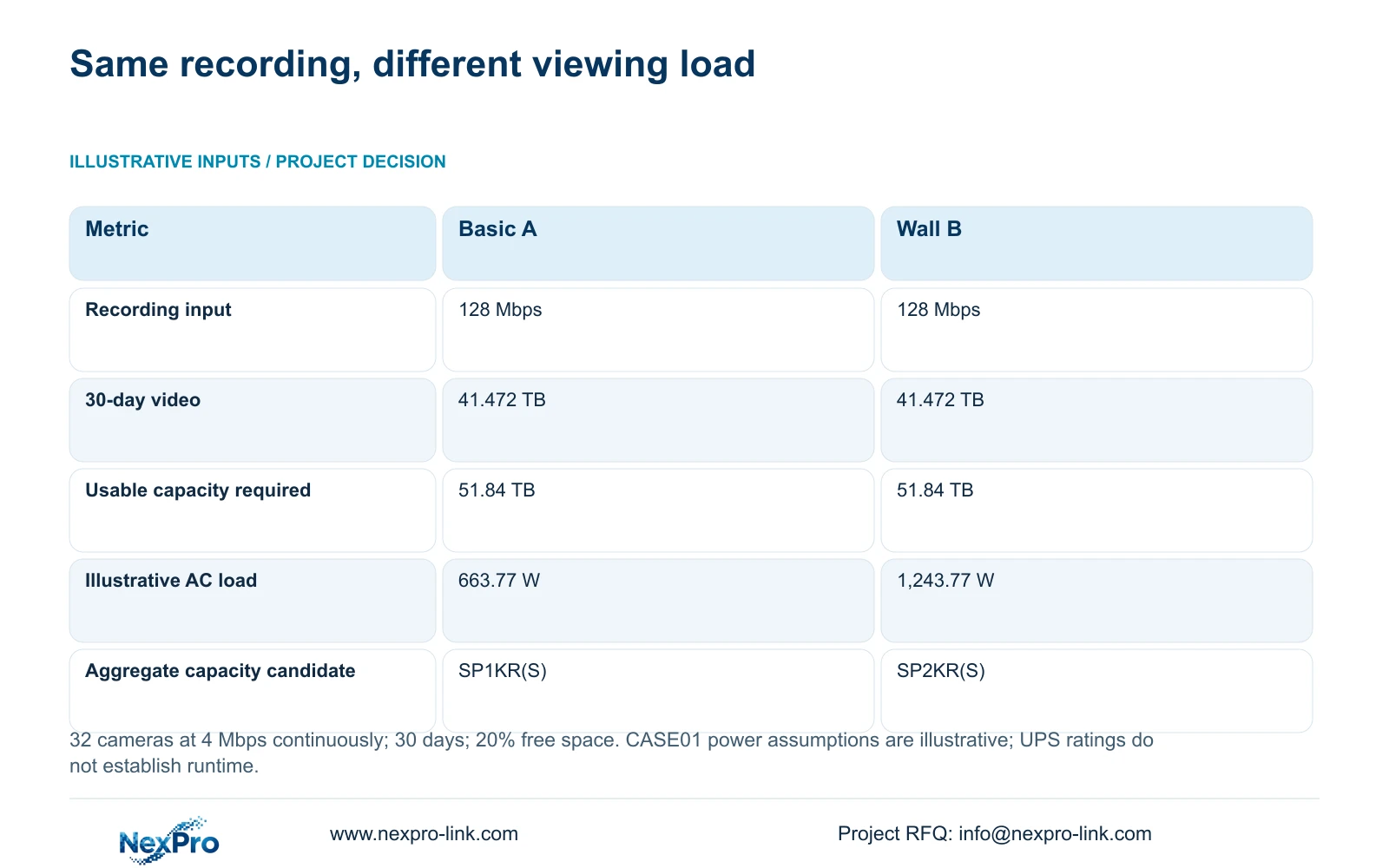
Assume an average 4 Mbps per camera, continuous operation and decimal TB. Input is 32 × 4 = 128 Mbps. Video volume is 0.0108 × 32 × 4 × 30 = 41.472 TB. Retaining 20% of usable capacity free requires 41.472 / 0.80 = 51.84 TB, rather than adding 20% to the payload.
CASE01 examines one NexPro-NVR4449-4K with four 16 TB drives. Its 64 TB raw total becomes 60.8 TB under the illustrative 95% formatting allowance. Keeping 20% free leaves 48.64 TB for video, exceeding the 41.472 TB target and corresponding to 35.19 planning days. This independent-disk example includes no RAID capacity loss.
The product record lists 320 Mbps input and four SATA bays, with up to 18 TB per drive. Recording modes, drive compatibility and playback remain separate checks. Its summary lists 49 × 5MP and 9 × 4K; 49 channels do not establish 49 simultaneous 8MP streams. Each eight-camera access group carries 32 Mbps of recording traffic, or 35.2 Mbps with the case's 10% allowance. Add viewing and export traffic only to links they actually traverse.
| Metric or condition | Essential package A | Enhanced package B |
|---|---|---|
| Recording input | 128 Mbps | 128 Mbps |
| 30-day video data | 41.472 TB | 41.472 TB |
| Required usable capacity | 51.84 TB | 51.84 TB |
| Protected path | Cameras, network and recording | Same path plus selected extras |
| Operator display | Task-sized monitor/workstation | Optional wall; recording independent |
| Cost comparison | Complete scope quotation | Documented incremental scope |
Section 04
Carry protection through PoE nodes and cable routes
Four access nodes each serve eight cameras. At an assumed 12 W device peak, each group needs 96 W at the powered devices. With 90% cable delivery, switch output must supply 106.67 W. A 20% spare-output target raises the required budget to 133.33 W per group. The PDFs do not verify a 12 W maximum.
NexPro SW-POE1618G remains an inquiry candidate: its record lacks total PoE watts and conflicts between the Gigabit title and detailed 10/100 Mbps access-port description. Confirm both the individual-port capability and total output. The case estimates complete switch AC input using 92% conversion efficiency and 20 W own consumption per node. Adding recorder, core network and ordinary screen gives 663.77 W, or 737.52 VA at PF 0.9. Do not add the cameras again.
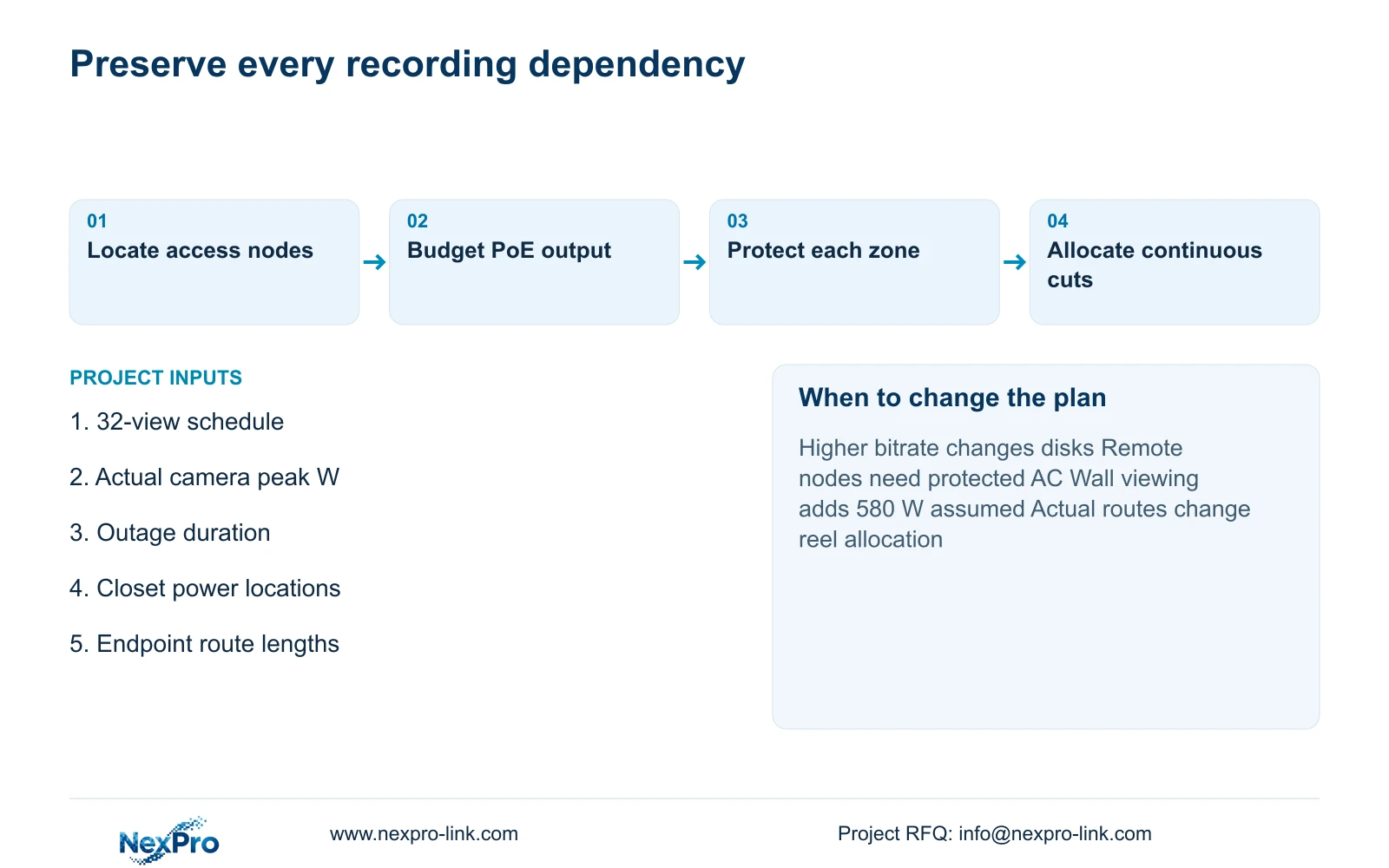
CASE01's 32 continuous CAT6 routes total 1,826 m, including termination allowances. Its feasible seven-reel plan uses 305 m reels and leaves 309 m in separate tails. These routes differ from a uniform-length cable example and must retain their own cut allocation. SP5648 is a patch panel and DT968MX a module; neither identifies bulk cable.
| Reel | Cuts in metres | Tail in metres |
|---|---|---|
| 1 | 78 + 78 + 78 + 68 | 3 |
| 2 | 78 + 78 + 78 + 68 | 3 |
| 3 | 68 + 68 + 68 + 68 | 33 |
| 4 | 58 + 58 + 58 + 58 + 58 | 15 |
| 5 | 58 + 48 + 48 + 48 + 48 + 48 | 7 |
| 6 | 48 + 48 + 38 + 38 + 38 + 38 + 38 | 19 |
| 7 | 38 + 38 | 229 |
Section 05
Price the viewing upgrade without changing retention
Option B adds an assumed four panels at 120 W each and a 100 W decoder, increasing protected load by 580 W to 1,243.77 W and 1,381.96 VA. To retain the case's 20% W and VA reserve, the aggregate capacity candidate changes from SP1KR(S), rated 1 kVA/900 W, to SP2KR(S), rated 2 kVA/1800 W. Actual distributed protection requires sizing each zone.
Capacity does not establish runtime. The basic 30-minute nominal-energy estimate is 663.77 × 0.5 / (0.90 × 0.80) = 460.95 Wh. Use a supported battery configuration and load curve for selection. This figure is not an installed battery specification.
NX-VP-5535 is a 55-inch Full HD LCD panel, not direct-view LED. A suitable two-by-two signal arrangement provides a nominal 3840 × 2160 canvas. Compare viewing distance and service access with a single operating monitor before buying the wall; recording should continue when the optional display is off.
Section 06
Turn the reference into a scoped equipment inquiry
Request the 32-view schedule, recorder and supported disks, four access-node budgets, protected power by location and a route-based cabling package. Separate the optional display, mounting and decoder scope. Revise the package if actual bitrate, environmental duties or mandatory operator platforms invalidate the assumptions.
NexPro-Link can discuss model matching, BOQ support and coordinated supply. Its CCTV manufacturing core and associated equipment coordination should remain distinct in the proposal. Local installation and third-party integration require explicit responsibility. The supplied policy record gives applicable main equipment a 24-month limited hardware baseline from receipt; batteries, disks, cables and OEM terms follow their scoped order records.
Send public-area drawings or the camera schedule, retention and outage targets, and destination to info@nexpro-link.com. Include mandatory platform requirements and whether alternatives are permitted. Hotel project equipment support and BOQ and tender support provide the relevant inquiry routes.
Section 07
Buyer questions
Why consider a 49-channel recorder for 32 cameras? The disk arrangement and supported recording profile can control selection before channel count does. Confirm the exact drives and replay workload; unused channels alone do not justify the purchase.
Can the display wall be omitted from outage protection? Yes, if the approved outage task requires recording without continuous wall viewing. Keep the camera, access-network and recorder power paths protected, and identify any local screen still needed for operation.
What should the first quotation leave provisional? Unconfirmed camera peak power, battery runtime, switch output and actual cable routes should be identified as provisional inputs. A quotation should state how each affects equipment quantity or configuration.
Engineering references
These sources support the general planning principles. Always use the selected product's current datasheet and applicable project standards for final design.
- N01: Hotel & Hospitality Project Supply
- N02: BOQ & Tender Support
- N04: NexPro-NVR4449-4K
- N05: NexPro SW-POE1618G
- N07: Structured Cabling
- N09: Rack Online UPS
- N10: Video Wall and Decoder System
- N14: Warranty Policy
- Supplied NexPro BL2812M 5MP/8MP product specification
- Supplied NexPro DM2812M 5MP/8MP product specification