Upgrade an operating hotel's CCTV by testing reusable paths, proving a complete IP recording chain and moving each zone within an agreed cutover window.
Section 01
Decide which operating functions to retain
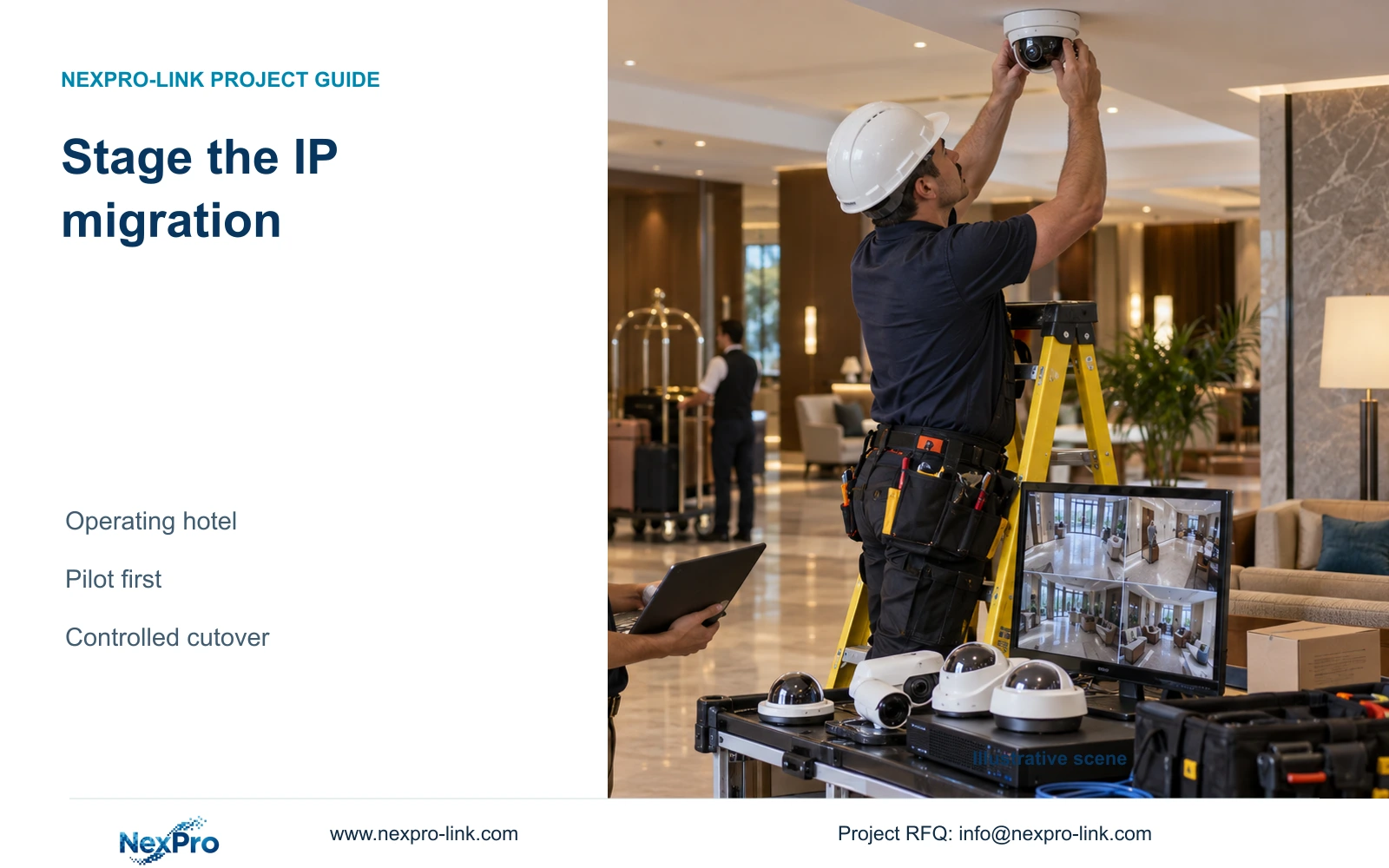
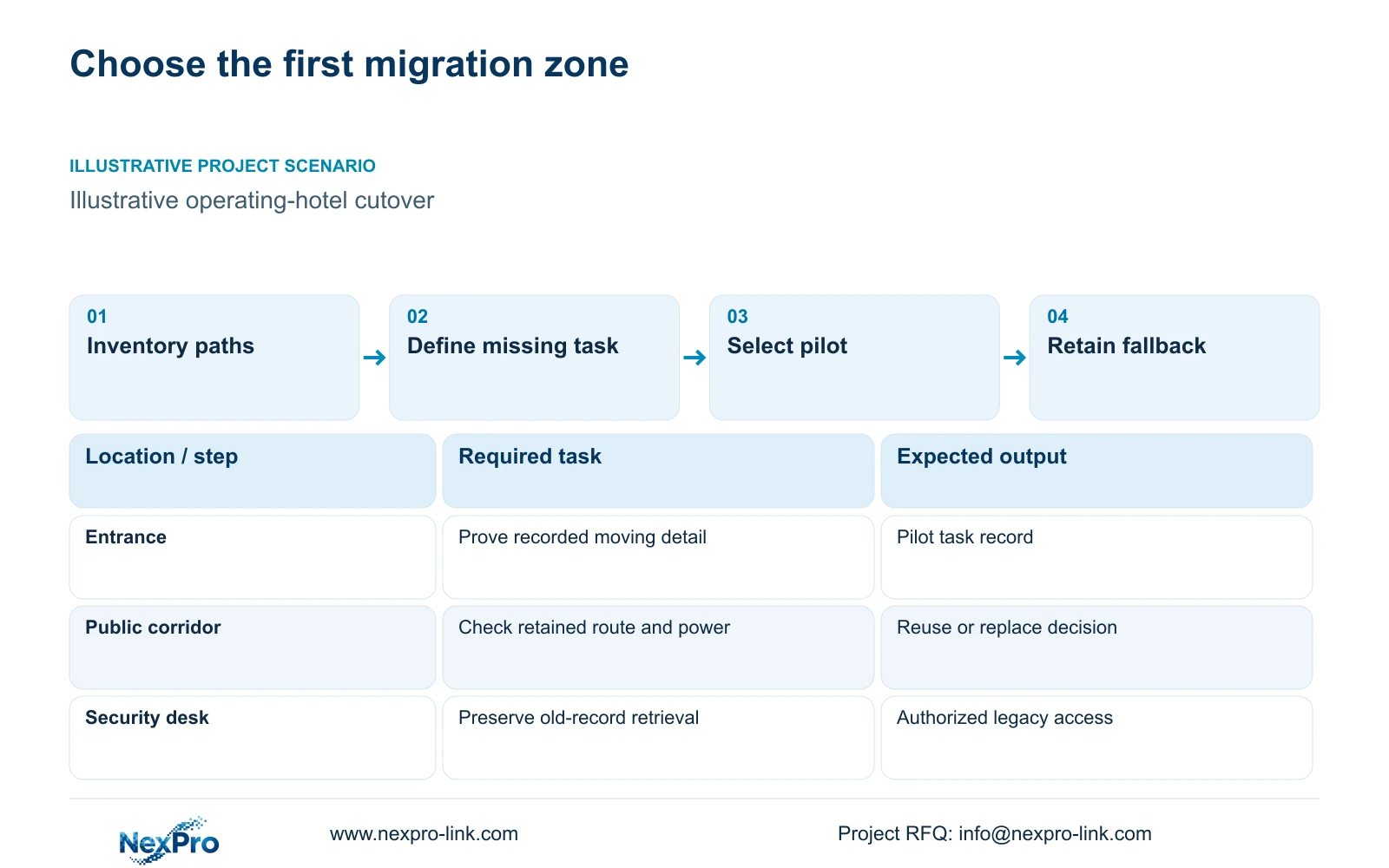
Choose a staged analog-to-IP migration when the hotel must keep required public-area monitoring and retrieval available during renovation. Inventory the working system, prove one representative IP recording path, then release zones for controlled cutover with an agreed fallback. Replace a retained path when its condition, interfaces or operating results cannot support the new task.
Record each camera position together with its observation purpose, cable route, power source and recording destination. Include the recorder model, configured image modes, disk arrangement and the people authorized to retrieve footage. A working preview establishes only that a view is presently available; it does not establish the suitability of the cable or the ability to export an incident.
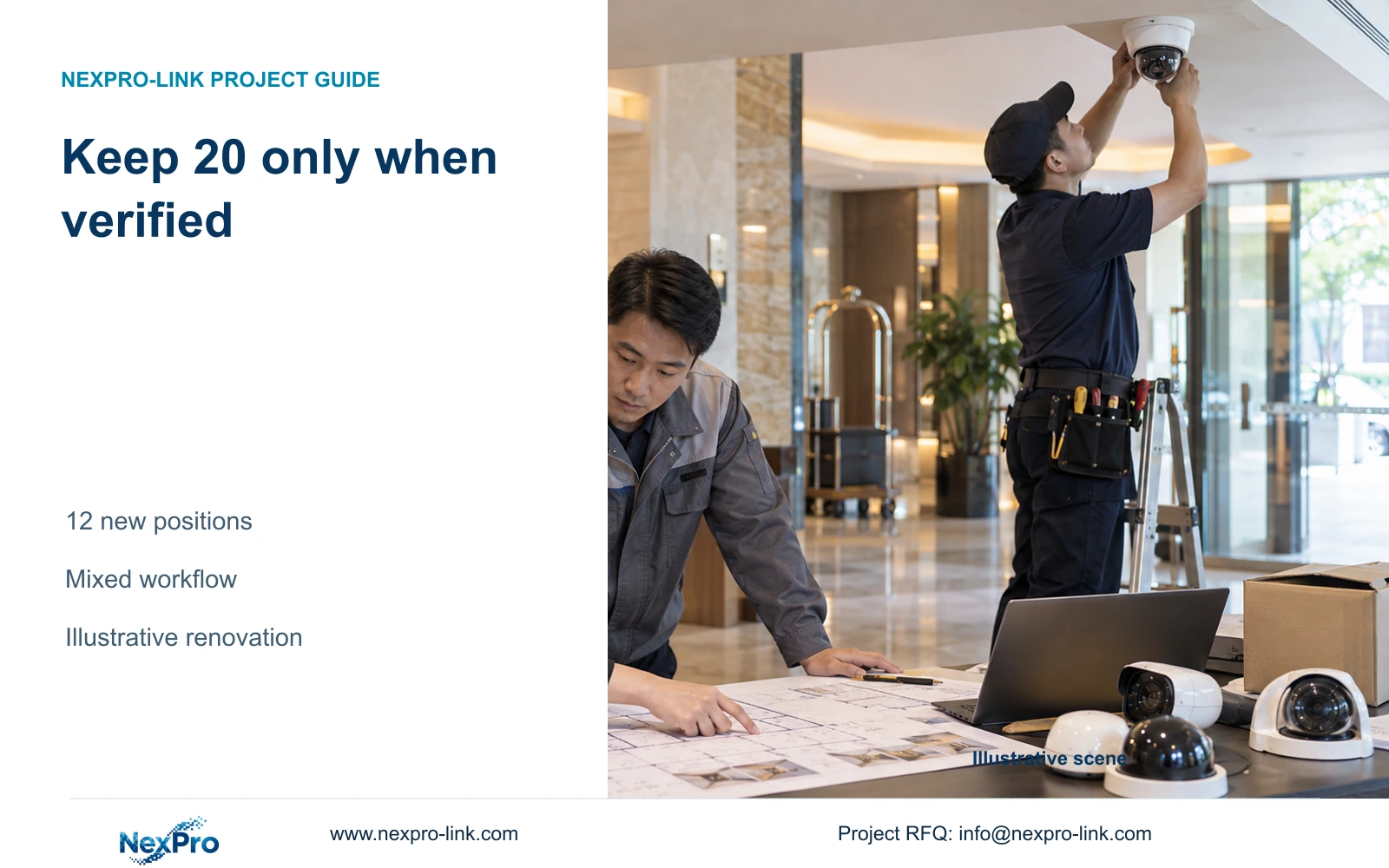
The illustrative CASE07 renovation has 20 retained public-area positions and 12 proposed gap-filling positions. Those figures describe a teaching layout. They do not establish that 20 analog devices can connect directly to a proposed IP recorder, and they are unrelated to the hotel's room count. Assign every retained device a tested role before treating it as an avoided purchase.
| Required task | Given information | Decision still needed |
|---|---|---|
| Entrance incident retrieval | Existing view produces video | Prove recorded detail and export |
| Public-route recording during outage | Recorder has backup power | Identify camera and network power dependencies |
Section 02
Define the improvement before selecting replacements
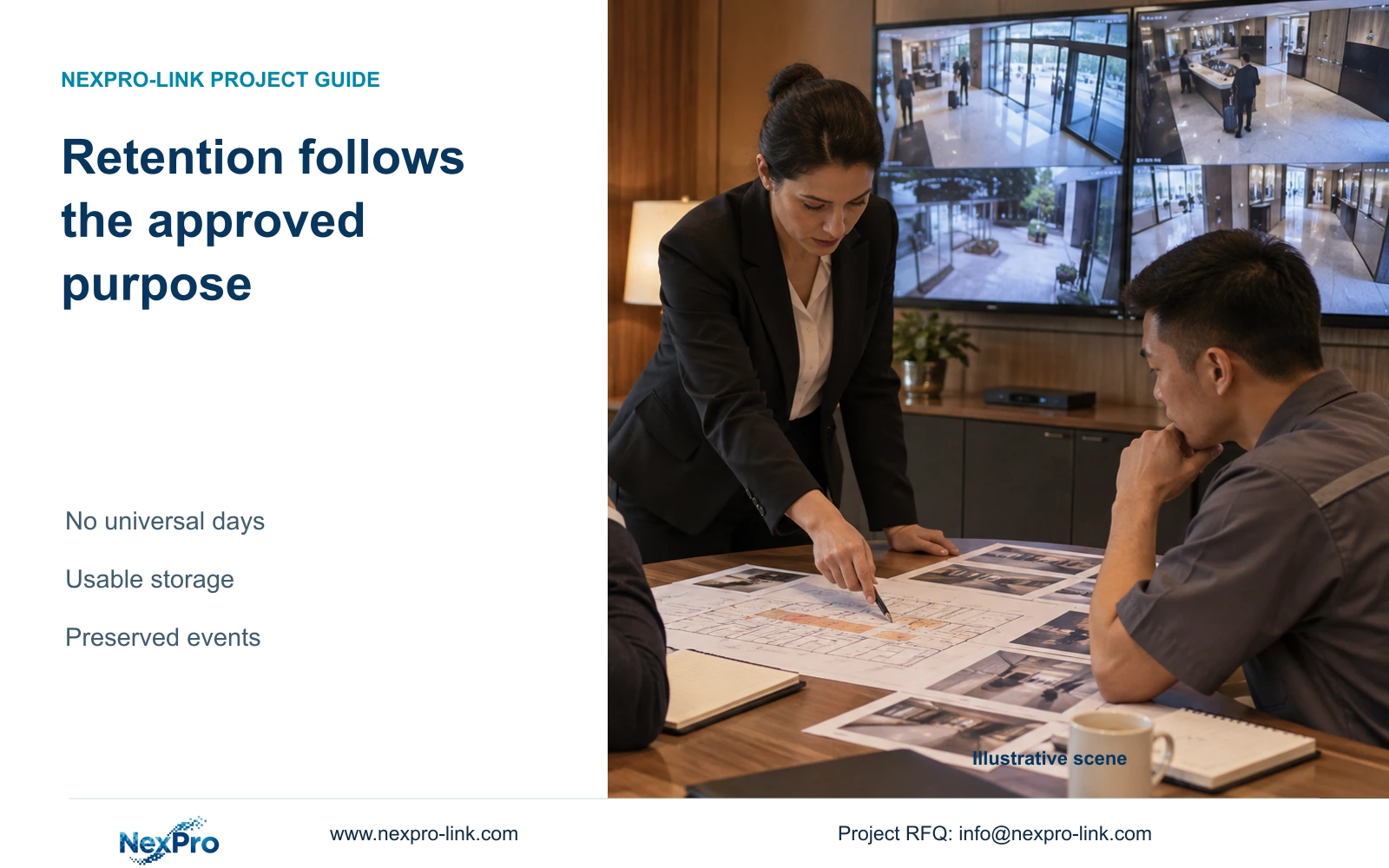
Describe each deficiency as an operating task. An entrance may need usable moving detail, while a service corridor may need a separate view around an obstruction. Specify the required recording hours, approved retention and retrieval workflow. This gives the designer a basis for deciding whether adjustment, an additional point or replacement equipment is necessary.
Keep improvements to viewing separate from improvements to recording. A larger display can help operators inspect an event, but it cannot restore detail missing from the recorded stream. Similarly, remote access does not establish cloud storage or continued recording during a local power failure.
The BL2812M product PDF identifies NexPro-BL2812M55-5MP-DIC-AI as a PoE camera with a 2.8-12 mm motorized lens and a listed 2880×1620 main-stream mode. These fields support a candidate selection for adjustable framing. They do not supply a verified maximum power value, demonstrate night performance or establish compatibility with the retained management platform.
| Item | Retain and adjust | Replace or add | Hotel effect |
|---|---|---|---|
| Camera position | Keep if task is achieved | Change for a documented blind spot | Coverage follows the layout |
| Operator display | Use suitable existing workstation | Add wall for defined viewing duties | Recording remains independent |
Section 03
Compare reused paths with new cabling
Trace the installed media before choosing reuse. An analog cable path is not automatically an Ethernet and PoE path. Any proposed conversion equipment needs its own supported media, distance, power and interface conditions. Compare that complete arrangement with new cabling, including maintenance access and the consequences of an extra active device.
Draw video traffic and protected power separately. A remote switch may provide the camera's PoE supply while depending on a different local electrical circuit. A fiber backbone carries data and does not automatically protect that remote power source. Price the enclosure, backup supply and local work wherever the proposed topology introduces a new dependency.
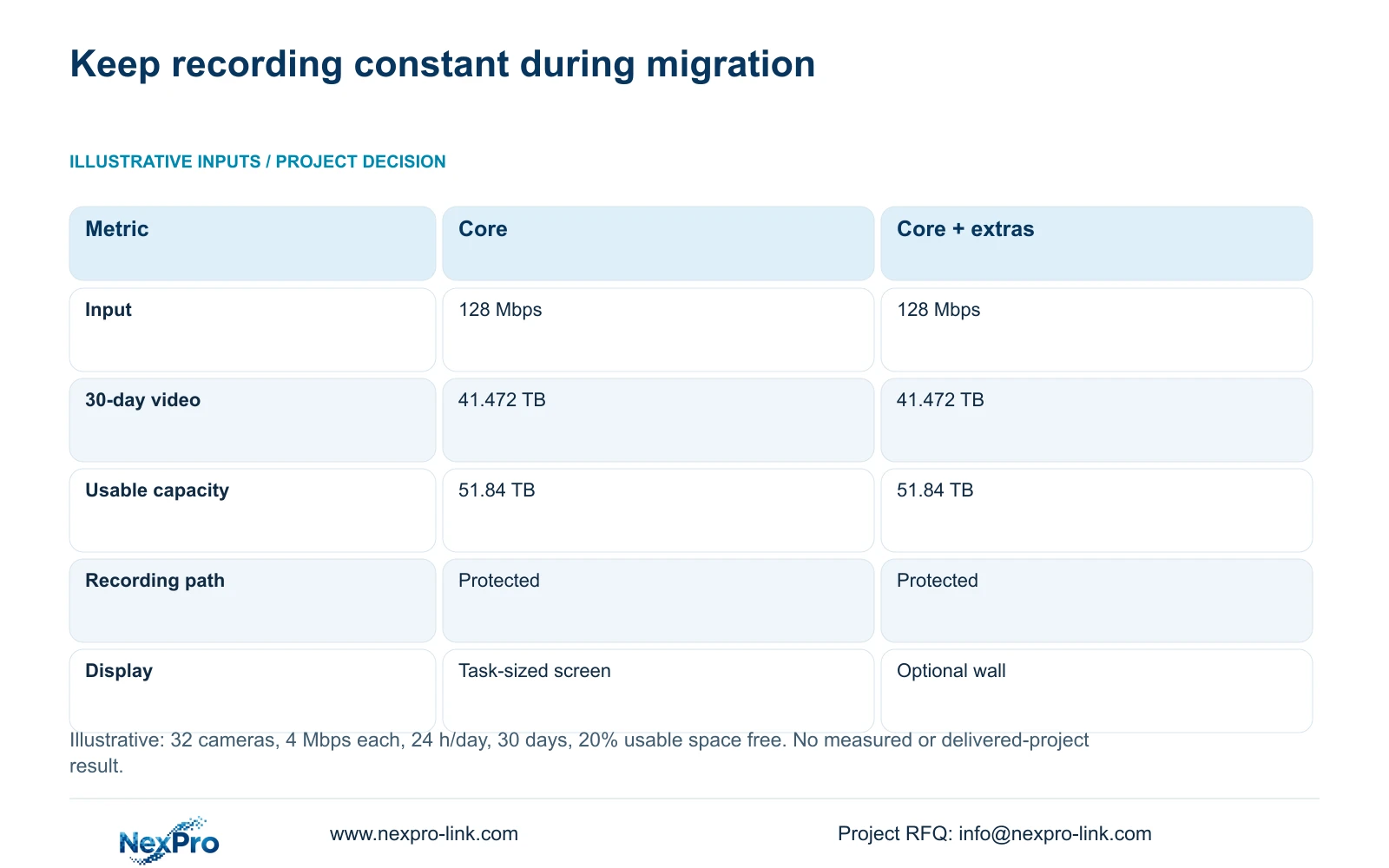
Use the same recording requirement for both infrastructure options. In the following independent teaching calculation, 32 cameras average 4 Mbps each, record continuously for 30 days and retain 20% of usable space free. Input is 32×4 = 128 Mbps. Video data is 0.0108×32×4×30 = 41.472 decimal TB; required usable space is 41.472/0.80 = 51.84 TB. These assumptions are not measured camera outputs or legal retention requirements.
| Metric / condition | Essential recording-first package | Same core plus optional display/recovery |
|---|---|---|
| Recording input | 128 Mbps | 128 Mbps |
| 30-day video data | 41.472 TB | 41.472 TB |
| Required usable capacity | 51.84 TB | 51.84 TB |
| Protected path | Cameras + network + recording | Same plus selected extras |
| Operator display | Task-sized monitor/workstation | Optional wall; independent recording |
| Cost comparison | Complete scope quotation | Documented incremental scope |
Section 04
Build a pilot that records and retrieves
Select a pilot zone that represents the migration's difficult condition, such as an entrance with changing light or a remote access node. Include the actual cable arrangement, proposed camera, switch, recorder and authorized client. Review recorded movement, incident search and export using the intended configuration.
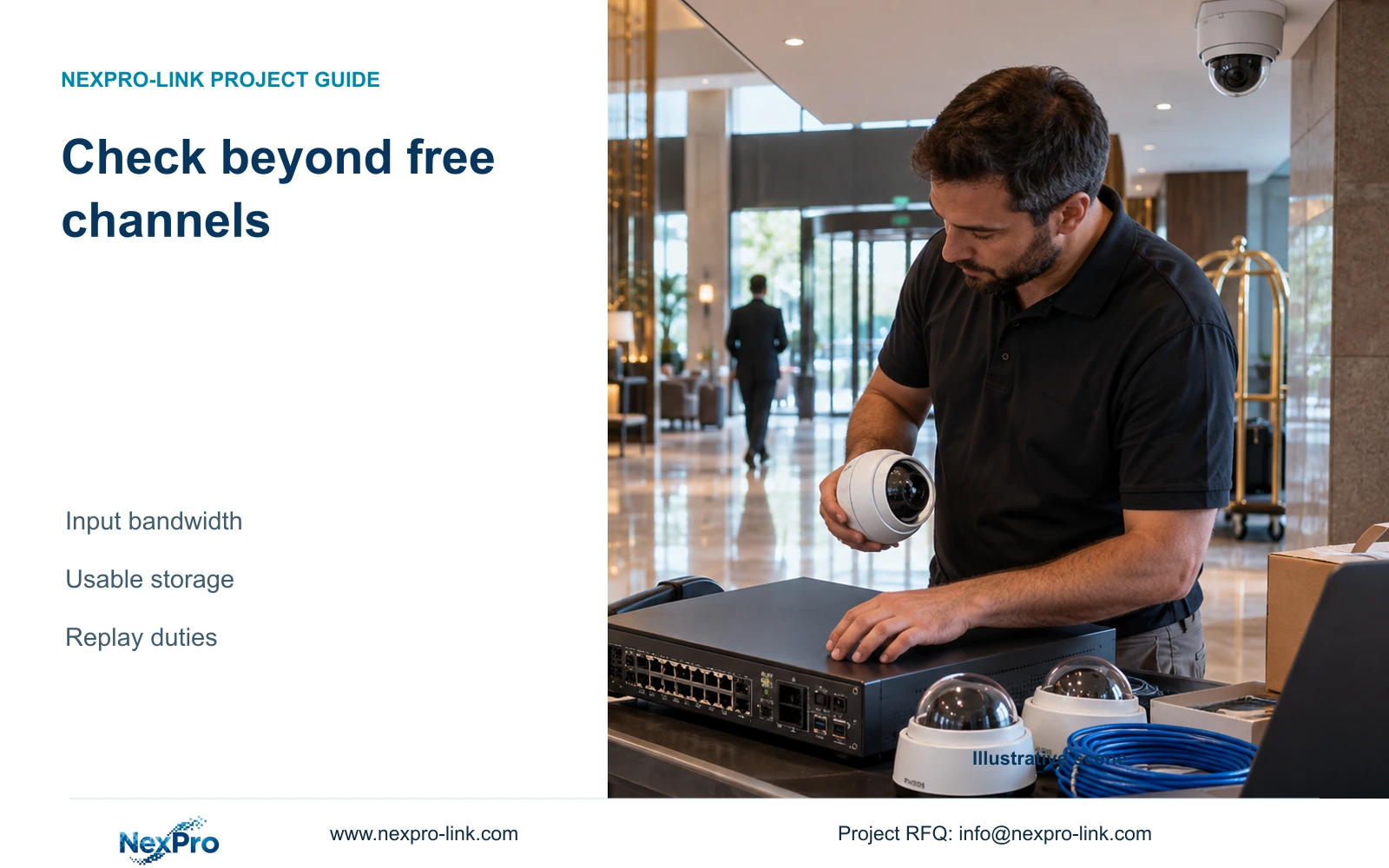
The calculation establishes a common storage target for the two packages. It does not prove that a pilot recorder supports every proposed image mode. NexPro-NVR4449-4K lists 49 channels, 320 Mbps input and four SATA positions with an 18 TB per-drive field. Its summary lists 49×5MP/9×4K, so the channel count cannot establish support for 49 arbitrary 8MP streams.
Record unresolved behavior against a specific task, configuration and responsible party. Repeat the same test after correction. A successful pilot supports the conditions observed; it does not establish every retained camera's compatibility or a zero-interruption migration.
Section 05
Schedule controlled zone cutovers
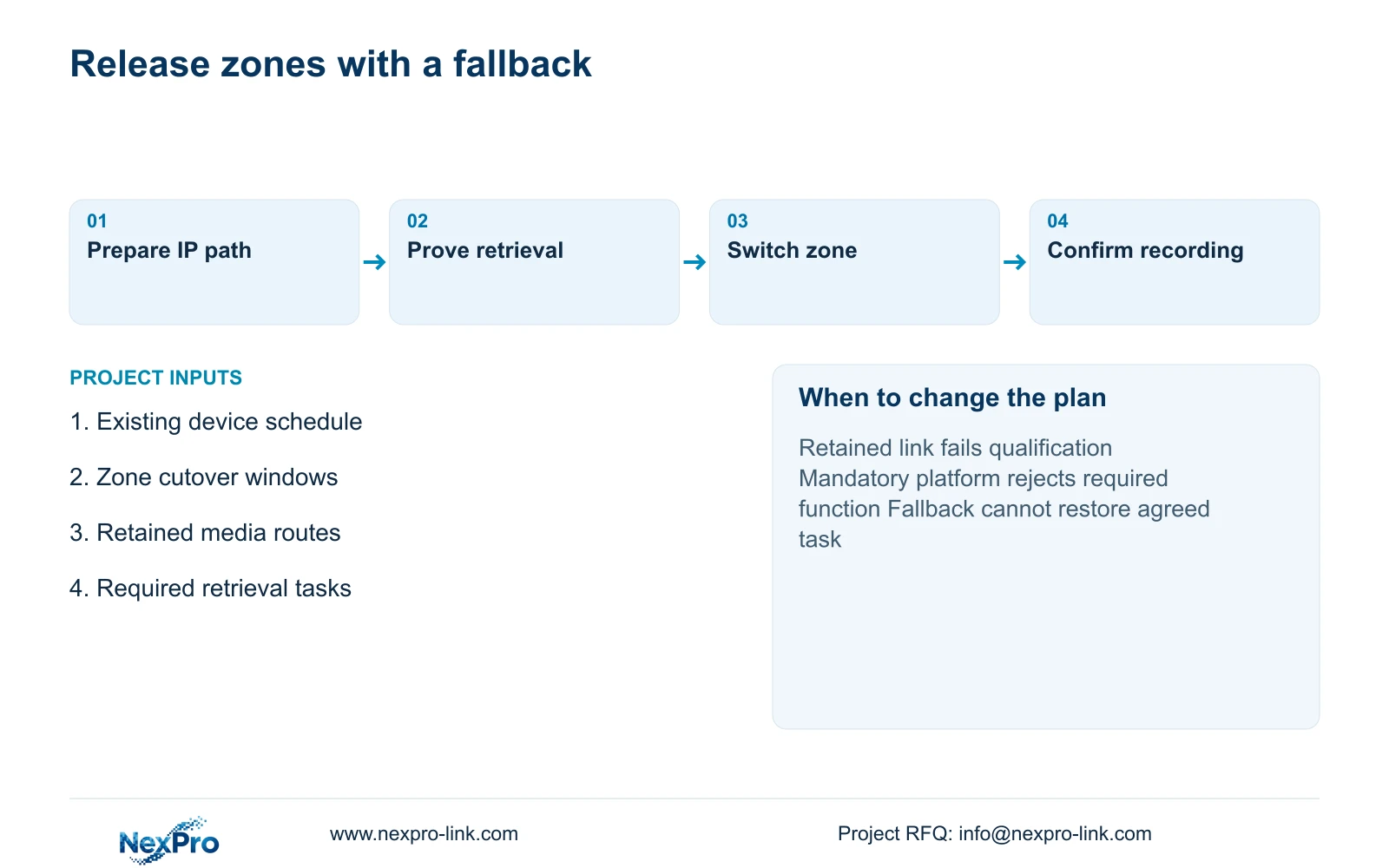
For each zone, agree who authorizes the interruption, who changes connections and who confirms recording afterward. State the permitted window and the condition that triggers fallback. Keep the old retrieval route available for records the hotel still needs, subject to its approved access and retention arrangements.
Prepare equipment and configuration before disconnecting the operating path. Where supported and practical, parallel recording can help the team compare results before transfer. It creates additional temporary scope and does not guarantee uninterrupted coverage. The installer must identify which views are unavailable during each physical change.
Separate procurement readiness from site readiness. Equipment can arrive while cable routes, IT access or work permits remain unresolved. Release the next zone only after the preceding zone's required tasks are demonstrated and the hotel accepts the remaining limitations.
| Retained outcome | Extra scope | When useful | Counter-condition |
|---|---|---|---|
| Old-record retrieval | Authorized legacy access | Needed records remain on old system | Approved retention has ended |
| Pilot fallback | Temporary parallel path | Reconnection is practical and authorized | Old path cannot meet the minimum task |
Section 06
Calculate and quote the complete migration
Issue a zone-based BOM covering cameras, recording, disks, access nodes and the necessary power path. Calculate PoE per switch and UPS W/VA per protection zone. Do not add downstream camera power again when a complete switch AC input already includes it. Quote cable testing, conversion equipment and local installation separately from supplied hardware.
Recommend the essential recording-first package after the pilot confirms its interfaces and operating tasks. Add display or recovery scope only for a defined duty. Revise the arrangement if retained links fail, mandatory platform requirements prevent integration or measured streams exceed the planned capacity. NexPro-Link can support model matching and coordinated supply; local installation and third-party integration remain explicit proposal boundaries.
Send the existing equipment schedule, the blocking upgrade tasks and allowed zone cutover windows to info@nexpro-link.com through the hotel project or BOQ support route. Include the destination and any mandatory platform. Passwords and guest footage are unnecessary for an initial scope review.
Section 07
Buyer questions
Can an existing live image prove compatibility with the new system? No. Verify the required recording mode, retrieval, export and supported client behavior using the exact retained device and proposed configuration. ONVIF Profile matching is a starting point for relevant functions, not proof of full platform interoperability.
Can we request a proposal before every route is surveyed? Yes. Identify confirmed and provisional routes separately. NexPro-Link can discuss a scoped equipment proposal with unresolved quantities visible; those quantities should be confirmed before purchasing the affected materials.
Does technical support include hotel-site attendance? Site attendance, local labor and restoration duties need their own agreed scope. The supplied policy records a receipt-based 24-month limited hardware baseline for applicable main equipment; accessories and order-specific terms remain separate.
Engineering references
These sources support the general planning principles. Always use the selected product's current datasheet and applicable project standards for final design.