Free recorder channels do not establish capacity for additional 8MP cameras. Identify the first limit across recording, storage and operator tasks.
Section 01
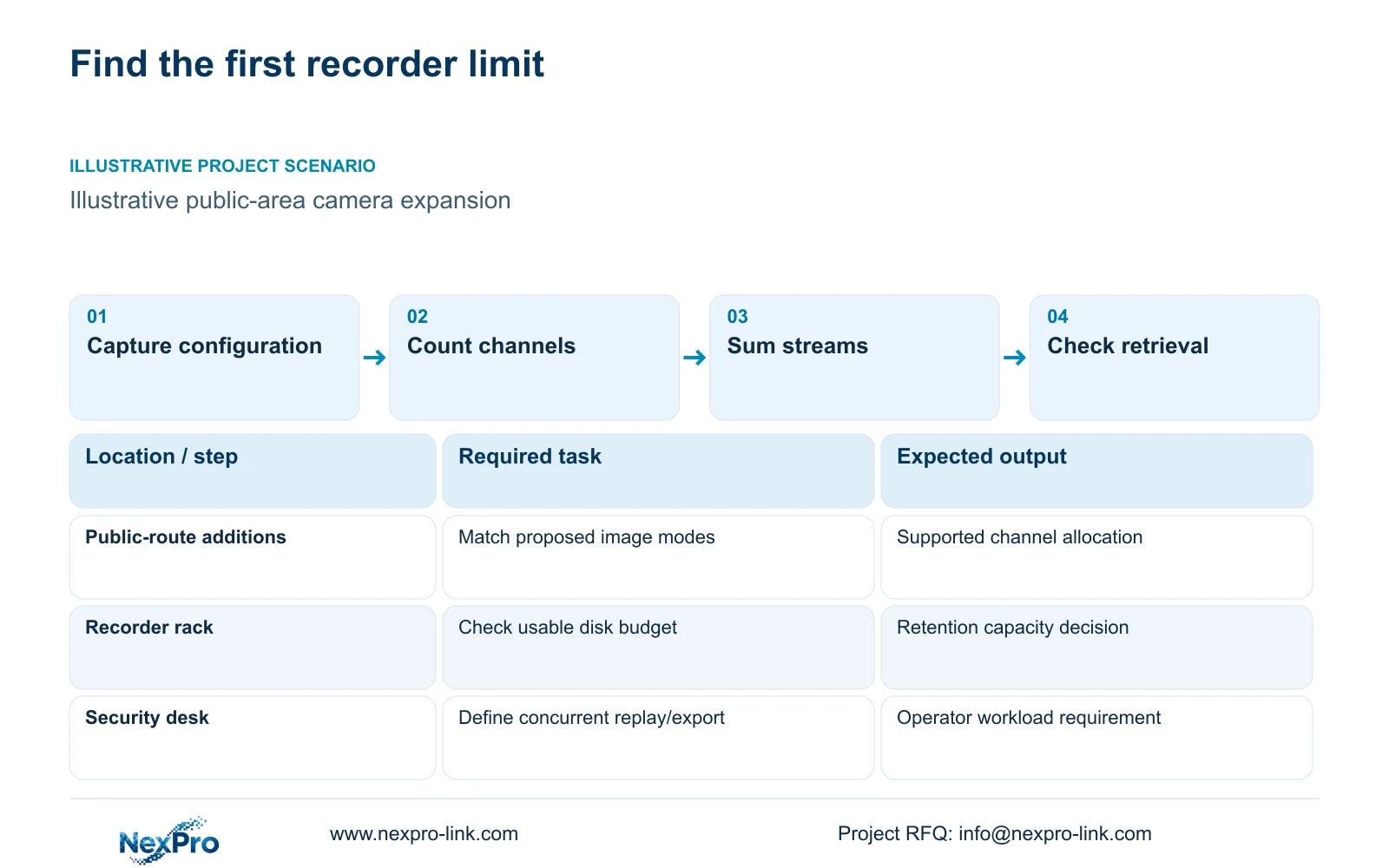
Establish the recorder's current operating limits
Add cameras to an existing hotel NVR only when the revised configuration meets channel, input-bandwidth, image-mode, storage and retrieval requirements together. Upgrade the resource that reaches its limit first. A free channel does not establish support for an arbitrary 8MP recording profile.
Capture the exact recorder model and firmware alongside the connected camera schedule. For each stream group, record resolution, frame rate, codec, recording hours and the bitrate basis used for planning. Identify whether a value is configured, measured or assumed so the buyer can judge the uncertainty.
Record the installed drives, their capacities and the actual usable recording space. Include any array arrangement or dedicated spare. A disk-bay count and a maximum per-drive label describe different constraints from the capacity available to footage.
Review the operator's current incident workflow as part of the baseline. The hotel may need concurrent replay, live viewing and export while recording continues. Preserve those duties in the expansion proposal instead of accepting new cameras solely because they appear in a live grid.
| Required task | Given information | Decision still needed |
|---|---|---|
| Record proposed image modes | Exact NVR identity | Supported mode and firmware scope |
| Retain approved footage | Installed disk labels | Usable space and recording budget |
| Retrieve incidents | Existing client workflow | Required concurrent replay/export |
Section 02
Count free channels without assigning other capacity
Calculate available channels from the supported configuration and the devices already allocated to it. Then assign the proposed additions by zone and observation task. Spare positions on a channel list should remain separate from bandwidth headroom and storage allowance.
The supplied CASE07 teaching renovation contains 20 retained positions and 12 proposed positions, totaling 32. It illustrates how a mixed scope can be assembled, but does not prove that an unknown existing recorder accepts those devices. Retained cameras require their own functional compatibility checks.
Published specifications illustrate the distinction. NexPro-NVR4449-4K lists 49 channels and 320 Mbps input, while its summary lists 49×5MP/9×4K. The 49-channel field cannot be rewritten as support for 49×8MP. A proposed 8MP addition needs an explicit recording-mode check.
NexPro-NVR8864-4K lists 64 channels and the same 320 Mbps input field. More channel positions therefore do not, by themselves, provide a higher published input allowance. Compare the exact resource the hotel needs to expand.
Section 03
Calculate the revised incoming traffic
Sum the incoming recording streams by group. For a mixed installation, retain the existing group's rate and add the proposed group's rate separately. Do not derive bitrate from megapixels alone or assume every camera operates at the same average.
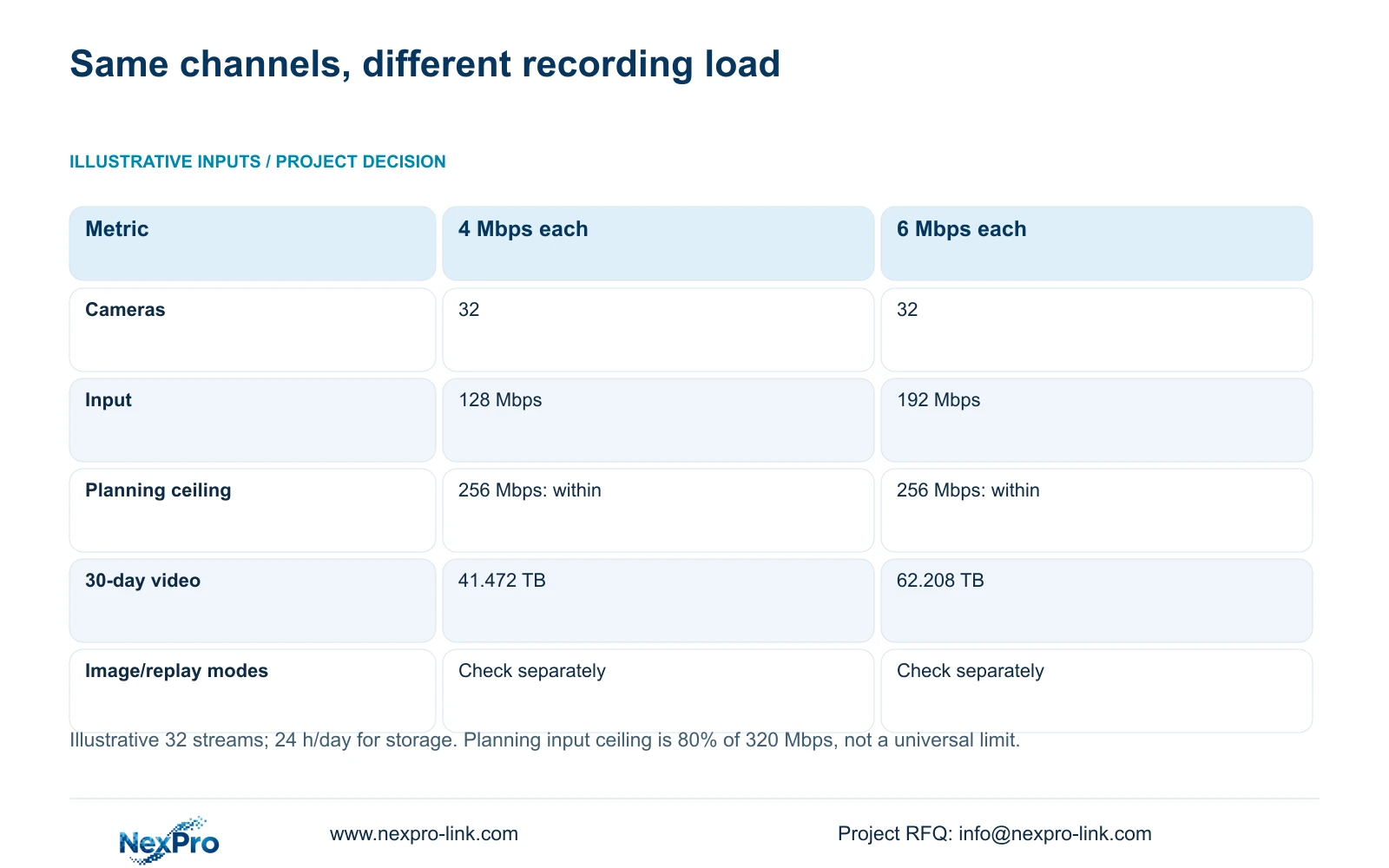
The independent teaching comparison uses 32 streams at either 4 or 6 Mbps each. Aggregate input equals camera count×average Mbps, giving 128 or 192 Mbps. An illustrative planning ceiling of 80% of a 320 Mbps published input field is 256 Mbps. The 80% ceiling is a stated design assumption, not a product limitation or universal rule.
Both profiles remain below that ceiling. This result permits the team to continue checking the remaining constraints; it does not establish supported resolution, concurrent decode performance or the disk arrangement. The higher-rate profile also changes retention demand even though the channel count is identical.
Calculate network links from their actual flows. Recording input at the NVR and traffic on a shared uplink are related but different boundaries. Include viewing or export on a link only when those flows traverse it.
| Metric / condition | 4 Mbps per camera | 6 Mbps per camera |
|---|---|---|
| Cameras | 32 | 32 |
| Aggregate video input | 128 Mbps | 192 Mbps |
| 256 Mbps planning ceiling | Within | Within |
| 30-day video data | 41.472 TB | 62.208 TB |
| Modes, decoding and disks | Separate model checks | Separate model checks |
Section 04
Check storage and concurrent replay
For continuous 30-day recording, decimal video TB equals 0.0108×camera count×average Mbps×days. The two profiles produce 41.472 and 62.208 TB. If the project retains 20% of usable capacity free, divide each result by 0.80. The higher bitrate must earn its additional capacity through the required recorded detail.
List raw capacity, array capacity and formatted usable capacity separately. Exclude a dedicated hot spare from the video budget. Do not assume that a statement such as RAID-ready establishes a particular supported level or performance during rebuilding.
CASE07 independently illustrates four 16 TB drives, 64 TB raw and a hypothetical 95% formatted fraction. After its 20% reserve, 48.64 TB remains for video, sufficient for its 41.472 TB teaching target. That arrangement cannot inherit adequacy for the separate 62.208 TB profile.
Specify simultaneous replay windows, the image modes used for them and whether export continues alongside viewing. NVR input, local decoding and workstation decoding have different limits. A recorder accepting all streams can still require a different client layout for incident work.
Section 05
Compare recorder expansion against the limiting resource
Retain the recorder if all revised duties fit its supported configuration. Consider a storage change when disk capacity controls the result and the recorder supports the intended arrangement. Consider replacement or a second recorder when input, image modes or channel allocation cannot be satisfied.
NexPro-NVR4449-4K lists four SATA positions and NexPro-NVR8864-4K lists eight, both with an 18 TB per-drive field. These facts support a disk-position comparison. They do not establish usable capacity, a particular RAID level or full concurrent playback behavior.
The supplied NexPro-NVR2232-4K record contains conflicting 2×8 TB and 2×18 TB/36 TB capacity fields, with differing playback descriptions. Keep the conflict visible in procurement review; do not select the larger value to make an expansion appear suitable.
Distributed recording changes retrieval locations, maintenance windows and the scope of a recorder failure. Include protected power and client access for the second unit. An extra recorder is useful only when the resulting operation remains manageable for the authorized hotel team.
| Retained outcome | Extra scope | Worth buying when | Counter-condition |
|---|---|---|---|
| Approved retention | Supported disk arrangement | Storage alone is limiting | Required layout is unsupported |
| Required recording modes | Replacement or second NVR | Existing recorder cannot accept them | Existing unit meets every duty |
Section 06
State the supported addition scope
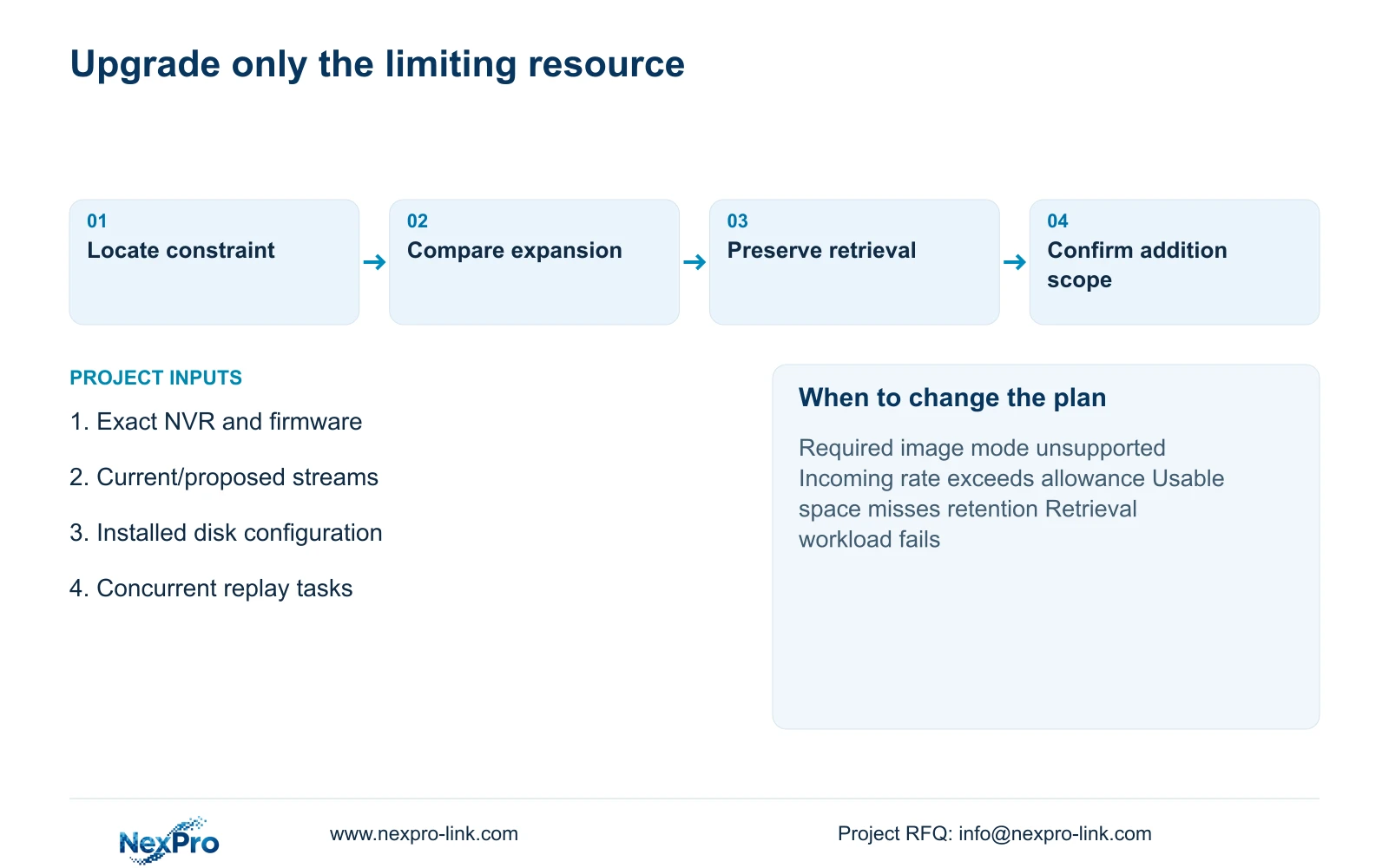
Write the approved addition as a configuration: camera groups, recording modes, bitrate allowance, retention and replay duties. State which existing components remain and which require replacement. Include the conditions that invalidate the proposal, such as a higher measured stream rate or a newly required image mode.
Recommend retaining the existing NVR only after these checks support the complete revised task. Change the proposal at the first unsatisfied constraint, preserving the operator's required retrieval and export workflow. Assign hotel security, IT and installer responsibilities separately; a shared interface does not justify shared administrator access.
Send the exact NVR identity, current and proposed stream schedules, disk configuration and concurrent replay requirement to info@nexpro-link.com. Include the permitted cutover window. NexPro-Link's BOQ support can help map candidate equipment and supply scope without assuming third-party compatibility or local installation is included.
Section 07
Buyer questions
Should we lower bitrate to avoid replacing the recorder? Only if the resulting recorded detail still meets the hotel task. Compare representative recordings before accepting the lower profile, then recalculate storage and input. Capacity compliance alone does not justify losing necessary image detail.
Will a 64-channel recorder provide more bandwidth than a 49-channel recorder? Not necessarily. The supplied NexPro-NVR8864-4K and NexPro-NVR4449-4K records both list 320 Mbps input. Their channel and disk-position differences must be evaluated separately.
Can old cameras be retained on a new NVR? Treat them as a tested mixed-device scope. Verify recording, retrieval and required events on the exact configuration. Relevant ONVIF Profiles can inform that review, but do not establish all client or cloud functions.
Engineering references
These sources support the general planning principles. Always use the selected product's current datasheet and applicable project standards for final design.