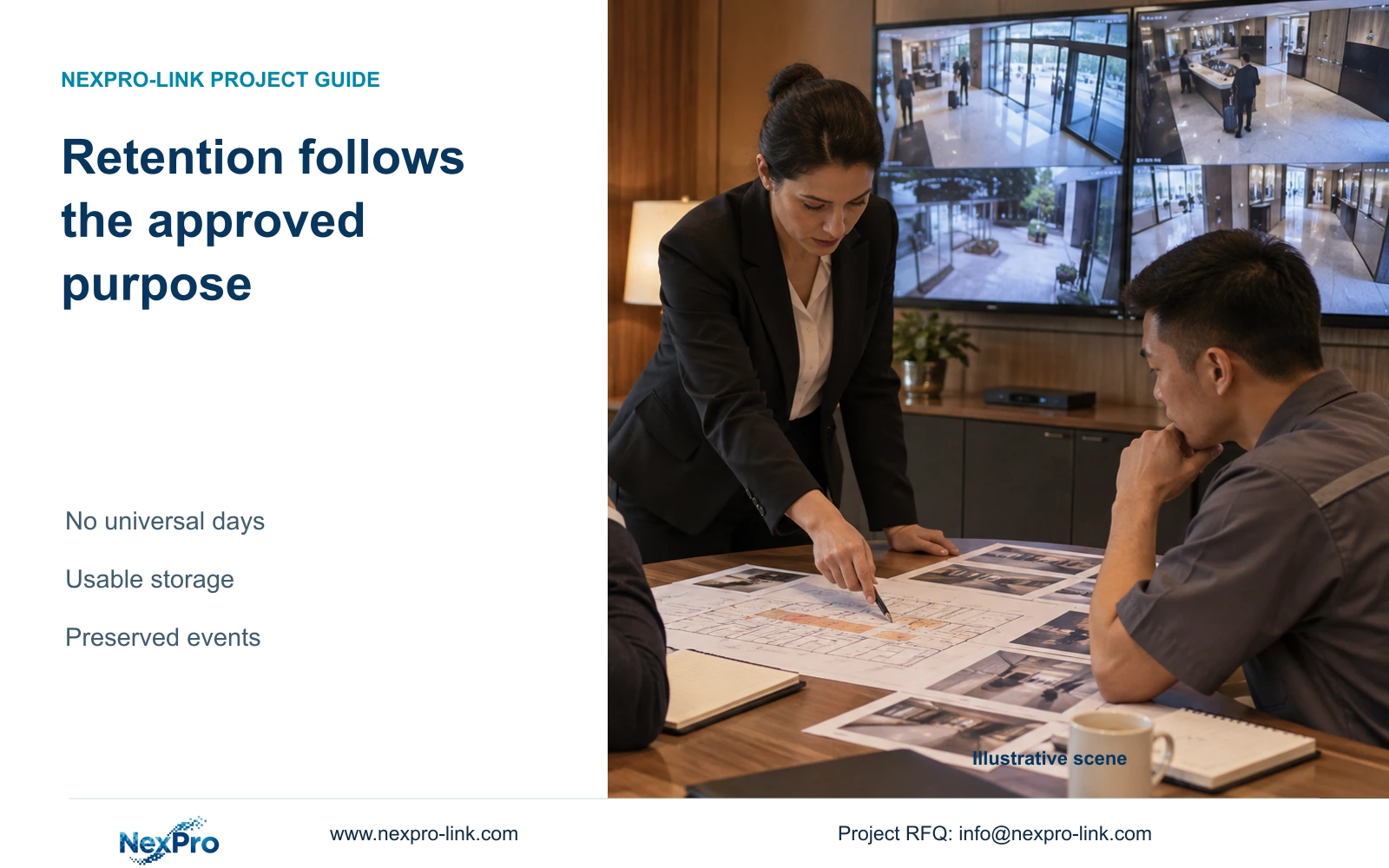
Approve the reason and duration for retaining hotel footage before sizing storage. A 30-day or 90-day calculation cannot establish the hotel's policy.
Section 01
Assign responsibility for the retention decision
Set hotel CCTV retention through the hotel's responsible decision owner using applicable requirements and a defined monitoring purpose. Do not adopt 30 or 90 days as a universal rule. Once the duration is approved, size and verify the recording system against it. Change the equipment proposal when the approved policy or measured recording demand changes.
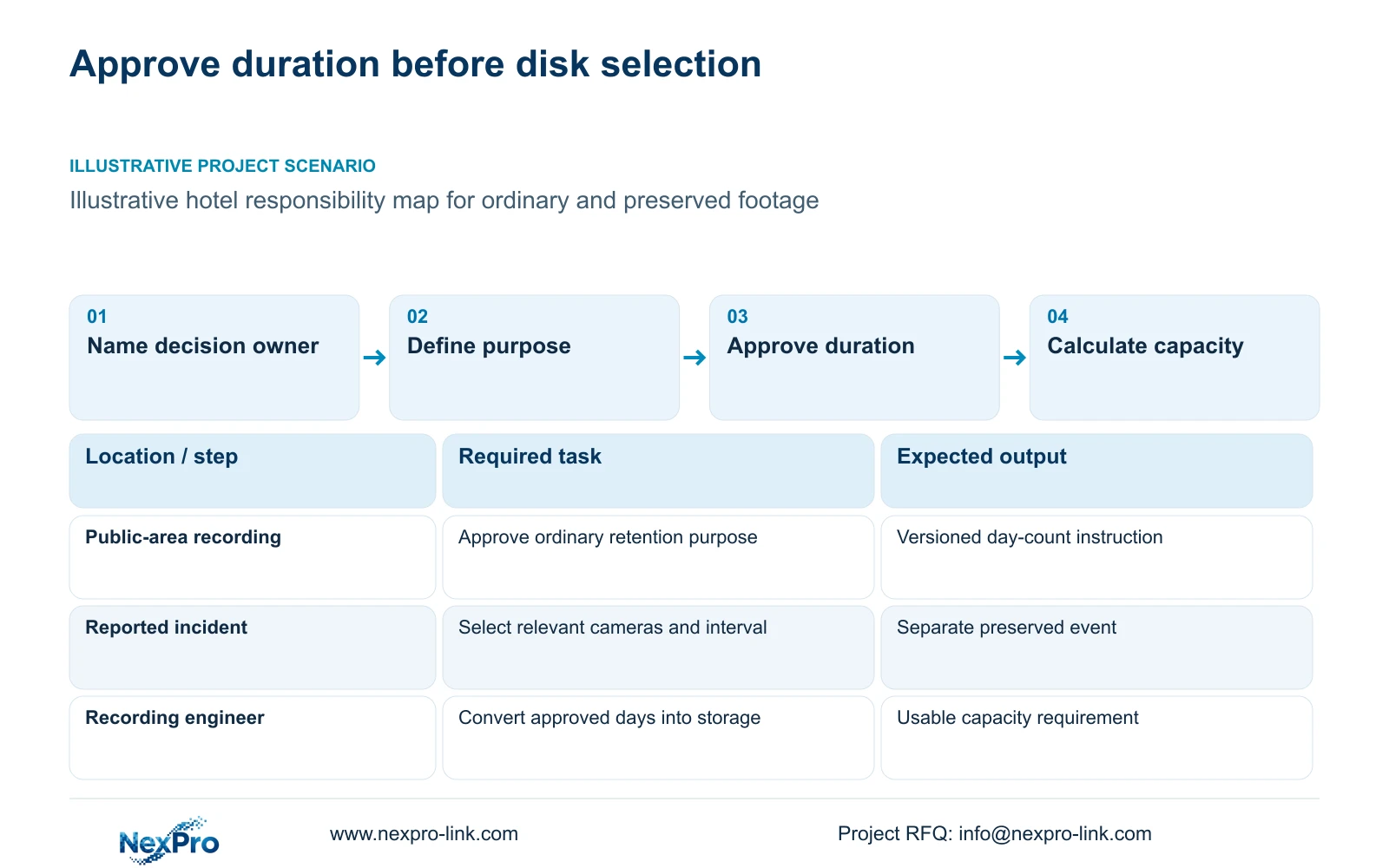
Name the role authorized to approve ordinary retention and incident preservation. Security operations can explain how footage is used, IT can assess implementation, and the designer can calculate capacity. Those contributions do not automatically give the equipment supplier authority to choose the policy. Record who resolves the decision and who maintains the operating settings.
Give the engineer a versioned instruction containing the camera groups, purpose, approved days and recording hours. A provisional period can support a clearly labeled estimate, but it should remain distinguishable from the approved requirement. This prevents an early storage assumption from becoming the hotel's operating policy simply because it appears in a quotation or recorder setup.
| Required task | Given information | Decision still needed |
|---|---|---|
| Set ordinary retention | Purpose and local assessment | Authorized owner approves duration |
| Preserve an incident | Camera range and event interval | Custodian and review/removal basis |
| Size recording capacity | Approved hours, days and stream profile | Supported usable disk configuration |
Section 02
Separate applicable requirements from business preferences
Identify the destination and the requirements that apply to the hotel's surveillance use. Keep those inputs distinct from operational preferences such as allowing time to investigate a report. The decision owner should document why the chosen duration is necessary for the stated purpose, with responsible local advice where needed.
The supplied ICO record discusses purpose minimization, appropriate access and purpose-based retention in UK guidance. It also notes that the guidance is being revised. It supplies no global hotel day count. Treat a chain's internal preference, a storage estimate and applicable legal requirements as separate inputs, then resolve them for the actual property.
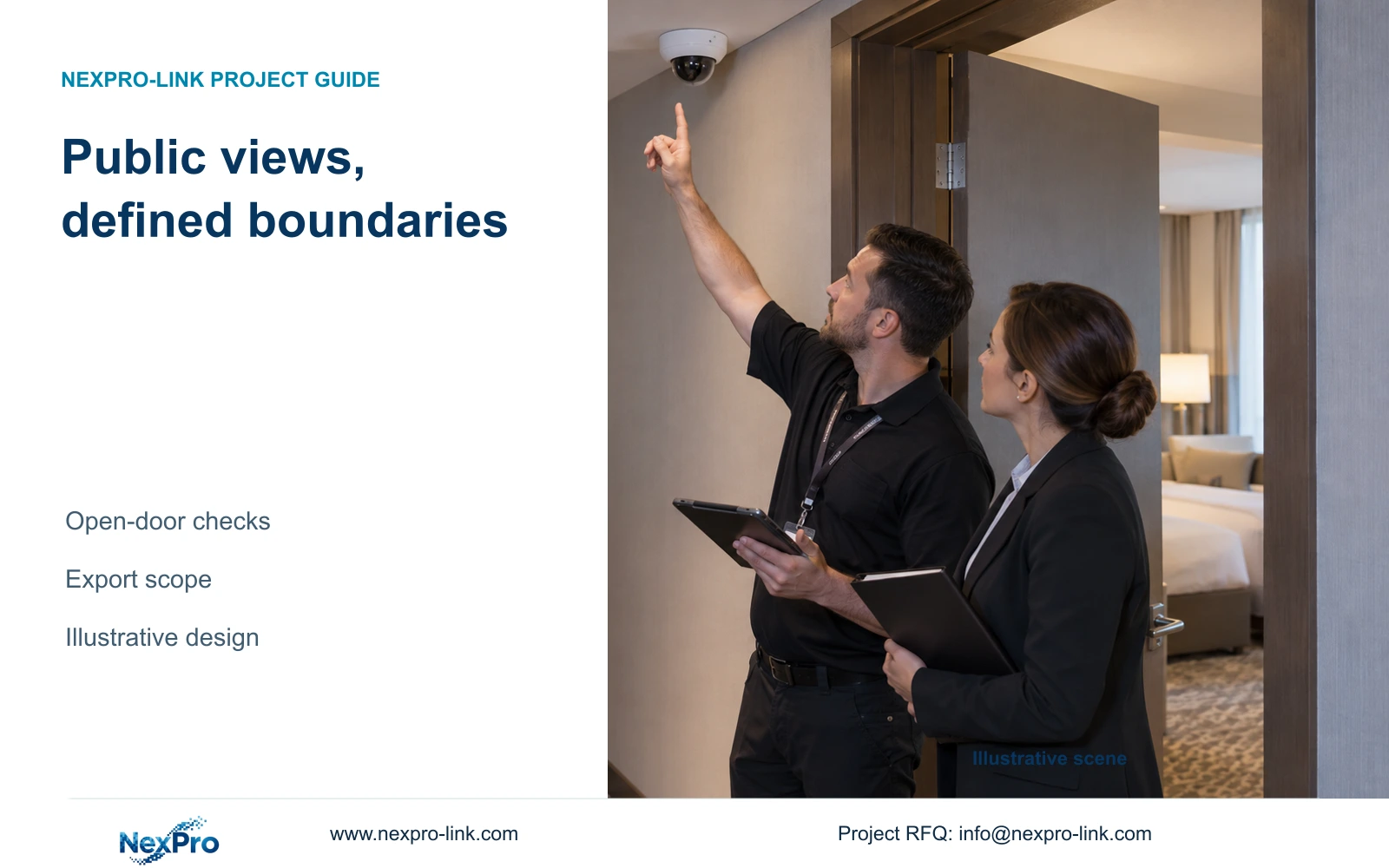
Review the content being retained as well as its duration. Public-route footage should avoid unnecessary open-door interior views; toilets and changing spaces are outside the routine coverage considered here. Audio recording needs a separate justified decision. Keeping footage for fewer days cannot correct an unnecessarily broad capture boundary, so the view schedule and retention instruction should remain connected.
Section 03
Separate ordinary footage from preserved incidents
Ordinary footage follows the approved routine policy. A preserved incident has a defined camera range, time interval, custodian and purpose. Record its review or removal basis separately. Preserving a relevant event does not automatically justify keeping every camera's ordinary footage for the same extended period.
The source matrix below compares broad capture by default with purpose-limited design. It is an illustrative decision comparison, not a numerical calculation or a legal conclusion. For retention, its main consequence is that disk capability cannot select the policy. Access and audio decisions remain relevant because they determine what is retained and who can receive it.
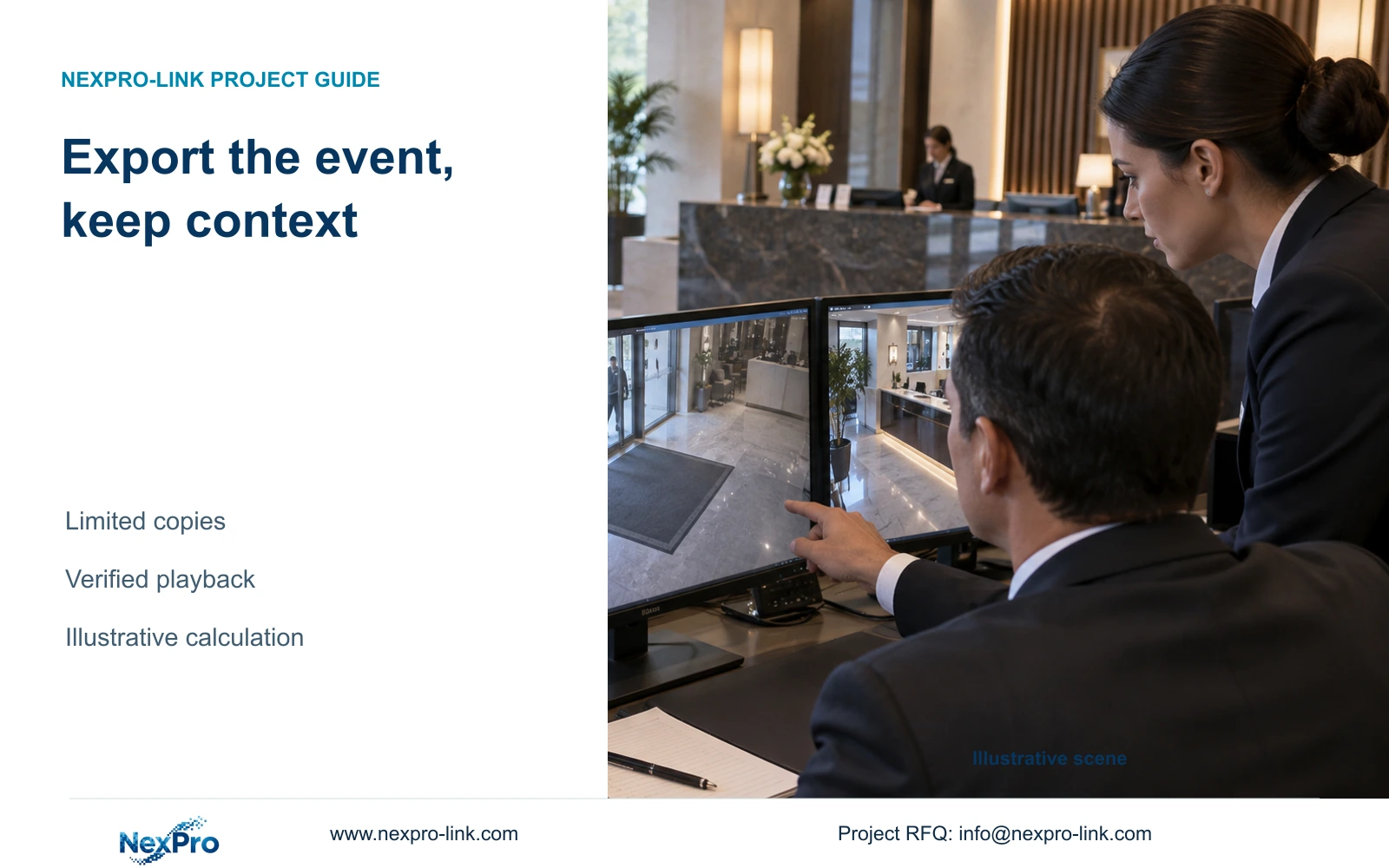
Confirm the actual preservation workflow before relying on it. An event may require an authorized export or a supported protection function, depending on the configuration. Verify playback of the preserved material and identify its storage destination. A planned archive action should not be described as successful until the responsible team has checked the result.
| Metric / condition | Broad capture by default | Purpose-limited design |
|---|---|---|
| View boundary | Maximum field regardless of purpose | Required public task; excluded private space |
| Audio | Enabled because hardware includes a mic | Separate justified and authorized decision |
| Retention | Longest disk can hold | Approved purpose and applicable requirements |
| Access | Whole system shared | Defined recipients, roles and export scope |
Section 04
Translate approved days into usable storage
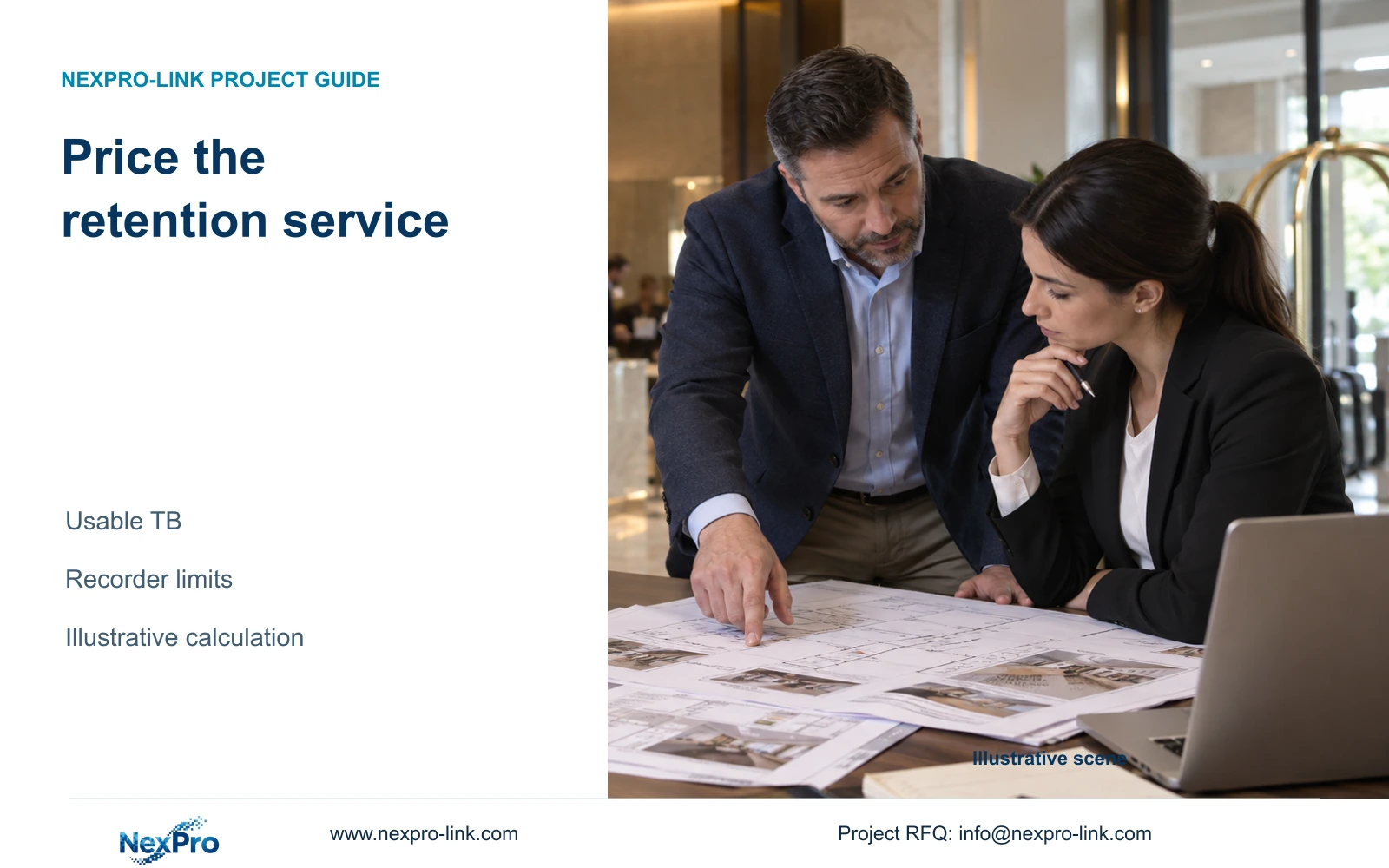
Calculate video data from camera count, average Mbps, daily recording hours and approved days. In decimal units, video TB equals the sum of cameras × Mbps × 10^6 × hours/day × 3600 × days, divided by 8 × 10^12. Divide that result by 0.80 when the design keeps 20% of usable space free.
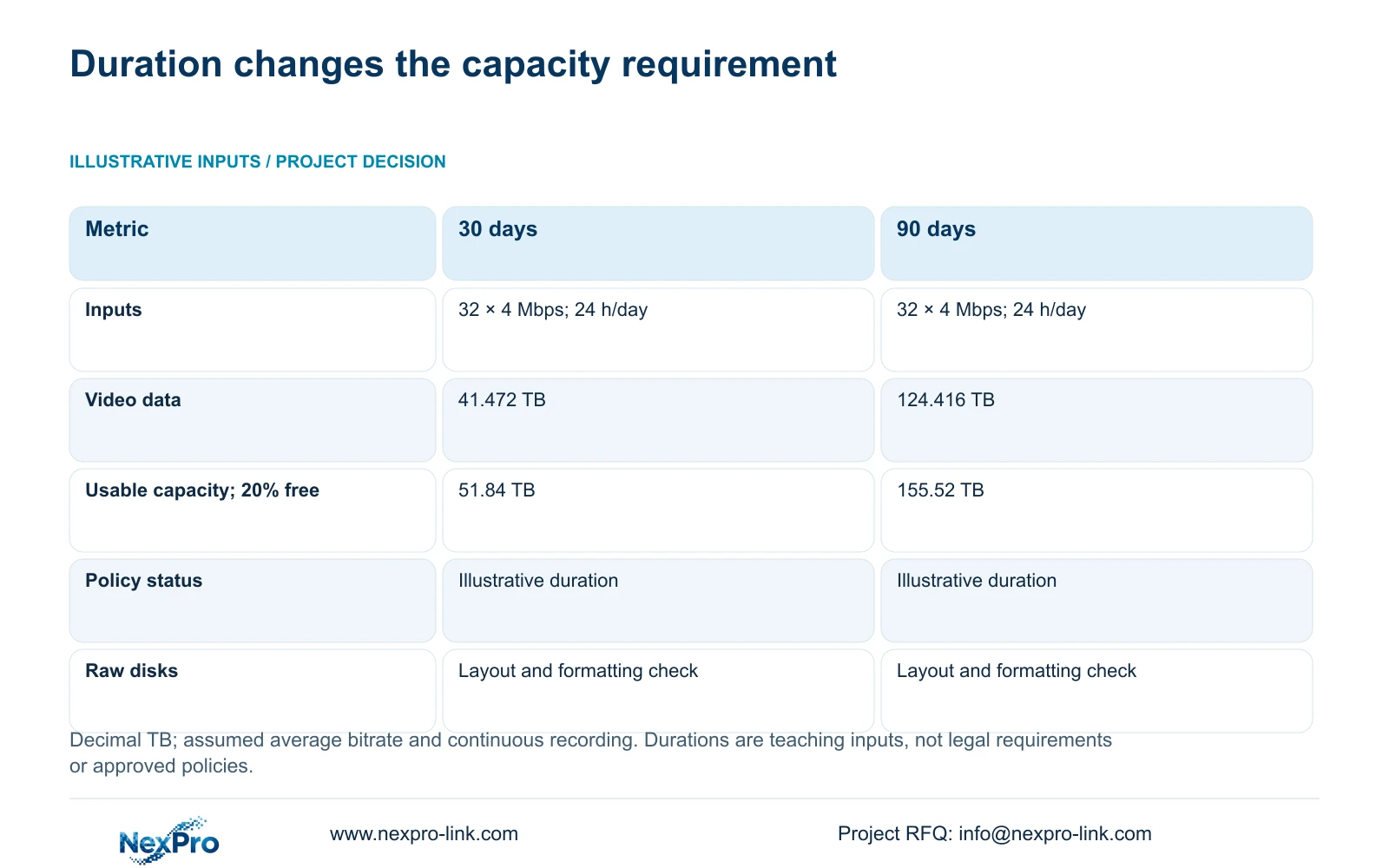
The following independent teaching comparison assumes 32 cameras averaging 4 Mbps and continuous recording. Its 30-day and 90-day periods demonstrate capacity consequences; neither is a policy recommendation. The required usable capacity rises from 51.84 TB to 155.52 TB. Raw disks, array losses and formatting must be assessed separately before buying hardware.
CASE01 uses the same 30-day video target with an illustrative 64 TB raw independent-disk arrangement and 95% formatting allowance. That yields 60.8 TB usable before reserve. It is not a RAID promise or proof of a final disk configuration. The NexPro-NVR2232-4K source contains conflicting capacity fields, so do not select its larger figure to resolve a storage shortfall. Measure relevant bitrate variation before changing image quality or equipment.
| Metric / condition | 30-day recording | 90-day recording |
|---|---|---|
| Camera and bitrate inputs | 32 × 4 Mbps | 32 × 4 Mbps |
| Recording hours | 24 h/day | 24 h/day |
| Video data, decimal TB | 41.472 | 124.416 |
| Required usable TB with 20% free | 51.84 | 155.52 |
| Raw disk selection | Depends on supported layout and formatting | Depends on supported layout and formatting |
Section 05
Control deletion and access in the actual system
Specify how ordinary footage leaves the system at the approved limit. Confirm whether the recorder supports the required age-based or group-specific behavior. Capacity-driven overwrite alone may not reproduce an approved maximum duration when bitrate or available space changes. The operating instruction must match an implemented and checked mechanism.
Treat exported copies and preserved events as separate holdings with named recipients and removal responsibility. A recorder's deletion setting cannot establish that an earlier exported copy has been removed. Define which role may search, export or alter retention settings, and verify those privileges on the actual client.
Buy extra platform scope when a necessary retention or preservation task cannot be implemented by the selected recorder and workflow. Include its storage, administration and support costs in the proposal. If the existing equipment can perform the approved task, additional disks do not by themselves improve policy control. Keep the authorized outcome visible when comparing alternatives.
Section 06
Review the policy when surveillance use changes
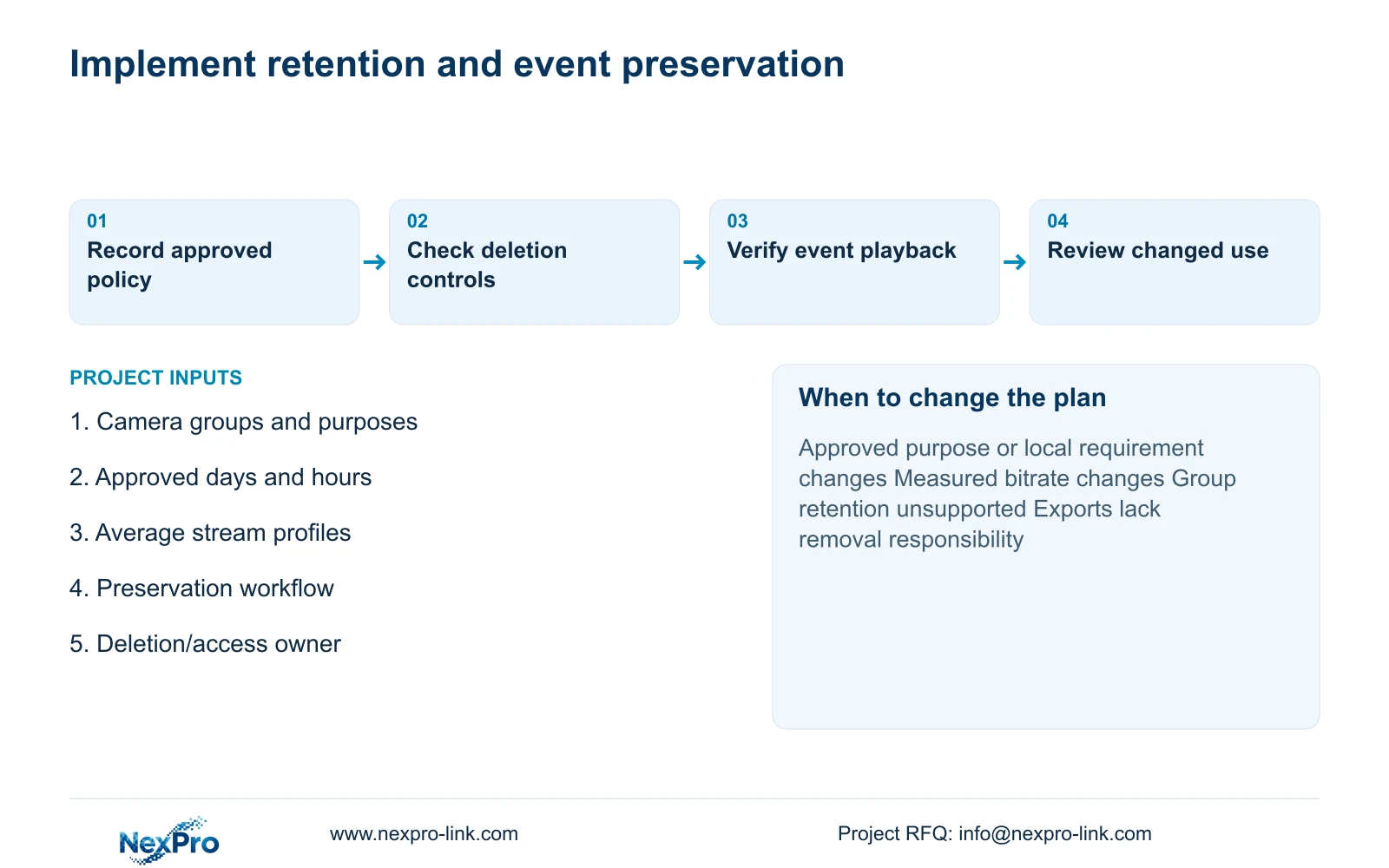
Revisit retention when camera purposes, access recipients or applicable requirements change. Adding a new public-area view or enabling audio changes the material being collected. A higher measured bitrate may require a capacity revision without changing approved days. Keep those two decisions separate so a hardware upgrade does not silently extend retention.
Maintain the previous approved version and explain the revised scope. Identify whether the change affects camera groups, duration, preservation handling or only storage allocation. Recheck supported deletion and access behavior after implementation. The decision owner should receive the operational consequences, while procurement receives the documented equipment and service difference.
Recommend the smallest justified retention scope that meets applicable requirements and the approved purpose, backed by sufficient usable capacity and verified controls. Reconfigure when those inputs change or the selected system cannot enforce them. Send camera groups, approved days and hours, average stream profiles and the incident preservation workflow to info@nexpro-link.com. NexPro-Link's hotel project and BOQ support can translate those inputs into equipment options without choosing the hotel's legal policy.
Section 07
Buyer questions
Can we ask for a quote before retention is approved? Yes. Mark the duration as provisional and request clearly separated capacity options. Do not let the estimating assumption become the operating setting until the responsible hotel role approves the policy.
Can different camera groups have different retention periods? The policy can distinguish purposes, but implementation depends on supported recorder or platform controls. Confirm group-specific behavior before assuming that a grouped storage calculation can be enforced.
Does more disk space justify longer retention? No. It can help maintain the approved duration at the required recording quality, but extending retention needs a separate justified decision. Also check how spare space affects the system's actual deletion behavior.
Engineering references
These sources support the general planning principles. Always use the selected product's current datasheet and applicable project standards for final design.