A larger raw disk total does not establish equal hotel recording service. Match stored bitrates, usable capacity and supported recorder configurations before comparing cost.
Section 01
Fix the recording profiles before pricing disks
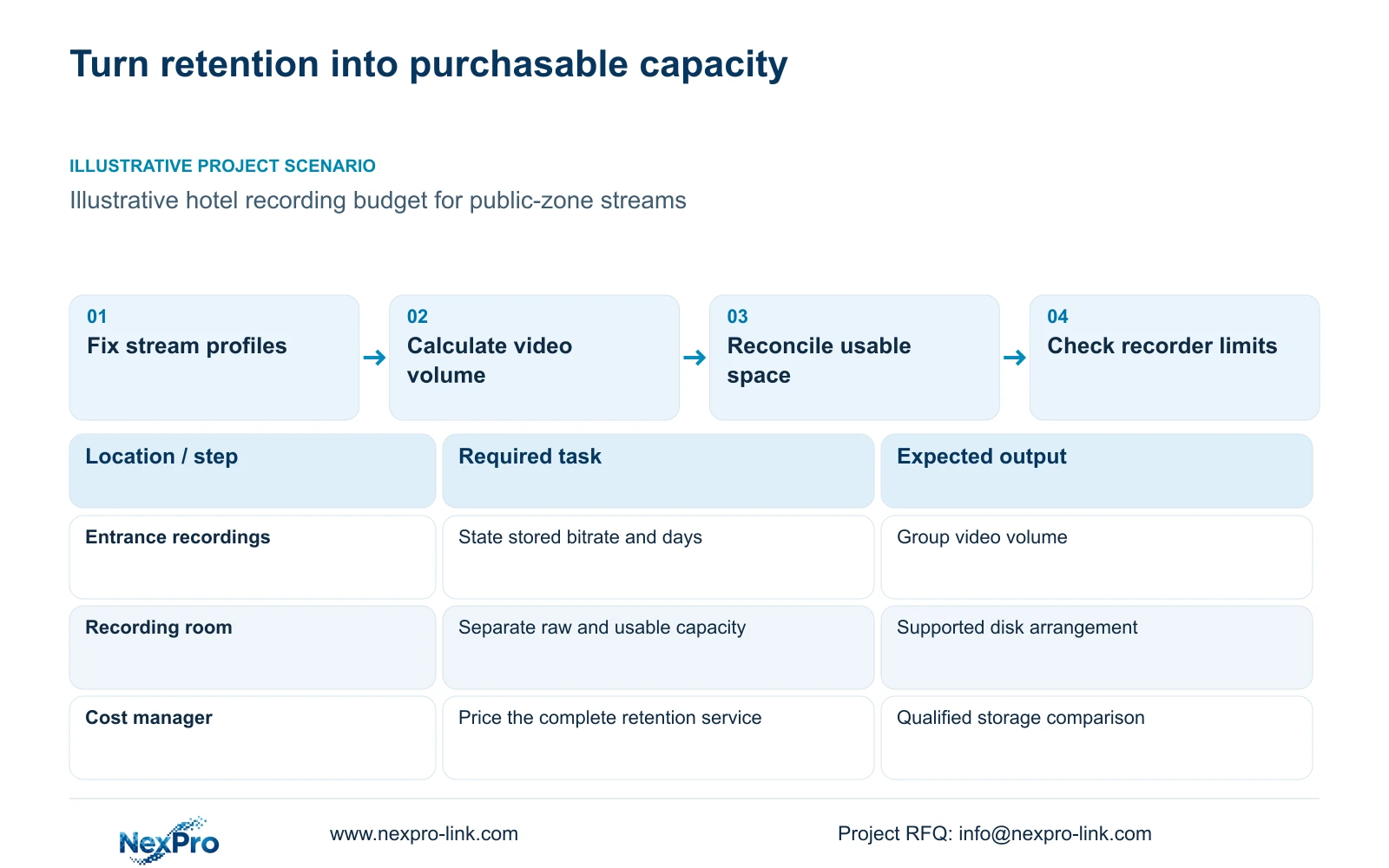
Compare storage offers against the same approved recording profiles and retention period. Select a supported recorder and disk arrangement that supplies enough usable capacity after the chosen disk mode, formatting and free-space reserve. Recalculate when average bitrate, camera quantity or fault-tolerance requirements change. A cheaper raw-terabyte total is acceptable only if it preserves the required service.
Create stream groups with camera count, average stored bitrate, recording hours and retention days. Resolution and codec names cannot supply an average bitrate by themselves. Where entrance and overview tasks use different profiles, calculate each group separately and add their video volumes. Keep any audio or other stored payload requirements explicit.
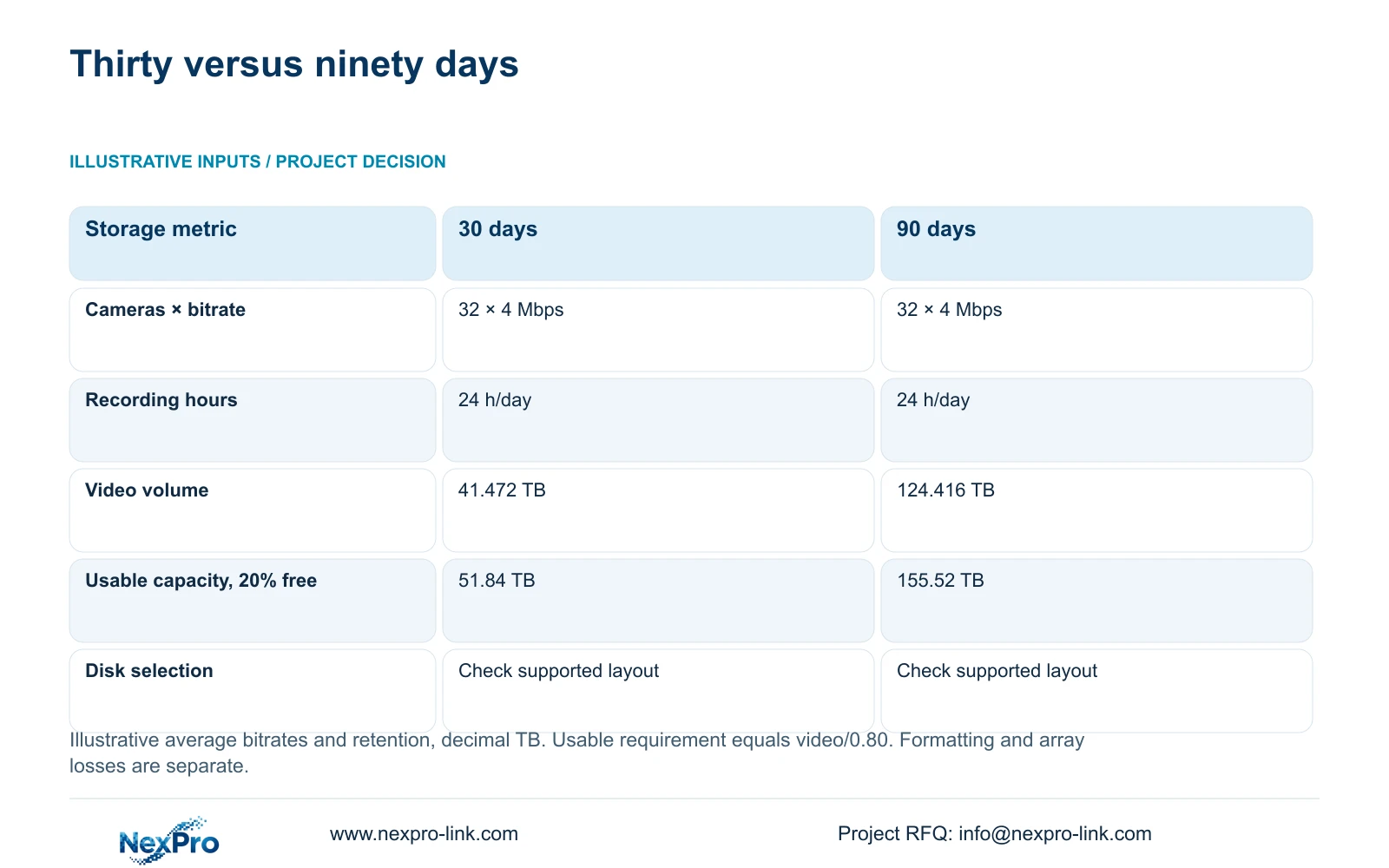
The article's comparison assumes 32 cameras averaging 4 Mbps each, recording 24 hours daily, with 20% of usable capacity left free. Thirty and ninety days are illustrative policy choices, not global hotel legal requirements. The average bitrate is a teaching input, so a procurement calculation needs the selected recording settings and a plan to examine relevant night and activity conditions.
| Required task | Given information | Decision still needed |
|---|---|---|
| Retain approved recordings | Camera groups and operating hours | Average stored bitrate and retention policy |
| Maintain service after disk failure | Fault-tolerance requirement | Explicitly supported disk mode and resulting capacity |
Section 02
Calculate required usable capacity
Calculate decimal video terabytes as the sum of cameras × Mbps × 10^6 × hours per day × 3600 × days, divided by eight and then by 10^12. The division by eight converts bits to bytes. Use the same units for all stream groups and distinguish decimal TB from binary capacity displays.
At the stated inputs, thirty days produce 41.472 TB of video and ninety days produce 124.416 TB. A reserve equal to 20% of usable capacity means video occupies at most 80% of that capacity. Required usable capacity is therefore video TB divided by 0.80, giving 51.84 TB and 155.52 TB. Multiplying by 1.20 would not preserve the stated free-space fraction.
These results establish the usable-capacity requirement before selecting raw disks. Formatting and any array capacity loss require separate treatment. The ninety-day policy triples the video volume under unchanged profiles, but this does not prove the complete configuration will cost exactly three times as much. Recorder thresholds and supported disk arrangements can change the procurement scope.
| Metric / condition | Option A | Option B |
|---|---|---|
| Recording policy | 30-day recording | 90-day recording |
| Video data (decimal TB) | 41.472 | 124.416 |
| Required usable TB with 20% free | 51.84 | 155.52 |
| Raw disk selection | Depends on supported layout and formatting | Depends on supported layout and formatting |
Section 03
Compare disk modes and limits
Request a capacity reconciliation for every offer: physical raw disks, capacity after the selected disk mode, filesystem usable space and the amount budgeted for video. Exclude dedicated hot spares from video capacity. Independent disks and fault-tolerant arrays address different service conditions, so matching their raw labels does not establish equivalent retention or recovery behavior.
A generic eight-drive example with equal 12 TB disks has 96 TB raw capacity. Without a dedicated hot spare and before filesystem overhead, RAID5 yields 84 TB and RAID6 yields 72 TB. Those are general calculations, not declared features of a named NexPro-Link recorder. The actual controller must explicitly support the intended arrangement.
Examine operation during degradation and rebuilding as well as normal capacity. Disk tolerance does not replace independent preservation of an authorized incident clip. Also test the estimate against a changed average bitrate: required space scales with that input when hours and days stay fixed. Night noise and busy scenes belong in the measurement plan; do not assume a universal intelligent-codec saving.
Section 04
Identify recorder upgrades
Check channel count, recording mode, aggregate input bandwidth and disk support independently. The supplied NexPro-NVR4449-4K record lists 49 channels, 320 Mbps input, four SATA bays and up to 18 TB per disk. Its summary lists 49 × 5MP and 9 × 4K modes; channel count does not establish 49 simultaneous 8MP recordings. Its RAID levels are not specified.
NexPro-NVR8864-4K lists 64 channels, 320 Mbps input and eight SATA bays with 18 TB per disk. Even eight 18 TB drives total only 144 TB raw, below this example's 155.52 TB usable requirement for ninety days before any losses. A single unit therefore cannot meet that capacity target under the stated inputs. Evaluate a different supported architecture without assuming undocumented expansion.
Central and distributed recording also change search paths, maintenance windows and failure impact. Include those consequences when evaluating extra recorders. NexPro-NVR2232-4K has conflicting source capacity fields, with 2 × 8 TB and 2 × 18 TB both recorded, plus playback differences. Do not use the larger unresolved figure to justify a final storage purchase.
Section 05
Normalize the complete cost
Compare recorder and drive costs with the work required to operate them. Additional recorders may need rack space, protected power, network configuration and another retrieval workflow. A disk quote without installation, supported configuration and commissioning is a different boundary from an operational recording package. Obtain missing costs rather than assigning them zero.
Preserve drive identity and configuration records. An apparently similar replacement needs the relevant compatibility checks, and an old spare may require review after the system changes. Quote any agreed restoration stock separately from warranty handling. Neither an unused spare nor a hardware warranty automatically restores hotel recordings.
The supplied policy record gives applicable main equipment a 24-month limited hardware baseline from receipt, subject to controlling written terms. Disk and other accessory coverage must be stated separately. Include local labor, return transport and support responsibilities where they affect the comparison. A lower disk price cannot establish a lower complete cost when these service boundaries differ.
Section 06
State the resulting retention envelope
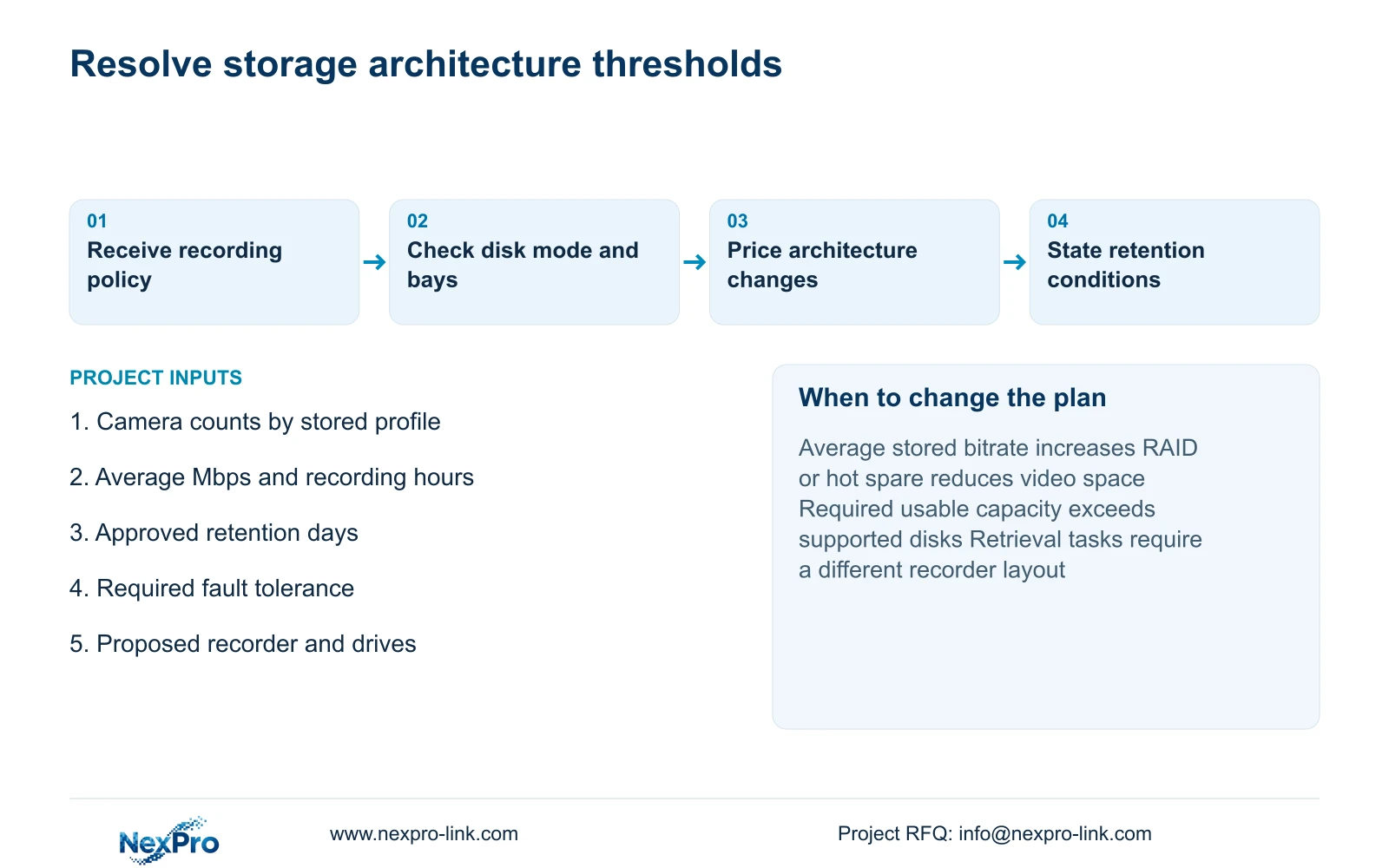
Describe the proposal with its approved retention policy, stream settings and usable video budget. Capacity-supported days are a planning result under those inputs; they do not authorize retaining footage longer than the hotel's approved purpose. State the condition that triggers recalculation, including higher average bitrate or a different array mode.
The independent full reference shares the thirty-day inputs and illustrates four 16 TB disks in one NexPro-NVR4449-4K. Its 64 TB raw total becomes 60.8 TB under an assumed 95% formatting allowance, then 48.64 TB of video budget after the reserve. That supports 35.19 planning days at its assumed bitrate, without RAID loss. It illustrates a candidate for thirty days, not ninety days or a verified drive configuration.
Recommend the smallest supported complete arrangement meeting the approved policy and failure requirement. For the ninety-day example, change architecture because 155.52 TB usable exceeds the listed single-recorder raw limit above. Send camera counts by stored profile, recording hours, approved retention and required disk mode to info@nexpro-link.com. Add the proposed recorder configuration and destination for a focused equipment and BOQ response.
Section 07
Buyer questions
Can a larger disk package shorten retention? Yes, if the recording bitrate increases or the selected disk mode leaves less usable video space. Compare the reconciled video budget and stored profiles rather than raw capacity alone.
Does a 64-channel recorder prove a ninety-day solution? No. Channels establish only one constraint. This example needs 155.52 TB usable, while eight 18 TB disks total 144 TB raw before losses. Recording modes and retrieval limits also need separate checks.
Can spare capacity extend the hotel's approved retention automatically? No. Capacity-supported days and the approved retention policy are separate. Configure the agreed policy using supported controls and preserve authorized incident material through a separately defined workflow.
Engineering references
These sources support the general planning principles. Always use the selected product's current datasheet and applicable project standards for final design.