Export only the authorized incident scope and preserve the information needed to interpret it. Transfer speed, usable playback and recipient access require separate checks.
Section 01
Define the authorized request before copying
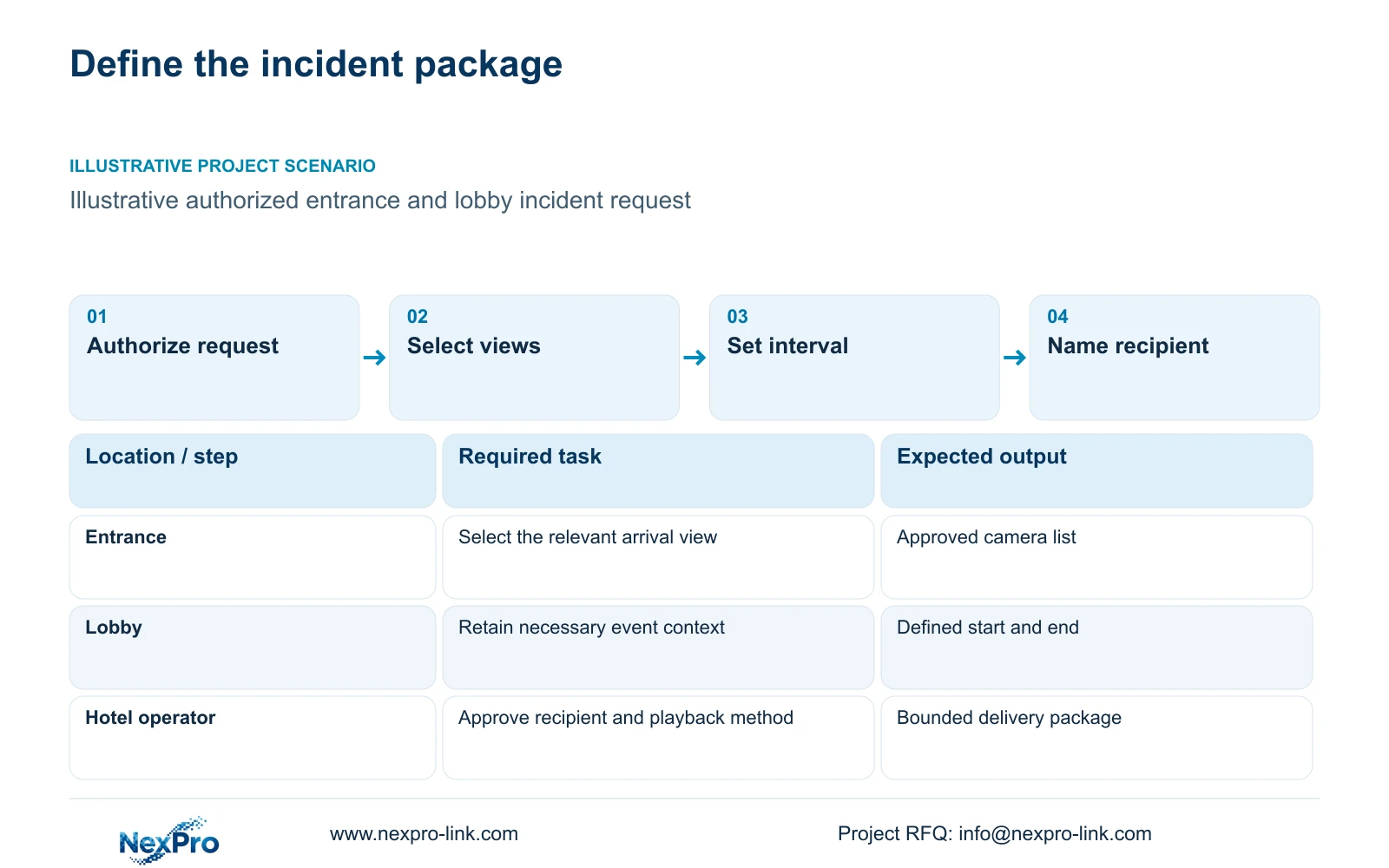
Limit an incident export to the approved cameras, time window and recipient, while retaining enough context to interpret the event. Select a delivery method that meets the hotel's access rules and the recipient's playback needs. Expand the export only when an authorized review establishes that additional footage is necessary; a broad request does not justify copying the entire hotel's recordings.
Record the purpose of the request and the hotel authority responsible for disclosure. An insurer or another outside recipient may need particular event information, but the operator should resolve the permitted scope before an engineer begins extraction. The technical task is to supply usable material within that scope, without deciding legal entitlement through a file-transfer setting.
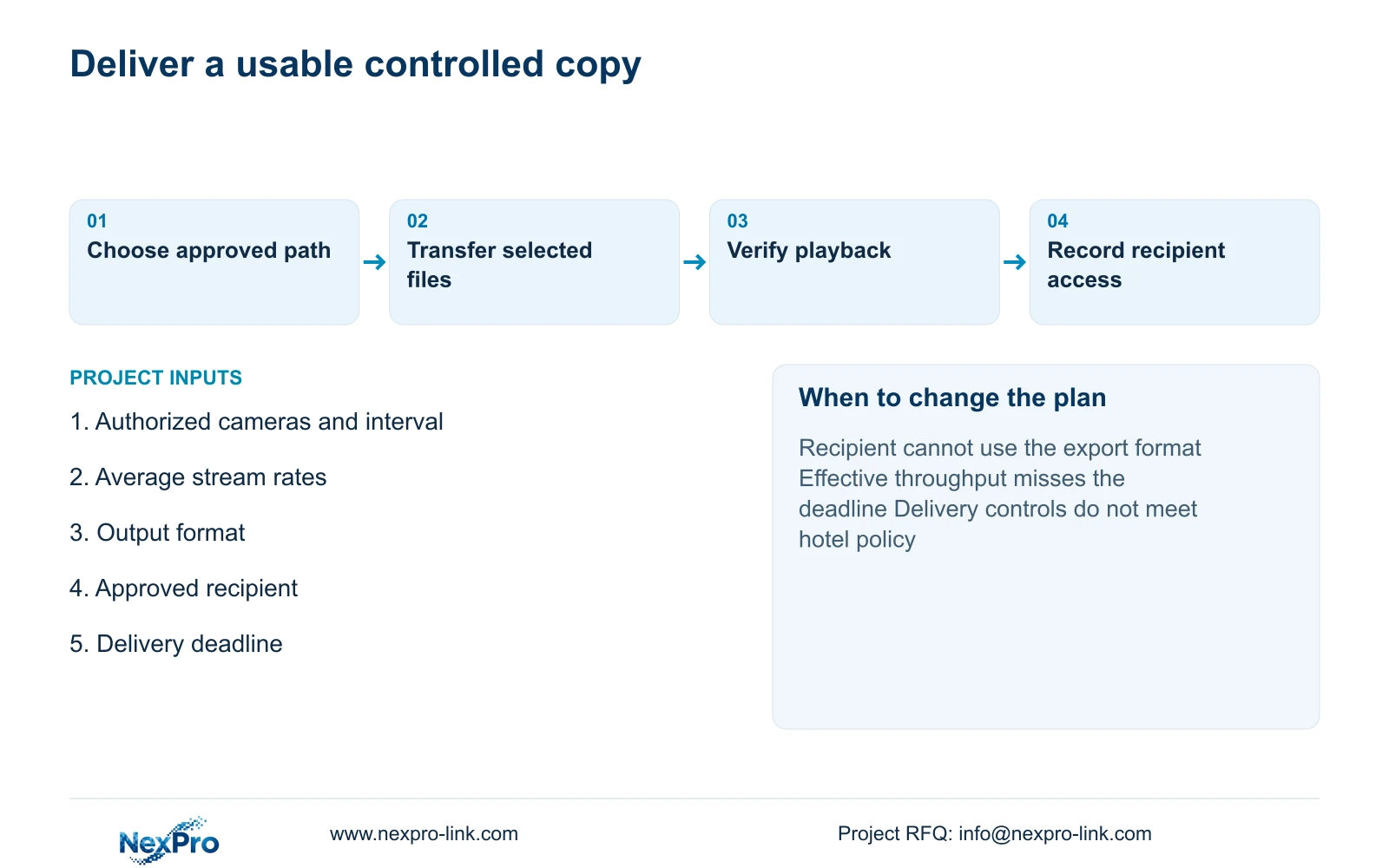
Identify the requested format and delivery deadline early. A recipient who cannot use the recorder's export format may require a supported playback tool or a separately approved format. Confirm that workflow for the actual recorder and client. UK ICO guidance supports purpose-limited disclosure in its jurisdiction; the supplied page is under revision and does not establish requirements for every hotel destination.
| Required task | Given information | Decision still needed |
|---|---|---|
| Provide incident footage | Event location and approximate time | Approved cameras, interval and recipient |
| Deliver usable files | Recipient requests a copy | Supported format, player and transfer path |
Section 02
Select relevant cameras and a defensible time window
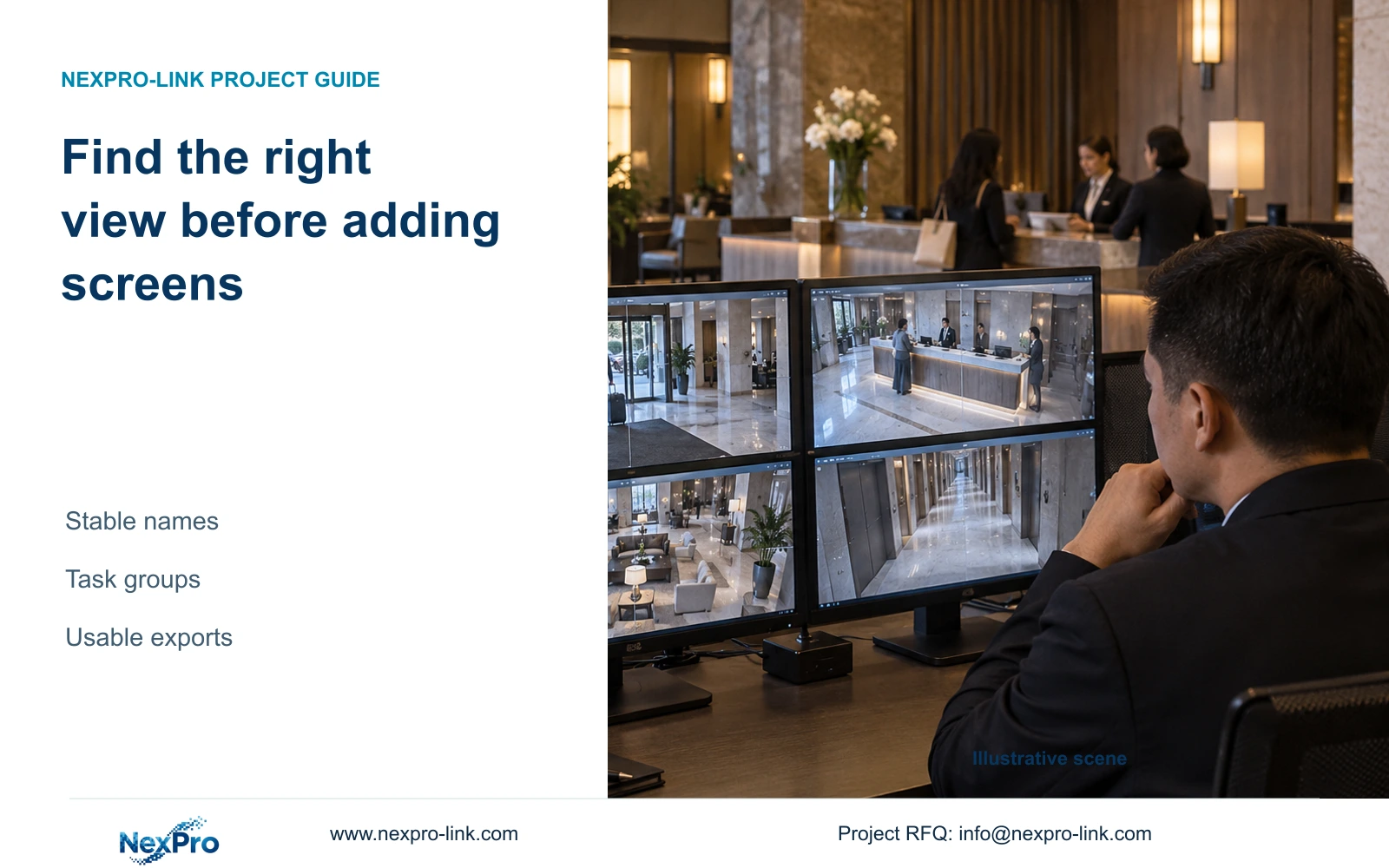
Use the camera schedule to identify views that explain the event. An entrance view may show arrival, while a permitted lobby view supplies the next part of the sequence. Include relevant context without extending the export to unrelated public routes merely because the recorder makes them available. Private interiors remain outside the routine coverage scope described in the hotel reference.
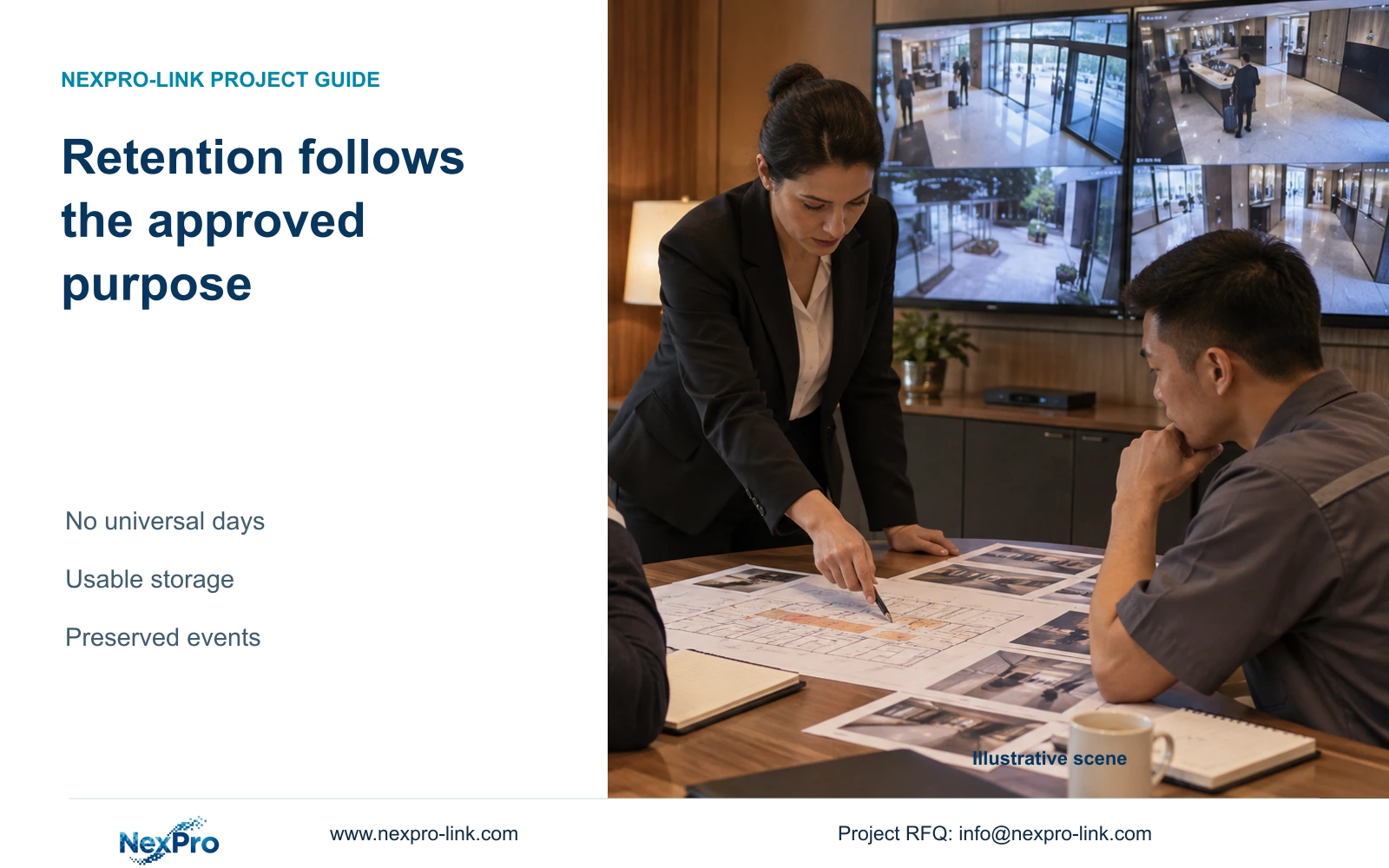
Define the beginning and end of the required interval and record the time basis used by the system. Keep any known clock discrepancy visible to the recipient. Shortening a clip too aggressively can remove context, while exporting a full day can disclose unnecessary activity. The authorized purpose determines the appropriate interval.
Compare the proposed event package with a wider package before extraction. Retain additional cameras or time only where they explain a required part of the event. CASE01 is an illustrative 32-camera system background, not an instruction to export 32 streams. The four-stream calculation below is an independent incident example and does not represent that case's complete storage requirement.
Section 03
Calculate payload size before choosing delivery
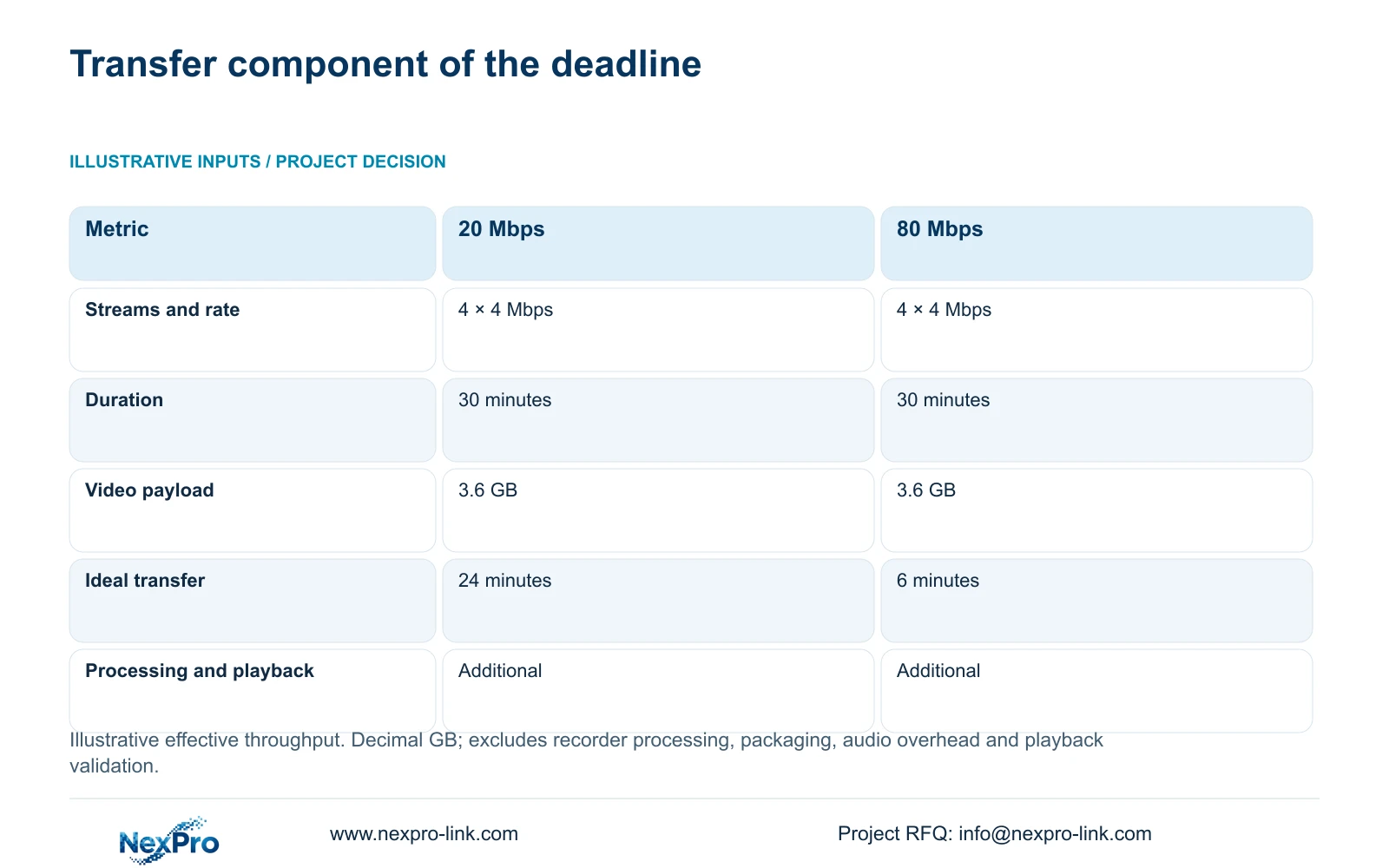
For this illustrative authorized event, assume four streams averaging 4 Mbps each for 30 minutes. The duration is 1,800 seconds. Calculate decimal gigabytes as streams × Mbps × seconds ÷ 8 ÷ 1,000: 4 × 4 × 1,800 ÷ 8 ÷ 1,000 = 3.6 GB. Dividing by eight converts bits to bytes.
This estimates the video payload. Packaging, additional audio and metadata can change the resulting file size, and actual variable stream rates may differ from the assumed average. Use the real selected streams for a project estimate. The example's 4 Mbps is a teaching input, not a bitrate inferred from a camera's megapixel label.
Transfer seconds equal payload GB × 8,000 ÷ effective Mbps. At 20 Mbps the calculation gives 1,440 seconds, or 24 minutes; at 80 Mbps it gives 360 seconds, or six minutes. Both estimates exclude recorder processing, packaging and playback validation. Use them to assess the transfer component of the deadline, without presenting either result as a measured recorder speed.
| Metric / condition | 20 Mbps effective transfer | 80 Mbps effective transfer |
|---|---|---|
| Video data (GB) | 3.6 | 3.6 |
| Effective transfer (Mbps) | 20 | 80 |
| Ideal transfer time (minutes) | 24 | 6 |
| Processing / playback checks | Additional | Additional |
Section 04
Compare approved local and remote delivery paths
Choose between approved local media and remote delivery using the same event package. Compare recipient access, transfer capacity and the work needed to validate playback. A faster path is useful when it meets the disclosure boundary and deadline. If it requires broader credentials or uncontrolled sharing, resolve those conditions before using it.
The 80 Mbps example reduces ideal transfer time by 18 minutes compared with 20 Mbps, but recorder processing may control the overall completion time. A gigabit interface nameplate does not establish sustained export throughput. NexPro-NVR4449-4K and NexPro-NVR8864-4K list 320 Mbps input and dual gigabit networking in the supplied records; those fields do not demonstrate their export rate.
Central and distributed recording also affect retrieval. Identify which recorder holds each selected interval and which network segment the export uses. A failed remote path may leave local material available, while recorder or disk problems require a different response. Include configuration and support work in any proposed delivery upgrade, without assigning hypothetical prices to a brand.
Section 05
Record the files and their event context
Create a controlled export record linking the authorized request to the files delivered. Include camera identities, the selected interval, the system's time basis and the required playback method. Record who receives the material and the approved delivery route. These details help the recipient distinguish the event package from unrelated footage.
Preserve the supported original export and describe any separately prepared viewing copy accurately. A file conversion or edited extract should not silently replace the context needed to interpret the source. The hotel should define the handling and access conditions for each copy. A generic technical procedure cannot establish legal admissibility or replace the applicable evidence-handling requirements.
Treat source retirement as a separate decision. An old disk cannot be assumed readable in a replacement NVR, even where physical connections fit. Verify the necessary export before removing the old recording arrangement. Extra playback preparation is worth including when the approved recipient otherwise cannot use the material; unnecessary duplicate packages increase the copies the hotel must control.
Section 06
Verify playback and recipient access
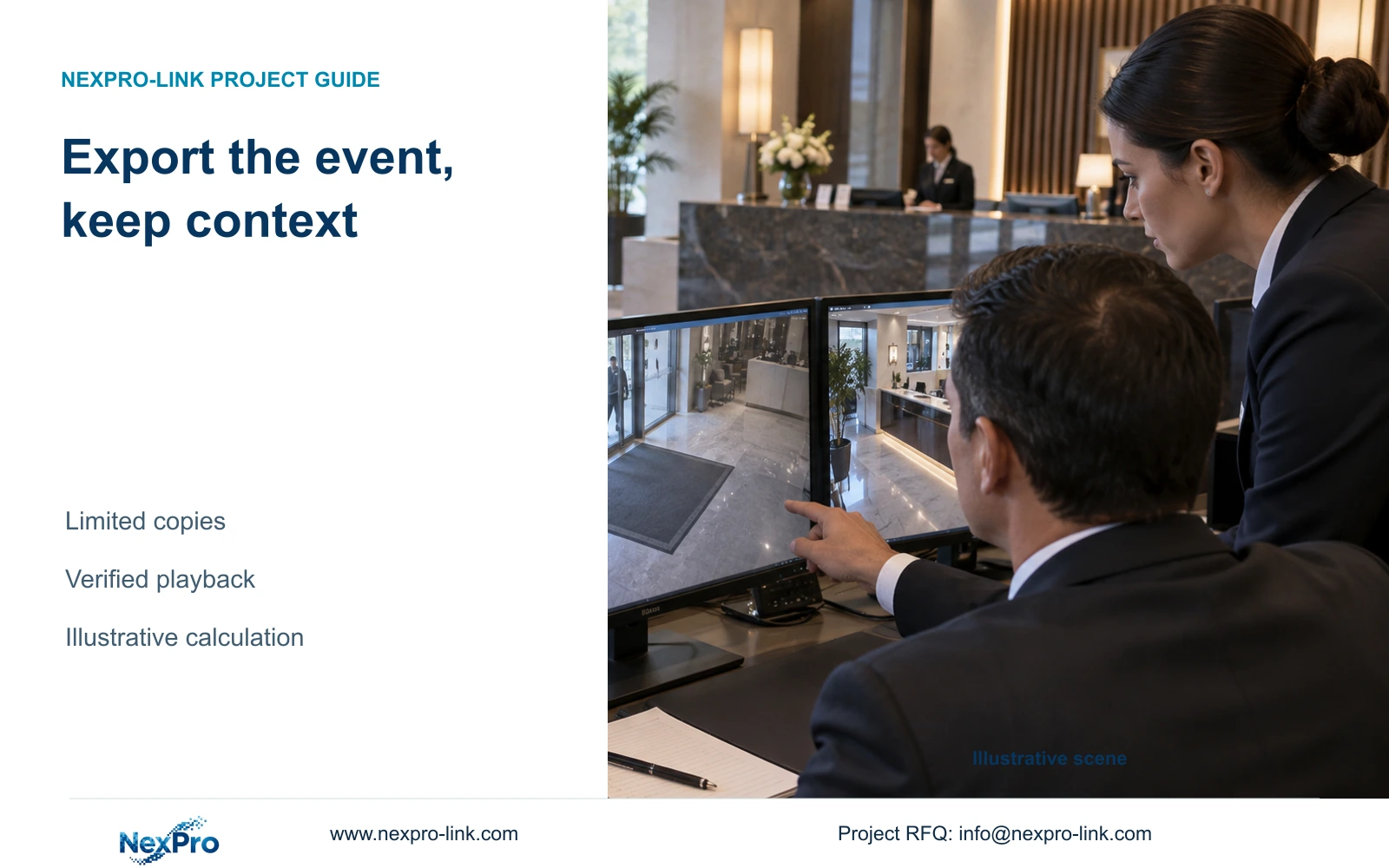
Check the delivered package through the approved recipient workflow. Confirm that files open with the stated method, contain the selected cameras and interval, and retain the necessary timing context. A successful upload establishes only that data reached a destination. It does not establish that the recipient can interpret every file.
Verify the selected access restrictions and any agreed access-removal process using the actual delivery service. Keep encryption and access-duration requirements within the hotel's approved arrangement, without assuming the NVR provides every delivery feature. Record the observations and resolve unusable files before authorizing removal of the original source.
Recommend the smallest authorized event package with a verified playback method. Choose the faster approved path when the delivery deadline requires it and sustained throughput supports the estimate; use another approved route if recipient controls or connectivity prevent that choice. Email info@nexpro-link.com with camera count, time window, average stream rates, recorder/client versions and required output format. NexPro-Link can discuss the equipment workflow and supply scope without receiving guest footage or passwords in the initial inquiry.
Section 07
Buyer questions
Can the recorder's input bandwidth predict export time? No. Input bandwidth describes accepted recording traffic. Export processing and effective transfer throughput are separate constraints and need confirmation for the selected recorder and workflow.
Can we move the old disks into a new NVR to retrieve incidents? Do not assume the new recorder can read them. Confirm compatibility through the authorized process and verify usable exports before retiring the original recording system.
What changes the 3.6 GB estimate? A different number of streams, duration or average bitrate changes the video payload directly. Export packaging, audio and metadata can also affect the final file size.
Engineering references
These sources support the general planning principles. Always use the selected product's current datasheet and applicable project standards for final design.