Use thermal equipment for a defined detection task and retain a suitable detail view where the hotel needs identification evidence. Terrain, lighting and response determine whether a hybrid is justified.
Section 01
Assign detection and detail to separate tasks
Retain visible-light CCTV where the hotel needs recorded detail, and add dedicated thermal equipment only where a defined detection task justifies it. A thermal proposal should not remove ordinary cameras or lighting without showing how the required observation and response tasks remain covered.
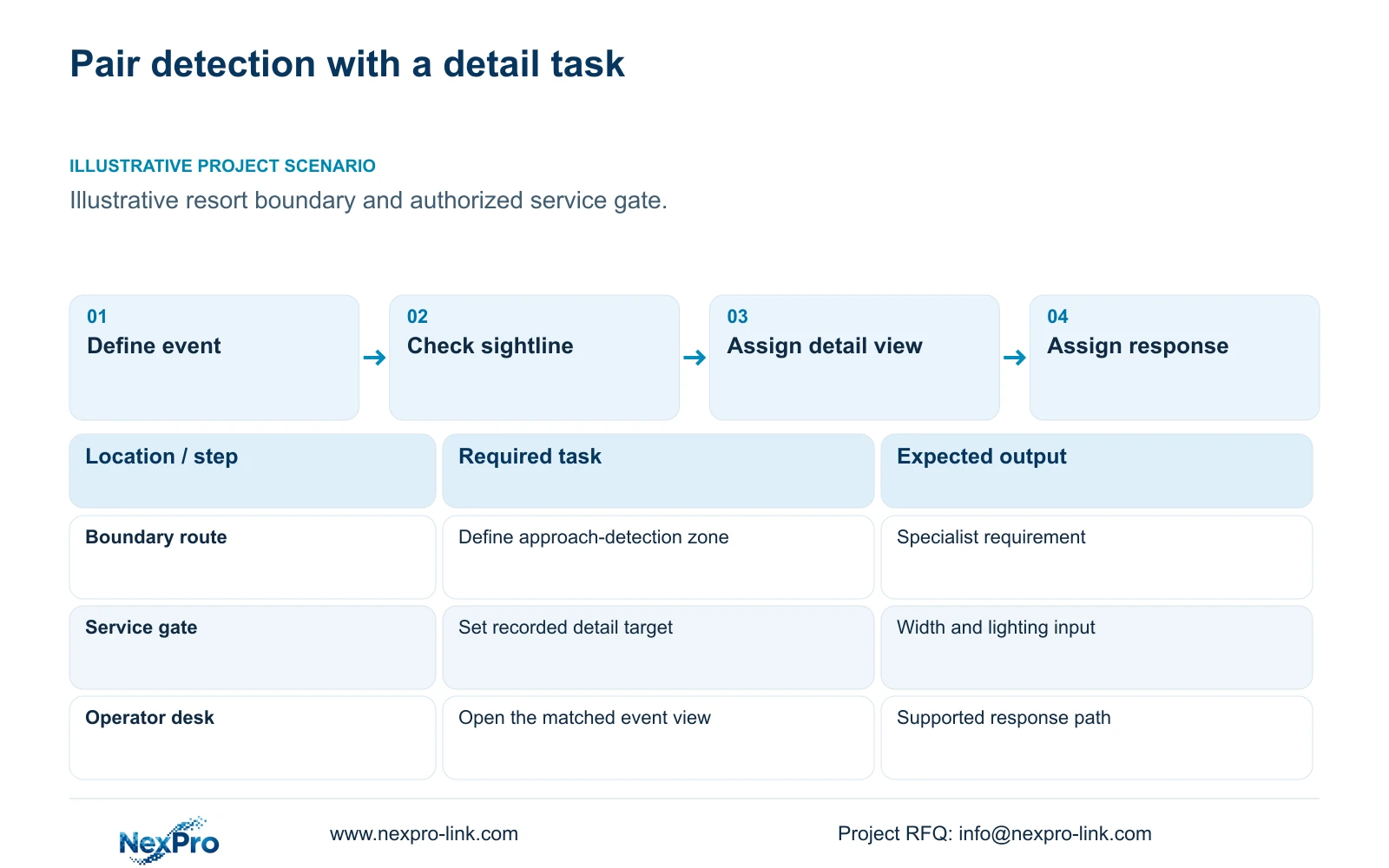
Describe the event at each permitted perimeter location. A service-gate task might require staff to notice an approach and then review the handover. A remote boundary task may prioritize detection before an operator requests another view. These requirements can use different equipment and different target areas.
List public access routes and authorized service points before counting cameras. Guest-room interiors and unnecessary private views are outside this planning scope. Separate an overview from the detail needed at a selected location. Combining the two is acceptable only when the approved task remains achievable under the relevant conditions.
| Required task | Given information | Decision still needed |
|---|---|---|
| Notice an approach | Perimeter route identified | Detection zone and response owner |
| Review useful detail | Service handover point | Target width, exposure and illumination |
| Preserve event footage | Recording required | Streams, retention and export scope |
Section 02
Map terrain and obstructions at the target
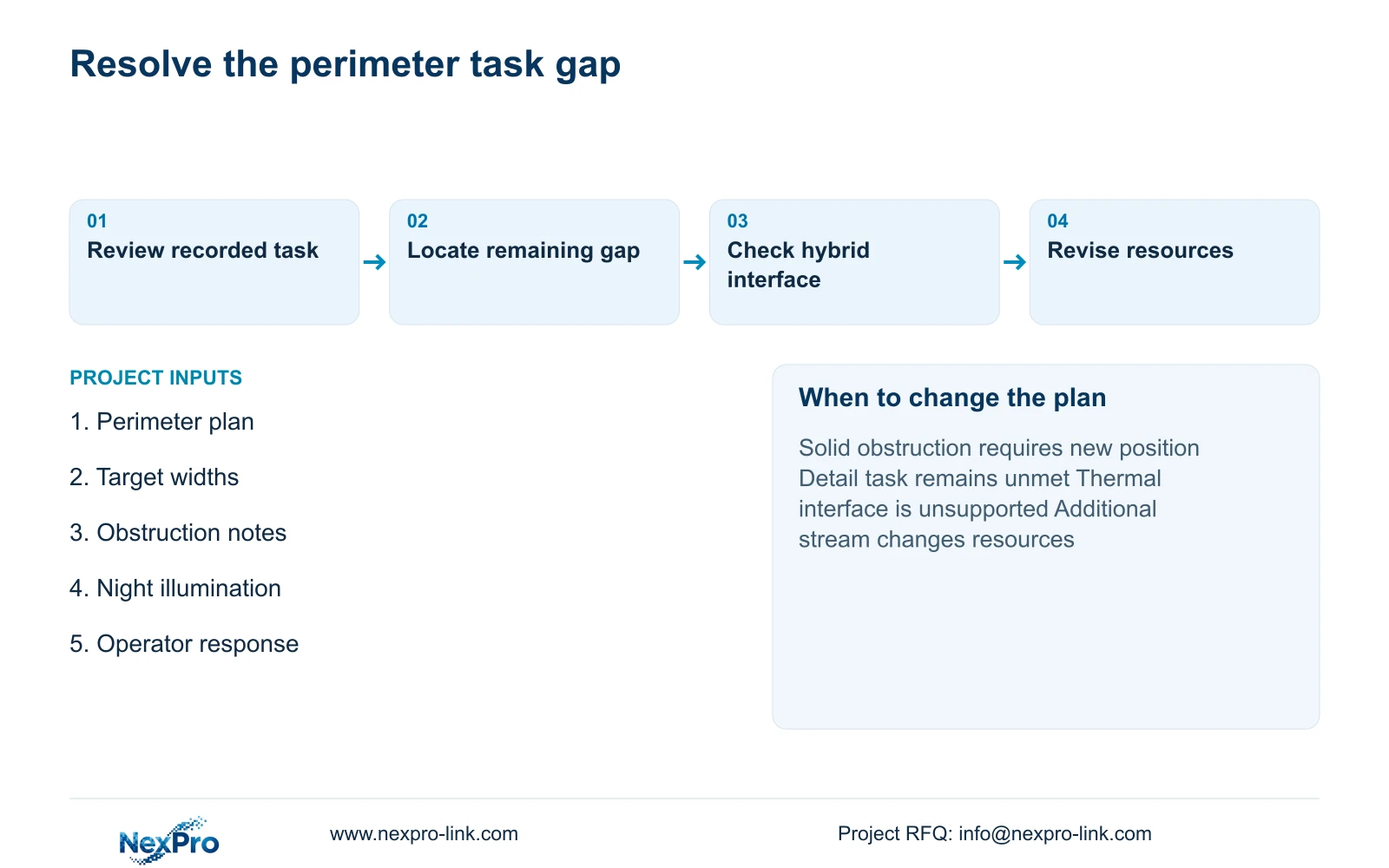
Mark the target route, mounting position and obstructions on the perimeter plan. Include terrain changes and fixed barriers that affect the line of sight. A sensor choice cannot replace this geometry review, and the proposal must not claim that thermal equipment sees through solid obstructions.
Compare repositioning a camera, changing its view and adding a separate position. A narrower detail view may improve the geometric pixel allocation while losing part of the overview. Preserve the overview task through another justified view where necessary, rather than declaring a smaller camera count equivalent.
Use the width at the relevant target plane for detail planning. A large area on a site drawing does not establish the width visible where a person passes. Record mounting and maintenance constraints together so a technically useful view is not assigned to a position that cannot be safely serviced.
| Item | Retain position | Revise or add position | Effect |
|---|---|---|---|
| Solid obstruction | Task remains hidden | Check a clear sightline | Sensor label does not resolve it |
| Wide overview | More route context | Dedicated narrower detail | Recheck both tasks |
| Service access | Existing constraints remain | New access method possible | Include installation scope |
Section 03
Compare thermal support with illuminated detail
Compare technologies against the same target route and relevant lighting state. Specify what the operator needs to detect and what must be visible in the recorded detail view. There is no supplied thermal SKU or thermal field-test result in this package, so a dedicated thermal selection needs its own supported specification and evaluation.
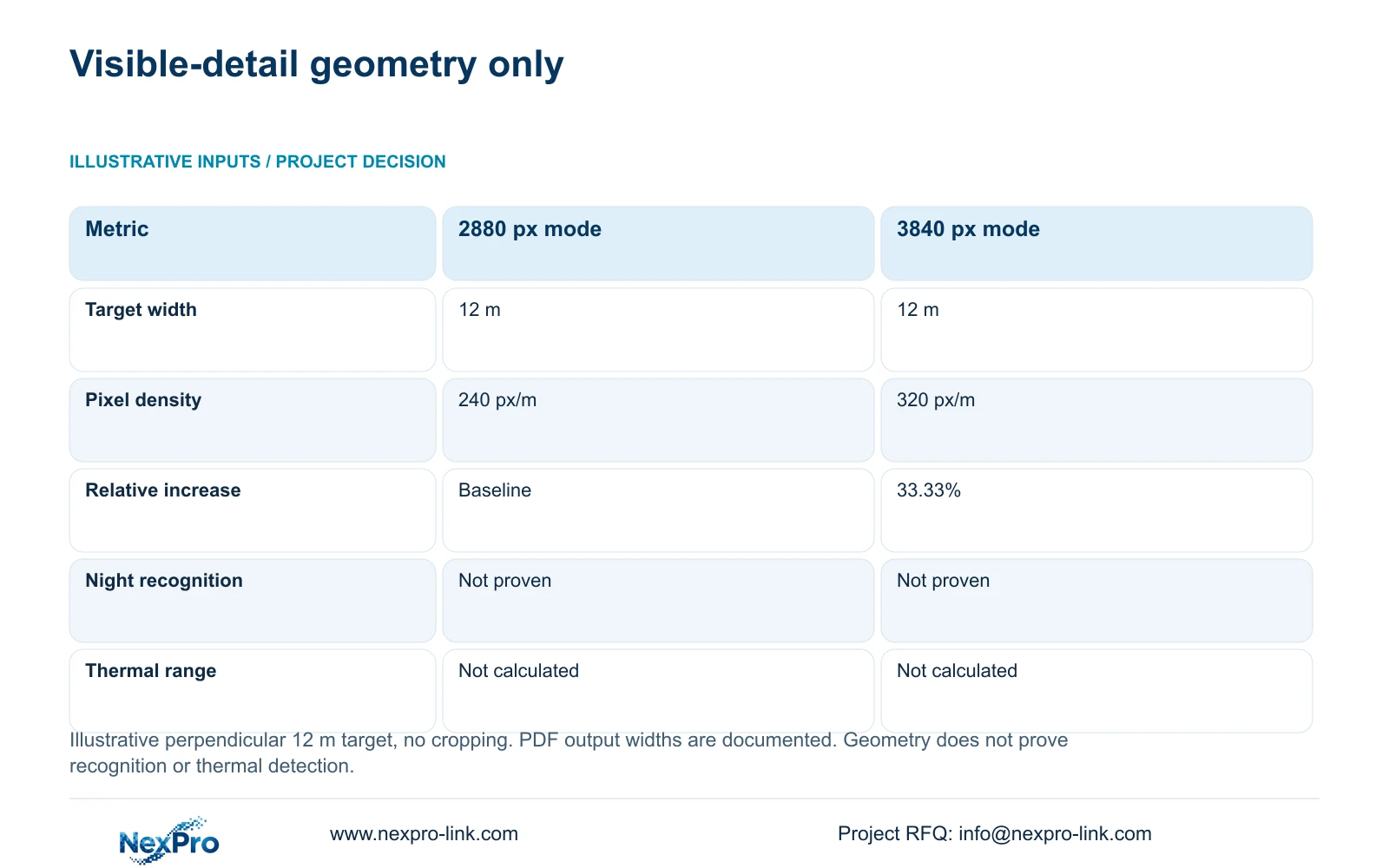
The supplied BL2812M PDF documents 2880-pixel horizontal output for the 5MP mode and 3840 pixels for the 8MP mode. At an illustrative perpendicular target plane 12 m wide, without cropping, planning density equals horizontal pixels / width. The results are 240 and 320 px/m, a 33.33% increase.
This comparison concerns visible-camera geometry. It is not a thermal detection-range comparison or an identification guarantee. NexPro-BL2812M55-5MP-DIC-AI and NexPro-BL2812M88-8MP-DIC-AI have documented 2.8 to 12 mm motorized lenses and dual-light fields. Those specifications do not establish an exact field of view, night recognition performance or a dedicated thermal function.
| Metric / condition | Documented 2880 px output | Documented 3840 px output |
|---|---|---|
| Output width | 2880 px | 3840 px |
| Same target width | 12 m | 12 m |
| Planning pixel density | 240 px/m | 320 px/m |
| Increase relative to A | Baseline | 33.33% |
| What is not proven | Recognition / night performance | Recognition / night performance |
Section 04
Locate analytics and the operator response
Identify where the detection decision occurs: the camera, recorder or a supported management platform. Then specify how the authorized operator receives it and opens the relevant detail view. Equipment from several categories in one order does not establish that these event functions integrate automatically.
The supplied 8MP camera evidence supports human and vehicle detection, which does not establish number-plate recognition. Verify the exact function needed at a vehicle entrance instead of extending a general detection label. ONVIF support also needs relevant device and client Profile matching; it is not a guarantee of every event or search workflow.
The 240 versus 320 px/m comparison helps define a detail-view candidate, while exposure, illumination and obstruction still require task-based review. Evaluate recorded moving targets under comparable conditions. Record whether the operator can locate the event and retrieve usable footage, without presenting an unperformed exercise as a passed test or an alarm-rate statistic.
Section 05
Calculate resources for every retained stream
Once the observation tasks are settled, translate the accepted views into camera tags and stream requirements. Sum recording bitrate by recorder and traffic by actual link. A separate thermal stream or added detail camera can change channel demand, storage and viewing load; it should not inherit a conventional camera's assumed bitrate or peak watts.
Calculate each supplying switch's per-port and total PoE requirement from actual supported loads. NexPro SW-POE1618G has an unresolved total-watt field and conflicting access-speed descriptions, so it cannot be declared suitable solely from its 16-port count. Include each remote active node in the required power boundary.
CASE04 provides an illustrative distributed-resort architecture, not a thermal equipment bill or a detection test. Its 96-camera resource totals apply to its own conventional recording inputs. Recalculate the affected groups for a hybrid proposal and keep optional display equipment independent of the recording path.
Section 06
Buy a hybrid only for a demonstrated task gap
Start with visible-camera positions that meet the approved detail requirements. Consider thermal support where a defined detection task remains unmet and a supported thermal configuration can address it with a workable response path. Change position or illumination first when those changes resolve the task without adding an unnecessary subsystem.
Compare qualified proposals with the same coverage, retention, response and service scope. Include specialist equipment, interfaces and replenishment arrangements separately. A local spare or substitute needs verified replacement behavior; matching appearance cannot establish compatibility. Obtain RMA authorization and information-handling instructions before returning any equipment that may contain footage or credentials.
Send an annotated perimeter plan, target widths, obstruction notes and the required nighttime response to info@nexpro-link.com. NexPro-Link can discuss visible-camera matching, BOM/BOQ support and the coordinated supply boundary for a hybrid. Specialist thermal parameters, third-party interfaces and local installation remain explicit selections, with no unsupported claim that the standard camera range supplies them.
Section 07
Buyer questions
Does 320 px/m guarantee identification at night? No. It is a geometric allocation for the stated target width. Review the recorded task with its actual exposure, lighting, target movement and mounting angle before accepting the detail outcome.
Can human and vehicle detection replace ANPR? The supplied detection field does not establish plate recognition. If plate reading is required, retain it as a separate task and request a supported dedicated configuration.
What can be quoted without a selected thermal model? A scoped conventional-camera package and the unresolved thermal requirements can be identified. Thermal price, power, stream and interface commitments require an actual supported model and configuration.
Engineering references
These sources support the general planning principles. Always use the selected product's current datasheet and applicable project standards for final design.