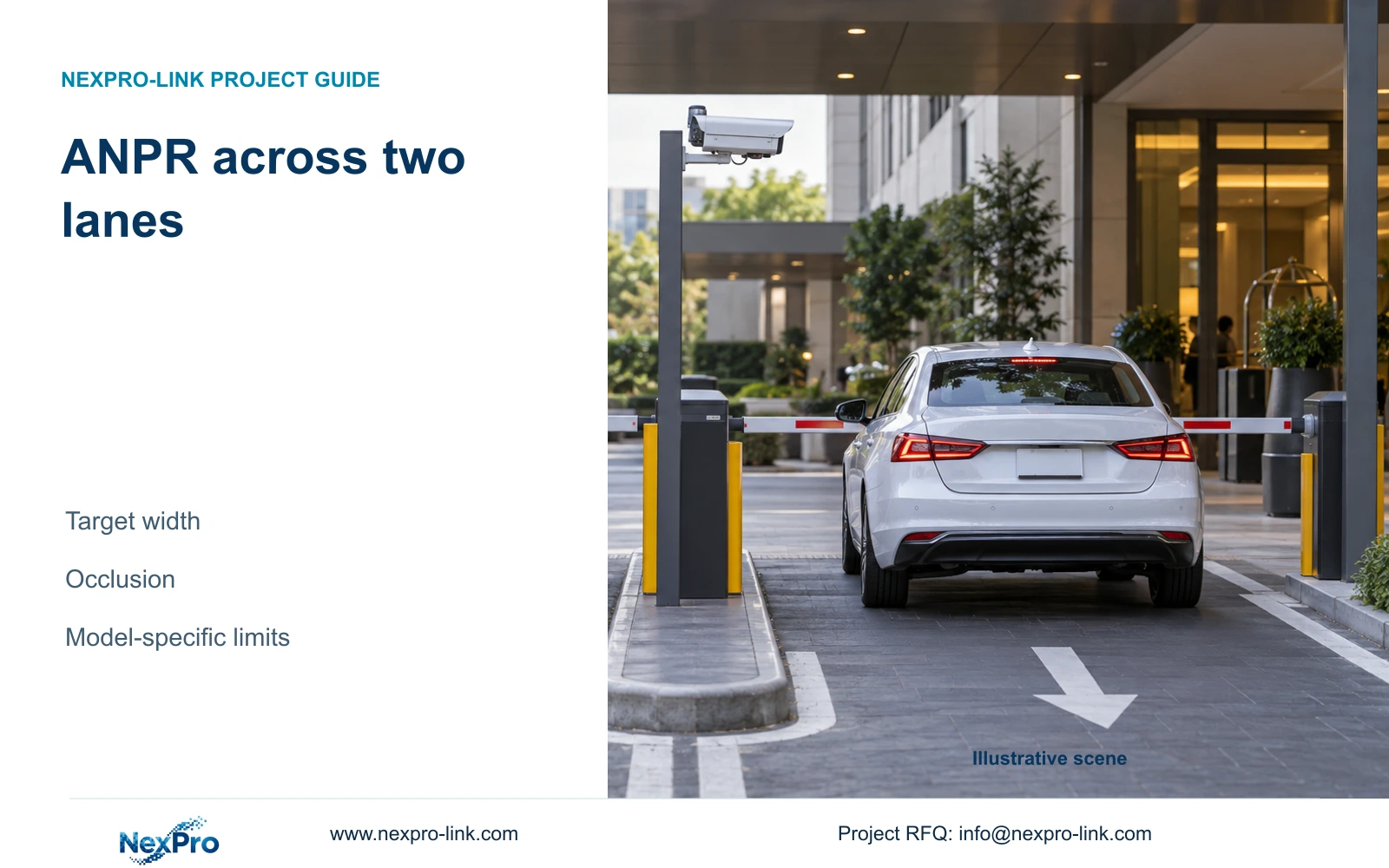
Accept one camera for two lanes only when the selected ANPR model supports the actual capture geometry and simultaneous traffic task, including plate visibility.
Section 01
Map each independent vehicle path
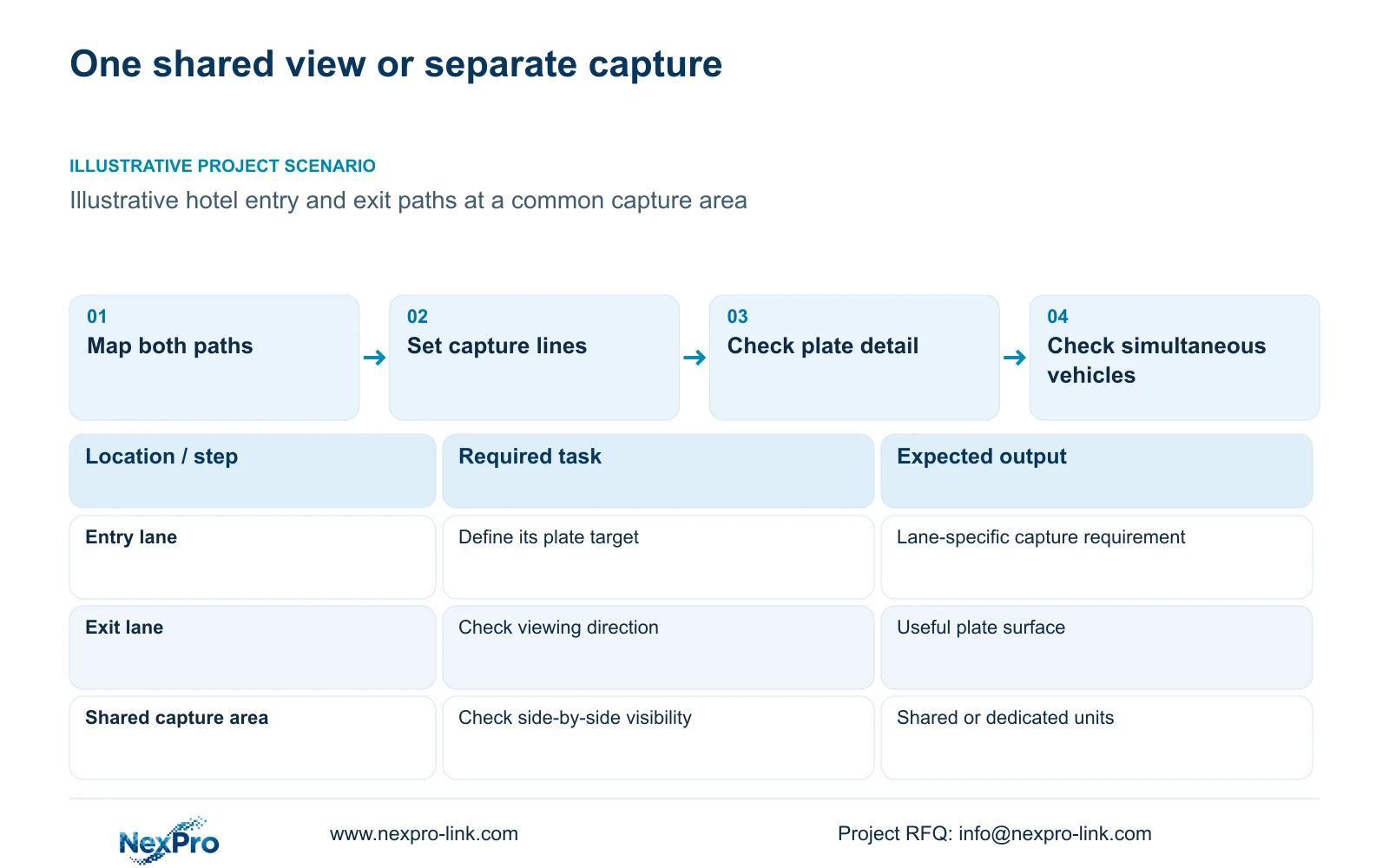
Accept a shared two-lane capture unit only when the selected ANPR model supports the actual target width, vehicle paths and simultaneous capture task. If either lane loses the required plate detail or visibility, compare dedicated capture units or a revised position. A wide overview showing both lanes is insufficient evidence for automatic plate recognition.
Mark entry and exit paths independently, including where vehicles stop, turn or pass side by side. Give each path a capture task and identify the controller or platform that receives its result. A vehicle appearing somewhere in the frame does not establish a usable plate at the capture line or an event associated with the correct lane.
Keep public-area overview tasks on the same drawing but distinguish their camera tags. The illustrative parking-annex reference has 16 overview views, with dedicated ANPR separately scoped. That count does not determine how many recognition units a real hotel needs. Layout and the selected recognition model must drive the capture-unit schedule.
| Required task | Given information | Decision still needed |
|---|---|---|
| Entry-lane plate capture | Entry path and proposed stop line | Approved capture width and recognition-model requirements |
| Exit-lane plate capture | Separate movement direction | Useful plate surface and event destination |
| Two vehicles at once | Side-by-side paths are possible | Visibility and supported simultaneous capture |
Section 02
Define the plate detail required by the chosen model
Obtain the recognition unit's documented capture requirements before fixing a shared view. These should be applied to the actual plate formats and geometry expected at the hotel. The supplied evidence does not provide a dedicated ANPR model or its minimum plate-image requirement, so no universal lane width or plate-pixel threshold can be specified here.
Target-plane pixel density describes the geometric allocation of image pixels. The expected plate width in the image also depends on the plate's projected width at that plane. Use the selected recognition model's requirements to judge that allocation. Perspective and viewing direction can change the useful detail even when the overall scene fits inside the frame.
Compare a combined view with separate lane views using the same required outcome. A combined overview preserves broad context; dedicated capture can allocate framing to a particular vehicle path. Keep overview recording when the narrower plate view omits surrounding events. The buyer should know which device preserves context and which device supplies a supported recognition result.
| Item | Shared view | Dedicated lane view |
|---|---|---|
| Target width | Includes both vehicle paths | Follows one assigned path |
| Plate detail | Must meet requirements across the full capture area | Must meet requirements at its lane capture line |
| Simultaneous vehicles | Check visibility and supported capture behavior | Check cross-lane obstruction and event assignment |
Section 03
Calculate pixel allocation at the capture line
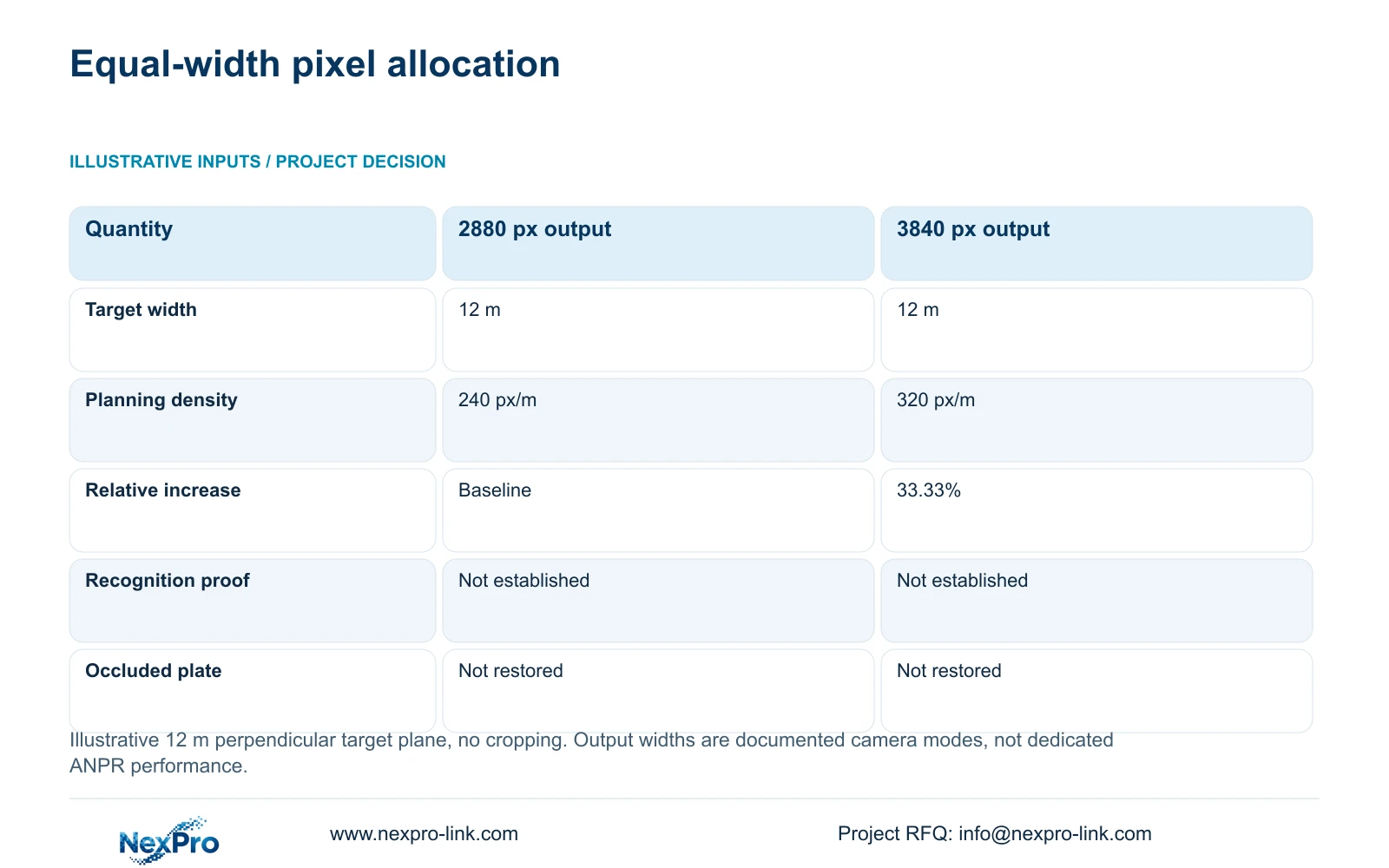
The illustrative comparison holds the perpendicular target-plane width at 12 m, assumes no cropping, and uses documented horizontal outputs of 2880 and 3840 pixels. Planning density equals horizontal output pixels divided by target width in metres. The results are 2880 ÷ 12 = 240 px/m and 3840 ÷ 12 = 320 px/m.
The increase is (320 ÷ 240 − 1) × 100 = 33.33%. It is a geometric budget increase, not an increase in recognition accuracy. The 12 m input is a teaching width, not a recommended two-lane capture width. It must not replace a measured width or the selected ANPR device's capture limits.
The supplied BL2812M PDF supports these output modes for ordinary camera candidates. NexPro-BL2812M55-5MP-DIC-AI lists a 2880 × 1620 main-stream mode; NexPro-BL2812M88-8MP-DIC-AI lists 3840 × 2160. Neither becomes a dedicated ANPR unit through this calculation. Their 2.8-12 mm lens range also does not prove an exact field of view.
| Metric or condition | Documented 2880 px output | Documented 3840 px output |
|---|---|---|
| Output width | 2880 px | 3840 px |
| Same target width | 12 m | 12 m |
| Planning pixel density | 240 px/m | 320 px/m |
| Increase relative to first option | Baseline | 33.33% |
| What is not proven | Recognition or night performance | Recognition or night performance |
Section 04
Check side-by-side vehicle occlusion
Review plate visibility with two vehicles occupying the capture area. A layout that works for an isolated vehicle can lose useful detail when the nearer vehicle obstructs the farther path. Examine normal operation and the relevant queuing or turning conditions, rather than approving a shared camera from an empty-lane drawing.
Compare a change in mounting position with dedicated capture units. A different position may restore visibility while preserving sufficient target detail. If the geometry still leaves one lane obscured, separating the capture tasks is justified. The preferred remedy should preserve the required event and avoid creating an inaccessible maintenance position.
Use recorded comparisons at the agreed capture line. Include the relevant movement direction, light condition and simultaneous-vehicle condition. The 240 and 320 px/m figures describe unobstructed geometric allocation only. Extra pixels cannot reconstruct a plate hidden by another vehicle. Keep any observed result attached to the specific position and configuration that produced it.
Section 05
Compare complete dedicated-capture scope
Price the shared-unit and dedicated-unit alternatives against the same lane tasks. Separate unit-count changes from specification changes. Include mounting, network ports, protected power and the supported recognition or controller interface. Removing a device is a saving only when the retained arrangement still completes the required capture workflow.
A dedicated-unit option may add local connections and maintenance items. A shared option may require different positioning, illumination or recognition capability. Those differences belong in the evaluated scope, alongside the evidence needed to establish supported operation. There are no supplied quotations or comparative recognition tests that justify a brand-price ranking.
Carry accepted camera tags into the network and recording schedules. If added recognition units also record streams, include their actual profiles in the storage calculation. If they only deliver events through a separate supported workflow, name that destination and its scope. CASE09's 16 overview streams must not silently absorb additional ANPR streams.
| Retained outcome | Extra scope | Change condition |
|---|---|---|
| Plate detail in each lane | Dedicated capture unit | Shared framing fails the selected model's capture requirements |
| Visible plates during simultaneous movement | Repositioning or separate capture | One path is obstructed at the required point |
| Correct lane event workflow | Supported interface configuration | Shared result cannot complete the required lane task |
Section 06
Keep recognition limits attached to the exact model
The final schedule should retain the exact capture model, its supported recognition functions, the relevant configuration and the approved target geometry. A general ONVIF statement does not establish plate-event exchange or the database and account behavior required by a third-party access platform.
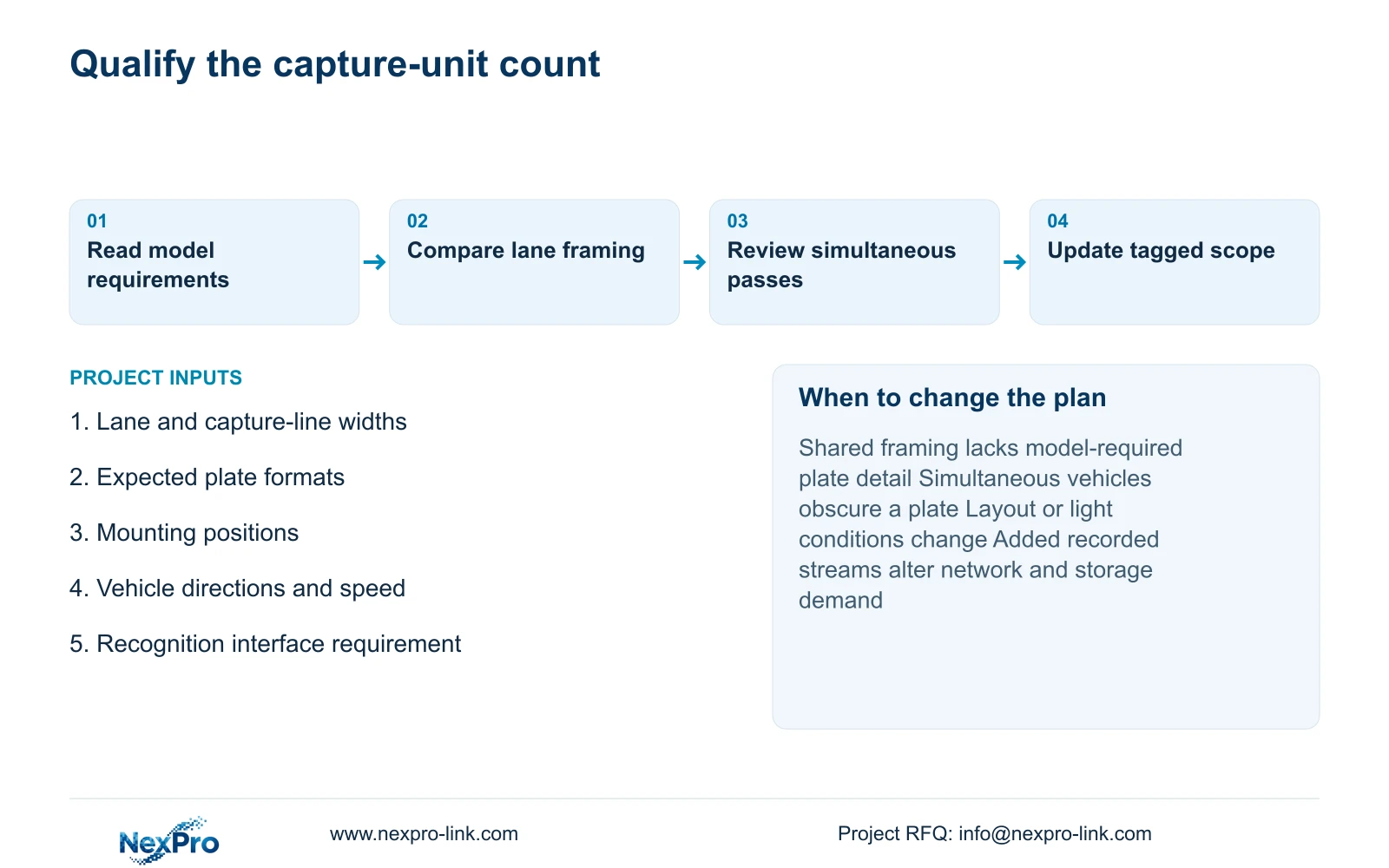
Use separate lane capture as the proposal basis when the shared layout cannot preserve model-required detail or when side-by-side traffic obscures the required plate. Accept a shared arrangement when its documented capability and recorded task comparison support both lanes. Reopen the choice if the lane layout, plate formats, speed or light condition changes.
Send the lane plan with capture-line widths and mounting constraints, expected plate formats, and the required recognition-platform or controller interface to info@nexpro-link.com. NexPro-Link can coordinate an overview schedule and a scoped equipment comparison. Dedicated ANPR supply, integration and local acceptance responsibilities should remain explicit in the response, without treating an ordinary CCTV SKU as a recognition solution.
Section 07
Buyer questions
Can digital zoom make a wide two-lane image suitable for ANPR? Digital enlargement does not add original captured detail. Judge the recorded plate image at the capture line against the selected recognition model's requirements. Optical framing or separate capture may be needed if the shared view allocates insufficient detail.
Is 320 px/m an approval threshold for plate recognition? No. It is the result of the supplied 3840-pixel output divided by an illustrative 12 m target width. Approval requires the dedicated model's documented limits and the actual plate geometry, motion, illumination and visibility.
Can we retain the existing overview cameras when adding ANPR? Yes, retain them when they continue to provide the required incident context. Add dedicated recognition scope with separate tags and interface requirements. Check any new recorded streams, network demand and power loads instead of assuming they fit the existing package.
Engineering references
These sources support the general planning principles. Always use the selected product's current datasheet and applicable project standards for final design.