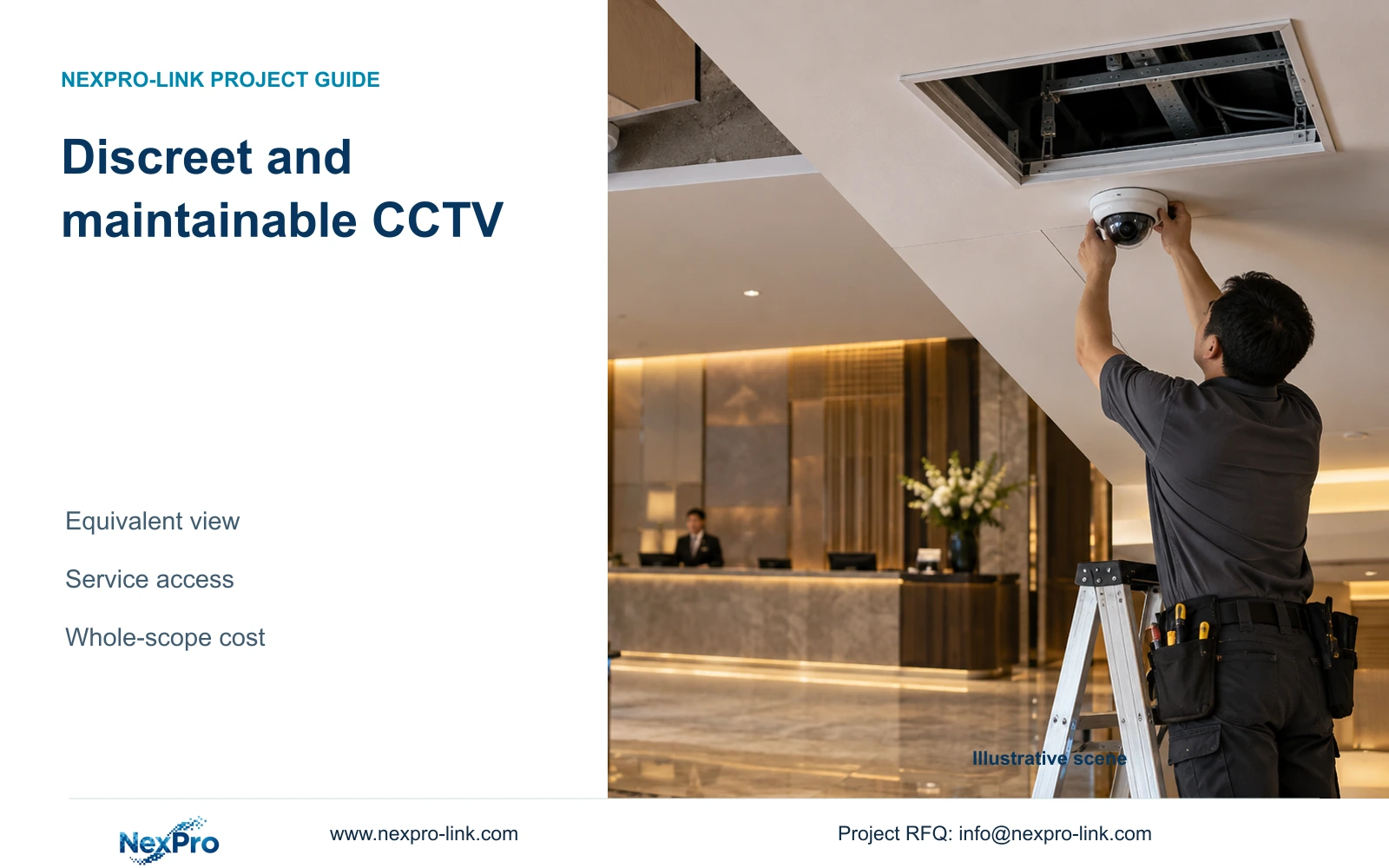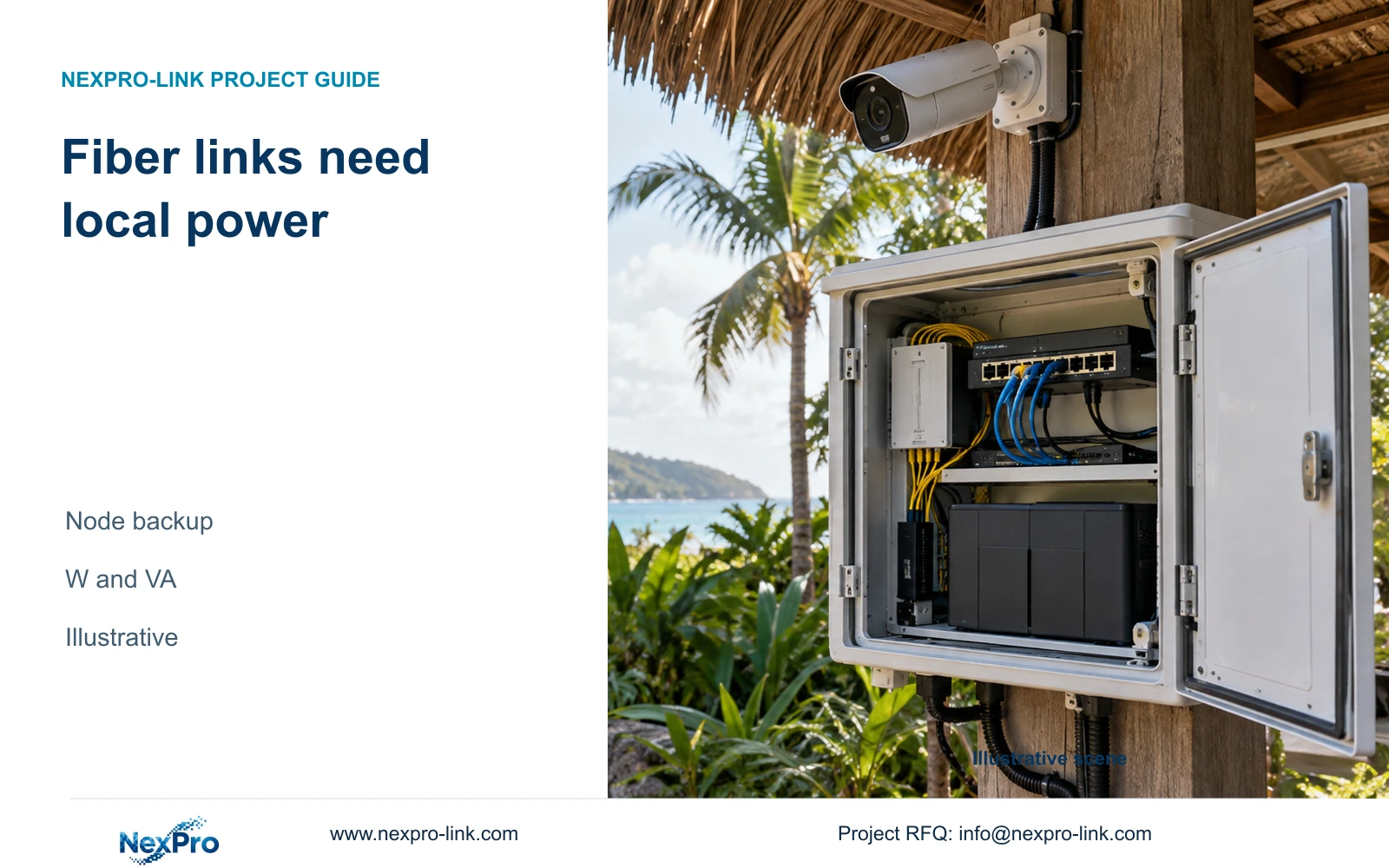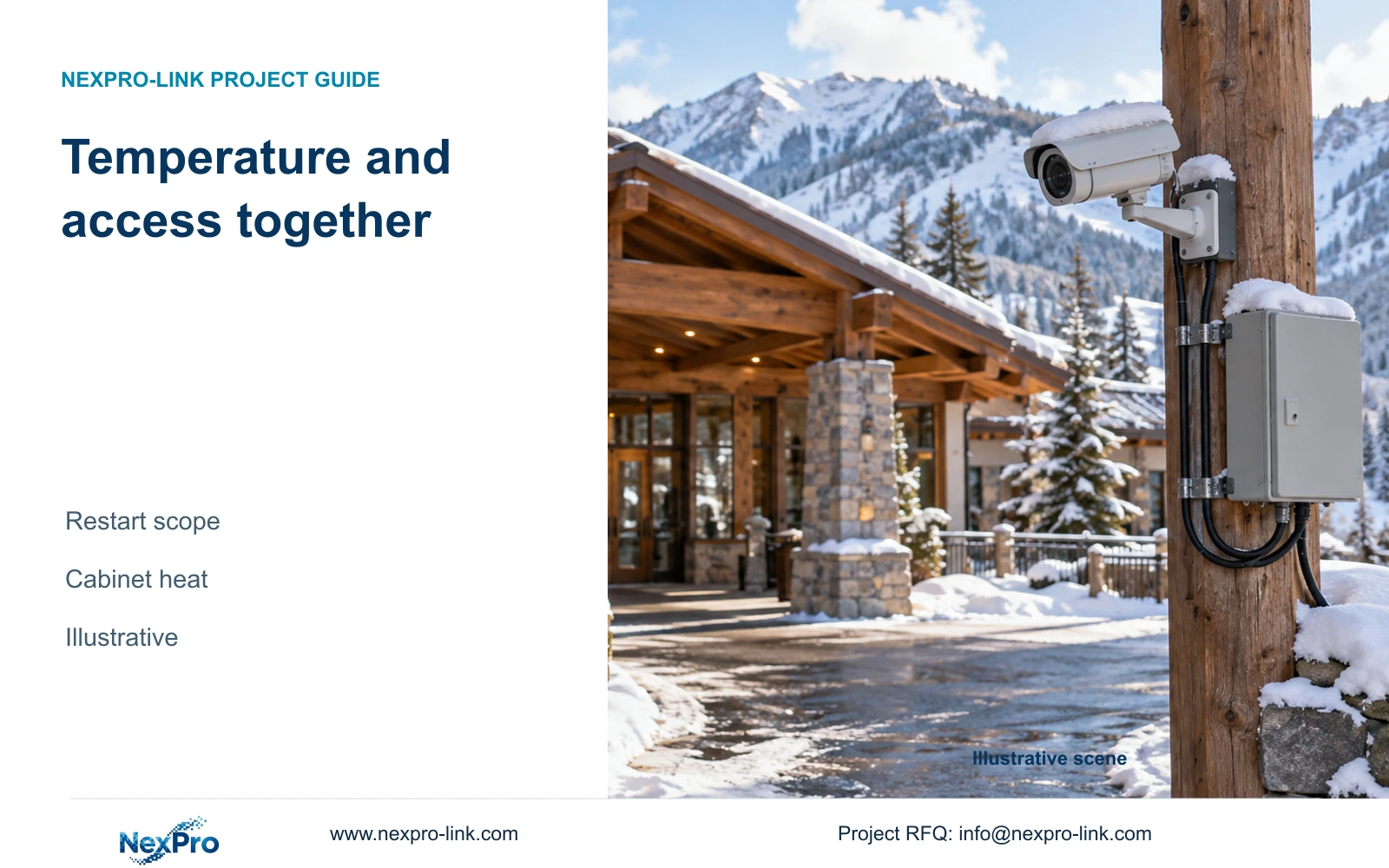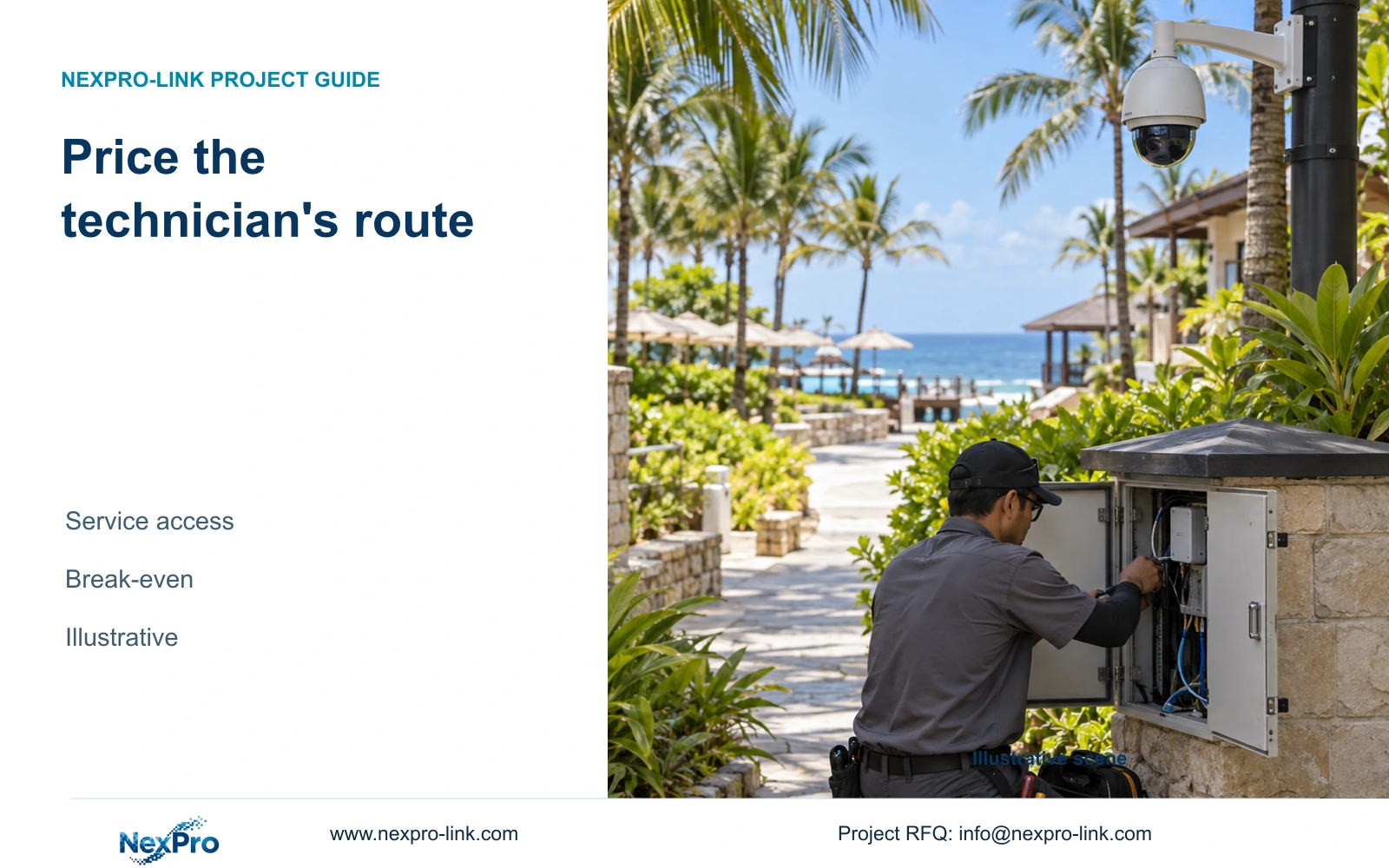
Evaluate resort CCTV maintenance through the journey, access method and restoration work each location requires. Compare qualified scope before accepting a lower equipment price.
Section 01
Map the technician's route before pricing service
Choose the qualified CCTV arrangement whose installation and service costs fit the hotel's evaluation period and restoration requirements. Treat remote cabinet locations, accessible mounts and spare placement as cost variables. Prefer a higher initial-cost option only when its supported service advantage outweighs the premium over the agreed period.
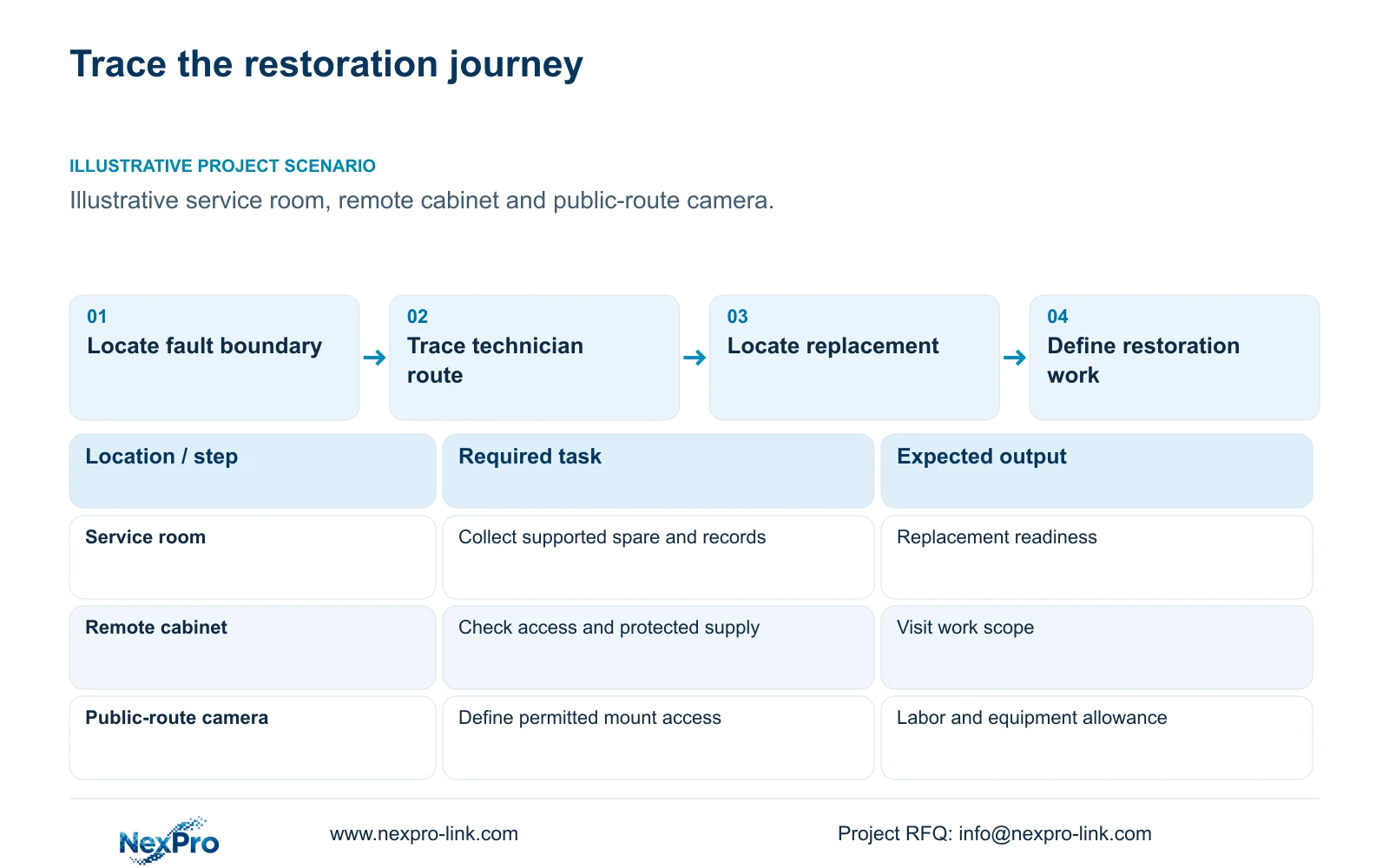
Trace a service journey from the technician's starting point to the cabinet and affected camera. Identify access permissions, the permitted work method and the route for replacement equipment. On a resort site, the distance between devices on a drawing does not describe the entire visit.
Keep that journey separate from data and electrical routes. A nearby camera can still depend on a distant switch, and the fault may require visiting both. Mark copper, fibre and protected power differently so the cost manager can identify intermediate nodes and the engineer can preserve the required operating state.
| Required task | Given information | Decision still needed |
|---|---|---|
| Reach camera | Mounting position on plan | Access method and work restriction |
| Restore camera group | Supplying cabinet identified | Visit sequence and isolation boundary |
| Obtain replacement | Spare location proposed | Custody, compatibility and transport |
Section 02
Group devices by access difficulty
Classify service locations by the work needed to reach and handle equipment. An accessible service-room recorder, an external cabinet and a high public-route camera can require different labor arrangements. Use the actual location and authorized work method rather than a uniform cost per camera.
Ask bidders to price the same access categories. Separate equipment, initial installation, freight and taxes from later service. Identify software or support exclusions explicitly. An unresolved cost should remain visible in the evaluation instead of being treated as zero.
CASE04's illustrative resort includes several locally recorded building groups. That architecture helps identify service locations, but supplies no measured travel time or failure rate. A distributed layout may preserve recording during backbone loss while increasing the number of cabinet locations. Evaluate both consequences using the hotel's required failure boundary.
| Item | Accessible service room | Remote cabinet or mount | Cost effect |
|---|---|---|---|
| Journey | Established indoor access | Site route and restrictions | Price travel separately |
| Work method | Device access to verify | Mount or enclosure access | Include required labor |
| Restoration | Local replacement path | Transport and configuration | Keep service outcome equal |
Section 03
Separate planned visits from failure assumptions
Describe a planned service visit by its included work. Keep an assumed corrective event separate, with the affected function, access method and replenishment path stated. An allowance can compare a defined event without claiming how often a brand's equipment fails.
Use scheduled work, travel time and local labor rates when those inputs are available. Where they are missing, request them or retain a provisional allowance. Do not infer reliability from a warranty period, a similar housing or the number of cameras in the system.
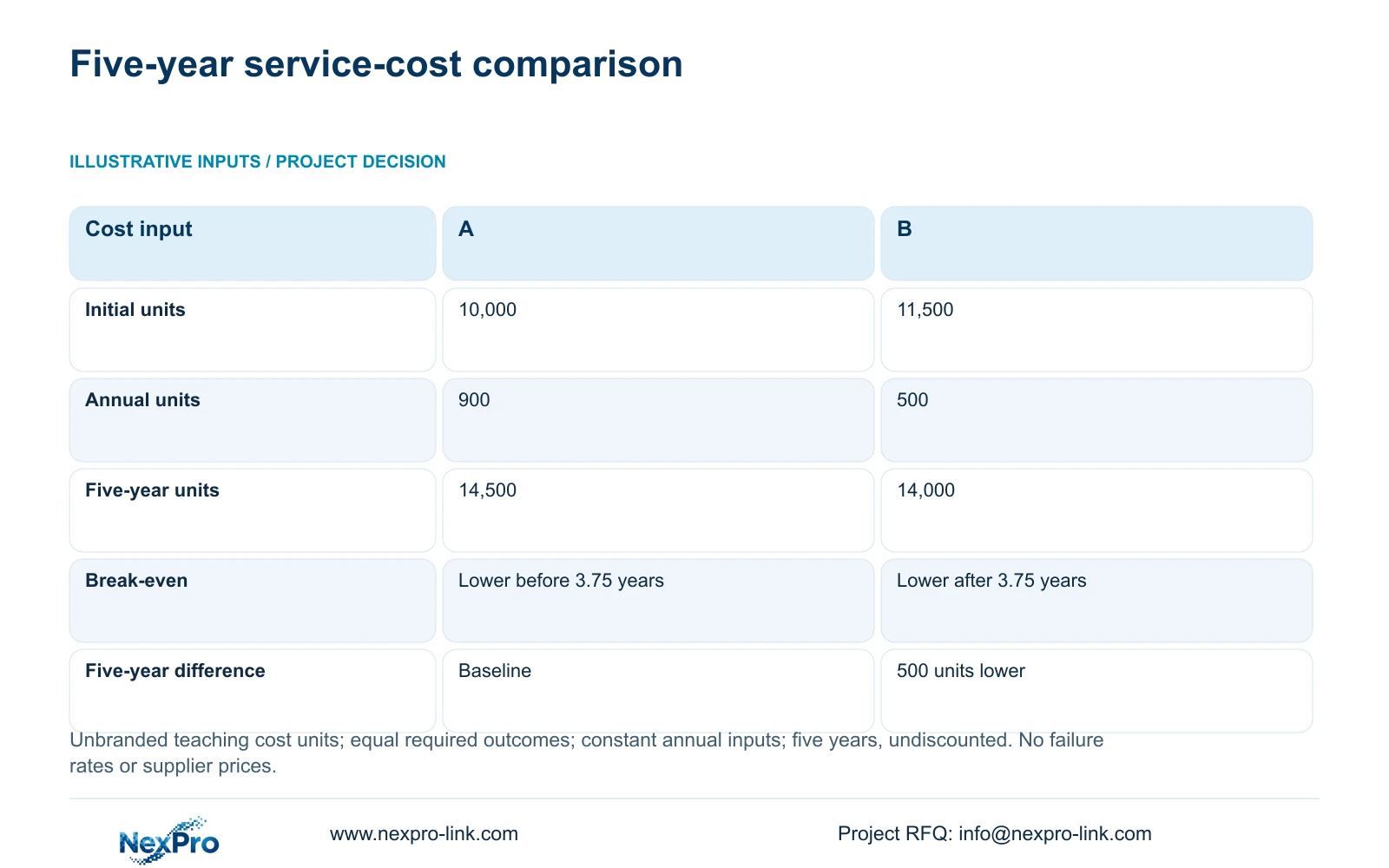
For the teaching comparison below, option A has 10,000 initial cost units and 900 annual cost units; option B has 11,500 initially and 500 annually. Both deliver the same required outcomes over an undiscounted five-year period. These aggregate inputs illustrate a method. They are not quotations, predicted failure costs or a ranking of NexPro-Link and competing brands.
Section 04
Compare spare storage and cabinet placement
Compare holding a suitable spare at the central service room, at an approved local store or obtaining it through replenishment. Include the journey to collect it and the work needed to install and configure it. A nearby spare is useful only when its storage conditions, custody and functional replacement scope are suitable.
Moving a cabinet may shorten service access while changing cable routes, supply and installation costs. Preserve the required recording and power boundaries when evaluating that move. Remove duplicate accessories or work already included in a package before adding the incremental amount.
A supported substitute needs checks against the required lens, power, stream and software behavior. Retain equipment and version records for spare review. RMA handling also requires authorization and symptoms; do not send a recorder containing footage or credentials without the hotel's approved handling instructions. None of these arrangements guarantees that all downtime disappears.
Section 05
Calculate the evaluation-period cost
Five-year total equals initial cost plus five times annual cost. Option A therefore totals 10,000 + 5 × 900 = 14,500 cost units. Option B totals 11,500 + 5 × 500 = 14,000. Under these assumptions, B is lower by 500 units at five years.
Break-even time equals the initial premium divided by the annual difference: (11,500 minus 10,000) / (900 minus 500) = 3.75 years. A is lower before that point, the totals are equal at that point, and B is lower afterward. The example assumes constant annual inputs and excludes discounting.
Replace the annual allowances with a documented work schedule before making a commercial selection. At five years, B's 1,500-unit premium requires an annual advantage greater than 300 units to produce a lower total. Changed access restrictions, included service or the evaluation period can reverse the choice. RICS measurement guidance provides context for distinct cost-planning and maintenance uses; this table is an independent teaching example.
| Metric / condition | Lower initial cost: A | Lower recurring cost: B |
|---|---|---|
| Initial teaching cost | 10,000 cost units | 11,500 cost units |
| Annual assumed cost | 900 cost units | 500 cost units |
| Five-year undiscounted total | 14,500 cost units | 14,000 cost units |
| Break-even time | Before 3.75 years: A lower | After 3.75 years: B lower |
| Actual tender ranking | Requires scope-matched quotes | Not established by this example |
Section 06
Select the maintainable qualified arrangement
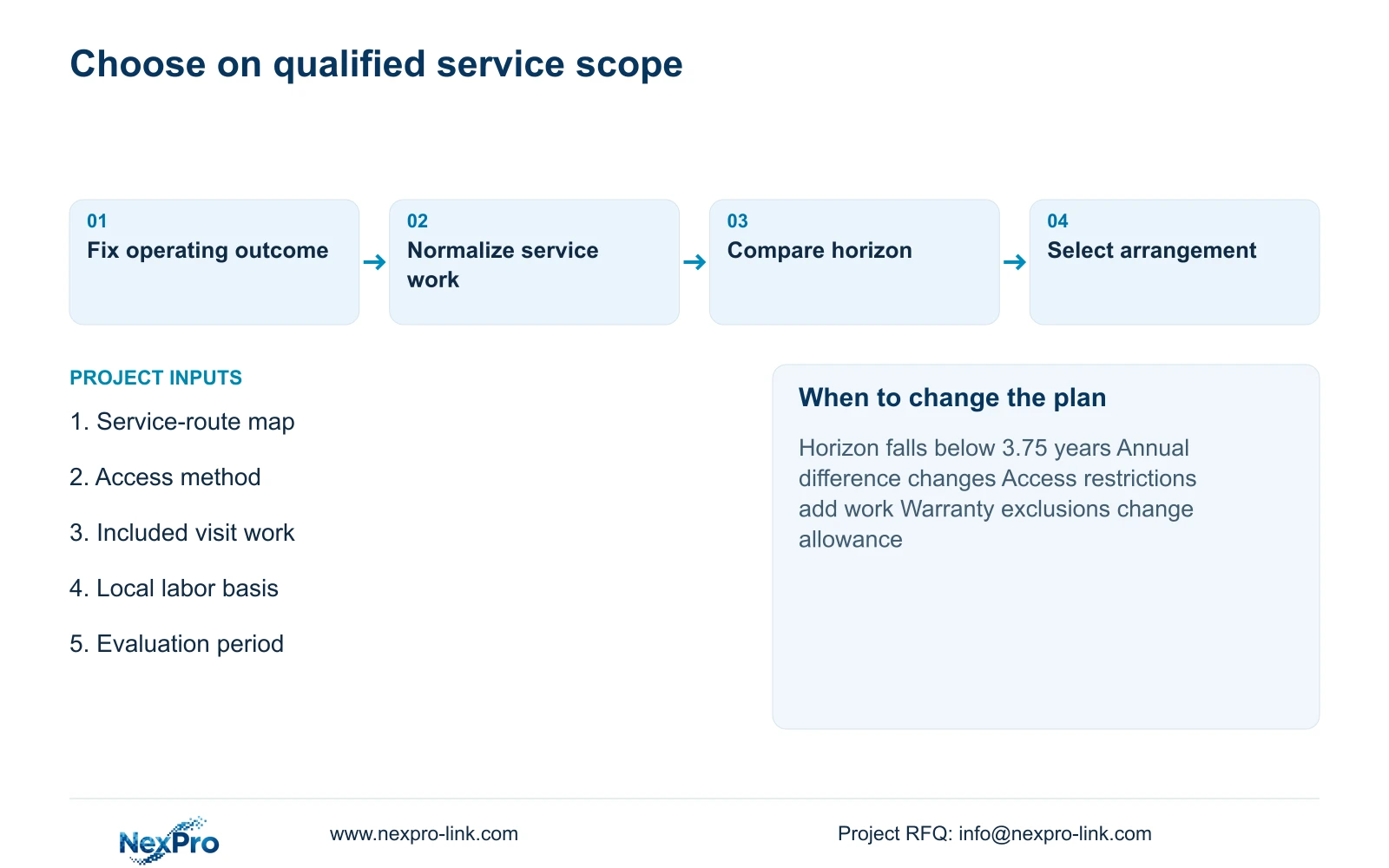
Check required coverage, recording retention and outage behavior before ranking costs. Then normalize delivery basis, installation responsibilities and recurring work. A lower total obtained by omitting a remote node's protected power or necessary access work does not meet the same scope.
Keep warranty and service allowances distinct. The supplied policy record states a 24-month limited hardware baseline from receipt for applicable main equipment, subject to controlling order terms. Batteries, disks, cable and OEM scope require their own terms. Remote guidance does not establish free site labor, travel or return transport.
Recommend B in the illustrative five-year comparison only while equal outcomes and the annual advantage remain supported. Prefer A for a shorter horizon below 3.75 years under the same assumptions. Send the cabinet and camera access map, service work schedule, local labor basis and evaluation period to info@nexpro-link.com. NexPro-Link can help reconcile a coordinated equipment scope through BOQ and tender support, while the local service provider prices site work.
Section 07
Buyer questions
Should every SKU receive the same spare percentage? Use the restoration task and replenishment path instead. Critical recording and entrance functions may justify different stock arrangements, while a percentage alone says nothing about compatibility or local action.
Can a longer warranty replace a maintenance allowance? Only costs explicitly covered by the controlling terms can be removed. Keep travel, site labor, access equipment and transport visible where they are excluded or unresolved.
What should be sent before comparing quotations? Provide the same camera tasks, retention, delivery destination and service boundaries to each bidder. Add the service-route map and evaluation period so recurring work can be compared on an equal basis.
Engineering references
These sources support the general planning principles. Always use the selected product's current datasheet and applicable project standards for final design.