Approve a discreet camera position only when the required view and a practical service method are both defined. Compare access costs separately from equipment prices.
Section 01
Define the architectural limits before approving a hidden position
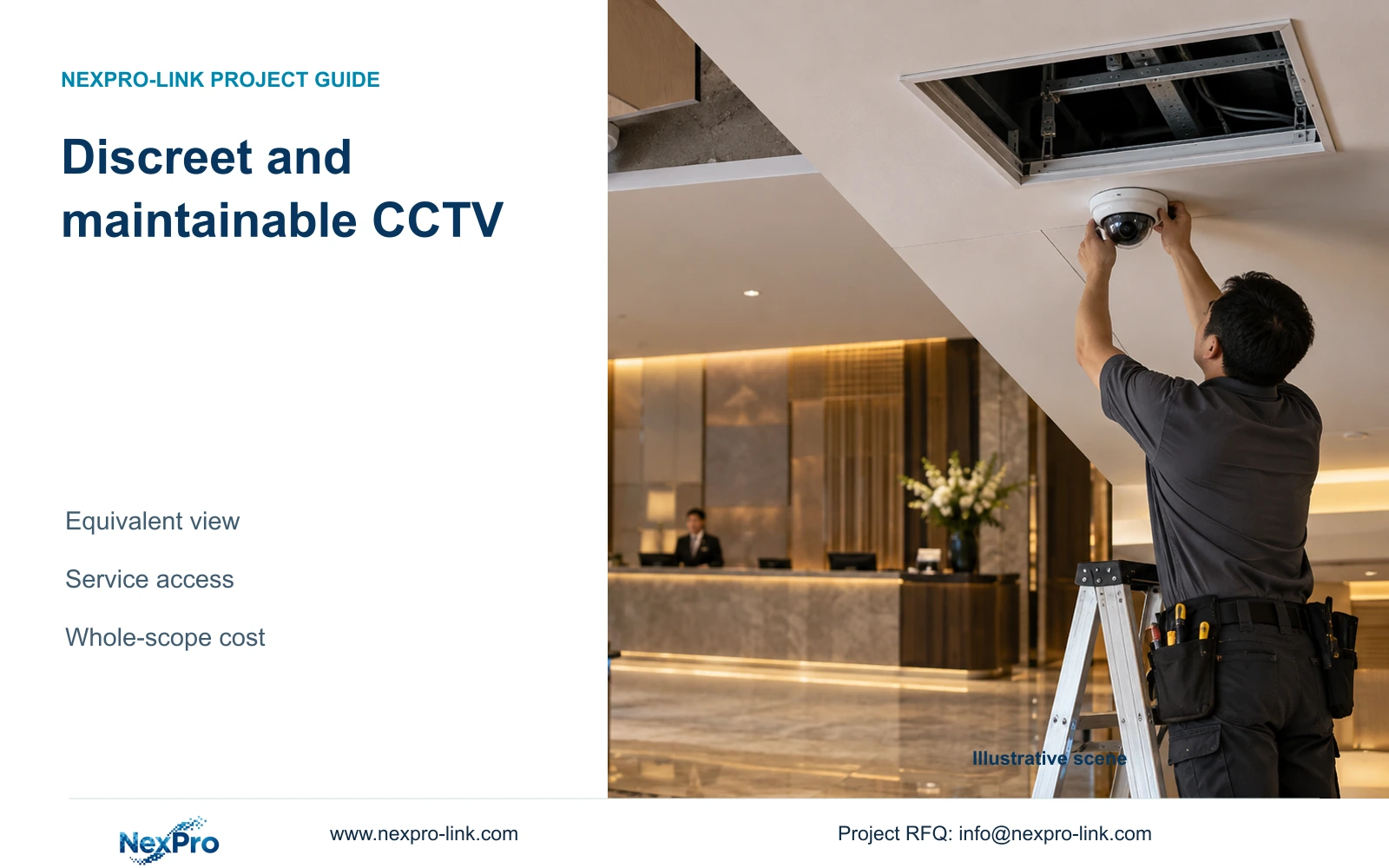
Choose a tidy, reachable installation when it retains the required camera view. Approve a more concealed position only when its service method is practical and its complete cost is acceptable. A mount that needs scaffolding for routine access should be evaluated with that access burden visible before the ceiling is closed.
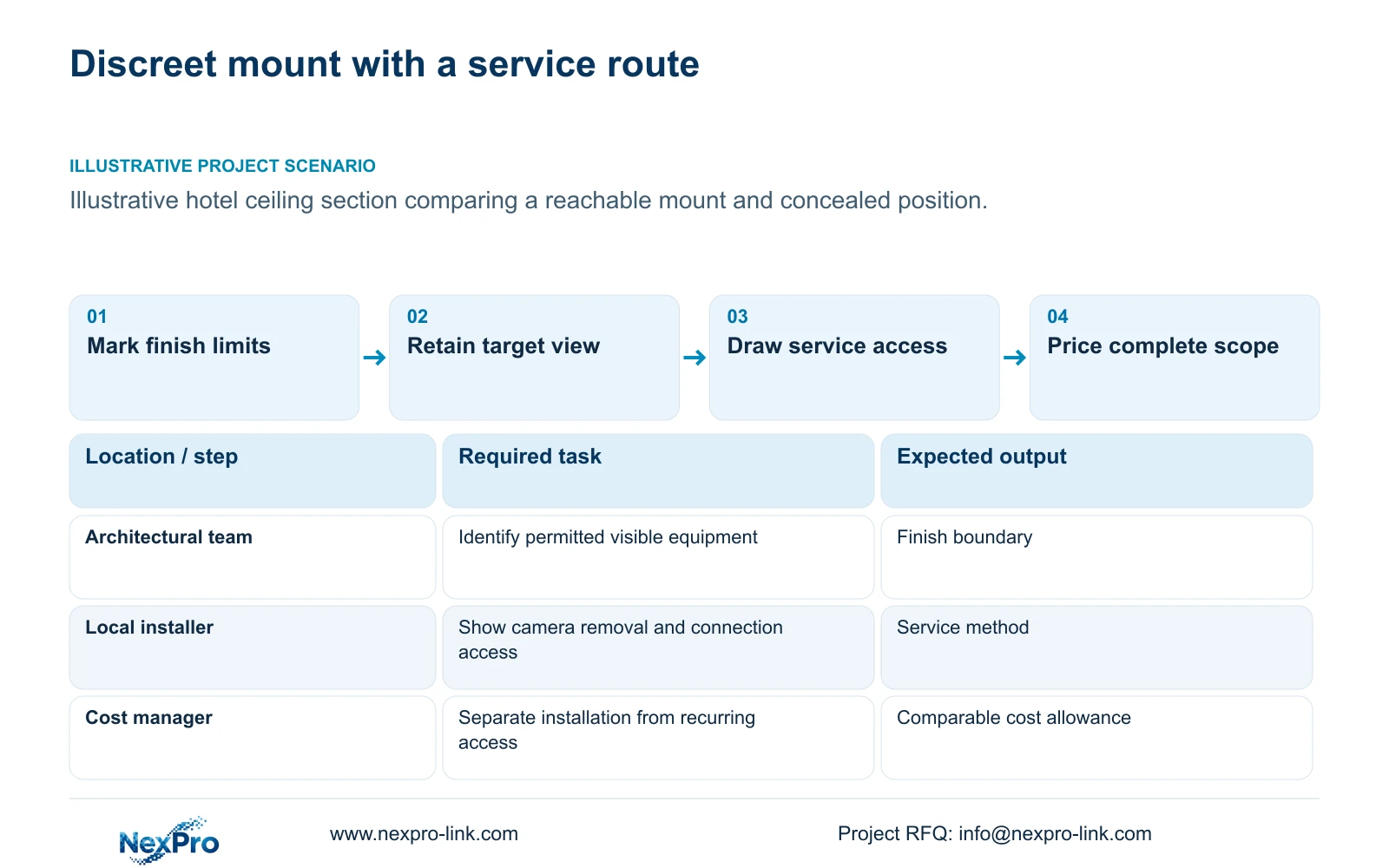
Mark the proposed camera, supporting surface and approach for maintenance on the lobby plan and ceiling section. Identify finish restrictions and the space available for removing the camera or reaching its connections. Ask the architectural team to distinguish a preference for visual discretion from a fixed restriction on visible equipment.
The cost comparison needs the same entrance or reception task, quantity and supply boundary. Record what each offer includes in mounting, cabling and reinstatement. This prevents an apparently lower installation price from representing a position that has no priced service access. Where access details are unresolved, retain them as open scope rather than assuming they cost nothing.
| Required task | Given information | Decision still needed |
|---|---|---|
| Discreet arrival view | Architectural finish restriction | Which visible mount is acceptable? |
| Camera replacement | Proposed ceiling position | How are camera and connections reached? |
| Counter detail | Required observation point | Does the concealed location retain the view? |
Section 02
Compare mounting and service methods as complete arrangements
Evaluate the installed camera together with its bracket, connection access and removal method. A small visible mount at a reachable position and a concealed high-level mount may have different initial and recurring costs even when the equipment is the same. The architectural appearance is one part of that comparison.
Describe the actual service sequence: gaining access, making the area suitable for work, reaching the equipment and reinstating the finish. Establish the local installer's proposed method and the hotel's permitted work window. Do not assume a removable panel resolves every access problem; its position must allow the intended work.
Separate one-time mounting work from repeat access effort. If equipment hire or protection work is shared across several cameras, allocate it once within the agreed service event. Comparing only bracket prices hides these differences and can charge the same shared activity more than once.
| Item | Reachable tidy mount | Concealed high-level mount | Effect on the hotel task |
|---|---|---|---|
| Appearance | Visible within approved finish | Reduced equipment visibility | Architectural acceptance differs |
| Service access | Defined reachable method | Access equipment may be required | Changes recurring scope |
| Observation | Verify required target | Verify the same target | Cost comparison needs equivalent views |
Section 03
Estimate access effort separately from equipment cost
Build the evaluated cost from equipment, initial installation and later service activities. Keep freight, taxes and any software or support charges visible where they differ between offers. An annual service allowance should state its assumed activities; it must not imply a measured camera failure rate or a warranty entitlement.
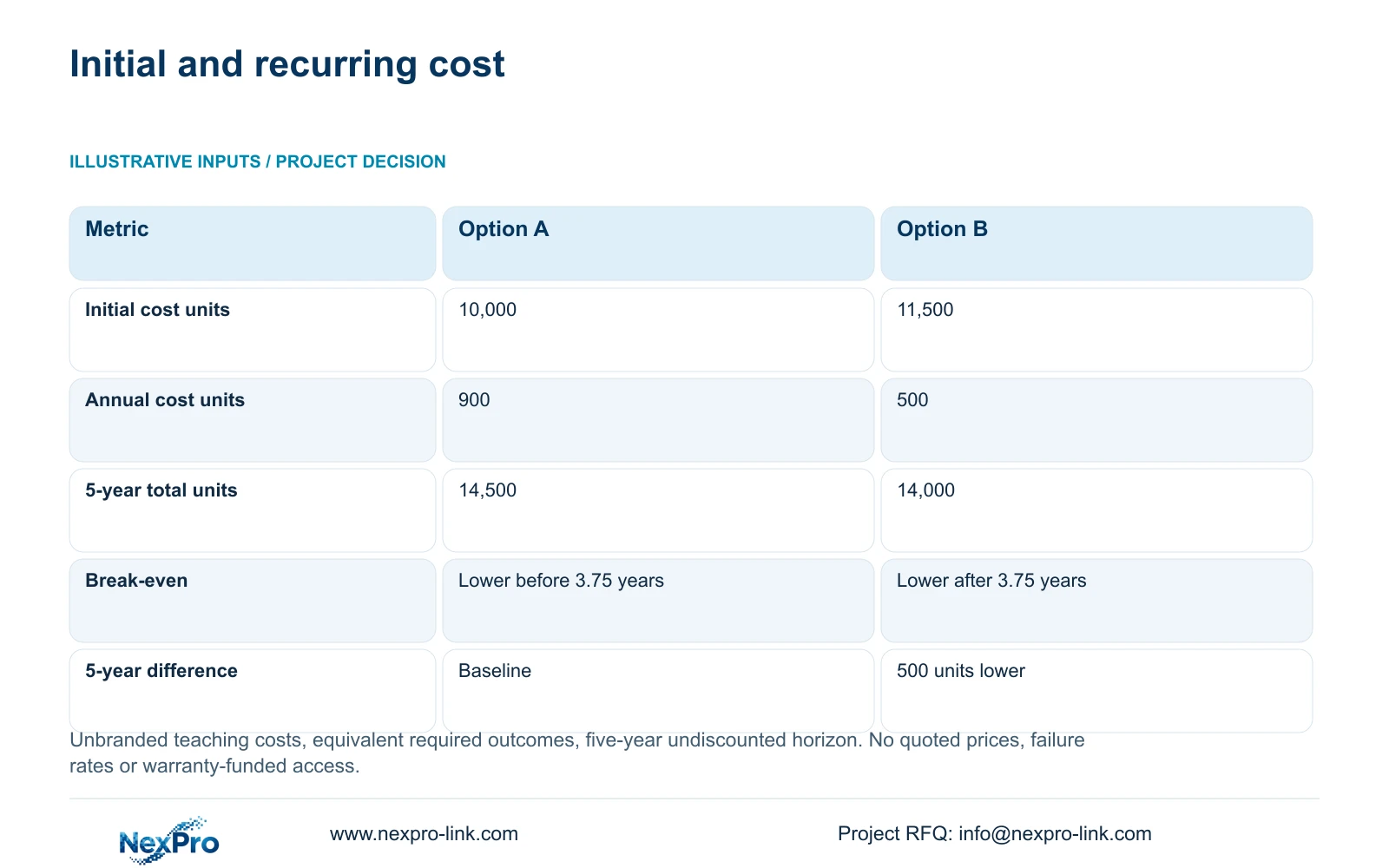
The illustrative alternatives below use unbranded cost units. A starts at 10,000 units with an assumed annual cost of 900; B starts at 11,500 with 500 annually. Both are assumed to meet the same required outcome over a five-year undiscounted horizon. These are teaching inputs, not quotations for NexPro-Link or another brand.
Five-year total equals initial cost plus five times annual cost. Break-even time equals the initial difference divided by the annual difference: (11,500 minus 10,000) divided by (900 minus 500), giving 3.75 years. The model shows when a higher initial allowance can be justified by lower recurring scope.
| Metric / condition | Option A | Option B |
|---|---|---|
| Initial teaching cost | 10000 | 11500 |
| Annual assumed cost | 900 | 500 |
| 5-year undiscounted total | 14500 | 14000 |
| Break-even time | Before 3.75 years: A lower | After 3.75 years: B lower |
| Actual tender ranking | Requires actual scope-matched quotes | Not established by this example |
Section 04
Keep the target view equivalent when assessing savings
At five years, B is 500 cost units lower under the stated assumptions. Before 3.75 years, A has the lower accumulated cost; at break-even, the totals are equal. Replacing the evaluation period or either annual allowance can reverse the result. Obtain actual scope-matched offers before choosing a commercial winner.
The comparison is valid only after both positions preserve the required view. Keep the entrance target, counter task and relevant night conditions consistent. A cheaper position that loses useful moving detail has changed the service being purchased. Price the correction before comparing its total with the alternative.
Recheck the framing after an access-led relocation. A position suitable for maintenance may need a different lens setting or another view to retain the observation task. Conversely, a concealed position may create an obstruction or reflection that its equipment specification does not resolve. Record those technical consequences before assigning any lifecycle saving.
Section 05
Review finishes and accessories without hiding service costs
List the approved mounting accessories and finish treatment as separate scope where they are not included in the equipment package. Confirm that the proposed treatment leaves the required lens view, light functions and service connections usable. No unspecified custom enclosure or surface treatment should be assumed compatible with the selected camera.
NexPro-Link's OEM scope includes branding, labels, manuals and project packing. A branding capability does not establish that any finish alteration is suitable for a lobby mount. Surface processes and artwork need agreement against the actual item. Preserve model and serial identity so a discreet appearance does not remove service traceability.
The supplied public policy record gives applicable main equipment a 24-month limited hardware warranty baseline from receipt, subject to controlling written terms. Batteries, disks, cable and OEM scope have their own boundaries. Site access, labour, travel and reinstatement must be identified separately; continuing technical support does not establish unlimited free local repair.
| Retained outcome | Extra scope | Purchase condition | Counter-condition |
|---|---|---|---|
| Required camera view | Approved bracket or finish treatment | Appearance improves without losing function or access | Treatment obstructs the view or service method |
| Repeat service access | Access provision and reinstatement | Real service quotations justify the provision | Unpriced recurring work prevents a fair comparison |
Section 06
Approve the view and maintenance method together
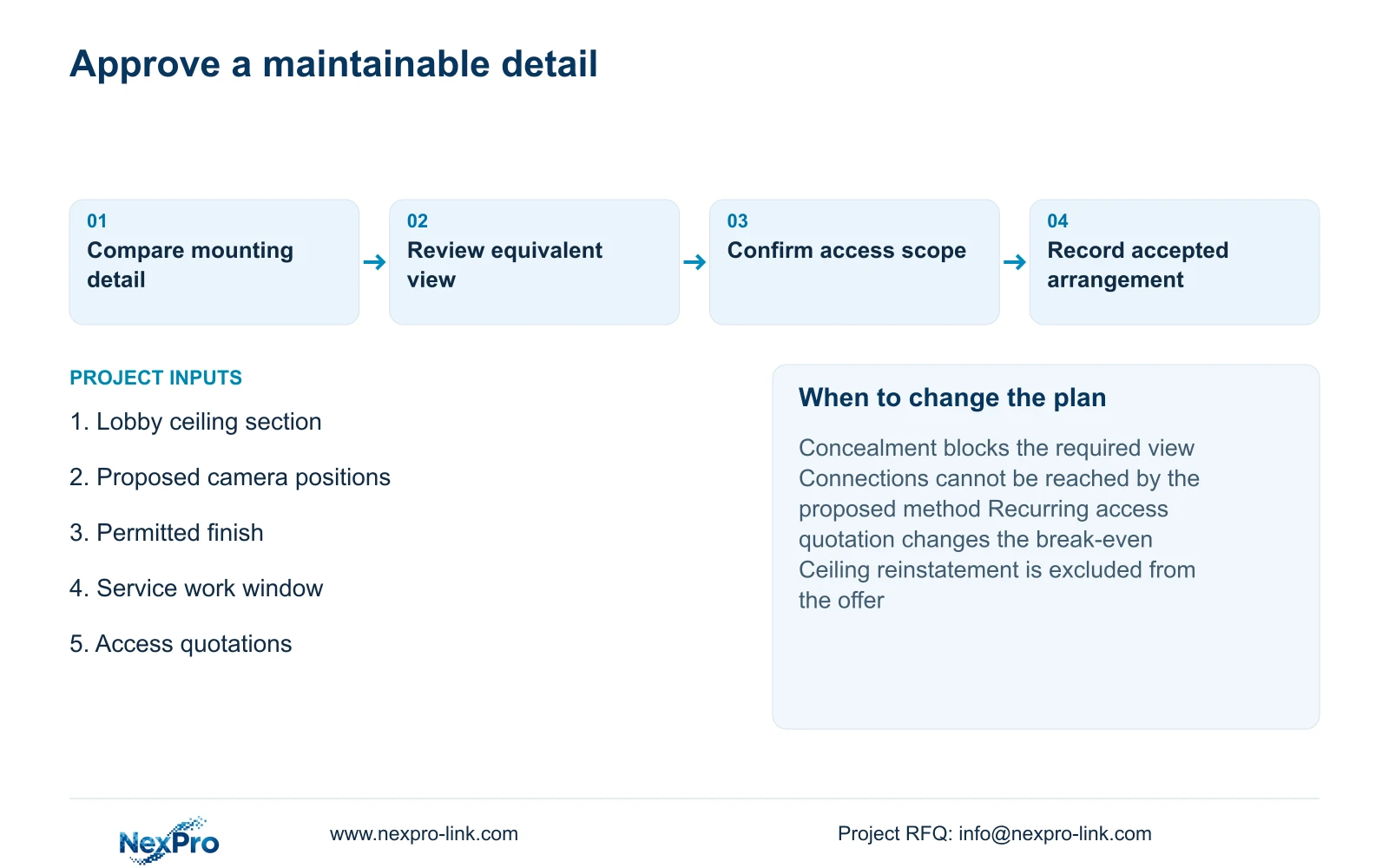
Select the maintainable installation when its approved appearance and recorded view meet the hotel task. Choose a more concealed arrangement only if its access method is feasible and the evaluated cost suits the owner's period of use. Revise the decision when ceiling details, work windows or actual service quotations change.
A representative mounting detail can support a focused review before ceiling closure. Record the accepted position, accessory scope and service responsibility in the camera schedule and BOQ. Equipment approval, architectural approval and order authority remain separate decisions. The illustrative CASE01 system does not establish mounting access for any actual hotel.
Send the lobby ceiling section, proposed camera positions and allowed service-access method to info@nexpro-link.com. Include the required view and available installation or maintenance quotations. NexPro-Link can discuss model documentation and coordinated supply; its CCTV manufacturing scope should remain distinct from supporting equipment coordination and local installation work.
Section 07
Buyer questions
What if the maintenance quotation has no access-equipment allowance? Ask whether access equipment is included, excluded or still unpriced. Keep the missing allowance visible in the evaluated total. Do not treat an exclusion as a zero-cost service.
Does hardware warranty cover scaffolding and ceiling reinstatement? The supplied policy baseline concerns applicable limited hardware coverage. Those site activities need an explicit project agreement; they cannot be inferred from the 24-month main-equipment term.
Can a mounting sample approve the complete installation? It can support review of the representative appearance and access method. Final acceptance still needs the actual position, required recorded view and agreed local installation scope.
Engineering references
These sources support the general planning principles. Always use the selected product's current datasheet and applicable project standards for final design.